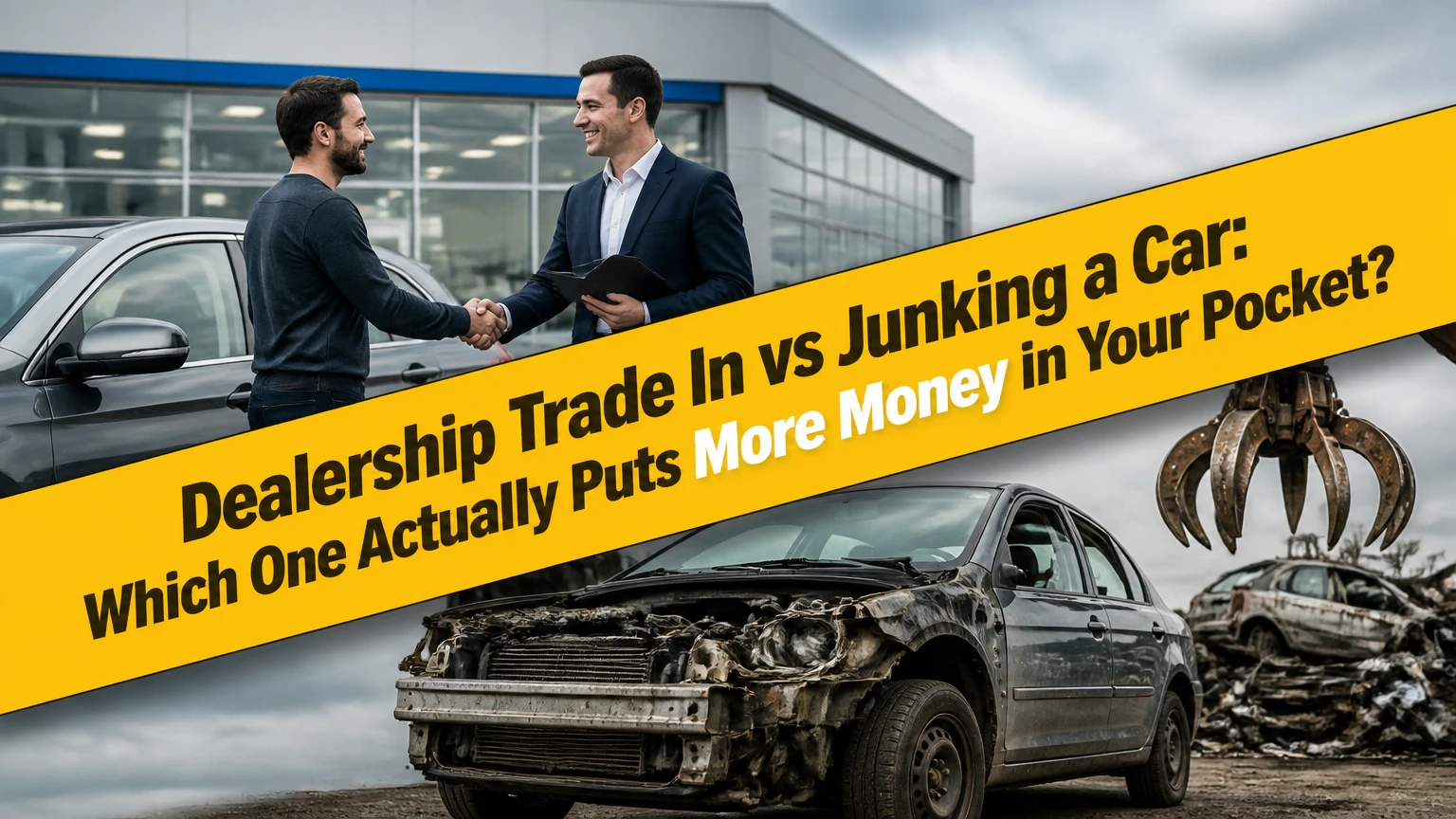
You walk into the dealership with a car that barely survived the trip there. The salesperson takes one look at it, disappears into the back for ten minutes, and returns with a number written on a piece of paper. It is lower than you expected. Much lower. But you nod anyway because you are tired of dealing with the car, you want the new one, and at least this way everything happens in the same parking lot.
What happens next is not a coincidence. The dealership calls a junk car buyer, the same ones you could have called yourself, and sells your car to them for roughly what they just paid you. The difference between their cost and their sale price is money that could have been yours. Sometimes it is $50. Sometimes it is $300.
This article is the comparison you should run before walking into that showroom. Both options have genuine advantages. The right answer depends on your car’s condition, whether you are buying another vehicle at the same time, and what your state does with trade-in taxes. Once you know those three things, the decision becomes obvious.
The Core Difference Between the Two Options | Dealership Trade In vs Junking a Car
A dealership trade-in is convenient. Junking a car is almost always more financially direct. Those two facts are the foundation of everything else in this comparison.
When you trade in at a dealership, you are selling your car to a business that needs to make a profit on it. That means they pay you wholesale value at best. For a car in poor or non-running condition, they pay considerably less than that, because they are essentially charging you for the service of taking it off your hands and handling the disposal themselves.
When you junk a car, you sell directly to the buyer who actually wants it: a salvage yard or junk car buyer who processes it for parts and scrap metal. You cut out the middleman. The dealership was going to call these people anyway. You are just calling them first.
What Dealers Actually Do With Old Trade-Ins
This is the part most people do not know, and it changes how the trade-in option feels once you understand it.
When a dealership accepts a trade-in that is worth reconditioning and reselling, they put it through their used car operation. They spend $500 to $2,000 on detailing, minor repairs, and certification, then sell it at retail to the next customer. That process works well for cars with real resale value.
When a dealership takes a car that cannot realistically be resold, which includes most vehicles in junk or near-junk condition, they do exactly one thing with it: they call a junk car buyer. The same companies that would have come to your house, paid you cash, and picked up the car for free. The dealership sells the car to that buyer, pockets the difference between what they paid you and what they received, and processes it as a junk trade-in credit on your paperwork.
This is not illegal or even particularly unfair. Dealers are businesses. But it does illustrate that when you trade in a junk car at a dealership, you are paying for a service you did not ask for and could have handled directly in about fifteen minutes.
The Money Comparison: What Each Option Typically Pays
Car Condition | Typical Dealer Trade-In Offer | Typical Junk Car Buyer Offer | Difference |
|---|---|---|---|
Non-running, high mileage | $0 to $500 | $200 to $700 | Junking wins by $100-$500 |
Running but poor condition | $300 to $1,500 | $300 to $800 | Roughly equal, depends on car |
Running, fair condition | $1,500 to $5,000 | $300 to $700 | Trade-in wins, car has resale value |
Salvage or rebuilt title | $0 to $300 (many dealers refuse) | $200 to $800 | Junking wins clearly |
The pattern in this table reveals the logic of the decision. For cars that a dealer can recondition and resell at a profit, the trade-in offer can be meaningful. For cars that cannot be resold, the dealer’s offer drops to near junk-yard rates because that is exactly what they will do with it. At that point there is no reason to use the dealership as a middleman.
The Factor That Changes Everything: The Tax Benefit
If there is one piece of this comparison that genuinely surprises people when they hear it for the first time, it is the trade-in tax benefit. It is real, it is significant, and it is specifically available only when you trade in at a dealership while simultaneously buying another vehicle from that same transaction.
In almost every state, when you trade in a vehicle as part of a car purchase, you only pay sales tax on the difference between the new car’s price and your trade-in value. Not on the full purchase price.
Here is what that looks like with numbers. You are buying a $30,000 car. Your old car trades in for $8,000. Your state sales tax rate is 6 percent.
- Without trade-in: you pay 6% on $30,000 = $1,800 in sales tax
- With trade-in: you pay 6% on $22,000 ($30,000 minus $8,000) = $1,320 in sales tax
- Tax savings: $480
At a 6 percent tax rate, the tax savings equal 6 percent of the trade-in value. If your car trades in for $8,000, you save $480. If it trades in for $12,000, you save $720. The savings scale with the trade-in amount.
Here is the critical implication for end-of-life vehicles: if your junk car trades in for $500, your tax savings at 6 percent is $30. At that level, the tax benefit is minor and does not change the calculation much. But if your car is worth $3,000 to $5,000 and you are buying a new vehicle, the tax savings might be $180 to $300. At that level, it starts to matter.
The tax benefit only applies when you are buying another vehicle in the same transaction at the same dealership. If you are not buying a new car at the same time, the tax benefit does not exist, and the comparison is straightforward: junking almost always pays more for poor-condition vehicles.
Three states currently do not offer this trade-in tax credit at all: California, Hawaii, and Michigan has an $11,000 cap. Check your state’s current rules before factoring this into your decision.
When a Dealership Trade-In Makes More Sense
You Are Buying Another Vehicle at the Same Dealership
This is the only scenario where the trade-in math regularly competes with direct selling. The tax benefit makes a real difference, the process is seamless, and you walk away from a single appointment with the old car gone and the new one in your name. For anyone who values simplicity, this is a genuinely strong argument for trade-in even if the cash offer is slightly lower.
The calculation to run: what is the junk buyer’s cash offer minus the dealer’s trade-in offer? That is the gap you are paying for the convenience and the tax benefit. If the gap is $200 and the tax savings are $180, you are essentially paying $20 for the convenience of having everything handled in one place. That is probably worth it to most people. If the gap is $500 and the tax savings are $180, you are paying $320 for convenience. That is a decision only you can make.
Your Car Is in Drivable Condition With Decent Resale Appeal
A running car in fair condition is worth significantly more to a dealer than to a junk buyer. Junk car buyers price based on scrap metal and parts value. Dealers who can recondition and resell can offer more for cars that have a second life in them. If your car drives, is relatively common, and is not facing a major mechanical failure, a trade-in offer may compete meaningfully with what a junk buyer would pay.
Get both numbers before committing. Call a junk buyer for a quote and get a trade-in appraisal. Compare the two alongside the tax savings calculation. The best offer is not always obvious from the outside.
The Car Has a Lien and You Are Simplifying the Payoff
When there is still a loan balance on the car, trading in at a dealership that handles the payoff directly can simplify an otherwise complicated transaction. The dealer pays the lender, the title is cleared, and the negative equity, if any, rolls into the new loan. This is convenient but potentially expensive. Know the payoff amount before you trade in so you understand exactly how negative equity is being handled.
When Junking a Car Makes More Sense
You Are Not Buying Another Vehicle at the Same Time
If you are not buying a replacement car, there is no tax benefit to trade-in. None. The only advantage the dealership has in that scenario is convenience, and you are paying for it in the form of a lower offer. Call a junk car buyer instead. You will receive more money, payment on the spot, and free pickup.
The Car Does Not Run or Has a Salvage Title
Many dealerships will not accept non-running vehicles at all. Those that do treat them as a liability, offering near-zero credit or sometimes literally nothing beyond taking the car away. Junk car buyers exist specifically for this situation. They have the equipment to pick up a non-running car and the relationships with recyclers to extract value from it. This is their entire business model. A running car dealership is not equipped to compete here.
Salvage and rebuilt titles are similarly problematic for dealers. A salvage title dramatically reduces or eliminates a car’s resale value, which means the dealer has no path to profit. Junk buyers do not care about the title status in the same way because they are buying the metal and parts, not the title’s retail credibility.
The Dealer’s Offer Is Significantly Below the Junk Buyer’s Quote
Some dealerships will offer very little for old vehicles as a matter of policy. If the number on that piece of paper is $200 and a junk buyer will pay $500 for the same car with free pickup, there is no calculation that makes the dealership the right choice. The gap is just money.
Always get a junk buyer quote before walking into the dealership. Knowing the floor value of your car is leverage, and knowing it ahead of time means you are negotiating from information rather than uncertainty.
You Want Cash, Not a Transaction Credit
A trade-in value is not cash. It is a credit applied to a transaction. If you plan to finance the new vehicle, that credit reduces your down payment need. But if you walk out of the dealership without buying a car, you receive nothing for the trade-in because there is no transaction for the credit to apply to.
Junk car buyers pay you at pickup. Cash or company check, before the car leaves your property. That money is in your hand. It can go anywhere. It is not tied to another purchase.
The Deal That Looks Good but Often Is Not
There is a specific dealership tactic worth knowing about before you walk in. Some dealers, especially during end-of-month pushes or when they want to close a deal, will advertise unusually high trade-in values on older or damaged vehicles. Numbers that seem generous given the car’s condition.
When this happens, look carefully at the new car price. In many cases, the inflated trade-in value is offset by a reduction in discount on the new vehicle, or by a slightly higher new car selling price than you would have been offered without a trade-in in the picture. The dealer gives with one hand and takes with the other. The net result is often the same as a lower trade-in would have produced.
The way to protect yourself is to negotiate the new car price before revealing that you have a trade-in. Lock in the best new car deal you can get, then bring the trade-in into the conversation. This separates the two transactions and makes it much harder for the dealer to play offsetting numbers.
Getting the Most From Whichever Option You Choose
If You Decide to Trade In
- Negotiate the new car price first, trade-in second. Never let the dealer combine them into a monthly payment negotiation.
- Get outside offers from CarMax, Carvana, or Vroom before your appointment. These offers are transferable in some cases and give you a documented baseline to compare the dealer’s offer against.
- Know your car’s KBB trade-in value before you go. Dealers sometimes use inflated book value references to justify low offers. Coming in with the actual number prevents that confusion.
- Ask specifically how the trade-in affects the taxable amount on the new purchase. Having the dealer confirm the tax savings in writing makes the comparison concrete.
If You Decide to Junk
- Get three quotes from different buyers. National services, local yards, and online platforms often produce meaningfully different offers for the same car.
- Do not remove the catalytic converter before selling. The car with the converter intact almost always produces a higher total payout.
- Disclose condition honestly. Accurate descriptions prevent pickup-day price drops that waste your time and erode trust in the transaction.
- Remove personal items, license plates, and any aftermarket accessories you want to keep before the driver arrives. Once the car is on the truck, everything in it goes with it.
- Get the offer confirmed in writing before scheduling pickup. This prevents the most common complaint in the junk car industry: a price that changes between the phone call and the pickup.
Real Experiences From People Who Have Faced This Choice
People who have sold cars on their last legs describe this decision in consistent ways when they look back at it.
The most common story from people who chose the dealership trade-in and later had second thoughts is the discovery that the junk buyer would have paid more. They traded in a non-running car for $150 in credit, then learned that a junk buyer would have paid $400 in cash. The credit was applied to a transaction they were going to make anyway, so it was not nothing. But the $250 difference stayed with them.
The most common story from people who were happy with the trade-in route involves the tax calculation. They had a car worth $4,000 in trade-in value, they were buying a $25,000 car, and their state’s 7 percent sales tax meant they saved $280 by trading in versus paying tax on the full amount. Combined with the convenience of handling everything in one place, the slightly lower trade-in offer relative to what selling privately might have produced felt like a reasonable trade.
The clearest regret pattern is from people who did not know the tax benefit existed and did not factor it in. They declined the trade-in offer thinking it was too low, sold the car separately for slightly more, and then paid tax on the full purchase price of the new vehicle. In a few cases, the extra money from selling separately was less than the tax they paid on top by not trading in.
The lesson in all of these stories is the same: run the numbers before you decide, not after.
Frequently Asked Questions
Does a dealership trade-in pay more than junking a car?
It depends entirely on the car’s condition and whether you are buying another vehicle at the same time. For poor-condition or non-running vehicles, junk car buyers almost always pay more than dealers offer as trade-in credit. For running cars in fair to good condition, the trade-in offer can be competitive, especially when the sales tax savings are factored in.
Will a dealership take a car that does not run?
Some will, some will not. Dealerships that do accept non-running vehicles typically offer very little because they have no path to resale. They will sell the car to a junk buyer themselves. Going directly to that junk buyer yourself almost always produces a better outcome for a non-running vehicle.
What is the trade-in tax benefit and how much can I save?
In most states, trading in a vehicle at a dealership while buying another car means you only pay sales tax on the difference between the new car price and your trade-in value. At a 6 percent tax rate, a $5,000 trade-in saves you $300. At 8 percent, it saves you $400. The savings scale with the trade-in amount and the tax rate. This benefit only applies when buying and trading in at the same dealership in the same transaction.
Should I tell the dealer about the junk car offer I got?
Yes, and it can be useful leverage. If a junk buyer has offered you $500 and the dealer is offering $200, mentioning the outside offer gives the dealer a number to beat. Some dealers will match or exceed competing offers to keep the transaction simple. Others will not. Either way, you know where you stand.
Can I trade in a car with a salvage title?
Some dealers will accept salvage-titled vehicles, but offers are typically very low because the car cannot be retitled for resale. Junk car buyers are generally a better option for salvage-titled vehicles because they are buying for parts and metal rather than resale value.
What if I owe more on the car than it is worth?
Negative equity complicates both options. With a trade-in, the shortfall is typically rolled into your new car loan, which increases the total amount you finance. With junking, you receive the scrap value in cash but still owe the lender the difference between that amount and your remaining loan balance. Neither option makes the negative equity disappear. It just moves differently through the transaction.
Is it better to junk a car or trade it in if I am not buying a new car?
If you are not buying a new car, there is no tax benefit to trade-in. The only remaining advantage is convenience, and dealerships typically offer less money than junk buyers for poor-condition vehicles. In this scenario, junking is almost always the financially superior choice.
The Bottom Line
Dealership trade-in and junking a car are not competing for the same situation. They are different tools for different circumstances, and knowing which one fits yours is worth fifteen minutes of math before you make any decisions.
Trade in when you are buying another car at the same dealership, your state offers the sales tax benefit, and your car is in good enough condition that the dealer’s offer is meaningful. The convenience plus the tax savings can make the lower offer worth accepting.
Junk when the car does not run, has a salvage title, the dealer is offering near nothing, or you are not buying another vehicle at the same time. In those situations, you are better served by calling a junk buyer directly, getting paid in cash at pickup, and skipping the middleman entirely.
The dealership gets to keep the difference either way. The only question is whether you let them.