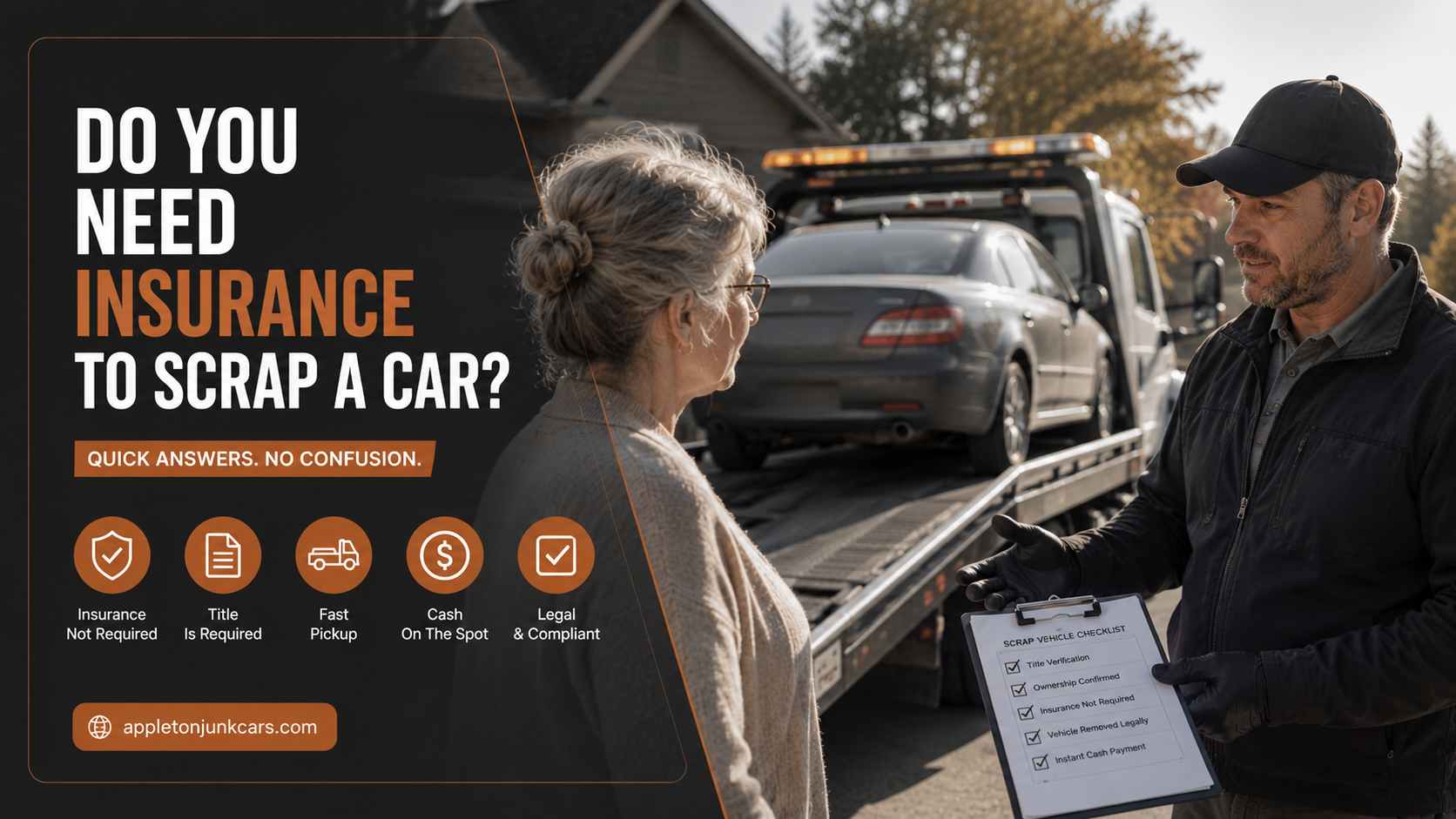
No, you do not need your own insurance to scrap a car if you are using a licensed junk car buyer or scrap pickup service. The moment they load your vehicle onto their truck, their own motor trade insurance takes over. That said, there is one big exception to know, and there are also some smart moves to make with your existing policy that most people completely miss. This article covers all of it in plain language.
Need Insurance to Scrap a Car? (And Why It Depends on One Thing)
Whether or not you need insurance comes down to a single question: who is moving the car?
If a licensed junk car removal company is coming to your home and picking up the vehicle using their own recovery truck, you personally do not need to have active insurance on that car at the time of pickup. If the car is being collected by a licensed scrap dealer using a recovery truck, you generally do not have to keep your own insurance active for transport. The collection company will have motor trade road risks insurance, which covers the vehicle while it is being moved.
If, however, you plan to drive that car to the scrapyard yourself, the answer flips completely. If you plan to drive your car on public roads, it needs to be insured. There are no exceptions and no excuses whatsoever. Driving an uninsured vehicle on public roads is illegal in almost every state, even if your destination is the junkyard and even if the car is technically on its last legs.
So the rule is simple:
- Junk car company picks it up from your property: no personal insurance required
- You drive it yourself: insurance is legally required the entire way there
What Is Actually Happening With Your Insurance Right Now
If your car is currently registered with your state DMV, there is a good chance you are legally required to carry at least minimum liability coverage on it. In the United States, car insurance laws are set at the state level. Most states require insurance coverage for any vehicle that is currently registered, whether or not it is operational.
This means that even if the car has not moved in months, if it is still in your name and still registered, many states expect you to keep some form of coverage active. The moment you decide to scrap it, though, you gain the ability to cleanly exit that policy and potentially get some money back. More on that in a bit.
What If the Car Is Just Sitting on Your Property?
This is where people get confused, and honestly, the rules vary by state. If your car is parked on private property like your driveway or in your garage, there is no legal obligation for you to have insurance.
Some states allow you to formally declare a vehicle as non-operational with the DMV, which removes the insurance requirement while keeping the title in your name. Think of it as telling the state “this car is not going anywhere.” If your vehicle has been sitting on your property for a while and you have already stopped paying insurance on it, you may be in the clear legally as long as it has not been on a public road.
However, dropping coverage on a car you still own does come with a risk: if something happens to that vehicle while it is sitting there, whether someone hits it, it gets stolen, or a tree falls on it, you have no protection. While it saves you some money, it is worth noting that your vehicle is not covered in the case of any damage or theft, so if you want to keep your no claims bonus in the unlikely event of something happening, it is worth talking to your insurance provider before cancelling.
The honest advice here is to call your insurer and tell them you are planning to junk the car. Ask them what your options are. Most will walk you through exactly what applies in your state without any pressure.
What to Do With Your Insurance Before Scrapping
Here is the step-by-step process most people wish someone had told them earlier.
Step 1: Call Your Insurer Before the Pickup Date
Let them know you are planning to junk the car. They will confirm whether you need to keep coverage active until the moment of pickup or whether you have already met their requirements. Some insurers require the policy to stay active until ownership officially transfers. Others are flexible.
Step 2: Do Not Cancel the Policy Too Early
This is the most common mistake. Wait until you have the Certificate of Destruction before cancelling your insurance. This way, you will stay covered until your car is officially scrapped. The Certificate of Destruction (sometimes called a Certificate of Title transfer or junk slip, depending on your state) is the document proving you no longer own the vehicle.
If something happens to that car between the time you cancel your insurance and the time the junkyard officially takes ownership, you could be stuck with a liability you did not expect.
Step 3: After the Pickup, Cancel the Policy Immediately
Once your car is gone and you have your paperwork in hand, call your insurer and get the policy cancelled. Most providers will refund the unused portion of your premium once you confirm the car has been scrapped and submit any required documentation.
Step 4: Get Confirmation in Writing
Ask your insurer to confirm the cancellation in writing. This protects you from any future billing issues or claims tied to that vehicle. Keep the document somewhere safe alongside your other junk car paperwork.
Can You Get a Refund on Your Unused Insurance?
Yes, and this is something a lot of people do not think to ask about.
A refund is essentially the money you get back for the unused portion of your premium once you cancel your insurance. Most insurers calculate this on a pro-rata basis. That means you get money back for the part of the premium you have not used.
If you paid your annual premium in full upfront, you may be entitled to a partial refund covering the months you will not be using. If you pay monthly, your insurer should simply stop billing you once the cancellation goes through.
A few things affect how much you get back:
- How far into your policy term you are
- Whether your insurer uses daily pro-rata or full-month refund calculations
- Any administrative cancellation fees (ask about these upfront)
- Whether you have had a claim on that policy recently
To make sure you get what you are owed, ask your insurer for a written breakdown showing the refund amount, any fees deducted, and the date the policy ends. Do not just trust a verbal number over the phone.
What If You Are Getting a New Car Right Away?
If you are junking the old car and picking up a new one around the same time, you actually have an easier path. If you manage to time it right, receiving your new car on the day you scrap its predecessor, all you will need to do is inform your insurer on the day and give them the details of your new car so that they can amend the policy.
This avoids the awkward gap between policies and keeps your coverage history continuous. A gap in insurance history, even a short one, can cause your rates to go up when you get your next policy. It is one of those things that seems minor in the moment but can cost you more down the road.
What Happens If Your Insurance Company Is the One Scrapping the Car
If your car was totaled in an accident and your insurer declared it a total loss, the situation works a little differently.
If your car is scrapped, your insurance company will include the amount they get from the junkyard in your check. Claims for totaled vehicles include the value an insurance company will get from selling what is left of your car.
In this case, you do not need to worry about coordinating with a junk car company yourself. Your insurer handles the pickup and paperwork. Your job is to make sure you receive fair value for the vehicle and to remove it from your active policy once everything is settled.
What Documents Does Your Insurer Need to Close the Policy?
Every insurer is a little different, but generally they will ask for at least one of the following:
- A Certificate of Destruction from the junkyard or salvage facility
- The signed title showing transfer of ownership to the buyer
- A junk slip or bill of sale (depending on your state)
- Confirmation from your state’s DMV that the vehicle has been deregistered
Having these documents ready before you call speeds up the process significantly and removes any back-and-forth delays.
Real Experiences From People Who Have Been Through This
Real owners across online communities have shared their experiences with junking cars and navigating the insurance side of things. A few common themes come up again and again.
Many people are surprised to learn that they are entitled to a refund. One car owner from a popular automotive forum shared that they called their insurer expecting a fight but were simply asked for proof that the car had been picked up and were told a check would be mailed within two weeks. The lesson there is: just call and ask. Most insurers have a standard process for this and it is less complicated than people expect.
Another theme that comes up frequently is the importance of not cancelling too early. Several people reported cancelling their policy before the junkyard formally took ownership, only to realize later that they were technically unprotected during the time the car was still sitting in their driveway waiting for pickup. The car was not going anywhere, so in most cases nothing happened. But it is a risk that is easy to avoid by simply waiting until you have paperwork in hand.
A third experience worth noting: some people tried to drive their junk car to the yard themselves without insurance, thinking “it is just a quick trip.” This is never worth it. Getting pulled over without insurance, even on the way to the scrapyard, can result in fines, license suspension, and future insurance rate increases that far outweigh any savings.
Common Mistakes to Avoid
People make the same few errors when it comes to insurance and scrapping. Knowing them in advance means you do not have to learn the hard way.
Cancelling insurance before the car is officially gone. Keep coverage active until you have paperwork confirming the transfer. Even one day of exposure matters if something goes wrong.
Forgetting to notify the DMV. Cancelling your insurance does not automatically deregister the vehicle. You need to separately notify your state DMV that the car has been disposed of, or you may continue receiving registration renewal notices and could even be held liable for anything tied to that VIN.
Not asking about the refund. A lot of people simply let their policy lapse without ever calling to ask what they are owed. If you paid ahead, that money belongs to you. Ask for it.
Assuming the junk car company’s insurance covers everything. Their policy covers the vehicle from the moment of collection, but it does not retroactively protect you for anything that happened before that. Make sure your own liability coverage stays in place until the handoff happens.
Frequently Asked Questions
Do I need insurance to sell my car to a junkyard?
Not in most cases. Licensed junk car buyers carry their own insurance and take on liability the moment they collect the vehicle. You do not need active insurance on the car at the time of pickup, as long as you are not the one driving it there.
What happens to my insurance once the car is junked?
Once the car is officially scrapped and ownership has transferred, your insurer will cancel the policy on that vehicle. If you paid upfront, you may receive a refund for unused time. If you pay monthly, billing simply stops.
Can I cancel my insurance before the junkyard picks up the car?
Technically you can, but it is not recommended. Keep coverage active until you have the Certificate of Destruction or a signed title transfer in hand. If something happens to the car during that window, you want to be protected.
Do I need insurance if my junk car is just sitting on my driveway?
This depends on your state. Some states require insurance on any registered vehicle regardless of whether it is being driven. Others allow you to designate a vehicle as non-operational to remove the insurance requirement. Check with your state DMV and your insurer for the specific rules that apply to you.
Will scrapping my car affect my insurance rates?
Scrapping a car itself does not affect your rates. What can affect rates is a gap in coverage. If you cancel your insurance without immediately replacing it with a new policy, insurers may charge you higher rates when you come back. Try to time the cancellation with either getting a new vehicle or formally exiting the car ownership stage entirely.
What if I drove the car to the junkyard without insurance and got pulled over?
Driving without insurance is illegal in almost every state. Penalties vary but commonly include fines, license suspension, and SR-22 requirements. There are no shortcuts here. If the car can be towed by the junkyard, let them do it.
Can a junkyard refuse to take a car that has no insurance?
No. Whether your car is insured has no bearing on a junkyard’s decision to accept it. They care about ownership documentation (the title, primarily) and the vehicle’s condition. Insurance status is your business, not theirs.
The Bottom Line
Scrapping a car is one of those situations where the insurance question sounds more complicated than it actually is. If you are using a pickup service (and most people are), you do not need active personal insurance on the vehicle at the time of collection. If you are driving it yourself, you absolutely do. Keep coverage in place until the car is officially out of your hands, ask your insurer about any refund you are owed, and make sure the DMV knows the vehicle has been disposed of.
That is really it. The paperwork side of scrapping a car is manageable, and when you handle the insurance piece correctly, you might even walk away with a small refund you did not expect.