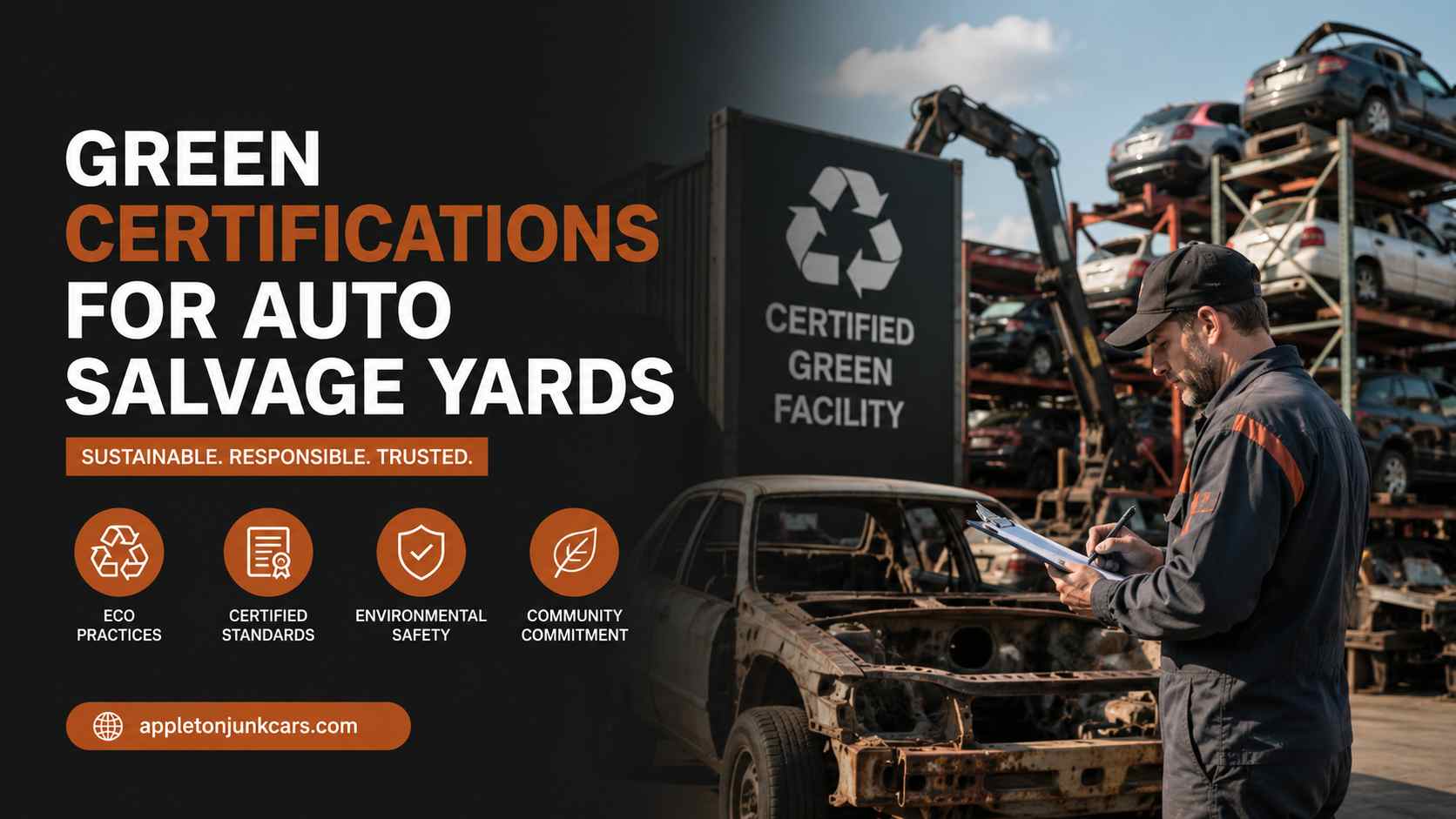
Not all auto salvage yards operate at the same environmental standard. The difference between a certified green dismantler and an unlicensed operation can be the difference between a vehicle that is fully depolluted, carefully parts-recovered, and properly documented, and one that is crushed whole with fluids still inside. Green certifications for auto salvage yards provide third-party verification that a facility meets specific environmental standards, going beyond the minimum requirements of a state operating license.
Understanding the certification landscape matters for three groups: consumers who want to ensure their junk car is handled responsibly, businesses that include end-of-life vehicle management in their sustainability reporting, and policymakers and procurement officers who specify certified recyclers for fleet disposal programs. Each of these audiences benefits from knowing what each certification actually requires, how it is verified, and how to confirm a facility’s current certification status.
This guide covers every significant green certification program for auto salvage yards in the United States, what each requires, who administers it, and how the programs relate to state licensing, federal environmental law, and each other. It also explains what certification means in practice for the vehicle handling process and how to verify a yard’s certification status before you do business with it.
Why Certification Matters Beyond a Basic State License
A state operating license for an auto dismantler is the legal minimum required to receive and process end-of-life vehicles. Licensing confirms that a facility has registered with the appropriate state agency, that it has disclosed its operations, and that it is subject to periodic inspection. What a license does not necessarily confirm is the quality of the facility’s fluid management, the completeness of its hazardous material removal procedures, or the rigor of its documentation and parts quality practices.
The gap between the licensed minimum and best practice is meaningful. State environmental agencies vary significantly in their inspection frequency, technical standards, and enforcement rigor. A facility that passed an inspection two years ago may have changed practices since then. A facility in a state with limited inspection resources may have gone years without a meaningful compliance review. A license is a floor, not a ceiling, for environmental performance.
Certifications fill this gap by requiring documented adherence to specific standards, verified through regular third-party audits rather than intermittent government inspections. The certification standards are typically written by industry organizations that have both the technical expertise to define meaningful requirements and the relationship with facilities to implement them practically. Certifications do not replace licensing but they provide a meaningful additional layer of quality assurance for environmental performance and operational practices.
The Certified Automotive Recycler (CAR) Program
The Certified Automotive Recycler (CAR) program is the primary voluntary certification for auto dismantlers in the United States. It is administered by the Automotive Recyclers Association (ARA), the national trade association representing the professional auto recycling industry. CAR certification is recognized by environmental agencies, fleet operators, and state environmental programs as the most meaningful third-party validation available for US auto salvage operations.
Certification Requirements
CAR certification evaluates facilities against four major assessment areas. Environmental compliance requires documented procedures for fluid management including the removal, storage, and disposal of all automotive fluids in compliance with applicable federal and state regulations. It specifically addresses refrigerant recovery, battery management, oil and fuel handling, antifreeze collection, and stormwater management at the facility.
Business practices covers licensing, record-keeping, VIN documentation for received vehicles, and compliance with applicable laws governing the purchase and sale of used parts and vehicles. Parts quality standards address how recovered parts are inspected, tested, graded, and warranted to customers. Safety requirements cover workplace practices, equipment maintenance, and training for employees who handle hazardous materials and operate heavy equipment.
The Audit Process
CAR certification requires an on-site audit conducted by an independent assessor working through the ARA certification program. The audit examines actual facility practices against the documented standards: auditors review records, inspect storage areas, observe procedures, and interview staff. An initial audit produces either a certification or a corrective action requirement. Facilities that receive CAR certification must undergo periodic reassessment audits, typically every three years, to maintain their certification status.
How to Verify CAR Certification
The ARA maintains a searchable database of CAR-certified facilities on its website at www.a-r-a.org. The database allows anyone to search by state or zip code to find certified facilities in their area. The database reflects current certification status rather than historical certifications and is updated as certifications are awarded, suspended, or expire.
The Automotive Recyclers Association and ANSI Standards
The Automotive Recyclers Association (ARA) is the national trade organization whose membership includes the majority of licensed professional auto dismantlers in the United States. ARA membership does not itself constitute a green certification: membership requires payment of dues and agreement to a code of ethics but does not require the environmental audit that CAR certification requires. However, ARA membership signals participation in the professional industry community and access to training, technical resources, and regulatory guidance.
The ARA has worked with the American National Standards Institute (ANSI) to develop industry standards for auto recycler environmental management, parts quality, and business practices. These standards, developed through a consensus process involving industry participants, environmental agencies, and other stakeholders, form the technical basis for CAR certification requirements. The ANSI standard for auto recycler environmental management specifies the fluid handling, hazardous material removal, and documentation requirements that CAR-certified facilities must meet.
State-Level Green Programs
California’s End of Life Vehicle Solutions (ELVS) Program
California operates the End of Life Vehicle Solutions (ELVS) program, a cooperative initiative between the State of California and vehicle manufacturers to manage the recovery of mercury switches from end-of-life vehicles. California dismantlers registered with ELVS receive collection containers for mercury switches and related equipment and participate in data collection that tracks mercury switch recovery rates. ELVS participation is required for California dismantlers who process vehicles from certain manufacturers under a statewide regulatory framework.
California also operates through its Bureau of Automotive Repair (BAR) a licensing system that includes stricter environmental standards than many other states, particularly around hazardous waste management and stormwater control. BAR-licensed auto dismantlers in California are subject to periodic inspections that go beyond what many state programs require.
Other State Programs
Several states have developed their own environmental performance programs for auto dismantlers that operate parallel to or in conjunction with the national CAR program. Washington State, Oregon, and several New England states have programs that recognize or align with CAR certification requirements while adding state-specific environmental requirements. State programs often address site-specific issues: stormwater management requirements are typically stricter in rainfall-heavy regions; permit requirements for above-ground fuel storage vary by state; and some states have specific regulations governing the storage of salvage vehicles in proximity to waterways.
ISO 14001 Environmental Management System Certification
ISO 14001 is an international standard published by the International Organization for Standardization (ISO) that specifies the requirements for an environmental management system (EMS). An EMS is a documented framework that an organization uses to identify, monitor, and systematically improve its environmental performance. ISO 14001 does not specify environmental performance targets but requires that an organization establish targets, document its processes for meeting them, and continually improve its system.
ISO 14001 certification is issued by accredited third-party certification bodies following a documented audit process. The certification is renewable every three years with annual surveillance audits in between. ISO 14001 is a higher administrative burden than CAR certification because it requires documentation of a full EMS rather than evaluation against a specific industry standard, but it carries broad international recognition and is often required or preferred in procurement specifications for government and large corporate contracts.
A minority of US auto salvage operations hold ISO 14001 certification, primarily larger multi-site operations and those with significant commercial or government fleet accounts that specify ISO-certified suppliers. ISO 14001 certification and CAR certification are complementary rather than competitive: a facility may hold both, and the documented management system required for ISO 14001 is compatible with and supports the operational practices required for CAR certification.
What Certified Facilities Are Actually Required to Do
The practical difference between a CAR-certified facility and a facility that holds only a state license is most visible in the specific operational practices the certification requires.
Practice Area | State License (Minimum) | CAR Certification (Above Minimum) | ISO 14001 (EMS Standard) |
|---|---|---|---|
Fluid depollution | Required by law but inspection frequency varies | Documented procedure for each fluid type; audit-verified | Documented procedure with targets and continuous improvement |
Refrigerant recovery | Required by EPA Section 609 | Verified technician certification; equipment certification records | Documented in EMS with performance tracking |
Mercury switch removal | Required in states with NVMSRP participation | Documented tracking of switch quantities recovered | Documented in EMS with targets |
Parts quality and warranty | Not typically regulated | Specific grading, testing, and warranty standards required | Documented quality processes in EMS |
Record-keeping | VIN records typically required | Comprehensive records on received vehicles, parts, and disposal | Full documentation requirements under EMS |
Staff training | Not typically specified | Required training on fluid handling, safety, and parts quality | Training program documented in EMS |
Audit and verification | Government inspection (frequency varies) | Third-party audit on certification cycle | Annual surveillance audit plus triennial recertification |
The parts quality and warranty standards are an aspect of CAR certification that is often overlooked in environmental discussions but is practically significant for buyers of used auto parts. CAR-certified yards are required to grade recovered parts, test applicable components, and provide warranty coverage meeting minimum standards. This commitment to parts quality reduces consumer risk when purchasing used auto parts and supports the reuse pathway that is environmentally superior to both recycling and landfill.
How to Verify a Salvage Yard’s Certification Status
Verifying a salvage yard’s certification status before doing business with them is straightforward when you know where to look.
CAR certification status: the Automotive Recyclers Association maintains a searchable member and certification directory at www.a-r-a.org. Search by name, city, or state to find certified facilities and confirm their current certification status. The directory is updated regularly and reflects active certifications rather than expired or lapsed ones.
State operating license: each state’s motor vehicle or environmental agency maintains records of licensed auto dismantler facilities. In most states, this information is accessible through the agency’s website or by calling the licensing division. A valid state license is the minimum requirement; confirmation that a license is current is a baseline check before any other evaluation.
ISO 14001 certification: the certification body that issued the certificate (accredited organizations such as Bureau Veritas, SGS, DNV, TUV Rheinland, or similar) maintains public records of current certifications. The International Accreditation Forum (IAF) CertSearch database at certipedia.com allows searches for organizations holding ISO 14001 and other ISO management system certifications.
When in doubt, ask the facility directly for copies of their current certifications. A legitimate certified facility will have documentation readily available. A facility that cannot provide documentation of claimed certifications should be treated skeptically.
Frequently Asked Questions
What is the Certified Automotive Recycler (CAR) program?
The Certified Automotive Recycler (CAR) program is a voluntary certification administered by the Automotive Recyclers Association (ARA) that verifies auto salvage facilities meet documented standards for environmental compliance, parts quality, business ethics, and worker safety. Certification requires an on-site audit by an independent assessor and periodic renewal audits. CAR-certified facilities have been assessed against specific requirements for fluid management, refrigerant recovery, mercury switch removal, and other environmental practices that go beyond the minimum state licensing requirements.
How do I know if an auto salvage yard is certified?
The Automotive Recyclers Association maintains a searchable directory of CAR-certified facilities at www.a-r-a.org. You can search by name, city, or state. For ISO 14001 certification, the certification body’s public records or the IAF CertSearch database at certipedia.com can confirm certification status. State operating licenses can be verified through the relevant state motor vehicle or environmental agency. You can also ask the facility directly for documentation of their current certifications.
Is a state license the same as a green certification?
No. A state operating license is the legal minimum required to receive and process end-of-life vehicles. It confirms registration and basic compliance but does not evaluate the quality of environmental practices at the specific performance level that certifications require. Green certifications such as CAR certification involve documented standards, third-party audits, and ongoing verification of practices that go beyond what state licensing programs typically require.
What does ISO 14001 certification mean for an auto salvage yard?
ISO 14001 certification means the facility has implemented and had audited an environmental management system (EMS) that systematically identifies environmental impacts, sets improvement targets, documents processes for managing those impacts, and drives continual improvement. ISO 14001 does not specify environmental performance targets but requires a rigorous management framework. It carries broad international recognition and is often specified by government and corporate procurement programs requiring ISO-certified suppliers.
What is the Automotive Recyclers Association (ARA)?
The Automotive Recyclers Association (ARA) is the national trade organization for the professional auto recycling industry in the United States. Its membership includes licensed auto dismantlers, industry suppliers, and related businesses. ARA administers the CAR (Certified Automotive Recycler) certification program, develops industry standards in partnership with ANSI, provides training and regulatory guidance to members, and advocates for the industry with federal and state regulators. ARA membership alone is not a certification but signals professional industry participation.
Do all junk car buyers need to be certified?
Junk car buyers are required to hold a valid state operating license as a minimum legal requirement. Green certifications such as CAR certification are voluntary programs that go beyond the licensing minimum. Not all licensed buyers hold additional certifications, and certification status varies significantly across the industry. Sellers who want to ensure their vehicle is handled at the highest environmental standard should verify that the buyer holds CAR certification or equivalent, which can be confirmed through the ARA’s online directory.
What is the NVMSRP and how does it relate to salvage yard certification?
The National Vehicle Mercury Switch Recovery Program (NVMSRP) is a cooperative initiative between the auto industry, state governments, and the Environmental Protection Agency to collect mercury switches from end-of-life vehicles before shredding. Participation in NVMSRP is a requirement or strong expectation of CAR certification, as documented mercury switch recovery is a component of the CAR environmental standards. The program provides certified facilities with collection containers and a mail-back system for recovered switches.
Can I ask a junk car buyer for proof of environmental certification?
Yes, and you should. A legitimate certified facility will have documentation of its current CAR certification, ISO 14001 certification if applicable, and state operating license available on request. Many certified facilities display their certifications at their facility or on their website. If a buyer claims certification but cannot provide documentation, that discrepancy is worth noting before completing a transaction.
The Bottom Line
Green certifications for auto salvage yards exist because the minimum legal requirement of a state operating license does not guarantee the quality of environmental performance that responsible vehicle disposal requires. The CAR certification program, administered by the Automotive Recyclers Association, is the most widely recognized and meaningful voluntary certification in the US auto recycling industry. ISO 14001 certification provides an additional management system framework recognized in international procurement specifications.
The practical value of certification is highest for three outcomes: consumers who want confidence that their vehicle is handled responsibly, fleet operators who must document responsible end-of-life management for sustainability reporting, and businesses that source used auto parts and want quality assurance that comes with documented grading and warranty standards.
Verifying certification status is straightforward: the ARA’s online directory provides current CAR certification information by location. State license verification is available through state agency websites. ISO certification status is public record through accreditation body databases. These three checks, taking perhaps ten minutes collectively, provide a reasonably complete picture of a facility’s credentials before any transaction is completed.