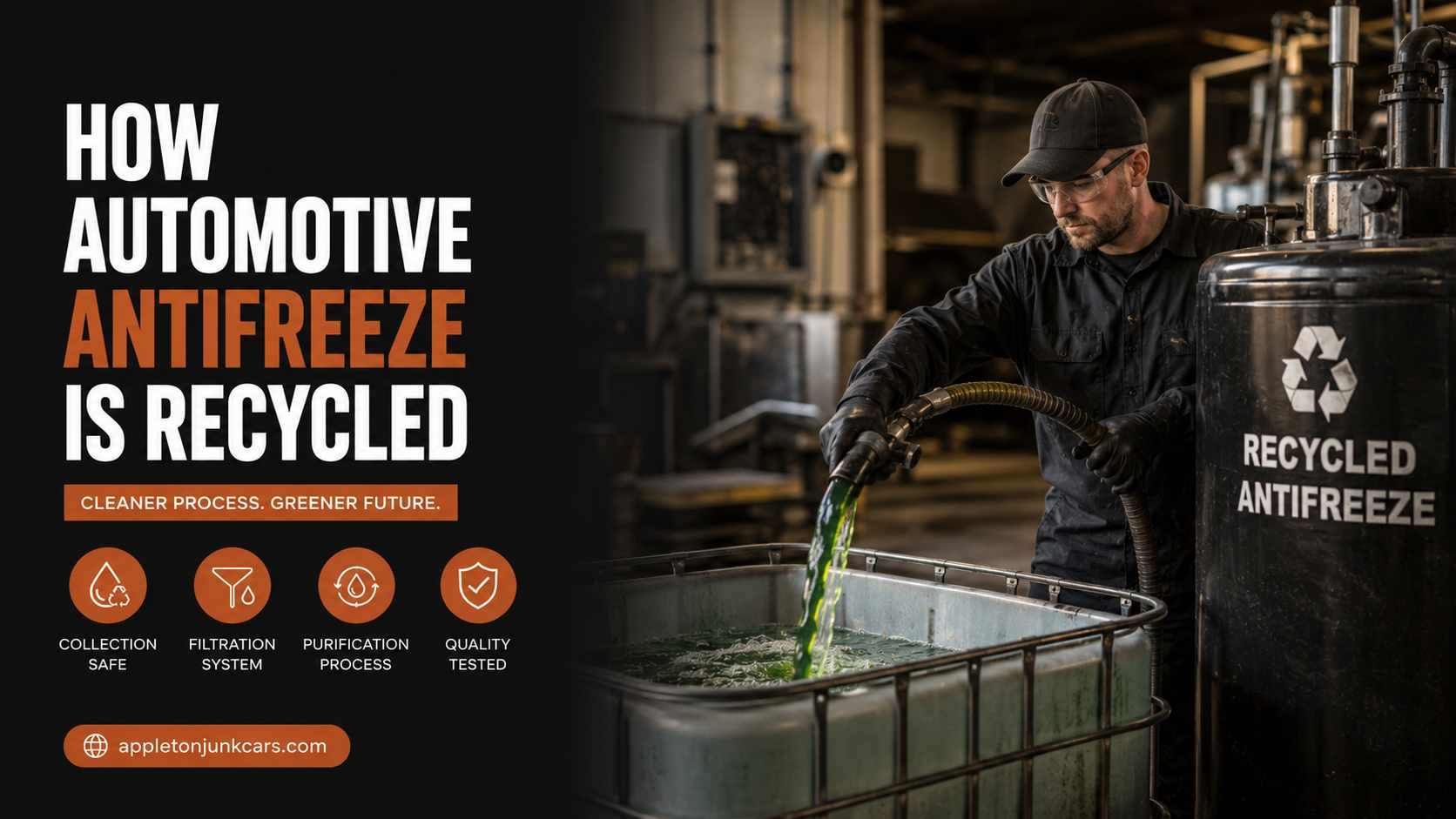
Automotive antifreeze does not wear out the way engine oil does. The ethylene glycol base compound that makes antifreeze work retains its freeze and boil protection properties through many service cycles. What actually degrades over time is the additive package: the corrosion inhibitors, pH buffers, and stabilizers that protect cooling system metals from rust and scale buildup.
This distinction is fundamental to understanding why antifreeze recycling works so effectively: the base compound can be cleaned, de-acidified, and returned to full performance with a fresh additive package, producing a product that is functionally identical to new antifreeze.
Antifreeze recycling is not as well-known as battery or oil recycling, but it is a mature industry with two primary pathways: on-site recycling at service centers and salvage yards using portable recycling machines, and centralized re-refining at dedicated processing facilities that handle bulk volumes. Both pathways produce recycled antifreeze that meets or exceeds ASTM International standards for new antifreeze products.
This guide explains what antifreeze actually contains and why it is recyclable, how each recycling pathway works, where the recycled product goes, and what individuals and businesses should do with used antifreeze they cannot handle through professional service channels.
What Antifreeze Actually Contains and Why the Base Can Be Recovered
Automotive antifreeze is a mixture of two primary components: a glycol base compound and water, with an additive package comprising a small percentage of the total volume. The glycol base is either ethylene glycol, used in most passenger vehicle antifreeze, or propylene glycol, used in applications requiring lower toxicity such as recreational vehicles, food processing equipment, and some European specifications.
Antifreeze Component | Approximate Percentage | What Happens to It During Service | Recyclability |
|---|---|---|---|
Ethylene glycol or propylene glycol (base compound) | 88 to 93 percent | Remains chemically intact through service; does not degrade | Highly recyclable; this is what re-refineries recover |
Water (dilutant) | 5 to 10 percent in pre-mixed formulations | Evaporates or is replaced; water content increases as pH drops | Removed during recycling; fresh water added in reblending |
Corrosion inhibitors (silicates, organic acids) | 2 to 5 percent | Depleted as they neutralize acids and prevent corrosion | Cannot be recovered; replaced with fresh additive package |
pH buffers | Under 1 percent | Consumed as pH drops from acidic degradation products | Cannot be recovered; fresh buffers added in recycled product |
Dye (typically yellow, green, or orange) | Trace | Remains in solution; may fade | Filtered or removed; new dye added in recycled product |
Contaminants accumulated in service | Variable | Rust particles, oil traces, scale deposits | Removed by filtration and distillation during recycling |
The critical insight for recycling viability is that 90 percent or more of antifreeze by volume is the glycol base compound, and that compound is chemically stable enough to survive multiple service and recycling cycles. Removing the depleted additive package and the accumulated contaminants, then restoring the additive package, recovers the full performance of the base compound without requiring any new glycol to be synthesized.
How Used Antifreeze Is Collected
Used antifreeze collection happens through several parallel channels that together capture a significant fraction of the antifreeze drained from vehicles annually. The Environmental Protection Agency estimates that approximately 800 million gallons of antifreeze are sold in the United States each year, of which an estimated 200 to 400 million gallons are drained from vehicles during service and at end of vehicle life. Collection rates vary significantly by region and collection infrastructure.
From Service Centers and Quick Lubes
Vehicle service centers that perform cooling system flushes drain used antifreeze into collection containers as part of their standard service operations. Licensed hazardous waste collectors or used antifreeze recyclers run scheduled pickup routes to collect from service centers in their region. High-volume service locations such as dealerships and fleet maintenance facilities generate enough used antifreeze to justify weekly or biweekly collection pickups.
From Salvage Yards and Dismantlers
Auto salvage yards drain coolant from every vehicle during the depollution stage, as described in the fluid management section of auto dismantling practice. Salvage yards that process hundreds or thousands of vehicles annually collect substantial volumes of used antifreeze. This stream is collected by licensed antifreeze recyclers who may operate their own on-site recycling equipment at larger facilities or collect the antifreeze in bulk for transport to a central re-refinery.
Household Collection Programs
Municipal household hazardous waste programs accept used antifreeze from private individuals. These programs are typically operated on specific collection days or at permanent drop-off locations. Acceptance is free in most programs. Used antifreeze collected through these programs is aggregated and either processed on-site or transported to a regional recycling facility.
The Testing Process: How Recyclers Determine What They Have
Before processing, used antifreeze is tested to determine its glycol type (ethylene or propylene), contamination level, pH, glycol concentration, and presence of heavy metals or other contaminants that would affect the recycled product quality. Testing is critical because ethylene glycol and propylene glycol must not be mixed in processing: the resulting blend cannot be reformulated to meet specifications for either glycol type.
Field testing instruments including refractometers (which measure freeze protection by glycol concentration), pH meters, and colorimetric test strips allow collection technicians to screen incoming material at the point of pickup. More detailed laboratory analysis is performed on representative samples from bulk collection volumes before large-scale processing begins.
Antifreeze that has been contaminated with petroleum products, which occurs when oil leaks into a cooling system through a failed head gasket or other failure, presents a processing challenge. Petroleum-contaminated antifreeze requires additional separation steps and may not be suitable for the standard on-site recycling pathway. It is typically routed to centralized facilities with the equipment to handle mixed-contamination streams.
On-Site Recycling vs. Centralized Re-Refining
Characteristic | On-Site Recycling Machine | Centralized Re-Refinery |
|---|---|---|
Location | At the service center or salvage yard | Regional or national processing facility |
Typical volume processed | 5 to 50 gallons per batch | Thousands to millions of gallons per year |
Processing steps | Filtration, ion exchange, pH adjustment, additive restoration | Distillation, filtration, heavy metal removal, additive restoration |
Contamination handling | Limited; petroleum contamination typically not treatable | Full treatment capability for most contamination types |
Product quality | Meets recycled antifreeze specifications; may not equal virgin | Meets or exceeds ASTM virgin antifreeze specifications |
Capital cost | $3,000 to $15,000 for equipment | Tens of millions for full facility |
Best suited for | Service centers with consistent coolant flush volumes | Bulk processors, municipal programs, large salvage operations |
On-site recycling machines use a combination of particulate filtration to remove rust and scale, ion exchange resins to remove dissolved metals and restore pH, and an additive injection system that adds a fresh corrosion inhibitor and buffer package to the cleaned glycol. The resulting product is tested for freeze point and pH before being returned to service in the same or another vehicle. These machines are widely used by automotive service chains that perform large volumes of cooling system flushes.
The Re-Refining Process at Centralized Facilities
Centralized antifreeze re-refineries handle bulk volumes of used antifreeze from multiple collection sources and produce recycled antifreeze that meets ASTM D3306 or D6210 specifications, the same standards applied to virgin antifreeze formulations.
Dehydration and Pre-Treatment
Incoming used antifreeze is first screened for contamination and separated by glycol type. Material with significant petroleum contamination enters a pre-treatment stage that may include air flotation or solvent extraction to remove the oil fraction before glycol processing begins. The antifreeze is then heated to drive off water and low-boiling contaminants through evaporation.
Distillation
The primary purification step in re-refining is vacuum distillation, in which the antifreeze is heated under reduced pressure to lower its boiling point. The ethylene glycol fraction vaporizes at the distillation temperature and is condensed and collected as a purified glycol stream. Non-volatile contaminants including metals, scale particles, and degraded additive residues remain in the distillation bottoms and are separated from the recovered glycol.
Polishing and Additive Restoration
The distilled glycol stream passes through polishing filters that remove any remaining particulates and through activated carbon beds that remove color bodies and trace organic contaminants. The resulting clear, colorless glycol is then blended with fresh water to the desired concentration (typically 50 percent glycol for standard freeze protection to approximately -34 degrees Celsius or -29 degrees Fahrenheit) and injected with a fresh corrosion inhibitor additive package.
The final product is tested against ASTM specifications for freeze point, boiling point, pH, corrosion protection, and glycol purity. Product that meets specifications is packaged for distribution. Product that falls short of specifications is reprocessed or diverted to industrial applications where the specification requirements are less strict.
Where Recycled Antifreeze Goes and Who Uses It
Recycled antifreeze that meets ASTM specifications is sold through the same distribution channels as virgin antifreeze: automotive supply stores, fleet supply companies, and service center supply chains. The recycled product is typically sold at a modest discount to equivalent virgin antifreeze, reflecting the lower raw material cost rather than any performance difference.
Large commercial and industrial users who specify recycled content in their procurement programs, including many municipalities, school districts, and fleet operators, actively purchase recycled antifreeze to meet sustainability goals. These buyers often represent the most reliable volume market for recycled antifreeze producers because their procurement requirements are specified in advance and predictable.
Industrial applications that do not require automotive-grade specifications purchase lower-grade recycled glycol for use as a heat transfer fluid in HVAC systems, as an ingredient in deicing fluids for airport runway treatment, and as a process chemical in various manufacturing operations. This industrial market absorbs recycled glycol that does not meet automotive specifications but is still a viable recovered material.
What to Do With Antifreeze at Home: Safe Disposal and Drop-Off Options
Used antifreeze from a home coolant flush or radiator drain should not be poured down a household drain, into a storm drain, or onto the ground. Ethylene glycol is toxic to animals, particularly dogs and cats, who are attracted to its sweet taste. It can also reach groundwater and surface water through soil infiltration or stormwater runoff.
Situation | Recommended Action |
|---|---|
Clean used antifreeze from a routine flush | Take to a municipal household hazardous waste collection event or permanent drop-off; many auto parts stores also accept it |
Antifreeze contaminated with oil (milky appearance) | Take to a household hazardous waste program; disclose the contamination; do not mix with clean antifreeze |
Very small amount (under 1 quart, clean) | Some municipalities allow disposal in sealed containers with regular trash; check local rules before assuming this is permitted |
Large volume from a commercial operation | Licensed used antifreeze hauler collection; commercial businesses cannot use household hazardous waste programs |
Propylene glycol antifreeze (RV, food-grade) | Same collection pathways as ethylene glycol; must be kept separate from ethylene glycol for recycling |
Most auto parts retailers accept used antifreeze at no charge, similar to their battery and oil collection services. AutoZone, O’Reilly, and similar chains typically have collection containers near the service desk. Calling ahead to confirm current acceptance at a specific location is worth doing, as collection capacity and policy varies by store.
Frequently Asked Questions
Can antifreeze be recycled?
Yes. Automotive antifreeze is highly recyclable because the primary component, ethylene glycol or propylene glycol, remains chemically intact during vehicle service. What degrades is the additive package of corrosion inhibitors and pH buffers. Recycling removes contaminants and depleted additives, then restores the additive package, producing recycled antifreeze that meets the same ASTM performance standards as new antifreeze.
What happens to antifreeze when it is recycled?
Used antifreeze is collected, tested to determine glycol type and contamination level, then processed through either an on-site recycling machine or a centralized re-refinery. On-site machines use filtration and ion exchange to clean the glycol and restore the additive package. Re-refineries use vacuum distillation to purify the glycol, followed by filtration, additive restoration, and quality testing. The product is sold as recycled antifreeze meeting ASTM specifications.
Where can I take used antifreeze for recycling?
Used antifreeze can be taken to municipal household hazardous waste collection programs, auto parts retailers that accept hazardous materials (including AutoZone and O’Reilly at many locations), automotive service centers that recycle their own flush waste, and dedicated used fluid collection sites operated by recyclers in some regions. Call ahead to confirm acceptance at any specific location.
Is recycled antifreeze as good as new?
Recycled antifreeze that meets ASTM D3306 or D6210 specifications performs identically to virgin antifreeze of the same formulation. The specifications cover freeze point, boiling point protection, corrosion protection for all cooling system metals, and pH stability. The recycled product has the same chemical composition as a new product because it uses the same glycol base compound with a fresh additive package. The distinction between recycled and virgin is in the source of the glycol, not in the performance.
Why is antifreeze toxic and what happens if it is disposed of improperly?
Ethylene glycol, the primary component of most antifreeze, is toxic to mammals including dogs, cats, and humans if ingested in sufficient quantity. Its sweet taste makes it attractive to animals. Improper disposal on the ground or into a drain allows it to reach soil and groundwater, where it persists and can contaminate water supplies. It is also attractive to wildlife if it pools on a surface. Propylene glycol antifreeze is significantly less toxic than ethylene glycol and is sometimes used in applications where low toxicity is required.
Can you mix different types of antifreeze for recycling?
Ethylene glycol and propylene glycol antifreeze must not be mixed before recycling because they require different processing parameters and cannot be reformulated into a single-glycol product after mixing. Different additive packages (green, orange, pink, yellow, etc.) within the same glycol base type can typically be mixed for recycling because the additive package is removed entirely during processing. When in doubt, keep antifreeze types separate and label containers.
How often should antifreeze be changed in a vehicle?
Antifreeze change intervals vary by formulation. Conventional green antifreeze (IAT, inorganic additive technology) is typically replaced every two years or 30,000 miles because its silicate-based corrosion inhibitors deplete relatively quickly. Extended-life orange or pink antifreeze (OAT or HOAT, organic acid technology) is designed for five-year or 150,000-mile service intervals. Checking the coolant’s pH and freeze protection annually with a test strip or refractometer is the most accurate way to determine actual replacement need.
Is antifreeze classified as hazardous waste?
Used antifreeze is classified as a hazardous waste in most states when generated by businesses, including auto service centers and salvage yards. Commercial generators must manage it through licensed hazardous waste haulers or licensed recycling facilities. Antifreeze from household sources is typically managed as household hazardous waste rather than commercial hazardous waste, and the household hazardous waste programs that accept it handle the proper routing to licensed facilities.
The Bottom Line
Antifreeze recycling works because of a fortunate chemical reality: the base compound, ethylene glycol, does not break down during vehicle service. The recycling process is essentially a cleaning and restoration process rather than a chemical transformation. Contaminants are removed, the depleted additive package is replaced, and the result is a product that meets the same specifications as the original.
The two pathways, on-site recycling machines and centralized re-refineries, handle the full range from individual vehicle flushes at a service center to bulk volumes from large salvage yard operations. Both produce a quality product when operated correctly. The choice between them is primarily a question of volume and capital investment rather than quality outcome.
For individuals and businesses with used antifreeze to manage, the collection infrastructure is accessible. Auto parts retailers, household hazardous waste programs, and service center drop-offs collectively cover most locations. The most important action is keeping ethylene glycol antifreeze separate from petroleum products and from propylene glycol antifreeze, both of which complicate or prevent recycling when mixed into the collection stream.