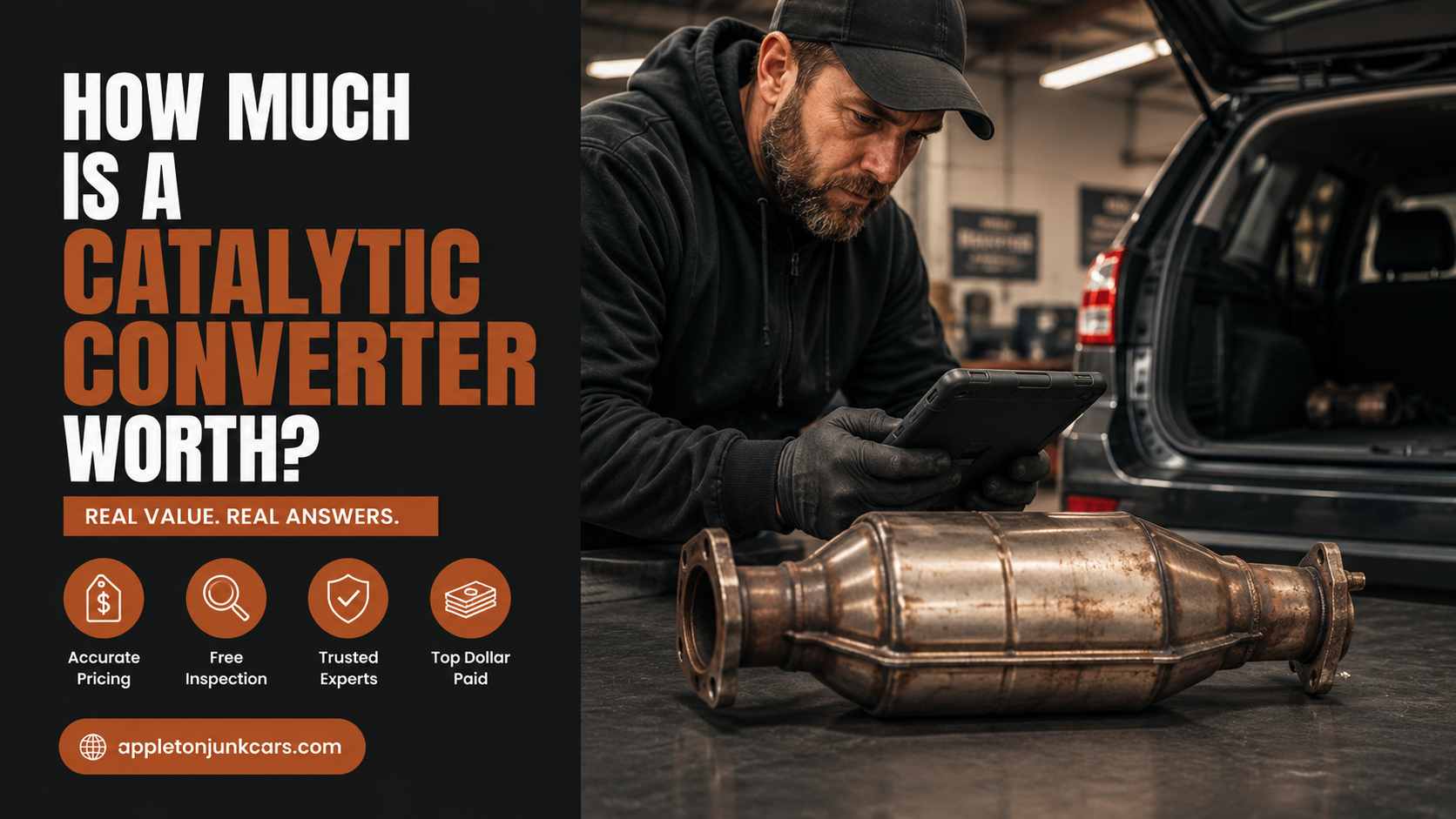
An average catalytic converter is worth between $50 and $450 in scrap value, though specialized or hybrid units can fetch up to $1,500 or more. The gap between those numbers is not random. It comes down to the exact precious metals inside the unit, whether it is original equipment or an aftermarket replacement, and which vehicle it came from. Understanding these factors is what separates a seller who walks away with fair value from one who accepts a lowball offer on something worth several hundred dollars.
What a Catalytic Converter Actually Is
The catalytic converter is the component in your vehicle’s exhaust system responsible for converting harmful engine emissions into less toxic gases before they exit the tailpipe. It sits between the engine and the muffler and handles hundreds of chemical reactions every minute the car is running.
What makes it valuable has nothing to do with the steel shell or the ceramic substrate inside. It is the thin coating of precious metals applied to that substrate that drives the price. These metals, called platinum group metals or PGMs, are among the rarest materials on Earth. They are mined primarily in South Africa and Russia, and their global supply is limited enough that the quantities found inside a single converter are genuinely worth recovering and refining.
When a car is scrapped or a converter is replaced, specialized recyclers extract these metals through a smelting and refining process and reintroduce them to the global commodities market. The price you receive for a converter is essentially the market’s estimate of how much platinum, palladium, and rhodium is inside yours, minus the refiner’s processing margin.
What Determines the Scrap Value
Precious Metal Content
The three precious metals found in catalytic converters each play a specific chemical role and each trades at its own price on global markets.
Platinum is a dense, corrosion-resistant metal that serves as a primary catalyst for oxidation reactions inside the converter. It has historically been the most well-known of the three. Platinum currently trades in the range of $900 to $1,100 per troy ounce, though this fluctuates with industrial demand, particularly from automotive manufacturers.
Palladium plays a similar catalytic role to platinum and has become increasingly important in modern gasoline engine converters as manufacturers shifted away from platinum in some designs. Palladium prices surged dramatically in 2020 through 2022, briefly exceeding $3,000 per troy ounce. Prices have since corrected to a range of roughly $800 to $1,100 per ounce as of current market conditions.
Rhodium is the rarest of the three and the most potent driver of converter value. It is used in smaller quantities than the other two metals but trades at prices that far exceed them. Rhodium hit a peak of nearly $29,000 per troy ounce in early 2021 before declining significantly. It still commands several thousand dollars per ounce, making even small quantities present in a converter meaningful.
Rhodium is exceptionally rare and drives the bulk of a high-value converter’s valuation. A converter that contains above-average rhodium content, which tends to be true of newer vehicles and hybrids, can be worth several times what a standard converter brings even if the physical units look identical from the outside.
The exact quantity of each metal varies by vehicle make, model, year, and whether the converter is a factory original or an aftermarket replacement. Scrap buyers and recyclers identify the specific metal content of a converter primarily through the serial number stamped on the unit, which references databases built from laboratory analysis of thousands of converter models.
OEM vs. Aftermarket
Original Equipment Manufacturer (OEM) parts hold the most value. Third-party aftermarket replacements often bring only $5 to $50 due to low metal quality. This is the single most important factor most sellers do not know about, and it is the reason why two converters from seemingly similar cars can have offers that differ by hundreds of dollars.
OEM converters are manufactured to the vehicle maker’s specifications and loaded with sufficient precious metals to meet original emissions performance standards and long service life requirements. Automakers like Toyota, Honda, and BMW invest in high-quality catalysts because their vehicles must pass emissions tests across dozens of markets for the full expected life of the car.
Aftermarket converters are manufactured to a lower standard and with significantly less precious metal content. They cost less to produce and less to buy when replacing a failed converter at a shop. But that lower metal content means they have far less scrap value. An aftermarket converter that replaced the original OEM unit on a car can easily bring $10 to $30 in scrap versus $200 to $600 for the original.
There is no reliable visual way to tell OEM from aftermarket at a glance. Aftermarket units sometimes look newer and cleaner than aged OEM units because they have fewer miles on them. The serial number is the only reliable identifier. Buyers who price converters by serial number rather than visual assessment will almost always give more accurate and competitive quotes.
Engine Type: Why Hybrids Command Premium Prices
Hybrid vehicle converters generally command premium prices. They require larger amounts of precious metals to handle the demanding conditions created by frequent engine cold-starts.
In a standard gasoline vehicle, the engine runs continuously once started and the catalytic converter quickly reaches its operating temperature, which is when it performs most efficiently. In a hybrid, the combustion engine cycles on and off repeatedly as the vehicle switches between battery and gasoline power. Every time the engine restarts from a cold or partially cooled state, the converter must handle a burst of unprocessed emissions before it reaches optimal temperature.
To maintain emissions compliance under these more demanding conditions, hybrid vehicle converters are engineered with higher concentrations of precious metals, particularly palladium and rhodium. This engineering decision, made for emissions performance reasons, is exactly what makes hybrid converters worth substantially more at the scrap yard. A Toyota Prius converter is the most commonly cited example, with values ranging from $300 to over $1,000 depending on the generation and condition.
Large trucks and SUVs with high-displacement engines also tend to produce converters with higher metal loading simply due to the volume of exhaust their engines generate. More exhaust requiring treatment means more catalyst is needed, which means more precious metal content.
Estimated Price Ranges by Manufacturer
Scrap yards and recyclers use the specific serial number stamped on the converter unit to reference daily market pricing databases. These databases reflect laboratory analysis of actual precious metal content for each converter model. The ranges below represent the broad market spread from the lowest-value units to the highest-value units within each manufacturer’s lineup.
The wide range within each manufacturer reflects how significantly converter value varies by model, year, engine type, and whether the unit is OEM or aftermarket. A Honda Civic converter and a Honda Odyssey converter will both appear in the Honda range but may be worth very different amounts. The serial number determines the specific value, not the brand name alone.
| Manufacturer | Scrap Price Range (Approximate) |
| BMW | $11 to $1,149 |
| Honda | $11 to $682 |
| Ford | $11 to $615 |
| Toyota | $11 to $578 |
| Chevrolet / GM | $11 to $462 |
These figures reflect current market data from scrap yard reference systems. Actual prices fluctuate daily based on platinum, palladium, and rhodium spot prices on global commodities exchanges. A converter that brings $400 today may be worth $350 or $450 next month depending on how those metals are trading.
The lowest figures in each range, the $11 values listed, typically represent aftermarket replacements with minimal precious metal content. The highest figures represent OEM units from premium or hybrid models within each manufacturer’s lineup with above-average metal loading.
How Scrap Yards Determine Your Specific Offer
When you bring a converter to a scrap yard or call for a quote, the buyer follows a specific process to determine what they will offer.
The first thing they look for is the serial number. This is a stamped code on the outside of the converter shell, typically five to ten characters, that identifies the specific model. They enter this into a database that returns the estimated precious metal content and the current market value of those metals at today’s spot prices, then apply their processing margin to arrive at an offer.
Some yards also use physical characteristics like size, weight, and the substrate density visible through the inlet or outlet to estimate value when the serial number is missing or illegible. This method is less accurate and typically produces more conservative offers because the buyer must account for uncertainty.
A buyer who prices your converter by serial number will almost always offer more than one who prices it visually. If the serial number on your converter is difficult to read, clean the area with a rag or wire brush before calling for quotes. A legible serial number is worth money.
Getting multiple quotes before selling is one of the most effective ways to increase what you receive. Offers for the same converter can vary significantly between buyers because different operations have different refinery relationships, processing margins, and current inventory needs. Three calls take about fifteen minutes and regularly produce a better outcome than accepting the first offer.
The Condition Factor: What Reduces the Offer
Not all converters in the same model range receive the top of the price range. Several conditions can reduce what a buyer offers for the same converter that might otherwise fetch a strong price.
Physical damage to the substrate. The ceramic honeycomb structure inside the converter is what the precious metals are coated on. If this structure has been broken, shaken apart, or cracked from overheating, impact, or engine backfires, the surface area for catalytic reaction is reduced and so is the effective precious metal recovery. A converter with a rattling interior is always worth less than an intact one.
Removed or missing substrate. Some people attempt to shake out or extract the ceramic substrate before selling the shell. This destroys most of the converter’s value. The precious metals are in the substrate coating, not in the steel housing. A gutted converter is worth only scrap steel value, typically a few dollars, not the converter’s actual PGM content.
Cut or torch marks. Converters removed by theft often show signs of cutting or torching. This can affect the structural integrity of the unit and may raise questions from buyers about the part’s provenance. Legal selling requirements vary by state but most require proof of ownership, which torch-marked converters sometimes complicate.
Aftermarket vs. OEM, as covered above. The single biggest downward driver of converter value is replacement with an aftermarket unit. If your car’s original converter was replaced with an aftermarket one at some point in its service history, the unit on the car now is likely worth a fraction of what the original would have been.
Key Requirements for Selling Legally
Laws around catalytic converter sales have tightened significantly in most states in response to the theft epidemic that peaked in 2021 and 2022. Before selling, confirm your state’s current requirements. Here is what most states now require.
- Verify Ownership. Scrap yards will ask for a matching vehicle title or current registration to confirm the converter came from a vehicle you own. A title in your name is the strongest proof of ownership. A current registration is generally accepted as well. Yards that do not ask for ownership documentation are not operating in compliance with most state laws and are best avoided.
- Provide Identification. You must present a government-issued photo ID to complete the transaction. Your ID is recorded alongside the transaction details in most states, creating an audit trail that allows law enforcement to trace converter transactions in the event of a theft investigation.
- Check Local Laws on Payment Method. Many states now ban cash payouts for catalytic converters entirely, requiring payment by physical check or bank transfer rather than cash. This restriction exists specifically to make it harder to fence stolen converters quickly. California, Illinois, Minnesota, and several other states have adopted payment restrictions. Check your state’s current rules before assuming you will receive cash at the sale.
Additional state-specific requirements may include waiting periods before payment is released, photographing the converter and the seller, or reporting converter transactions to local law enforcement within a set timeframe. A reputable buyer will know your state’s requirements and follow them as a matter of course.
If a buyer offers cash with no ID or title required and no paperwork at all, walk away. That buyer is not operating legally and any transaction with them creates risk for you.
Should You Sell the Converter Separately or With the Car?
This question comes up often when someone is preparing to junk a vehicle. The answer is not always the same.
If you are selling the car to a junk buyer, removing the converter beforehand can increase your total payout in some cases but reduce it in others. Many junk car buyers factor the converter into their whole-car offer. Removing it before calling for a quote means the offer for the car will be lower, and the amount you are offered separately for the converter may or may not make up the difference.
The general guidance: get a whole-car quote first with the converter in place. Then get a separate converter quote. Add the separate converter value to what the car would bring without it, and compare that total to the whole-car quote. The higher total is the right path.
For cars with high-value converters, particularly hybrids and certain premium vehicles, the separate sale often does produce a better total outcome. For standard passenger cars where the converter brings a modest amount, the simplicity of selling the car intact frequently wins on the math.
Frequently Asked Questions
How much is a catalytic converter worth at a scrap yard?
At a general scrap yard, most converters bring between $50 and $250. Specialized recyclers and precious metal processors who price by serial number typically offer more because they have direct relationships with refiners and can price more accurately on actual metal content.
How do I know if my converter is OEM or aftermarket?
The serial number is your best indicator. OEM converters have manufacturer part numbers that appear in specialized databases used by recyclers. Aftermarket converters typically have generic or non-matching codes, or no readable code at all. A buyer who specializes in converters can usually identify OEM from aftermarket quickly from a clear photo of the serial number.
Why are Prius catalytic converters worth so much?
Hybrid vehicles like the Toyota Prius require higher concentrations of precious metals in their converters to handle the emissions demands created by frequent cold-starts as the combustion engine cycles on and off. That higher metal loading translates directly into higher scrap value. Prius converters regularly bring $300 to over $1,000 depending on the generation, making them among the most valuable converters from any common vehicle.
Do catalytic converter prices change often?
Yes. Converter prices track the daily spot prices of platinum, palladium, and rhodium on commodities markets. These prices can move meaningfully week to week based on industrial demand, mining output, and currency movements. The value of your converter today may be different from its value in two weeks. Checking current PGM spot prices before calling for quotes helps you evaluate whether offers are reasonable.
Can I sell a catalytic converter without the car?
Yes, in most states. However, you must typically provide proof that the converter came from a vehicle you own, a vehicle title or registration being the standard documentation, along with a government-issued ID. States with cash payment restrictions will also require payment by check or bank transfer rather than cash. Check your specific state’s current requirements before selling.
What should I do if a buyer refuses to show me how they are pricing my converter?
Move on to another buyer. A transparent buyer will tell you what serial number they found on your converter, what database price it returned, and what their processing margin is. Opacity in the pricing process almost always means the offer is lower than it should be. Multiple quotes from different buyers, including at least one specialist recycler alongside a general scrap yard, is the best protection against underpayment.
The Bottom Line
A catalytic converter is worth between $50 and $450 for most vehicles, with hybrids and premium models pushing well above that. The gap between a $50 offer and a $500 offer on the same part often comes down to who you call, whether they price by serial number, and whether the unit is original equipment or an aftermarket replacement.
Know what you have. Find the serial number and make sure it is readable. Get quotes from at least two buyers, ideally including one that specializes in PGM recycling rather than general scrap. Follow your state’s documentation requirements to make sure the transaction is legal from your side. And if you are selling with the whole car, run the math both ways before deciding whether to remove it first.
The precious metals inside that unit are real and valuable. Getting a fair price for them takes thirty minutes of research and three phone calls. That is about as good a return on time as you will find anywhere.