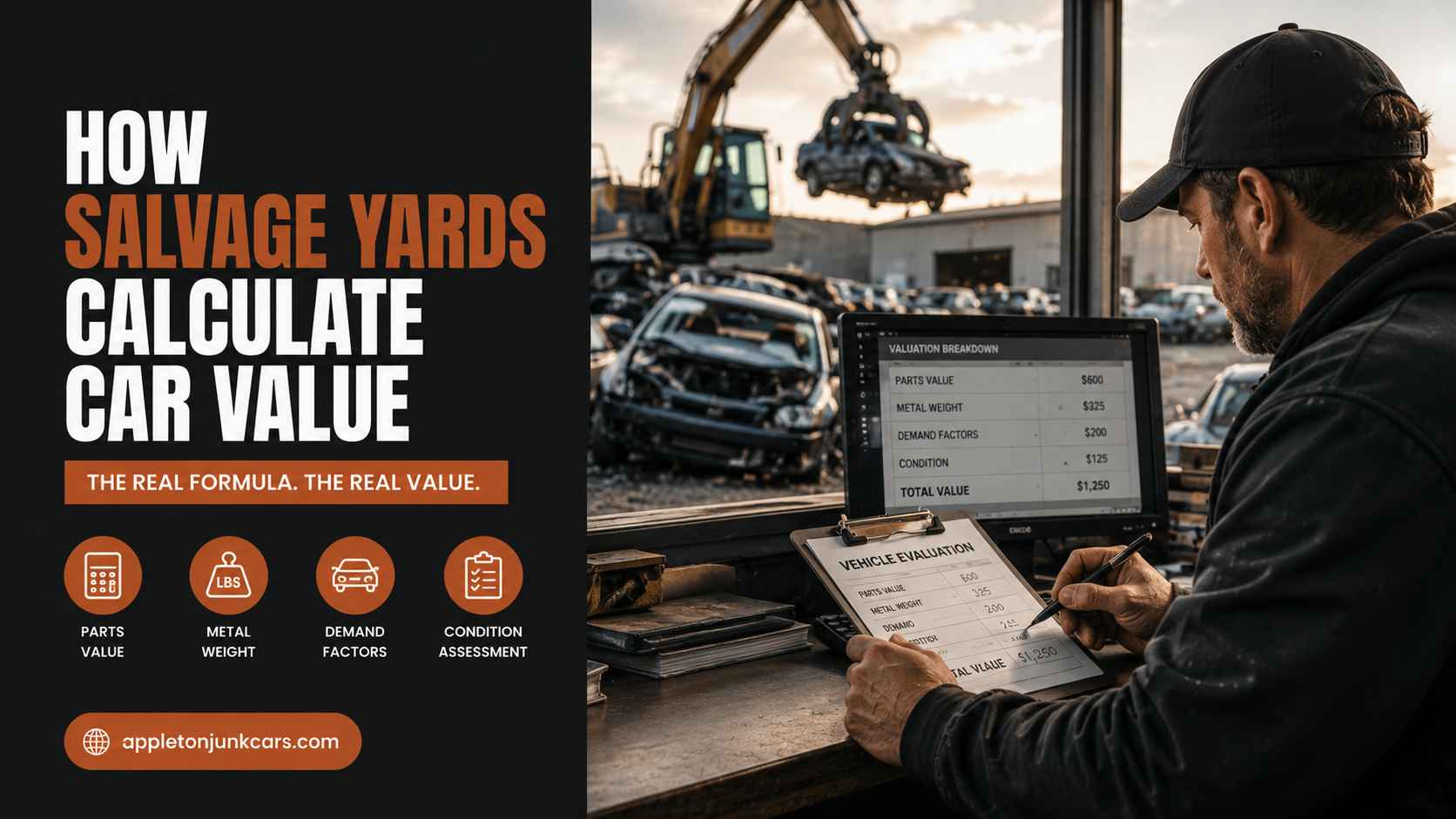
Salvage yards calculate car value using a two-part formula: the base scrap metal value of the vehicle’s weight at the current steel commodity price, plus individually priced additions for high-value components such as the catalytic converter, battery, and any parts with active buyer demand for that specific make and model. The final offer you receive is the sum of these two parts, adjusted downward for access difficulty, missing components, and fluid or structural conditions that increase the yard’s processing cost.
Most sellers accept whatever number a salvage yard quotes without understanding how it was calculated. Understanding the formula gives you the ability to evaluate whether a quote is accurate, identify what information to provide that increases the offer, and recognize when a buyer is pricing only one part of the formula and ignoring the other.
This guide explains every factor that goes into a salvage yard’s car valuation, how different types of buyers calculate value differently, and the specific steps that consistently produce higher offers.
The Base Metal Calculation: Weight Times Commodity Price
The foundation of every salvage yard offer is the vehicle’s weight converted to tons and multiplied by the current price per ton for shredded steel scrap. This number is the absolute floor: the minimum a vehicle is worth regardless of any other factor.
The calculation: Current shredded steel price (per ton) × vehicle weight in tons = base metal value
Example: A 3,500-pound midsize sedan weighs 1.75 tons. At a steel price of $180 per ton, the base metal value is $315.
Steel scrap prices fluctuate with global commodity markets and can range from $120 to $280 per ton depending on manufacturing demand, export volumes, and energy costs. The same car can be worth $80 more or less in base metal value depending on which month you call.
| Vehicle Type | Typical Weight | Base Metal Value at $180/ton |
|---|---|---|
| Subcompact or economy car | 2,400 to 3,000 lbs | $216 to $270 |
| Midsize sedan or hatchback | 3,000 to 3,800 lbs | $270 to $342 |
| Full-size sedan or wagon | 3,400 to 4,200 lbs | $306 to $378 |
| Compact SUV or crossover | 3,200 to 4,000 lbs | $288 to $360 |
| Full-size SUV (body-on-frame) | 4,500 to 6,000 lbs | $405 to $540 |
| Half-ton pickup truck | 4,200 to 5,500 lbs | $378 to $495 |
| Heavy-duty 1-ton truck | 5,500 to 7,500 lbs | $495 to $675 |
The Component Addition: What Gets Priced Separately From Steel Weight
The components that salvage yards price separately from steel weight are the ones whose market value, based on their specific material content, exceeds what they would contribute if they simply went into the shredder. These additions are where the difference between a low offer and a fair offer is made.
Catalytic Converter
The catalytic converter contains platinum, palladium, and rhodium: platinum-group metals with commodity values measured in dollars per gram. These metals are recovered by precious metal refiners who pay salvage yards a separate price for each converter based on the specific vehicle it came from.
Typical catalytic converter addition to a scrap offer: $50 to $600+
The variation is wide because converter size and precious metal loading varies significantly by engine size and manufacturer. A Toyota Prius converter contains more platinum-group metal than a small four-cylinder economy car converter and earns two to three times the scrap value.
The most important thing to know about the catalytic converter: never remove it before calling a buyer. Every legitimate buyer factors it into their whole-car offer. Removing it first reduces your total offer by more than its separate sale value in almost every case.
Lead-Acid Battery
The 12-volt battery is priced separately as a lead commodity. A standard car battery contains 18 to 22 pounds of lead at $0.20 to $0.40 per pound.
Typical battery addition: $8 to $20
High-Value Salvageable Parts (Make and Model Dependent)
For vehicles with active parts markets, a salvage buyer who recovers parts before shredding will offer more than a pure scrap buyer because they can sell individual components. This is the largest variable in the offer spread and the primary reason why two buyers with identical steel prices will quote very different numbers for the same car.
| Component | Parts Market Value Range | When a Salvage Yard Credits It |
|---|---|---|
| Engine (running, popular make) | $300 to $3,000 | When demand exists for that specific engine |
| Transmission (automatic, good condition) | $200 to $1,500 | Popular platforms with active repair demand |
| Catalytic converter (all vehicles) | $50 to $600+ | Always; priced on precious metal content |
| Wheels and tires (matching set, good condition) | $100 to $600 | OEM alloy wheels on desirable vehicles |
| Doors, fenders, body panels (undamaged) | $50 to $400 each | High-collision vehicles where panels are in demand |
| ECU / engine control module | $50 to $300 | Late-model vehicles; VIN-matched units |
How Different Types of Buyers Calculate Value Differently
Not every buyer who describes themselves as a salvage yard or junk car buyer uses the same formula. The type of buyer determines how much of the vehicle’s full value they capture and how much they pass on to you.
Pure Scrap Yards
Pure scrap yards buy vehicles for their metal weight only. They process everything through the shredder. Their offer is close to the base metal calculation plus the catalytic converter value. They do not credit parts market value for the engine, transmission, or body panels because they do not recover those components separately.
Best for: Very high-mileage, heavily damaged, or stripped vehicles where no parts have remaining buyer demand.
Auto Dismantlers and Parts Salvage Yards
Dismantlers remove and resell usable parts before shredding the remainder. Because they recover more value per vehicle, they can afford to offer more for the intact car. Their formula includes the base metal value, the catalytic converter, and a credit for parts they expect to recover and sell.
Best for: Popular makes and models with active repair markets: Honda, Toyota, Ford trucks, GM trucks, Chevrolet: where parts have consistent buyer demand.
National Junk Car Platforms
Online junk car buying platforms use algorithmic pricing that applies a formula across all makes and models. These platforms are efficient and fast but do not fully account for the parts premium that a specialist buyer for your specific make would apply.
Best for: Standard vehicles without significant specialty value. Less optimal for diesel trucks, European luxury vehicles, or vehicles with high-value specialty components.
What Reduces the Offer Below the Formula
Salvage yards adjust their formula downward for factors that increase their cost of processing the vehicle.
| Factor | Typical Offer Reduction | Why |
|---|---|---|
| Missing catalytic converter | $50 to $400 | Removes one of the highest-value additions from the formula |
| Non-running vehicle (if buyer expected running) | $50 to $200 | Increases towing and handling cost |
| Significant fluid leaks | $50 to $150 | Additional containment and cleanup cost |
| Location inaccessible to flatbed tow | $50 to $200 | Extended towing time and equipment |
| Fire damage | $100 to $300 | Limits parts recovery; additional processing time |
| Stripped interior or missing body panels | Variable | Reduces parts market credit; signals other missing components |
The most impactful reduction is a missing catalytic converter. Many salvage buyers specifically ask whether the converter is still on the car before giving a quote. A car with a confirmed intact converter consistently earns more than one where the buyer is uncertain.
How to Use the Formula to Get a Better Offer
Step 1: Establish the scrap floor. Look up current shredded steel prices at iScrapApp.com for your region. Multiply your vehicle’s approximate weight in tons by that price. Add $80 to $300 for the catalytic converter depending on your engine size. This is your floor.
Step 2: Identify your vehicle’s parts market strength. Search your year, make, model, and “engine” or “transmission” on eBay completed listings. If parts from your car sell regularly and for meaningful amounts, a dismantler will offer more than a scrap yard. Call make-specific salvage yards before calling general buyers.
Step 3: Get three competing quotes. Use every quote as leverage with subsequent buyers. A specific competing offer (“I have a quote of $X from another yard”) consistently produces better results than a general statement that you are shopping around.
Step 4: Confirm what is included. Before accepting any offer, confirm the catalytic converter and battery are included in the price. Some buyers quote without these components and add them as a separate item; others include them by default. Know which situation you are in before accepting.
Frequently Asked Questions
How do salvage yards determine the value of a junk car? Salvage yards calculate junk car value using the vehicle’s weight multiplied by the current scrap steel commodity price (the base metal value), plus separate pricing for the catalytic converter, battery, and any parts with active buyer demand. The base metal formula produces a number between $150 and $700 for most passenger vehicles. High-value components, particularly the catalytic converter, can add $50 to $600 or more depending on the vehicle.
Why do different salvage yards quote such different prices for the same car? Different buyer types use different formulas. A pure scrap yard prices on metal weight only. An auto dismantler who recovers parts before shredding credits the parts market value of the engine, transmission, and body components. A national online platform uses algorithmic pricing that may not capture the specialty value of your specific vehicle. Calling all three types produces a range that reveals the full market for your car.
Does the salvage yard pay more for a running car? Sometimes, but less than most sellers expect. A salvage buyer who prices on parts market value cares about the condition of specific components (engine, transmission, body panels) more than whether the car starts. A running car with a seized transmission earns less than a non-running car with a good transmission in most parts-market calculations. The exception is when the buyer plans to resell the vehicle as a driver, in which case running condition matters significantly.
What is the most valuable part of a car to a salvage yard? For most vehicles, the catalytic converter is the single most consistently valuable component when measured against its size and ease of removal. For vehicles with popular engines or transmissions, those drivetrain components may produce more value, but they require more labor to remove. The converter is priced separately on every vehicle regardless of running condition.
How often do steel prices change and how does that affect my junk car value? Steel scrap prices update daily in commodity markets and can shift by 20 to 40 percent over a single year. A car worth $400 in base metal value in a strong steel market may be worth $280 in a weak market. Check current prices at iScrapApp.com before any quote conversation to know where the market is and whether the offer you receive is consistent with current commodity pricing.
The Bottom Line
The salvage yard formula is not a mystery. It is weight times steel price, plus component additions, minus any factors that increase the buyer’s cost. Knowing this formula before the first call means you know exactly what inputs determine your offer, what information to provide to maximize it, and what a fair offer looks like for your specific vehicle in the current market.
The scrap floor is your baseline. The catalytic converter is always included in the offer from any legitimate buyer. The parts market premium: the difference between what a dismantler offers and what a scrap yard offers: is where the real money is for popular makes, and it is accessible with one additional phone call to a buyer who specializes in your vehicle type.