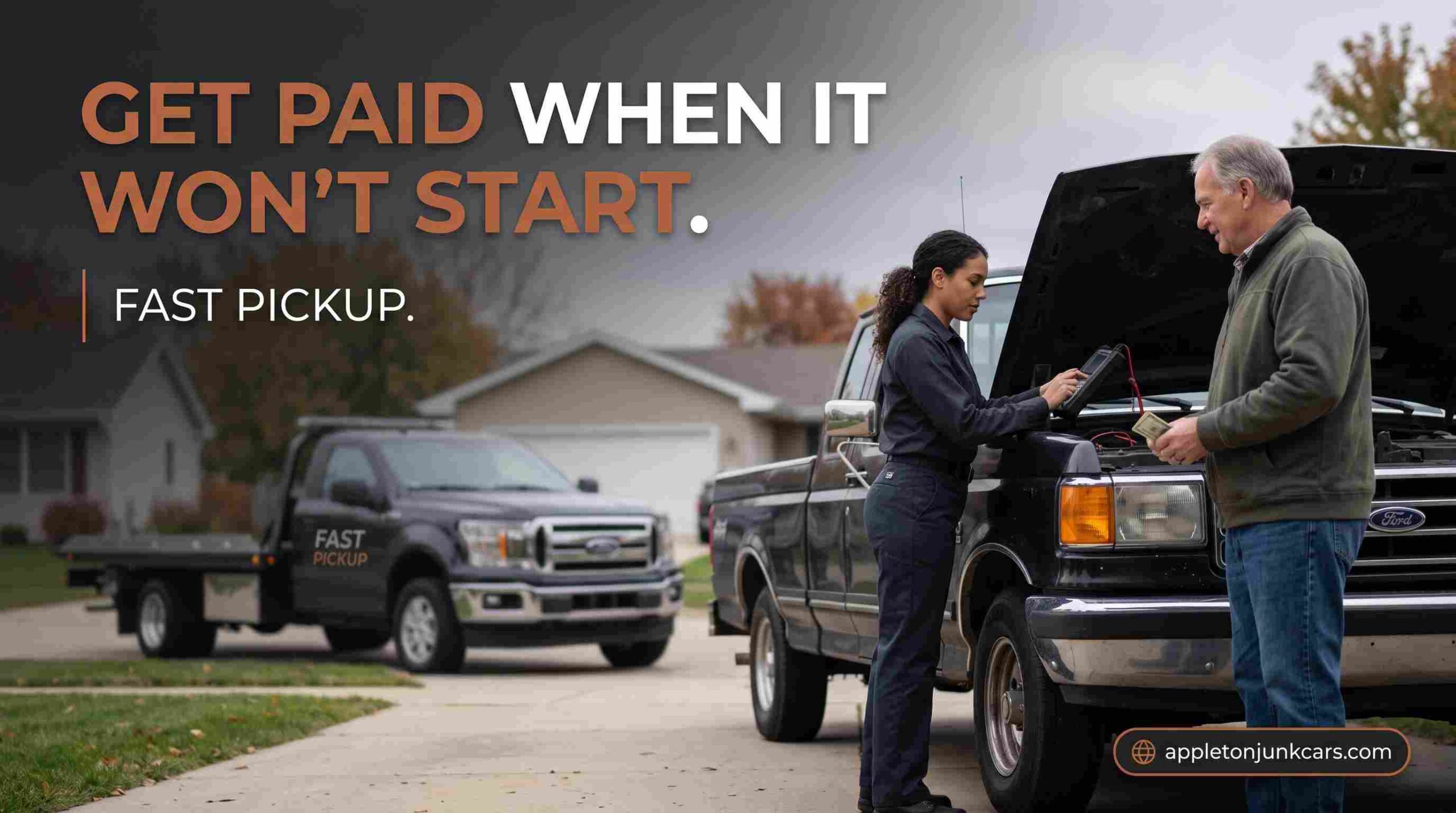
Yes, you can sell a car that won’t start. The car’s value drops compared to a running equivalent, but you still have real selling options, and several national buyers specifically specialize in non-running vehicles. The car does not need to move under its own power for any of the options below to work.
Here is everything you need: who buys it, what you need to prepare, how much to expect, and what to do first.
Who Will Buy a Car That Won’t Start
Instant online cash buyers
This is the most practical option for most people. Services like Peddle, Wheelzy, CarBrain, and CashForCars buy non-running vehicles as a core part of their business. You enter the vehicle details on their website, receive a guaranteed quote, and they send a flatbed tow truck to your location. Payment happens at pickup.
These buyers pay more than scrap yards because they evaluate the car as an asset with parts value, not just metal weight. A scrap yard might offer $200 for a car based on its steel weight. A buyer like Peddle or Wheelzy might offer $600 for the same car after pricing the catalytic converter, intact body panels, and working transmission. Free towing is included in all their offers.
Get quotes from at least three services before accepting any offer. The spread between the lowest and highest quote for the same non-running vehicle is typically $150 to $400. It takes under 15 minutes to get three quotes online and costs nothing.
Local salvage yards
Local junkyards and salvage yards accept non-running cars and typically include free towing for vehicles in their service area. Their offers range from $200 to $800 for most passenger cars, with heavier trucks and SUVs landing toward the higher end. They price primarily on scrap metal weight and the local demand for your model’s parts.
Call two or three yards before driving anywhere or agreeing to anything. Quote the vehicle over the phone (year, make, model, whether it cranks, and whether major parts are intact). Most yards will give you a number immediately. Compare those against an instant online buyer quote before you commit.
Private listing as a mechanic’s special
Facebook Marketplace and Craigslist have an active market for non-running project cars, engine-swap candidates, and parts donors. Tag the listing “mechanic’s special” or “parts car.” These terms signal to DIY buyers and flippers that the car needs work but has value.
This option takes more effort (writing a listing, taking photos, responding to messages, making yourself available for the buyer to come look at it) and more time (typically one to four weeks). It pays off for popular models in otherwise good condition. A 2015 Honda Civic that won’t start but has clean bodywork, a solid interior, and a recent transmission is genuinely worth more to a private buyer who can repair it than to a salvage yard pricing it for scrap.
Write the listing honestly. State exactly what the car does and does not do (example: “Cranks but won’t start, no other known issues”). Be specific about what works. Buyers will show up to inspect it, so accurate descriptions prevent wasted trips and protect you from post-sale complaints.
Charitable donation
Wheels for Wishes and Kars4Kids both accept non-running vehicles. They arrange free towing and send you an IRS tax deduction receipt equal to the car’s auction proceeds. This option makes sense when the car has minimal market value (likely under $500 in a private sale or from an instant buyer) and you itemize deductions on your tax return. If you take the standard deduction, the tax benefit does not apply and a cash sale is financially better.
Contact the organization directly before assuming they can take your specific vehicle. Some programs have geographic restrictions or minimum condition requirements.
Selling Options at a Glance
Selling Method | Typical Payout | Time to Close | Your Effort | Best Fit |
|---|---|---|---|---|
Instant online buyers (Peddle, Wheelzy, CarBrain) | $300 to $3,000+ | Same day to 48 hrs | Minimal | Best for most sellers. Free towing, cash at pickup, quotes in minutes. They price beyond scrap weight, so they consistently beat salvage yards. |
Local salvage yards | $200 to $800 | 1 to 3 days | Low | Easiest walk-in option. Pricing based on scrap weight and local parts demand. Call several yards to compare before committing. |
Private “mechanic’s special” listing (Facebook Marketplace, Craigslist) | Varies widely | 1 to 4 weeks | High | Best for popular, newer models in good shape besides the starting issue. Requires listing, photos, responding to buyers, and showing the car. |
Charitable donation (Wheels for Wishes, Kars4Kids) | Tax deduction only | 1 to 3 weeks | Low | Best when the car has minimal market value and you itemize tax deductions. They arrange free towing and send you an IRS receipt. |
What to Have Ready Before Anyone Shows Up
Your title
A clean title in your name is what most buyers require. Without it, some buyers will still make an offer, but they will deduct roughly $150 to $200 from the payout to cover the additional paperwork involved in clearing the title. If your title is lost, a replacement costs $15 to $50 at your state DMV and takes days to a few weeks. For vehicles with significant value, the replacement is worth getting before you sell. For low-value cars, selling without the title and taking the deduction may be faster.
A cleared loan
If there is an active loan on the vehicle, the lender has an interest in the title and the car legally cannot be sold without their involvement. Confirm the loan is fully paid off and request a lien release letter from the lender. If the loan is still active and the car’s value is less than the payoff amount, contact the lender directly to discuss options. Most licensed junk car buyers will not process a vehicle with an active lien without the lienholder’s written authorization.
An as-is bill of sale
For any private sale, draft a bill of sale that explicitly states the vehicle is “sold as-is, non-running, with no warranties expressed or implied.” Have both parties sign it. Both keep a copy. This is your legal protection against a buyer returning months later to claim you misrepresented the vehicle’s condition. Most state DMV websites offer free bill of sale templates that meet local legal requirements. Download your state’s version.
Your personal items removed
Check every compartment before the tow truck arrives: glove box, center console, door pockets, under the seats, and the trunk. This includes any garage door opener, EZPass or toll transponder, dashcam, chargers, and any documents with personal information. Once the car leaves, retrieving anything left inside is not possible.
How Much You Will Actually Get
Most non-running cars sell for $200 to $1,500 through instant buyers and salvage yards combined. The range is wide because several specific factors move the number significantly:
- Vehicle size and weight: Heavier vehicles (pickup trucks, full-size SUVs, vans) have a higher scrap floor than compact sedans. A non-running Ford F-150 brings more than a non-running Honda Fit by weight alone.
- Whether the car cranks: A car that cranks but won’t start (the engine turns over but does not fire) is worth more than a completely dead car that does nothing when you turn the key. A car that cranks likely has its major mechanical components intact, which buyers view more favorably.
- Catalytic converter present: The converter is one of the most valuable components on the car. An intact catalytic converter adds $100 to $600 to a buyer’s internal valuation depending on the vehicle. If it has been cut off or stolen, the offer drops by that amount.
- Completeness: Every missing major component reduces the offer. An engine that has been pulled, a transmission that is gone, or a missing battery all result in direct deductions. Sell the car complete.
- Model demand: Popular models with active used parts markets (Honda Civic, Toyota Camry, Ford F-150, Chevy Silverado) get better offers than obscure or low-demand models because buyers have a ready market for the parts.
- Location: Urban markets with more competing buyers pay more than rural areas. Scrap metal prices also vary regionally.
Real transaction data from 2026: non-running cars with all parts intact average $300 to $800. Trucks and SUVs average higher. Stripped or very old cars with minimal parts demand may land below $300. Getting three competing quotes before selling is the single most reliable way to find the top of the range for your specific vehicle.
A Few Things That Matter More Than Most People Realize
Cranks vs. completely dead
When a buyer asks “does it start,” they are really asking two things: does the engine turn over when you turn the key, and does it actually fire and run. These are different. A car that cranks (you hear the starter motor turning the engine) but does not fire usually means a fuel, ignition, or sensor problem. The engine itself is likely fine. A car that does nothing at all when you turn the key may have a dead battery, a failed starter, or a seized engine. These scenarios get priced differently. If your car cranks but will not fire, say that specifically on the quote request. If it is truly completely dead, describe that instead. Accuracy gets you an accurate quote.
Leave the car complete
Do not remove the battery, catalytic converter, wheels, or any other component before calling for quotes. Sell the car whole. Buyers price the complete vehicle as a package. Removing parts before the sale drops the offer by more than the removed parts would be worth if sold separately. This is covered in full in the “What to Remove Before Junking” article in this series.
What Quietly Reduces Your Payout
- Calling only one buyer: The first quote you receive is rarely the best. The spread between the lowest and highest offer for the same non-running car is typically $150 to $400. Compare at least three before accepting anything.
- Describing the car vaguely: “Has some issues” tells a buyer nothing. “Cranks but won’t start, catalytic converter intact, transmission shifts in neutral, all four windows work” tells them something useful. The more specific you are, the more accurate the quote. Vague descriptions produce conservative offers.
- Assuming Carvana or CarMax will help: Both platforms focus on retail-ready vehicles they can resell. They do not buy cars that won’t start. Do not waste time there.
- Not confirming towing is free: Most instant buyers and salvage yards include free towing. Some charge it separately and deduct it from the payout. Always confirm “is towing included in the offer?” before scheduling pickup.
- Signing over the title before receiving payment: Have cash or a certified check in hand before you sign anything. This sequence is non-negotiable.
Questions People Ask When Their Car Won’t Start
Does the car need to be in my driveway to be picked up?
No. Flatbed tow trucks can access cars in garages, parking lots, and tight driveways. If the car is in an unusual location (on a lift at a mechanic, in a storage lot), tell the buyer when you call so they can send the right equipment.
Can I sell it without the title?
Some buyers (particularly Peddle and some salvage yards) accept cars without titles under certain conditions, usually for older vehicles or when the car is going straight to scrap. You will receive a lower offer, typically $150 to $200 less, because the buyer takes on additional legal processing. Getting a replacement title from your state DMV costs $15 to $50 and usually adds more than that back to your payout.
What if I still owe money on the car?
The lender holds an interest in the vehicle until the loan is paid off. You cannot legally sell the car without their involvement. If the loan is paid but the lien was not released on the title, contact the lender and request a lien release letter. If the loan is still active and the car is worth less than what you owe, talk to the lender before contacting buyers. They may participate in a short sale.
Will anyone buy a car with a dead battery?
Yes. A dead battery is one of the most common reasons cars won’t start and is not treated the same as a seized engine. Tell buyers the car has a dead battery and cannot be started but is otherwise complete. They price this situation routinely. Do not let a dead battery make you assume the car has no value.
How do I know the quote is real and won’t be lowered at pickup?
Get the quote in writing, by email or through the buyer’s online portal, before scheduling a pickup. Reputable services like Peddle and Wheelzy lock in their offers for a set period (typically 7 days). If a driver shows up and offers significantly less than the confirmed quote with no legitimate reason, you can decline and call the next buyer on your list.
Should I fix it before selling?
Run the math first. Get a repair estimate from a mechanic and compare it to what a buyer would offer for the car fixed versus non-running. If the repair costs $500 and the car is worth $2,000 fixed but $600 non-running, fixing it nets you an extra $900 and may be worth it. If the repair costs $3,000 and the car is worth $4,500 fixed but $800 non-running, you spend $3,000 to gain $2,700, which is a net loss. For most cars that won’t start due to significant mechanical failure, selling as-is is the financially better decision.
Can I sell it if the car is in someone else’s name?
Not without their legal authorization. The title must be in your name, or the named owner must provide a notarized power of attorney authorizing you to sell on their behalf. If the registered owner is deceased, the vehicle typically needs to go through estate proceedings. Contact your state DMV for the specific process.
What to Do Next
- Run the VIN. Go to vehiclehistory.gov or a similar NMVTIS-connected portal and check the title status. Confirm there are no active liens showing on the record.
- Get three quotes today. Go to Peddle.com, Wheelzy.com, and CarBrain.com. Enter your vehicle details and the non-running status honestly. Note all three offers.
- Call two local salvage yards. Give them the same details by phone and compare their numbers to the online offers.
- Take the highest legitimate offer. Confirm that towing is included and that the offer is locked in writing for the pickup window. Schedule pickup.
- Prepare the car. Remove all personal items, the toll transponder, the garage door opener, and any documents. Have the signed title ready.
- At pickup, receive payment before signing the title. Sign the bill of sale if selling privately. File a Notice of Transfer with your state DMV the same day.
Wrapping Up: How to Sell a Car That Won’t Start
A car that won’t start is not a car without value. The buyers listed here purchase these vehicles daily. The main difference between a good outcome and a poor one is getting multiple quotes before saying yes to the first offer that shows up.