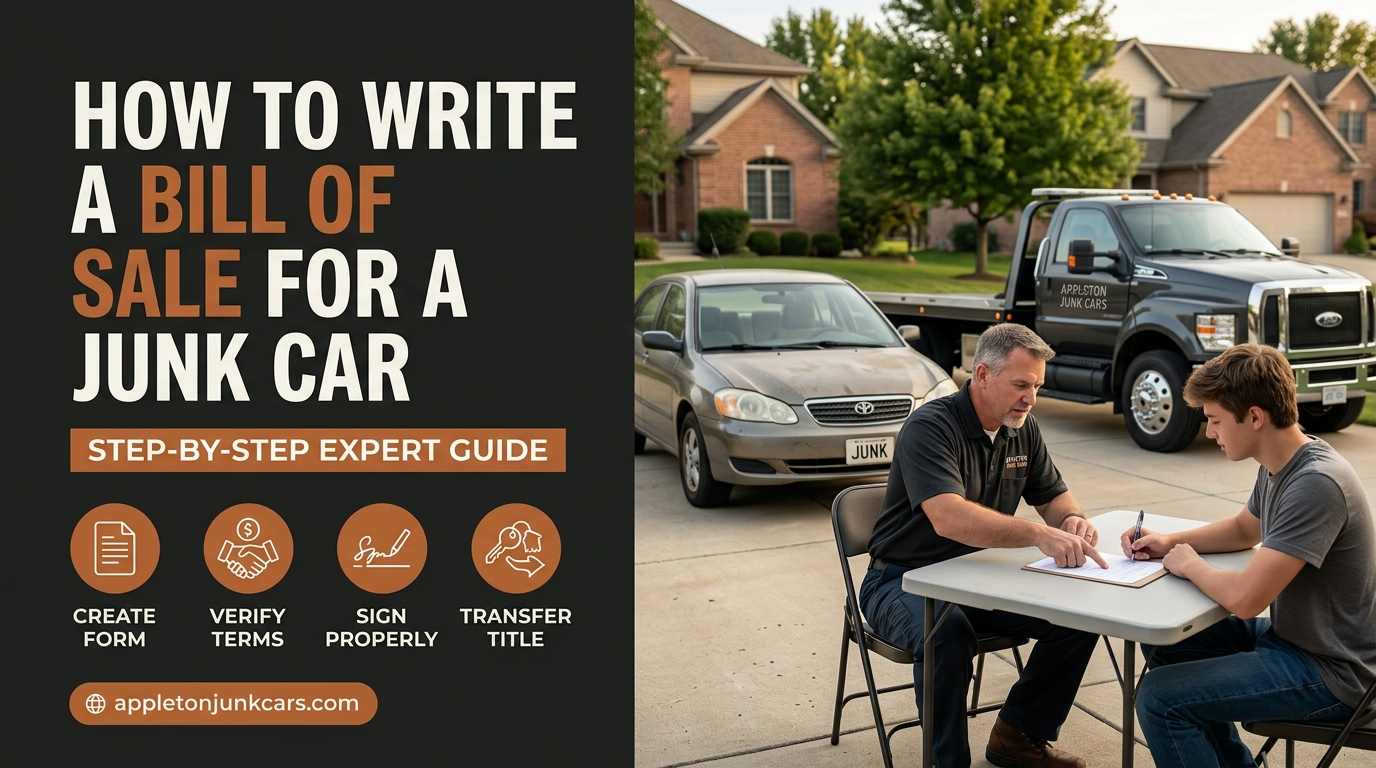
You have agreed on a price. The buyer is coming tomorrow. Now you need the paperwork that makes the transaction legal, protects you from any claim related to the vehicle after it leaves your property, and gives the buyer what they need to process the title transfer.
To write a bill of sale for a junk car, you must include specific identification details and an as-is clause to protect yourself from future liability. You can use a standard paper template or type it out. Keep in mind that some jurisdictions require specific official local forms, so always verify your local DMV requirements before finalizing the document. Many states accept a private bill of sale for junk car transactions, especially when the vehicle is being sold to a salvage yard or junk buyer rather than being retitled for road use.
This guide covers every required component, explains why each one matters, and includes a complete sample template you can fill out immediately.
Why a Bill of Sale Matters for a Junk Car
A junk car sale can feel informal: someone hands you cash, you hand them the car. But without a signed bill of sale, you remain legally exposed to anything that happens with that vehicle after the transaction. If the buyer drags the car to a location and leaves it, the local authority may trace it back to you. If the salvage yard delays processing the title and the car accumulates parking tickets in the meantime, those tickets may come back to you. If there is any dispute about what was agreed to, you have no documentation.
The bill of sale is the document that establishes the date the vehicle changed hands, the price that was paid, the exact vehicle involved, and the agreement that the buyer accepts the car in its current condition. For junk car transactions in particular, the as-is clause in the bill of sale is the language that prevents a buyer from coming back to you weeks later claiming the car was not what you said it was.
Keep one signed copy for yourself and provide one to the buyer. Some states also require the seller to file a release of liability or a notice of transfer with the DMV, which is a separate step from the bill of sale itself. Check your state’s requirements for both documents.
Required Components to Include
Every bill of sale for a junk car transaction should contain the following elements. Missing any of these reduces the document’s legal value and may cause problems at the DMV when the buyer attempts to process the title.
Contact Information
Write the full legal names, physical addresses, and phone numbers of both the buyer and the seller. Full legal name means the name exactly as it appears on a government-issued ID, not a nickname or abbreviation. If the vehicle is owned by two people, both names should appear as sellers. If the buyer is a business, use the full legal business name rather than a trade name.
Contact information serves two practical purposes: it identifies the parties to the transaction clearly, and it provides a way to reach both parties if a question comes up after the sale. A buyer who cannot be identified by name and address cannot be held accountable for what happens to the vehicle after purchase.
Vehicle Identifiers
Record the year, make, model, body style, and color. Be specific. A 2010 Ford F-150 SuperCrew Cab, white is more useful than a 2010 Ford truck. Body style, in particular, distinguishes between sedan, coupe, pickup, SUV, hatchback, and similar variations that affect which title the state issues.
Vehicle Identification Number
Copy the 17-digit VIN exactly as it appears on the dashboard or driver’s door jamb. The VIN is the unique fingerprint of the vehicle and is the primary identifier used by the DMV, law enforcement, and vehicle history services. A single transposed digit renders the VIN incorrect and can cause the buyer’s title transfer to be rejected.
The dashboard VIN is visible through the windshield at the base of the driver’s side dash. The door jamb VIN is on a sticker inside the driver’s door frame. Both should match. If they do not, that is a significant red flag worth investigating before the sale.
Odometer Reading
State the exact mileage as shown on the odometer at the time of sale. If the odometer is not functioning, note this specifically: Odometer is non-functional or Actual mileage is unknown. If the odometer has rolled over or you know it has been replaced, note that as well. Federal odometer disclosure law requires accurate reporting or a specific disclosure when the reading is not reliable, even for junk vehicles being sold for parts.
Transaction Details
List the final purchase price written in both numerals and words. For example: $450 (Four Hundred Fifty Dollars). Writing the amount in words alongside the numbers prevents any alteration of the written figure after the fact. Record the exact date of sale, which is the date the vehicle physically changes possession and the payment is made.
As-Is Liability Clause
This is the most important protective language in a junk car bill of sale. Include explicit text stating that the vehicle is sold in its current condition with no warranties of any kind.
Recommended language: “The vehicle is sold as-is, where-is, with all faults, and without any warranties or guarantees, express or implied. The seller makes no representations about the vehicle’s mechanical condition, safety, or fitness for any particular purpose. The buyer assumes all risk and responsibility for the vehicle from the date of sale forward.”
This clause is what prevents a buyer from returning to you claiming the engine blew up on the way home, that the car had undisclosed rust, or that something was missing. For a junk car transaction, this language is not optional. It is the central legal protection the bill of sale provides.
Signatures and Date
Both parties must sign and date the document. Without both signatures, the bill of sale is not a legally binding agreement. Both parties should initial each page if the document spans more than one page. If any corrections are made to the document, both parties should initial next to the correction.
Some states require the signatures to be notarized. This requirement is more common for vehicle sales involving a title transfer than for junk car transactions, but check your state’s requirements to be certain.
The Complete Sample Bill of Sale Template
The following template includes all required components. Fill it out completely and print two copies: one for you and one for the buyer. Both parties should sign both copies.
MOTOR VEHICLE BILL OF SALE
(JUNK / AS-IS CONDITION)
| Date of Sale: | ______________________________ |
| Purchase Price: | $______________ (__________________________________ Dollars) |
SELLER INFORMATION
| Full Legal Name: | ______________________________ |
| Address: | ______________________________ |
| City, State, ZIP: | ______________________________ |
| Phone Number: | ______________________________ |
BUYER INFORMATION
| Full Legal Name: | ______________________________ |
| Address: | ______________________________ |
| City, State, ZIP: | ______________________________ |
| Phone Number: | ______________________________ |
VEHICLE DESCRIPTION
| Year: | ______________________________ |
| Make: | ______________________________ |
| Model: | ______________________________ |
| Body Style: | ______________________________ |
| Color: | ______________________________ |
| VIN (17 digits): | ______________________________ |
| Odometer Reading: | ______________ Miles (check one: Actual / Not Actual / Odometer Inoperable) |
DISCLOSURE AND AS-IS WARRANTY WAIVER
The Seller certifies that they are the legal owner of this vehicle and that the vehicle is free of all liens and encumbrances to the best of their knowledge, unless otherwise disclosed in writing on this document. The Buyer agrees that this vehicle is purchased in “AS-IS, WHERE-IS” condition, with all faults present and known or unknown, and with no warranties, express or implied, including but not limited to any warranty of merchantability or fitness for a particular purpose. The Buyer assumes full responsibility for the vehicle, including all costs of transportation, storage, processing, and disposal, from the date of this sale forward. The Seller shall have no further liability for this vehicle after the date of sale.
SIGNATURES
| Seller Signature: | ___________________________ Date: ___________ |
| Seller Printed Name: | ______________________________ |
| Buyer Signature: | ___________________________ Date: ___________ |
| Buyer Printed Name: | ______________________________ |
Before You Finalize: Three Questions to Answer
The template above covers the universal requirements. But three factors specific to your transaction may require additional steps or language. Answer each one before you print and sign the document.
What State or Province Are You In?
Some states require their own official bill of sale form rather than a private document. Texas, for example, has a specific Form 130-U for vehicle title transfers. California has its own disclosure requirements. Florida requires specific language for as-is vehicle sales. A few states require notarized signatures even for junk vehicle transactions.
Before using the template above, check your state DMV’s website for any specific bill of sale form requirements, required language, or notarization rules. If your state has an official form, use it. If your state accepts a private bill of sale, the template above covers all standard requirements.
Are You Selling to a Private Buyer or a Commercial Salvage Yard?
Selling to a licensed junk car buyer or commercial salvage yard often involves the yard’s own paperwork in addition to a bill of sale. Many salvage operations have their own purchase agreements and lien waiver documents that they will have you sign at the time of pickup. These do not replace the bill of sale but supplement it.
If you are selling to a private individual who will then scrap the car themselves, the bill of sale is your primary protective document and should be as complete as possible. If you are selling to a commercial operation, ask upfront what paperwork they require so you have everything ready at pickup.
Do You Have the Physical Vehicle Title in Hand?
A bill of sale and a title are two separate documents that serve different purposes. The bill of sale records the transaction between the two parties. The title is the government document that formally transfers ownership in the state’s records.
For most junk car sales, both documents are needed. The buyer needs the bill of sale to document the transaction and the signed title to present to the DMV or to process the vehicle through their salvage operation. If you do not have the title, apply for a duplicate through your state DMV before finalizing the sale. Some buyers will complete a junk car purchase without a title for older vehicles or in states with flexible requirements, but having the title in hand always produces a cleaner, more defensible transaction.
If you have the title but there is an outstanding lien on it, the lienholder’s name appears on the title and must sign off before you can transfer ownership. Selling a vehicle with a lien you have not disclosed or resolved is fraud in most states.
What Happens After the Bill of Sale Is Signed
Once both parties have signed the bill of sale and the transaction is complete, each party has specific remaining obligations.
The seller should:
- Keep a signed copy of the bill of sale permanently. Even after the title is transferred and the car is long gone, the bill of sale is your proof of the date and terms of the sale if any question ever arises.
- File a release of liability or notice of transfer with your state DMV, if required. This step removes the vehicle from your name in the state’s records as of the sale date. Without it, your name may remain attached to the vehicle’s registration until the buyer processes the title.
- Cancel your insurance on the vehicle after confirming the sale is complete. Contact your insurer to remove the vehicle from your policy and request any applicable refund on unused premium.
The buyer should:
- Process the title transfer with the state DMV using the signed title and the bill of sale. For junk car buyers and salvage operations, this typically means submitting paperwork to the state within the required window, usually 10 to 30 days depending on the state.
- Keep their copy of the bill of sale as documentation of the transaction, the purchase price, and the as-is agreement.
Common Mistakes That Weaken a Junk Car Bill of Sale
Leaving the VIN blank or copying it incorrectly. The VIN is the single most important identifier in the document. An incorrect VIN can cause the title transfer to fail and may leave the sale legally uncertain. Verify the VIN from the physical vehicle rather than from memory or a previous document.
Omitting the as-is clause or using vague language. A bill of sale that says sold in current condition without explicit no-warranty language is weaker protection than one using the specific as-is, where-is phrasing. Be explicit. The more clearly the clause states that no warranties exist, the harder it is for a buyer to claim they were promised something that was not delivered.
Not getting the buyer’s signature. A seller-only signed bill of sale is a statement of your intent, not a binding agreement. Both parties must sign for the document to be a contract. Do not release the vehicle without the buyer’s signature on the bill of sale.
Using an amount that does not match the payment received. The purchase price on the bill of sale should match the actual amount exchanged. Some people are tempted to understate the price to reduce transfer taxes. This creates a legal discrepancy between the bill of sale and the actual transaction and can cause problems if the sale is ever reviewed.
Forgetting to keep a copy. One of the most common situations people regret is not retaining their own copy of the bill of sale. Print two, sign both, and keep one. If the buyer ever claims the sale did not happen, that you still own the car, or that different terms were agreed to, your signed copy is your evidence.
Frequently Asked Questions
Is a bill of sale required to sell a junk car?
It depends on the state. Some states require a bill of sale as part of any vehicle transfer. Others do not require it separately but it is always strongly recommended. Even where not legally required, a signed bill of sale is your protection against any future claim tied to the vehicle. For junk car transactions specifically, the as-is clause in the bill of sale is the primary document preventing a buyer from holding you responsible for the car’s condition after the sale.
Can I write a bill of sale by hand?
Yes. A handwritten bill of sale is legally valid as long as it contains all required information, is signed by both parties, and meets any state-specific requirements. Print clearly, use blue or black ink, and make sure every field is legible. If you have access to a printer, a typed document is easier to read and less likely to have legibility disputes, but it is not legally required.
Do I need a notary for a junk car bill of sale?
In most states, no. Notarization of a vehicle bill of sale is required in some states for clean-title transactions but is not typically required for junk car sales. Check your specific state’s requirements. If a notary is required, banks and UPS stores often offer notary services for a small fee.
What if I sold the car but the buyer never transferred the title?
This is exactly why filing a release of liability with your state DMV matters. If the buyer never transfers the title, your name may remain on record as the owner. Registration renewals, parking tickets, and toll violations tied to the vehicle can then come back to you. Filing the release of liability establishes in the state’s records that you no longer owned the vehicle as of the sale date. Your signed bill of sale supports this position if it is ever challenged.
What if I do not have the title but the buyer wants a bill of sale?
You can provide a bill of sale without a title, but be transparent with the buyer about the missing title. Apply for a duplicate title through your state DMV. Many junk buyers will proceed with a bill of sale alone for older vehicles, but the process for them is more complicated without a title. Some states have specific procedures for title-less transfers of older vehicles.
Does the as-is clause protect me from everything?
An as-is clause strongly limits your liability for the vehicle’s condition after the sale. It does not protect you if you knowingly misrepresented material facts about the vehicle. For example, if you told the buyer the car ran fine when you knew the engine was seized, the as-is clause does not protect against a fraud claim. The clause protects against undisclosed defects the buyer assumes when buying in as-is condition. It does not protect against active deception.
The Bottom Line
Writing a bill of sale for a junk car takes about ten minutes with the right template. The document you produce in those ten minutes protects you from liability for months or years after the car is gone.
Fill out every field completely. Copy the VIN exactly. Include the as-is clause with explicit no-warranty language. Get both signatures. Keep your copy. File the release of liability with your DMV if your state requires it.
The car is gone. The bill of sale is your proof that you handled the transaction correctly and that whatever happens with the vehicle next is someone else’s responsibility. That protection is worth the ten minutes.