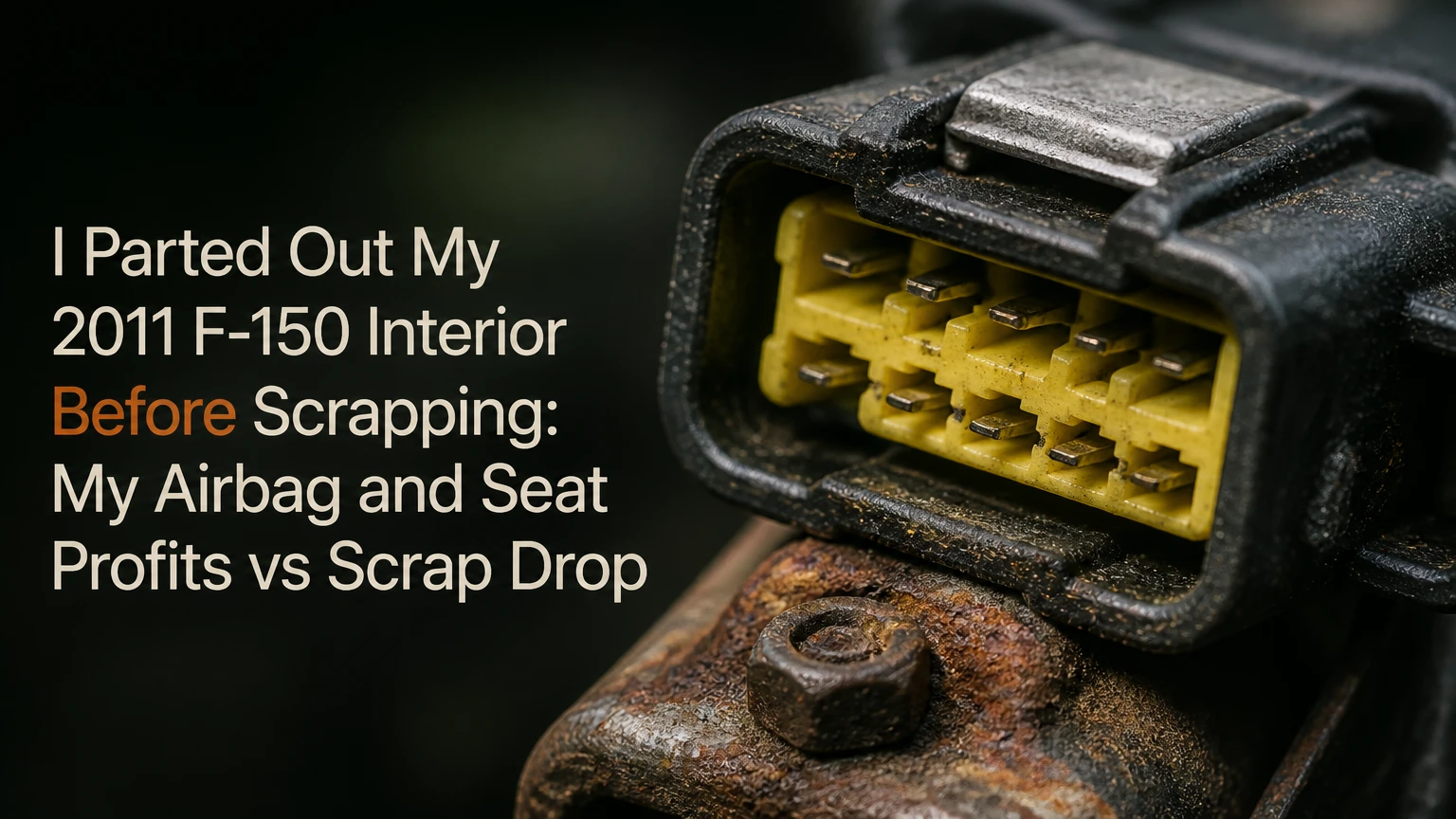
The frame was done. I knew it when I put a screwdriver into the left rear rail and it went in without much resistance. The 2011 F-150 SuperCrew XLT had 188,000 miles and had spent its whole life in Michigan, and Michigan had done what Michigan does to truck frames. The body was fine. The 5.0L Coyote was fine. The interior was genuinely clean for the age. But the frame had gone past the point where I was willing to drive it, and a truck with a compromised frame is not a truck you sell to a private buyer without that conversation getting complicated.
So it was going to scrap. The question was whether it was going to scrap the way I found it or the way I decided to leave it.
The Phone Call That Changed the Plan
I called a friend who buys and flips trucks before I called any junkyard. I told him the situation. He asked me one question: “Did you pull the airbags yet?” I had not thought about the airbags. I had not thought about the seats either, or the radio, or the center console. I was thinking about it as a truck that was going to a yard, not as a truck that was going to a yard after I took the valuable parts out of it first.
He told me that driver airbags for the 2011 through 2014 F-150 were selling on Facebook Marketplace for $120 to $180, and passenger airbags for $90 to $140, because so many of those trucks were still on the road and airbag replacements were common after minor accidents. The SuperCrew rear bench seat, the 60/40 fold-up with the integrated cup holders, was a frequent search item because people were upgrading from regular cab trucks. He said a clean set could go for $150 to $220.
I spent the rest of that day looking at Facebook Marketplace and Craigslist. He was not wrong.
What I Pulled and What Each Part Sold For | 2011 F-150
I gave myself one week to list and sell before I called the yard. I pulled everything I thought had realistic demand and left the rest. I did not try to strip the truck down to a shell. I was not running a parts operation. I was just trying to recover value from the pieces that had a real secondary market before they went into a crusher.
Part | Condition | Listed Price ($) | Sold Price ($) | Days to Sell | Buyer |
|---|---|---|---|---|---|
Driver airbag (steering wheel module) | Undeployed, original, confirmed with scan tool | $160 | $145 | 4 | Body shop sourcing stock for a repair |
Passenger airbag (dash module) | Undeployed, original | $135 | $120 | 4 | Same body shop, bought both |
Rear bench seat (60/40 fold-up, cloth) | Clean, no rips or stains, all hardware intact | $210 | $195 | 2 | Private owner upgrading from regular cab |
Driver front seat (power, cloth) | Normal wear, tracks working, lumbar functional | $125 | $110 | 6 | Private owner matching a replacement |
Center console with armrest and lid | Good condition, latch working, cupholder intact | $75 | $65 | 8 | Guy building a crew cab from two donor trucks |
Factory SYNC radio (8-inch MyFord Touch) | Working, all functions confirmed before removal | $95 | $85 | 5 | Private owner whose screen cracked |
Sun visors (pair, with lights and mirrors) | Good condition | $20 | $15 | 11 | Not worth the listing time, honestly |
Total from parts: $735. The sun visors I would skip next time. Eleven days for $15 is not a good use of listing energy. Everything else moved inside a week at prices close to what I had listed.
The Airbag Pull Took More Caution Than I Expected
I want to be specific about this because I almost skipped it based on a vague worry about setting one off. The procedure on the F-150 is not complicated but it is not casual either. You disconnect the battery at the negative terminal and wait 15 minutes before touching any airbag component. This is the capacitor discharge window. The airbag system has a backup capacitor that holds enough charge to deploy a bag even with the battery disconnected, and 15 minutes is the Ford-specified wait time to let it drain.
After the wait, the driver airbag comes out with a T40 Torx on two mounting bolts through the steering wheel back side, then a flat connector release on the clockspring harness. The passenger bag is more involved: glove box removal, three bolts on the airbag mounting bracket behind the dash, one harness connector. Total time for both: about 45 minutes if you have not done it before. I used the Ford workshop manual procedure from the 2011 F-150 service PDF, which walks through it step by step.
I photographed both airbag modules with a scan tool confirmation showing no airbag DTCs and the module serial numbers visible. The body shop buyer asked for exactly that proof before purchasing. Without it, they would not have bought from a private seller.
Image placeholder: photo of 2011 F-150 driver airbag module removed and placed on clean shop towel, scan tool display visible in background showing 0 airbag fault codes, module serial number sticker visible on the airbag housing face, no deployment damage visible on any surface
What the Yard Did When They Saw the Stripped Cabin
I called the yard after the parts sold. I got a quote of $960 for the stripped truck. The quote I had gotten two weeks earlier, before any pulling, was $1,240. The drop was $280.
I had expected a drop of $150 to $200. The $280 surprised me. When I asked the yard contact what was driving the larger reduction, he said the missing seats and airbag modules were the biggest factor. He explained that they pull and resell interior components from trucks like this, and the seats and airbags specifically were parts they would have valued as resale inventory. By pulling them myself, I had taken their best interior parts and left them with what they called a “parts-depleted cabin.”
This is the thing I did not check before I started pulling. I did not ask the yard what their own parts strategy was on an F-150. Some yards crush everything and care only about metal weight. Those yards would have deducted $80 to $100 for the missing parts, not $280, because interior parts have no weight value to speak of. The yard I called runs an active parts resale operation and had priced the original $1,240 quote assuming they would pull those seats and airbags themselves.
If I had asked one question at the start, I would have known which type of yard to call after stripping. I would have avoided the $280 drop by choosing a crush-only yard whose quote was not predicated on interior parts they expected to recover.
The Net Math | Parting Out 2011 F-150 before Scrapping
Scenario | Scrap Payout ($) | Parts Revenue ($) | Total ($) | Time Required |
|---|---|---|---|---|
Scrap whole truck (original quote) | $1,240 | $0 | $1,240 | 1 phone call, 1 pickup |
Strip then scrap (what I actually did) | $960 | $735 | $1,695 | 2.5 days of pulling, listing, meeting buyers |
Strip then scrap (crush-only yard) | $1,080 estimated | $735 | $1,815 estimated | Same parts effort, better yard choice |
I ended up $455 ahead of scrapping the whole truck. I could have been $575 ahead if I had called a crush-only yard after stripping. The difference was asking one question I did not think to ask.
Pull the parts if the secondary market supports it. Pull the airbags specifically because almost nobody thinks to, the demand is real, and a $145 to $120 sale for two modules that take an hour to remove is the best hourly return in the truck. But before you strip anything, call the yard you plan to use after and ask them directly: do you pull interior parts yourself, or do you crush for weight? That answer tells you how much the strip is going to cost you on the back end and whether the math still works.