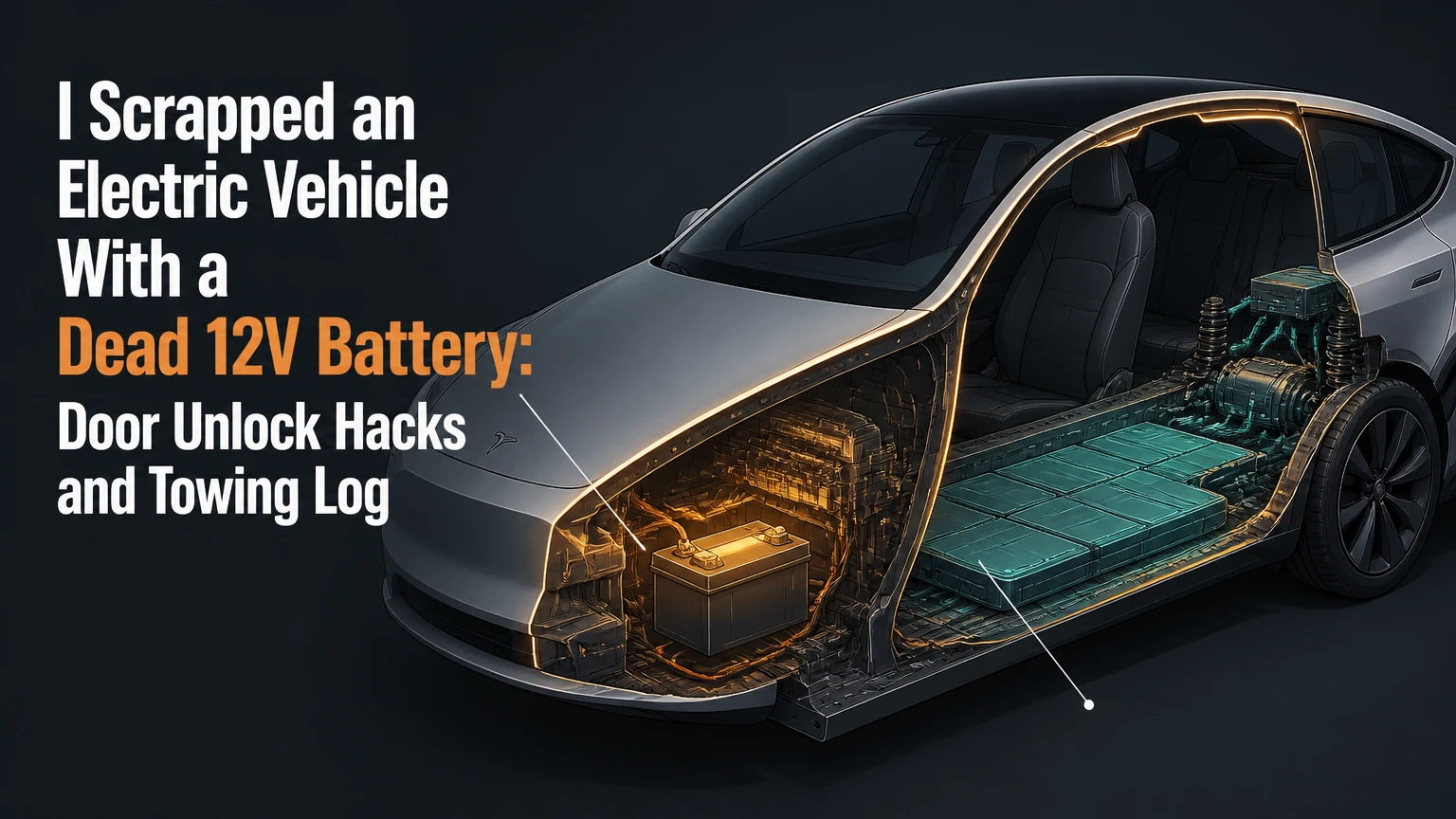
My 2018 Tesla Model 3 Long Range AWD was rear-ended on a highway, and insurance totaled it on repair cost. The HV battery pack was undamaged. The rear quarter panel, bumper cover, and trunk lid were destroyed. I retained the car for $2,400 in salvage value.
Three months of sitting in the garage while I figured out what to do killed the 12V auxiliary battery. On a Model 3, the 12V powers the door handle extension mechanisms, the touchscreen, and the ability to shift out of Park. With it dead, the car was effectively sealed: flush door handles that would not extend, no display, no way to shift to neutral.
Five buyers quoted the car. Three had never handled a dead-12V EV before. One standard tow driver arrived and tried to wheel-lift it. I stopped him before anything was damaged. Here is everything I found about unlocking, preparing, and towing a dead-12V electric vehicle, and the significant offer difference between buyers who understand EVs and buyers who do not.
What a Dead 12V Battery Does to an Electric Vehicle That Makes Access and Towing Complicated
Most people assume an electric vehicle with a dead 12V is like a regular car with a dead battery: pop the hood, jump it, done. On a modern EV, the 12V failure creates access problems that require knowing where the car’s emergency systems are before you can do anything else.
Why the 12V battery matters separately from the main traction battery
Every electric vehicle has two distinct battery systems. The high-voltage traction battery, typically 40 to 100 kWh on modern EVs, powers the electric motor. The 12V auxiliary battery, a small conventional lead-acid or lithium-ion unit, powers all the vehicle’s low-voltage electronics: door locks, windows, interior lights, the main computer display, and the ability to communicate with the charging system.
When the 12V dies, the car loses all electronic control even if the main traction battery is at full charge. On a Tesla Model 3, this means the door handles, which are flush and extend only when electronically activated, will not move. The interior is accessible only through a physical emergency release cable inside the door, which is unreachable from the outside.
The four specific access and towing problems I encountered
First: the exterior door handles would not extend. Pressing the handle produced nothing. The car looked sealed from the outside. Second: even after gaining access, the car could not shift out of Park without 12V power because the shift mechanism is electronically controlled. Third: Tesla specifically prohibits towing a Model 3 with any wheels on the ground due to the motor’s regenerative braking resistance and the risk of motor damage during rotation without the control system active. Fourth: the transport mode that disables regenerative braking for flatbed loading requires the touchscreen, which requires the 12V.
The Model 3-specific unlock procedure that solved the access problem
Tesla’s service documentation describes a 12V jump-start port accessible from the trunk area through a small panel on the driver-side rear. On a Model 3, this requires manually releasing the trunk latch from the exterior through a small physical release port behind the rear Tesla logo. A flathead screwdriver pressed into that port releases the trunk mechanically without 12V power.
With the trunk open, I connected a portable jump starter to the 12V charge port. Within 90 seconds, the car woke up: handles extended, display activated, and the car shifted to Neutral. Total time from finding the instructions to gaining full access: 28 minutes.
The same procedure works on other EV models with variation
Vehicle | 12V Location | Manual Door Release Location | Shift to Neutral Without 12V | Flatbed Towing Requirement |
|---|---|---|---|---|
Tesla Model 3 (2017+) | Driver-side trunk, behind access panel | Interior door pull cable behind footwell trim | Not possible without 12V; must jump 12V first | All 4 wheels on flatbed; no wheel-down towing |
Tesla Model Y (2020+) | Same as Model 3 | Same procedure | Same; requires 12V power | Same as Model 3 |
Nissan Leaf (2018+) | Under hood, driver side, marked post | Conventional handle; pull works without power | Floor console mechanical override; lever under center console | All 4 wheels; regen resistance damages motor in partial lift |
Chevy Bolt EV (2017+) | Under hood, conventional post | Conventional handle works mechanically | Floor shifter has mechanical cable release under console boot | Front-wheel drive; rear lift allowed; front lift not permitted |
BMW i3 (2014-2021) | Trunk, RH side behind liner | Conventional door handle works | Service mode required; contact dealer or tech | All 4 wheels strongly recommended due to regen drag |
What 5 Buyers Offered and How They Handled the EV-Specific Challenges
The offer spread on this car was the widest I have seen in any junk car transaction: $480 from the lowest buyer to $4,200 from the highest. The gap came almost entirely from whether the buyer understood what the intact HV battery was worth.
How I described the car on every call
I disclosed everything on every first call: 2018 Tesla Model 3 Long Range AWD, rear-end collision, totaled on repair cost, HV battery pack confirmed undamaged by Tesla service inspection, 12V battery dead but jumpable, salvage title, clean exterior except rear damage.
The HV battery confirmation was the key detail. I had paid $95 for a Tesla service center visual inspection specifically to confirm battery health before calling any buyers. That document changed every conversation with buyers who understood EV value.
Buyer | EV Experience | What They Focused On | Offer (USD) | Tow Method Arranged |
|---|---|---|---|---|
Standard scrap yard A | None; quoted it like an ICE car | Scrap weight only: ~3,800 lbs aluminum | $480 | Sent wheel-lift driver; I refused; they declined to reschedule with flatbed |
National auto buyer (online) | Limited; algorithm-based | Non-running salvage title deduction applied | $1,240 | Flatbed, confirmed; no EV-specific protocol |
Pick-and-pull yard | Moderate; had taken 2 Teslas before | Motors, inverter, seats, exterior glass | $1,850 | Flatbed confirmed; no extra fee |
Tesla-specific salvage dealer | Expert; specialized in Model 3 | HV battery, motors, inverter separately valued | $4,200 | Sent own Tesla-certified flatbed at no charge |
EV battery refurbisher | Expert on HV battery only | HV battery refurbishment/resale program | $3,500 (battery only; they arranged transport separately) | Specialized EV transport; paid for transport themselves |
Why the standard scrap yard offer was so far below every other buyer
The standard scrap yard treated the Model 3 as a heavy sedan: approximately 3,800 lbs of mixed aluminum and steel at a blended scrap rate. Their $480 offer reflected that calculation plus a salvage title discount.
The 75 kWh HV battery pack alone weighs approximately 1,060 lbs. At standard aluminum scrap rates, that is roughly $250 to $350 in the battery pack’s raw weight. But the cells inside are functional lithium-ion cells that refurbishers pay $2,000 to $4,000 for as a working unit. The scrap yard’s offer missed $2,000 to $4,000 of value sitting in a box it did not know how to access.
The High-Voltage Battery Decision: Why This Car Was Worth Much More Than Its Scrap Weight
When an EV’s HV battery is confirmed undamaged after an accident, selling the car to a standard scrap yard is one of the most expensive mistakes an EV owner can make. The HV battery is the single most valuable component in the car, and its value in the parts or refurbishment market is completely disconnected from the car’s scrap weight.
What a confirmed undamaged Model 3 HV battery is worth in different markets
A 75 kWh Tesla Model 3 Long Range battery pack in confirmed working condition sells in the refurbishment market for $3,000 to $6,000 depending on the state of health and the buyer’s program. Refurbishers test, recertify, and resell these packs for use in Powerwall-style home energy storage or in other EV repairs. The Tesla-specific salvage dealer’s $4,200 offer reflected their assessment of the full car’s part values with the intact battery as the anchor.
The battery refurbisher’s $3,500 offer was battery-only: they wanted the pack and would leave the rest of the car for me to deal with separately. Combined with a separate scrap offer on the body and remaining components ($480 from a basic yard), that path would have produced $3,980 total. The Tesla salvage dealer’s $4,200 all-in was $220 more with less coordination required.
How I confirmed the HV battery was undamaged
After the collision, I connected to the car using the Tesla app on my phone while the 12V was still functional. The app showed no battery fault codes and the state of charge was at 68%. The car had received no warning messages about HV battery integrity.
I also paid $95 for a Tesla service center inspection. The service tech confirmed no cell group voltage deviations, no thermal event indicators, and no BMS fault history. That $95 inspection report became the document that justified the $4,200 offer from the specialist and the $3,500 from the refurbisher. Without it, both buyers would have discounted heavily for battery condition uncertainty.
The Towing Log: What Each Driver Did When They Arrived
Three drivers actually arrived at the car. The other two buyers arranged transport that never needed to come because they withdrew (the scrap yard) or handled pickup through their own fleet (the specialist).
Driver 1: The wheel-lift attempt that did not happen
The standard scrap yard dispatched a wheel-lift tow truck. I stopped the driver before he touched the car. Tesla’s towing guidelines explicitly prohibit partial lift towing on a Model 3: the motor in the lifted axle rotates without the control system managing it, which can cause damage to the motor windings and bearing surfaces.
The driver was not aware of this restriction. He had towed many cars. He had not towed a Tesla. The yard’s dispatcher had not flagged it as an EV when sending the assignment. I called the yard, explained the restriction, and they said they could reschedule with a flatbed but at a higher fee. I declined and called the next buyer.
Driver 2: The national buyer’s flatbed, no EV protocol
The national buyer sent a standard flatbed truck. The driver was not EV-trained but had been briefed by dispatch that the car could not be towed on a wheel-lift. He attached the winch to the front tow hook and pulled the car onto the bed front-first. No complications. Loading took 22 minutes.
He did not use transport mode because the touchscreen was operational after I jumped the 12V. We shifted the car to Neutral, released the parking brake, and let the winch pull it up. He strapped all 4 wheels on the flatbed. The trip to the facility was straightforward.
Driver 3: The Tesla specialist’s certified flatbed
The Tesla salvage dealer sent a driver who had loaded Model 3s before. He connected his own jump pack to the 12V port before starting, activated transport mode through the screen, confirmed neutral, and pulled the car onto the bed in 14 minutes. Transport mode disables regenerative braking and keeps the drive units in a safe state during loading.
He also photographed the HV battery warning area through the trunk before loading, confirming no visible damage to the battery housing. That confirmation was part of his own intake process. He paid on the spot from a pre-issued check.
FAQs: Scrapping an Electric Vehicle With a Dead 12V Battery
Q: Can I jump-start a Tesla Model 3 with a dead 12V to gain access?
A: Yes. Access the 12V charge port in the trunk by manually releasing the trunk latch through the physical port behind the rear Tesla logo using a flathead screwdriver. With the trunk open, connect a portable jump starter to the 12V charge port. The car will power up within 60 to 90 seconds, allowing you to extend the door handles, activate the display, and shift to Neutral.
Q: Can a standard tow truck pick up a Tesla or other EV?
A: Only if it is a flatbed where all 4 wheels ride on the bed. Partial lift towing (wheel-lift on either axle) rotates the non-lifted motor without the control system managing it, which can cause motor damage. Tesla explicitly prohibits partial lift towing for Model 3 and Model Y. Most other EVs have similar restrictions due to regenerative braking drag and motor design.
Q: Is a junk EV worth significantly more than a junk ICE car of similar size?
A: It depends entirely on the HV battery. If the HV battery is intact and confirmed functional, the car is worth 3 to 10 times more than a standard scrap car of similar size when sold to an EV specialist or battery refurbisher. If the HV battery has been damaged in the accident or has significant degradation, the car may be worth only scrap weight plus aluminum and motor parts value.
Q: What document improves an EV junk car offer the most?
A: A confirmed battery health inspection from the vehicle manufacturer’s service center. On a Tesla, this costs $95 and produces a report showing cell voltage deviations, BMS fault history, and thermal event indicators. Buyers offering $3,000 to $4,000+ for an intact EV require this documentation to justify their offer. Without it, they discount for battery condition uncertainty.
Q: Which type of buyer offers the most for a junk EV with an intact HV battery?
A: EV-specific salvage dealers and HV battery refurbishment companies consistently offer the most, because they have a direct market for the battery pack as a functional unit. Standard scrap yards and general junkyard operations offer only scrap weight plus basic parts value, missing the battery’s most significant value entirely.
Bottom Line
Scrapping an electric vehicle with a dead 12V battery is a two-part problem: gaining access through model-specific emergency procedures, and making the right decision about the HV battery. The access problem is solvable with 30 minutes of research into your specific EV’s emergency 12V charge port location and mechanical door release.
The battery decision is more consequential: an intact HV battery from a collision-damaged Model 3 is worth $3,000 to $4,200 to a specialist, versus $250 to $350 in the scrap weight of the pack’s raw materials. Get a battery health inspection from the manufacturer’s service center before calling any buyer. Call EV-specific salvage dealers and battery refurbishers before calling standard junkyards. And confirm that whoever you book for towing knows to send a flatbed where all 4 wheels ride on the bed.