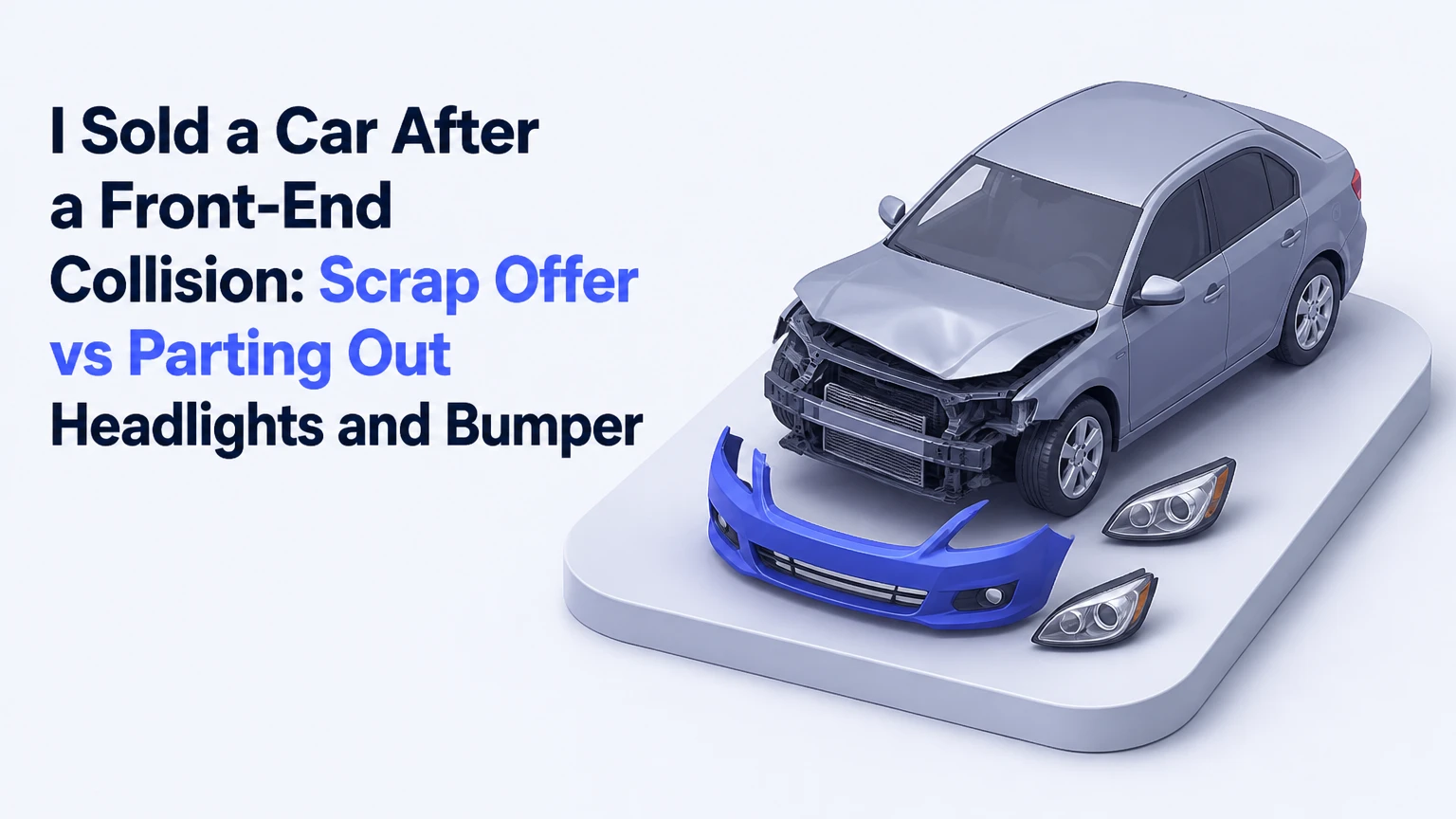
My 2016 Toyota Camry SE took a front-end collision on the driver side. The driver headlight, driver fog light, driver fender, and hood center were destroyed. The passenger-side headlight, passenger fog light, grille, and the outer bumper cover sections remained intact. The scrap yard offered $285 for the whole car. Before calling any yard, I parted out 5 intact front-end components over 11 days. Parts returned $415 net. Then I scrapped the shell for $245. Total: $660 versus the $285 whole-car scrap offer. Here is what I sold, what each part returned, which parts did not sell, and the 3 mistakes that slowed the process down.
What Survives a Front-End Collision and What Gets Destroyed
The asymmetric damage pattern that creates a part-out opportunity
Front-end collisions rarely destroy both headlights equally. A direct front impact typically obliterates the impacted corner while leaving the opposite corner partially or fully intact. An offset frontal collision (the most common real-world crash type, where one corner hits first) almost always leaves the opposite headlight assembly, the outer bumper end, and the far-side trim components undamaged. My Camry hit on the driver front corner. The passenger headlight assembly sat 3 feet from the impact center and came through without a scratch.
Body shops and independent repair technicians source intact used headlight assemblies constantly because OEM headlights on newer vehicles cost $350 to $850 each new. A body shop replacing a collision-damaged driver headlight on the opposite side of a matching vehicle will purchase the intact passenger assembly from a salvage source if it saves their customer $200 versus an OEM part. That demand channel is what makes post-collision part-outs viable.
A systematic check of what is worth listing on a front-end collision car
Walk around the car and assess each component by condition. On my Camry after the driver-side front impact: the driver headlight was crushed (zero value), the driver fog was shattered (zero), the driver fender was creased and torn (zero), and the hood was bent along the driver edge but solid on the passenger half. The passenger headlight, passenger fog, grille, and bumper outer sections were all intact and saleable.
What airbag deployment does to your part-out options
If your collision deployed the airbags, the airbag modules themselves are now expended and unsellable. However, airbag deployment does not affect the value of exterior front components. The headlights, bumper, grille, and fenders function independently of the airbag system. Do not let deployed airbags discourage you from parting out the exterior.
Every Part I Listed, Every Platform I Used, and What Each Returned
The passenger headlight: the highest-value single component
The passenger headlight assembly on a 2016 Toyota Camry SE uses a projector halogen unit with LED accent strip. New from Toyota dealers: $420 to $520. The used market for clean units runs $140 to $220 on eBay. I listed at $195 with 8 photos including a function test video (tested with a 12V battery and alligator clips). It sold in 3 days at $183. eBay fee at 12%: $21.96. Net: $161.04.
Part | Platform | Listed (USD) | Sold (USD) | Fee (USD) | Net (USD) | Notes |
|---|---|---|---|---|---|---|
Passenger headlight assembly | eBay | $195 | $183 | $21.96 | $161.04 | Tested, function video included |
Passenger fog light | $65 | $52 | $0 | $52.00 | Tested before listing | |
Front grille insert + surround | $95 | $72 | $0 | $72.00 | Minor scuff on upper bar | |
Front bumper cover (full unit) | $55 | $40 | $0 | $40.00 | Cracked center; outer ends intact; parts-only listing | |
Hood (bent driver edge, solid passenger half) | $120 | $90 | $0 | $90.00 | Buyer planned to straighten | |
Driver headlight (destroyed) | eBay | $25 | $0 | $0 | $0 | No sale: photos showed only damage, not usable sub-parts |
Driver fog (shattered) | $15 | $0 | $0 | $0 | No sale: no usable sections | |
TOTAL | $21.96 | $415.04 | 11 days elapsed |
How the Scrap Yard Priced the Stripped Collision Shell
What the yard assessed differently on a collision car vs a mechanical failure car
I called 4 yards with an honest description: 2016 Toyota Camry SE, front-end collision on driver side, driver-side exterior destroyed, passenger-side and grille components already removed, airbags deployed, non-running (engine impact damage), clean title, no frame damage confirmed by shop inspection. Three yards quoted. One refused without seeing the car in person.
The yard that accepted at $245 explained their assessment: the engine took impact damage with a bent accessory bracket and coolant leak, but the block and transmission were structurally fine and held parts value. The interior was clean, meaning seats, dash components, and the rear entertainment system had resale potential. The collision damage on the driver exterior was a cosmetic deduction, not a parts write-off, because the yard was not planning to resell the exterior panels anyway.
Why the collision reduced the scrap offer less than expected
Many sellers assume collision damage halves scrap value. It does not, particularly when the drivetrain and interior are unaffected. A scrap yard’s offer on a 2016 Camry in running condition might be $550 to $680. The collision reduced the offer from approximately $380 (what a non-running mechanical-failure Camry without collision damage might bring) to $245, a $135 reduction. That $135 represents the lost value of the driver exterior components and the deployed airbag modules. The engine, transmission, intact interior, and structural body shell drove the $245 floor.
The Net Comparison: Part-Out Then Scrap vs Whole Car to Scrap
Approach | Parts Revenue (USD) | Scrap Revenue (USD) | Total (USD) | Days | Active Effort |
|---|---|---|---|---|---|
Sell whole car to scrap yard (all components) | $0 | $285 | $285 | 1 to 2 | 1 phone call |
Remove intact parts, scrap the shell | $415 (net of fees) | $245 | $660 | 11 | 5 listings, 5 buyer pickups |
Gain from parting out first | $375 more | 9 extra days |
The 3 Mistakes I Made That Slowed Down the Part-Out
Listing the destroyed driver headlight without photos of the working sub-components
The driver headlight was shattered at the outer lens but the internal reflector and mounting bracket remained intact. A seller who needs just the bracket or the reflector housing for a custom build would have purchased it for $15 to $20. I listed it as ‘for parts, damaged, $25’ with one blurry photo showing the destruction. The photo repelled the exact buyer who would have purchased the working sub-component. Clear photos of every intact sub-component, labeled explicitly, would likely have generated that $20 sale.
Listing the bumper cover as a whole unit when only the ends had value
The bumper cover had a 14-inch horizontal crack across the center but both outer end sections remained structurally intact. A buyer replacing only one outer end after a parking lot impact would have paid $25 to $35 for one intact end section. By listing the whole cracked unit and not offering to cut and ship individual sections, I narrowed my buyer pool to people who needed the full unit (nobody) rather than end-section buyers (several). I eventually sold it for $40 to a buyer who planned to cut it himself.
Not testing the passenger fog light before listing
I listed the fog light as ‘removed from collision vehicle, untested’ at $65. The first 3 buyers who messaged asked whether it worked. I went back to the car, wired it to a battery, confirmed it worked, took a video, and re-uploaded the listing. The next message led to the $52 sale. Testing and documenting function before listing would have closed that sale 4 days earlier.
When Front-End Part-Out Is Worth It and When to Skip It
Part out first when the opposite-side headlight is worth more than $100 on eBay
Check eBay completed listings for your specific vehicle’s passenger headlight. If sold comparable units show final prices above $100 net of fees, parting out the opposite-side headlight alone almost certainly justifies the effort. That one part often represents 40 to 60% of the total parts revenue on a front-end collision car.
Skip the part-out when all front-end components took impact damage
A direct center-impact collision that damages both headlights, the full bumper, and the hood equally leaves nothing to sell. In that case, call the junkyard immediately. Also skip the part-out if the car’s front-end components are common and low-value: older economy cars with inexpensive replacement headlights have minimal used-market demand because buyers order a cheap aftermarket unit rather than sourcing OEM.
FAQs: Selling a Car After a Front-End Collision
Q: Which parts survive a front-end collision and are worth selling?
A: The opposite-side headlight assembly from the impact point is almost always intact and the most valuable single component. The intact fog light, grille, outer bumper ends, and hood (even if bent, sold for straightening) are typically sellable. Inspect each component individually by condition.
Q: How much can I get for a used headlight from a collision car?
A: It depends on the vehicle. OEM headlight assemblies on popular late-model vehicles (Camry, Accord, F-150, CR-V) sell used for $100 to $250 on eBay. Luxury and performance vehicles can command $300 to $900. Budget vehicles under $150 new produce little used-market demand.
Q: Should I list on eBay or Facebook for collision car parts?
A: eBay for headlights, fog lights, and any component a buyer might need shipped nationally. Facebook for bumpers, hoods, grilles, and heavy items where local pickup makes more sense than paying shipping.
Q: Does airbag deployment stop me from selling front-end parts?
A: No. Airbag deployment affects the modules and covers. It does not affect headlights, bumpers, grilles, hoods, or fenders. Exterior front-end components function independently of the airbag system.
Q: How much less does a collision damage a scrap yard’s offer?
A: On my 2016 Camry, the front-end collision reduced the scrap offer from approximately $380 (non-running mechanical failure Camry) to $245, a $135 reduction. The deduction reflects lost exterior parts value and deployed airbag modules. The engine, interior, and structural body still drove significant value.
Q: What is the fastest way to get cash from a front-end collision car?
A: Call a junkyard on day 1 for a baseline offer. List the passenger headlight on eBay the same day. The headlight will likely sell within 3 to 5 days, adding $100 to $200 net above the scrap offer with minimal effort. Then accept the junkyard pickup on day 5 or 6. This two-step approach captures 70% of the part-out value with 20% of the effort.
Q: Can I sell parts from a car that still has a loan on it?
A: If a lender holds a lien on the vehicle, they hold a security interest in the whole vehicle including its components. Removing and selling parts from a lien-encumbered vehicle before the lien is released may violate the loan agreement. Satisfy the lien before selling any parts.
Bottom Line
A front-end collision car’s scrap value is a floor, not a ceiling. The intact components on the unimpacted side of the car, particularly the opposite headlight, fog light, and grille, have real market demand from body shops and independent buyers.
On my 2016 Camry, those components returned $415 net, turning a $285 scrap offer into a $660 total. The most important first step is checking eBay completed listings for your opposite-side headlight. If similar units sold for $100 or more, the 11-day part-out window is worth it. Test every component before listing. Photograph every intact sub-component on damaged parts. Sell to a junkyard only after the fast-moving parts have cleared.