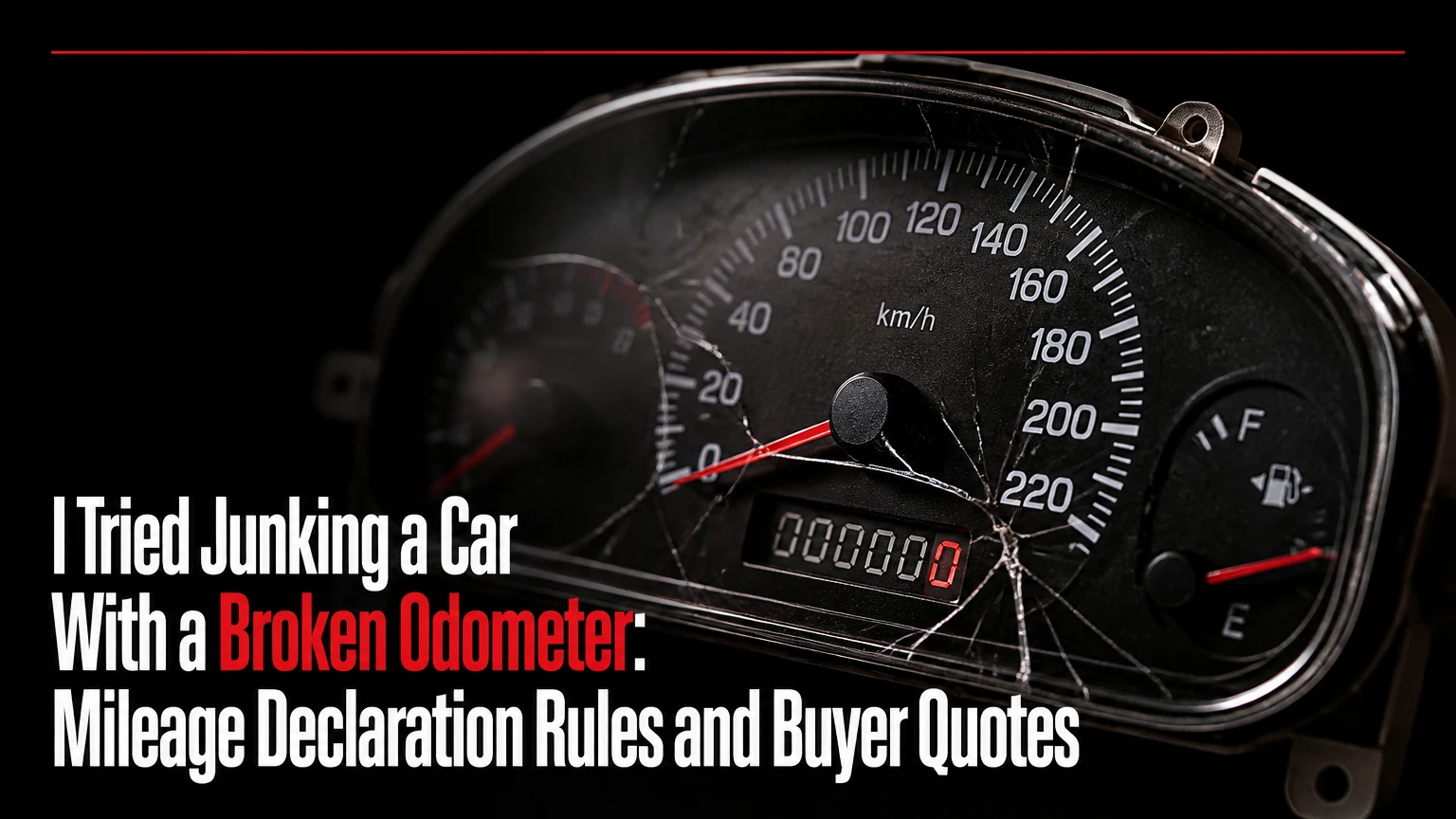
My 2016 Ford Fusion’s instrument cluster failed completely in August, leaving the odometer frozen at 89,247. The failure was not gradual. One morning the entire cluster was dark: no speedometer, no odometer, no fuel gauge, nothing. The car continued to run and I drove it for 6 weeks on a speedometer-less hunch before a transmission issue ended it.
When I decided to junk the car, I assumed the frozen odometer reading would simply be carried over to the title as the mileage. I was wrong. Federal odometer disclosure law for a vehicle under 10 model years old requires that a seller either disclose actual mileage or certify that the mileage is ‘not actual,’ and a frozen or broken odometer reading occupies a legally ambiguous space between those two options. Two buyers refused the car outright over the disclosure question.
One required a notarized declaration. One accepted my oil change records as sufficient documentation. Here is the law, the documentation process, and what the broken odometer cost me in cash at the driveway.
What Federal Mileage Disclosure Law Actually Requires When an Odometer Is Broken
Most sellers have never read the federal odometer disclosure law because most cars have working odometers. When the odometer breaks, that ignorance becomes expensive. The federal rules are specific, the required language is exact, and getting it wrong can delay the entire transaction while the yard’s title processor flags the submission.
The Motor Vehicle Information and Cost Savings Act and who it covers
The federal odometer disclosure requirement, codified in 49 U.S.C. Chapter 327 and implemented through NHTSA regulations at 49 CFR Part 580, requires that the transferor of a motor vehicle disclose the vehicle’s mileage at the time of transfer to the transferee. The disclosure must appear on the vehicle’s title document. The law covers any transfer of ownership, including sales to salvage yards and junkyards. The yard that buys your car is the transferee, and the yard’s title processor submits a title transfer to the state DMV on which the mileage field must be completed accurately. If the odometer is broken, the disclosure cannot simply be skipped or left blank.
The three disclosure options and which one applies to a broken odometer
The federal form provides three options in the odometer disclosure section. The first is the actual mileage reading: you certify that the number shown is the true mileage to the best of your knowledge. The second is ‘the mileage reading exceeds the odometer’s mechanical limits,’ which applies to vehicles where the odometer has rolled past its maximum (typically 99,999 or 999,999 miles). The third, and the one that applies to a broken odometer, is ‘the odometer reading is not the actual mileage.’ Selecting this option means you are certifying that the displayed reading does not accurately reflect the vehicle’s true mileage, because the instrument is not functioning correctly.
For my Fusion, the correct disclosure was: mileage of 89,247 (the last displayed number) with the ‘not actual mileage’ box checked. The reading was the last confirmed number the instrument produced, but I could not certify it as the true current mileage because the instrument had stopped recording miles the day the cluster failed. Certifying 89,247 as the actual mileage when the car had driven approximately 3,400 additional miles since the cluster failure would have been a federal odometer fraud violation, even though the intent was innocent.
Why vehicles over 10 model years old are exempt and why my Fusion was not
Federal regulation exempts vehicles that are 10 or more model years old from the odometer disclosure requirement entirely. A 2014 vehicle being sold in 2024 qualifies for the exemption. A 2016 vehicle being sold in 2024 does not. The exemption exists because older vehicles have typically changed ownership multiple times and the original mileage tracking has become less reliable over the vehicle’s lifetime. My 2016 Fusion, 8 model years old at the time of sale, fell inside the window where federal odometer disclosure was mandatory. If I had waited until the Fusion was 10 years old, the broken odometer would have been legally irrelevant to the title transfer.
The Documentation I Gathered Before Calling Any Buyer
Before making a single call, I spent two hours assembling every piece of paper that documented the Fusion’s mileage history. This turned out to be the most important preparation I did, because different buyers accepted different types of documentation, and having all of them organized meant I could respond to any requirement on the spot rather than delaying the transaction.
What counts as credible last-known mileage documentation
The clearest documentation of last-known mileage is any official record that captured the odometer reading while the instrument was functional. In order of credibility from most to least: a state vehicle inspection record that includes the odometer reading at the time of inspection; a service record from a dealership or independent shop showing the mileage at the time of service; an oil change receipt that records mileage at service; a title or registration renewal document that lists mileage (some states capture mileage at registration); insurance documentation that captures mileage for telematics pricing; and finally, the owner’s own written log if they kept records.
I had two oil change receipts from a Jiffy Lube showing 85,312 miles (10 months before the cluster failure) and 88,940 miles (4 months before failure), plus a state inspection record showing 82,150 miles from 16 months prior.
Why I also got the cluster failure documented by a shop
I took the Fusion to a Ford dealer and paid $85 for a diagnostic that confirmed the instrument cluster had failed due to a known issue with the printed circuit board. The dealer issued a repair order describing the failure mode and the date. This documentation served two purposes. First, it confirmed that the odometer failure was a mechanical event rather than a deliberate tampering, which is what the ‘not actual mileage’ declaration implies to anyone reading it. Second, it gave buyers who questioned the declaration a specific mechanical explanation rather than a vague claim that the instrument ‘just broke.’ The $85 for the diagnostic was the best money I spent in this entire transaction.
Document | What It Proves | Buyers Who Required It | Availability |
|---|---|---|---|
State vehicle inspection record (82,150 miles, 16 months prior) | Official confirmation of mileage while odometer worked | 2 of 5 buyers accepted as sole documentation | State DMV website or inspection shop records |
Jiffy Lube receipt (88,940 miles, 4 months prior) | Most recent documented reading before failure | 3 of 5 buyers accepted combined with inspection record | Jiffy Lube app or receipt copy |
Ford dealer diagnostic (cluster failure confirmed) | Confirms failure was mechanical, not tampering | 1 of 5 buyers required this specifically | Requested from dealer service department |
Notarized personal statement of last-known mileage | Owner’s sworn declaration of the facts | 1 of 5 buyers required in addition to service records | Notary, $10, 15 minutes |
VIN-linked service history (CarFax or equivalent) | External confirmation of mileage at recorded service visits | 2 of 5 buyers ran this independently | Buyers typically pull this themselves |
What 5 Buyers Required When I Disclosed the Broken Odometer on the First Call
I disclosed the broken odometer situation on every first call before describing anything else about the car. The specific language I used was: ‘The instrument cluster failed completely in August. The odometer is frozen at 89,247, which was the last displayed reading. The car drove an estimated 3,400 miles after the failure before stopping. I have service records documenting the mileage up to 88,940 miles from 4 months before the cluster failed, plus a dealer diagnostic confirming the cluster failure. The title will be completed with the last-known mileage and the not-actual-mileage box checked.’ That disclosure eliminated all surprises and separated the buyers who could handle the situation from those who could not.
The two buyers who refused the transaction over the disclosure
The first yard that refused told me their title processor requires a certified odometer reading from a qualified inspector before they can accept a ‘not actual mileage’ disclosure. A certified odometer reading on a failed instrument cluster requires a shop to either repair the cluster, read a backup mileage register (some vehicles store mileage in the engine control module and can be read with a scan tool), or certify the failure as preventing any reading. The $85 I had already paid for the Ford dealer diagnostic had actually produced exactly what this buyer needed, but the dispatcher I spoke to did not know to ask for it and simply said their policy was to decline not-actual-mileage cars. I should have asked for the title processor specifically rather than accepting the dispatcher’s answer at face value.
The second refusal came from a national online auto buyer whose system has a hard block on vehicles submitted with a not-actual-mileage disclosure. Their online form flags the condition and prevents the quote from completing. No human review of the documentation changes this: it is a policy coded into their intake system. For a car with a broken odometer and a not-actual-mileage title, national online platforms are not viable buyers.
The three buyers who accepted and what each required
The three buyers who completed the transaction accepted different combinations of my documentation.
Buyer 3 (a local family-owned junkyard) accepted the two Jiffy Lube receipts plus the inspection record as sufficient to fill in the title’s odometer disclosure field and complete their internal verification. Their title processor noted the service-record mileage on their intake form and submitted the not-actual-mileage title to the state DMV without additional steps.
Buyer 4 (a pick-and-pull yard) required the Ford dealer diagnostic on top of the service records, specifically because they wanted confirmation of a mechanical failure rather than odometer tampering before pricing the car.
Buyer 5 (a regional scrap chain) required a notarized personal statement from me declaring the last-known mileage and the cause of the failure, in addition to the service records. They provided their own form for the statement, which I signed and had notarized for $10 at a nearby UPS Store.
Buyer | Accepted Documentation | Title Handling | Offer (USD) | Deduction for Broken Odometer |
|---|---|---|---|---|
Buyer 1 (metro junkyard) | Refused – dispatcher policy on not-actual-mileage cars | N/A | N/A | N/A – refused |
Buyer 2 (online auto platform) | Refused – system block on disclosure type | N/A | N/A | N/A – refused |
Buyer 3 (family-owned yard) | Service records + state inspection record | Not-actual-mileage box checked, service-record mileage noted | $345 | $20 (title processing complication) |
Buyer 4 (pick-and-pull yard) | Service records + Ford dealer diagnostic | Not-actual-mileage box checked; dealer diagnostic in file | $360 | $15 (minor complication, documentation complete) |
Buyer 5 (regional scrap chain) | Service records + notarized personal declaration | Full documentation package submitted to DMV | $338 | $25 (notarized form required, added processing time) |
How the Broken Odometer Affected Each Buyer’s Offer and Why
The deductions across the three completing buyers ran from $15 to $25, a narrow range that tells a consistent story: the broken odometer is an administrative complication, not a valuation event. The car’s scrap weight did not change. The parts value of the engine, body, and interior did not change. The extra cost the yard absorbs is pure processing friction, and they price that friction accordingly.
Why the deduction is about title processing friction, not mileage uncertainty
A junkyard buying a car for scrap does not adjust its offer based on whether the car has 89,000 or 95,000 miles, because neither the scrap weight nor most parts values depend on mileage in that range. The deduction for the broken odometer reflects the extra steps the yard’s title processor must take: noting the not-actual-mileage disclosure, attaching supporting documentation to the DMV submission, and managing the small additional risk of the DMV querying the unusual disclosure. Pick-and-pull Buyer 4, whose offer of $360 was the highest, applied the smallest deduction ($15) because they had the most complete documentation package and their title processor had the highest confidence that the DMV submission would proceed without flagging.
What would have happened if the car had been 10 model years old
If the Fusion had been a 2014 model instead of a 2016, the federal odometer disclosure exemption for vehicles 10 or more model years old would have applied. The broken odometer would have been legally irrelevant to the title transfer. I would have checked the exemption box, no mileage would have been required on the title, and no buyer would have applied any deduction related to odometer condition. The $15 to $25 deduction across my transactions would not have existed. If your car is approaching the 10-year exemption threshold and has a broken odometer, waiting until the vehicle qualifies for the exemption eliminates the disclosure complication entirely.
What to Do Before the Car Dies if Your Odometer Has Already Broken
A broken odometer is far less problematic if you document it thoroughly at the time it fails rather than scrambling for paperwork when you decide to sell. The window between the odometer breaking and the car dying is the most useful documentation window you have.
The three-step documentation process that should happen immediately after failure
Step one: write down the last displayed reading the moment you realize the odometer has stopped. The date and the frozen number together form the foundation of every future disclosure. Step two: get any service record from within the last 6 months that confirms mileage close to the failure point. If no service has happened recently, schedule an oil change specifically to generate a dated mileage record while the car is still running, even if the change is not strictly necessary. Step three: if the car has an OBD-II port (all 1996 and later vehicles do), take it to any auto parts store and ask them to scan the engine control module for stored mileage data.
Many modern vehicles store the last known mileage in the ECM independently of the cluster. An AutoZone or O’Reilly associate can pull this with a scanner at no charge, and the printout from that scan is an additional documentation source that some buyers will accept as a more authoritative figure than service records.
Why the ECM mileage scan is the most valuable documentation in this situation
The engine control module mileage reading is stored by the vehicle’s computer independently of the instrument cluster display. When the cluster fails, the ECM continues recording miles internally in some vehicles, meaning the ECM may hold a mileage figure that is more current than the frozen cluster reading. In other vehicles, the ECM references the cluster and also stops updating.
Either way, a scan of the ECM mileage register gives you the most authoritative electronic record of mileage available, and that record came from the car’s own computer rather than from any paper document that a buyer might question. I did not know to request this scan until after I had already cleared the lien situation and discovered it on a forum. Had I scanned the ECM immediately after the cluster failure, I would have had a stronger documentation package and likely avoided the refusals entirely.
FAQs: Junking a Car With a Broken or Non-Functional Odometer
Q: Is it legal to sell a car with a broken odometer?
A: Yes. Federal law requires that you disclose the broken odometer condition by checking ‘not actual mileage’ on the odometer disclosure section of the title, combined with the last documented reading if known. You cannot certify a frozen odometer reading as actual mileage, but you can legally complete a title transfer using the not-actual-mileage disclosure with supporting documentation.
Q: Do all junkyards accept a not-actual-mileage disclosure?
A: No. Of 5 buyers I contacted, 2 refused. National online auto buying platforms typically block the disclosure type at the intake form level. Local and regional yards are more flexible, particularly when you present service records, a dealer diagnostic, or a notarized declaration with the last-known mileage.
Q: How much does a broken odometer reduce a junk car’s offer?
A: The deductions across my 3 completing buyers ran $15 to $25. The broken odometer is an administrative complication, not a valuation change. Scrap weight and parts values are unaffected by whether the odometer works. The deduction reflects extra title processing steps.
Q: What documentation do I need to sell a junk car with a broken odometer?
A: At minimum: any dated service record (oil change receipt, inspection record, repair order) that captured an odometer reading while the instrument was functional. Stronger: a dealer or shop diagnostic confirming the failure was mechanical. Strongest: an ECM mileage scan showing the stored mileage in the vehicle’s computer, combined with service records and a notarized personal statement.
Q: If my vehicle is older than 10 years, does the broken odometer matter?
A: No. Federal odometer disclosure law exempts vehicles that are 10 or more model years old from any mileage disclosure requirement. A broken odometer on a vehicle at or past the 10-year exemption threshold has no legal impact on the title transfer and no effect on buyer acceptance or offer amount.
Q: Can I scan my car’s ECM for stored mileage data?
A: Yes. Any vehicle with an OBD-II port (all 1996 and later US vehicles) can be scanned at AutoZone, O’Reilly, or any auto parts retailer for free. Ask them to check stored mileage in the engine control module. The availability of ECM mileage data varies by make, model, and year; some vehicles store it independently of the cluster, some do not. The printout from a successful scan is strong documentation for a not-actual-mileage disclosure.
Bottom Line
A broken odometer creates a legal disclosure requirement and an administrative complication for junkyard title processors, but it does not change the car’s scrap weight, its parts values, or the fundamental transaction. The correct disclosure is ‘not actual mileage’ with the last known figure supported by service records. Two out of 5 buyers I contacted refused the transaction, but 3 completed it with deductions of $15 to $25. National online auto buyers have hard system blocks on not-actual-mileage submissions. Local yards with dedicated title processors handle it routinely when the documentation is complete.
The most important step you can take the moment an odometer breaks is to scan the ECM at any auto parts store for stored mileage data, request any recent service records that captured mileage, and write down the frozen reading with the date. Those three actions, done within a week of the failure, give you the documentation package that makes every accepting buyer’s title processing routine rather than complicated.