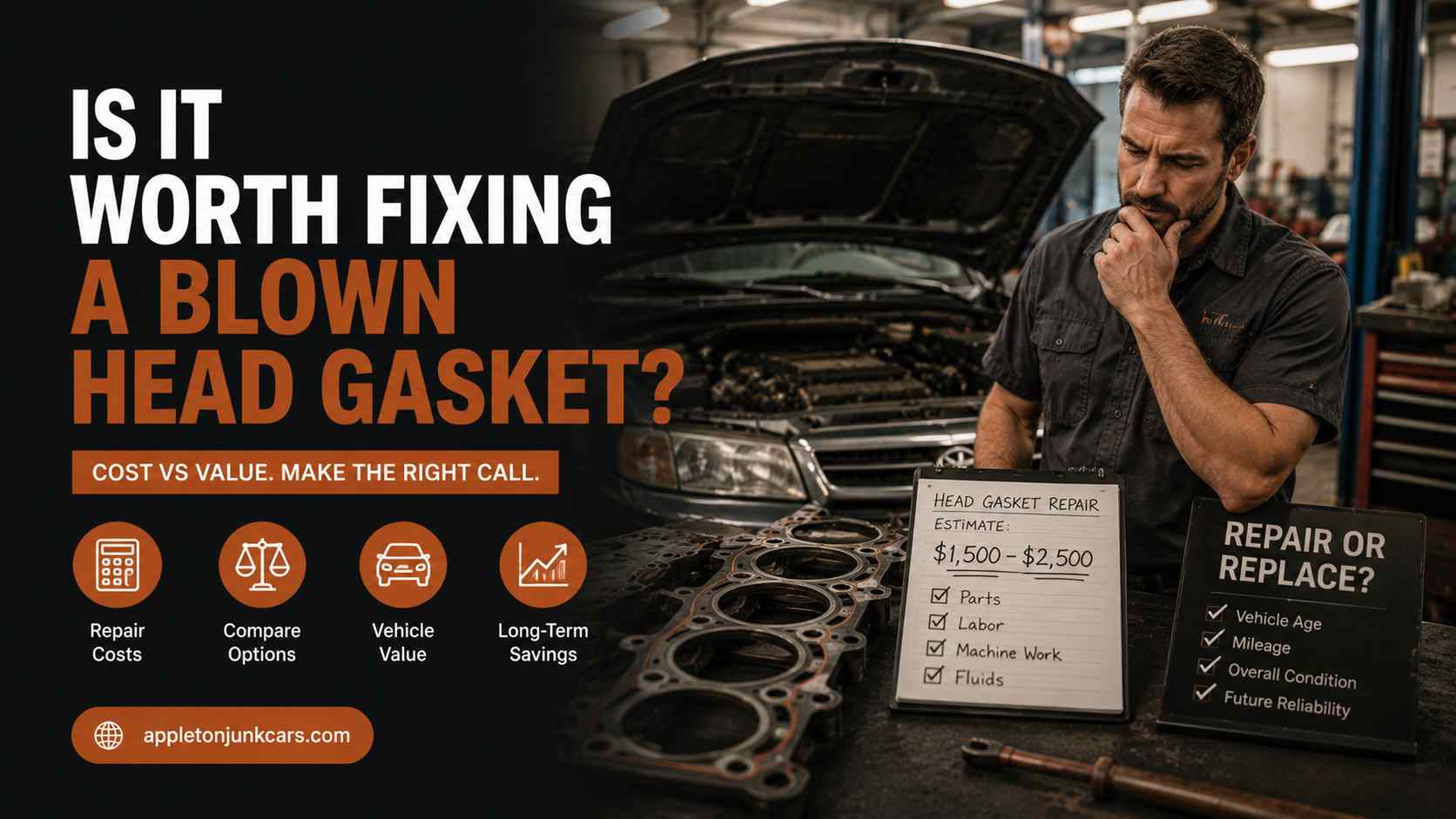
In most cases, no: fixing a blown head gasket is not worth it. That is the honest answer most mechanics already know but rarely say upfront, because they are about to quote you the job. The repair runs between $1,200 and $3,000 at most independent shops, and by the time the average driver notices the symptoms, secondary engine damage has often already occurred, pushing the real total well past the car’s actual market value.
But most cases is not every case. On the right vehicle, caught at the right time, a head gasket repair is a sound investment that extends a car’s life by another 100,000 miles. The question is not whether the repair can technically be done. It is whether doing it makes financial sense for your specific car and your specific numbers.
Three things determine the answer: what the repair costs, what the car is worth after it is fixed, and whether the engine has already suffered secondary damage from heat. This guide walks through each factor so you can make the call with clear information rather than mechanic pressure and an estimate that keeps climbing.
What the Repair Actually Costs, From Parts to Labor
The head gasket itself is inexpensive. The part runs $50 to $200 for most passenger vehicles. What costs money is the labor required to access it.
A head gasket sits between the engine block and the cylinder head. To replace it, the shop must drain the cooling system, remove the intake manifold, disconnect exhaust components, and lift the cylinder head completely off the top of the engine. On many vehicles this also means removing the timing belt or timing chain assembly. On front-wheel-drive cars with transversely mounted engines, the cramped access adds several extra labor hours on top of the core job.
Most drivers pay between $1,200 and $2,800 at an independent shop. Dealerships run 20 to 40 percent higher. European vehicles with more complex engine layouts can push the total past $4,000.
Vehicle Type | Independent Shop Cost | Dealership Estimate |
|---|---|---|
4-Cylinder Economy Car | $1,200 to $1,800 | $1,800 to $2,600 |
V6 Midsize Sedan or SUV | $1,600 to $2,500 | $2,400 to $3,500 |
V8 Truck or Full-Size SUV | $2,000 to $3,200 | $3,000 to $4,500 |
European or Luxury Vehicle | $2,500 to $5,000+ | $4,000 to $6,500+ |
These figures assume the cylinder head is in good condition. If the head is warped, cracked, or needs machine shop resurfacing, add $300 to $1,200 to the total. That single detail changes the financial equation significantly.
How Overheating Turns a Gasket Job Into an Engine Rebuild
Here is what most repair conversations skip over. By the time a driver notices the classic symptoms, white smoke from the exhaust, coolant disappearing from the reservoir, or the temperature gauge creeping higher than normal, the engine has already been through multiple heat cycles above its design temperature.
Aluminum cylinder heads warp under sustained heat. A head gasket often fails partly because the cylinder head has already begun distorting from heat, pulling away from the block seating surface. If the head is warped beyond the machine tolerance, it must be resurfaced or replaced outright. A cracked head cannot be repaired and requires full replacement, adding $500 to $1,500 or more to the job.
The Signs That Secondary Damage Has Already Occurred
Three indicators tell you the damage has escalated beyond a straightforward gasket swap.
Milky or foamy residue on the oil dipstick or inside the oil cap means coolant has been mixing with engine oil. Once that happens, the oil loses its ability to protect bearing surfaces. The bearings may already be compromised.
Coolant with a brownish tint or visible oil contamination in the coolant reservoir means the contamination has been circulating through both systems long enough to cause ongoing wear.
A compression test showing low readings on adjacent cylinders rather than a single one points to the possibility that the block itself is damaged. Any of these signs must factor directly into the repair decision and typically push the realistic cost significantly higher.
The 50 Percent Rule That Mechanics Rarely Volunteer
There is a simple financial framework that makes this decision clearer. If the total cost of the repair exceeds 50 percent of the vehicle’s post-repair market value, the repair almost never makes financial sense.
Here is how to apply it: find what the vehicle is worth in good running condition using Kelley Blue Book or Edmunds. That is your post-repair value. Subtract the full estimated repair cost from that number. What remains is your net gain from doing the repair. Then compare that figure to what you could realistically get by selling the vehicle as-is to a junk car buyer or a private buyer looking for a project car.
Post-Repair Market Value | Repair Estimate | Recommended Action |
|---|---|---|
$8,000 to $12,000 | Under $3,000 | Repair makes clear financial sense |
$6,000 to $8,000 | Under $2,500 | Repair is worth considering |
$4,000 to $6,000 | $1,500 to $2,500 | Get a second estimate before deciding |
Under $4,000 | Any amount | Sell or junk the vehicle instead |
Any vehicle value | More than 60% of repaired value | Not worth repairing |
A second estimate from an independent mechanic who did not diagnose the failure often comes in $300 to $800 lower than the first quote. On a borderline decision, that difference determines the call.
The Specific Conditions Where the Repair Is Actually Worth It
Fixing a blown head gasket is genuinely worth it when three conditions line up.
The Vehicle Has Strong Retained Value
Certain vehicles hold their worth because of documented long-term reliability. Toyota Tundras, Honda CR-Vs, Subaru Outbacks, and similar platforms routinely run past 200,000 miles when properly maintained. On a vehicle like this with 90,000 to 130,000 miles on the clock, paying $1,800 to $2,400 for a proper head gasket repair extends the vehicle’s useful life significantly. That math works in your favor.
The Damage Was Caught Before Secondary Failure
A driver who noticed the first symptom and parked the vehicle immediately gives the mechanic the best possible starting point. The cylinder head is more likely to be undamaged. The engine oil is more likely to be uncontaminated. In this scenario, the repair is predictable and the outcome is reliable. A clean repair on an otherwise solid engine is one of the better repair investments available.
The Rest of the Vehicle Is Mechanically Sound
A head gasket failure on a car with 210,000 miles, worn suspension, a slipping transmission, and multiple pending issues is a different calculation than the same failure on a well-maintained vehicle with a solid body and a clean service history. If repairing the gasket just puts you a few months from the next major failure, the full financial picture changes.
What Continuing to Drive Does to the Rest of the Engine
Driving a vehicle after a head gasket failure accelerates engine damage faster than almost any other mechanical failure. The gasket breakdown allows coolant to enter the combustion chamber, the engine oil passages, or both at once.
When coolant enters the combustion chamber, it burns off as white exhaust smoke and the coolant level drops steadily. The engine begins running hotter as the cooling system loses capacity. Heat cycles above normal operating temperature warp metal components that were manufactured to hold precise tolerances.
When coolant mixes with engine oil, the oil loses its film strength. Bearings that depend on a thin pressurized film of clean oil begin running without adequate protection. Within a few hundred miles under those conditions, bearing damage becomes irreversible without a complete engine rebuild or engine replacement.
The practical outcome most mechanics see: drivers who ignore the symptoms move from a $1,500 head gasket repair to a $4,000 to $8,000 engine replacement within weeks. The window to keep the repair economically viable closes fast once the warning signs appear.
What Car Owners Who Faced This Decision Consistently Regret
People who have navigated this situation share a consistent set of lessons. The most common regret is waiting. Every extra week of driving on a failing gasket added damage that turned a manageable repair into an unmanageable bill.
The second most common regret is paying for a repair on a low-value vehicle. Owners who spent $1,800 fixing a car worth $2,500 in perfect condition almost universally wish they had sold it instead. The money spent on the repair rarely came back out in resale value because other mechanical issues were already waiting in line.
The owners who reported satisfaction with their repair decision had two things in common: they caught the problem before secondary damage occurred, and the vehicle was worth considerably more than twice the repair cost once it was fixed.
Those who chose to sell the vehicle as-is, whether to a junk car buyer or a private buyer looking for a project, consistently said the experience was faster and simpler than they expected. The as-is price is lower than the repaired value, but it comes without the risk of an estimate that grows once the engine is opened up. For many cars in this situation, that trade-off is the smarter financial outcome.
Frequently Asked Questions
How do I know if my head gasket is actually blown?
The most reliable signs are white or bluish-white smoke from the exhaust when the engine is fully warm, a steady drop in coolant level without any visible leak underneath the car, milky or foamy residue on the oil dipstick or inside the oil cap, and a temperature gauge that climbs higher than normal. A shop can confirm the diagnosis with a combustion leak test on the cooling system, which detects combustion gases that should not be present in the coolant circuit.
Can I drive my car with a blown head gasket?
Technically yes, but every mile driven after the failure causes additional damage. Coolant entering the combustion chamber causes overheating events. Coolant mixing with engine oil degrades lubrication and accelerates bearing wear. Most mechanics will tell you that a car driven more than 20 to 30 miles on a confirmed blown head gasket often ends up needing a full engine replacement rather than a gasket repair. Once you suspect a head gasket failure, stop driving the vehicle.
Is a head gasket repair worth it on a high mileage car?
It depends more on the specific vehicle than on mileage alone. A 130,000-mile Toyota Camry or Honda Accord that is otherwise in solid condition can realistically run another 100,000 miles after a proper head gasket repair. A 200,000-mile car with multiple other mechanical issues is a very different calculation. The vehicle’s post-repair market value relative to the repair cost is a more useful guide than the odometer reading.
How much does a head gasket repair cost at a dealership?
Dealerships typically charge 20 to 40 percent more than independent shops because of higher flat-rate labor costs and parts markups. On a standard 4-cylinder engine, expect $2,000 to $3,000 at a dealership. For a V6 or V8, the range climbs to $3,000 to $4,500 or higher. Getting an estimate from a reputable independent shop first gives you a clear baseline before approaching any dealership.
What causes a head gasket to blow?
The most common causes are overheating events such as running out of coolant, a failed thermostat, or a stuck radiator fan. Engine age combined with repeated heat cycling that weakens gasket material over time is another factor. Incorrect torque sequence during a previous engine repair can also lead to premature failure. Some vehicle models and engine families are statistically more prone to head gasket failures than others, with certain early Subaru four-cylinder engines being a well-documented example.
Can a blown head gasket ruin the whole engine?
Yes, if the engine continues operating after the gasket fails. The gasket failure itself does not destroy the engine. What destroys the engine is continued operation that allows coolant and oil to contaminate each other, causes sustained overheating, and leads to warped or cracked metal components that cannot be machined back into spec. An engine caught before secondary damage occurs can often be repaired cleanly. One that has run extensively on a failed gasket usually requires full replacement.
What is the cheapest way to fix a blown head gasket?
Over-the-counter gasket sealant products are the cheapest option, costing $30 to $80. These are poured into the cooling system and circulate to seal small leaks. Results are unreliable and typically temporary. They are best used as a short-term measure to move the vehicle safely to a shop, not as a permanent repair. On a very small pinhole leak caught early, they occasionally hold longer term but cannot be depended upon.
How long does a head gasket repair take at a shop?
A standard replacement takes 5 to 10 hours of shop labor for most 4-cylinder engines. V6 and V8 engines take longer, often 8 to 14 hours. If the cylinder head needs to be sent to a machine shop for resurfacing, that adds one to two business days. Most drivers should plan for the vehicle to be in the shop two to four days, accounting for diagnosis, parts sourcing, and any machining required.
The Bottom Line
The decision comes down to three things: what the car is worth, what the repair costs, and how much damage has already occurred inside the engine. If your vehicle is worth significantly more than the repair cost after it is fixed, and a mechanic confirms the cylinder head and engine block are both in good condition, fixing it is a reasonable choice that protects a solid investment.
If the repair cost is approaching or exceeding half the vehicle’s repaired market value, the math works against you. Add any sign of secondary damage, such as milky oil on the dipstick or low compression on multiple cylinders, and the case for repair becomes very difficult to justify.
Selling the car as-is is a real option that many owners overlook when they are staring at a repair estimate. Junk car buyers, salvage yards, and private buyers looking for project vehicles will purchase a car with a blown head gasket. The as-is price is lower than the repaired value, but it arrives without the risk of an estimate that grows once the engine is opened. For many cars in this situation, that is the smarter financial outcome.