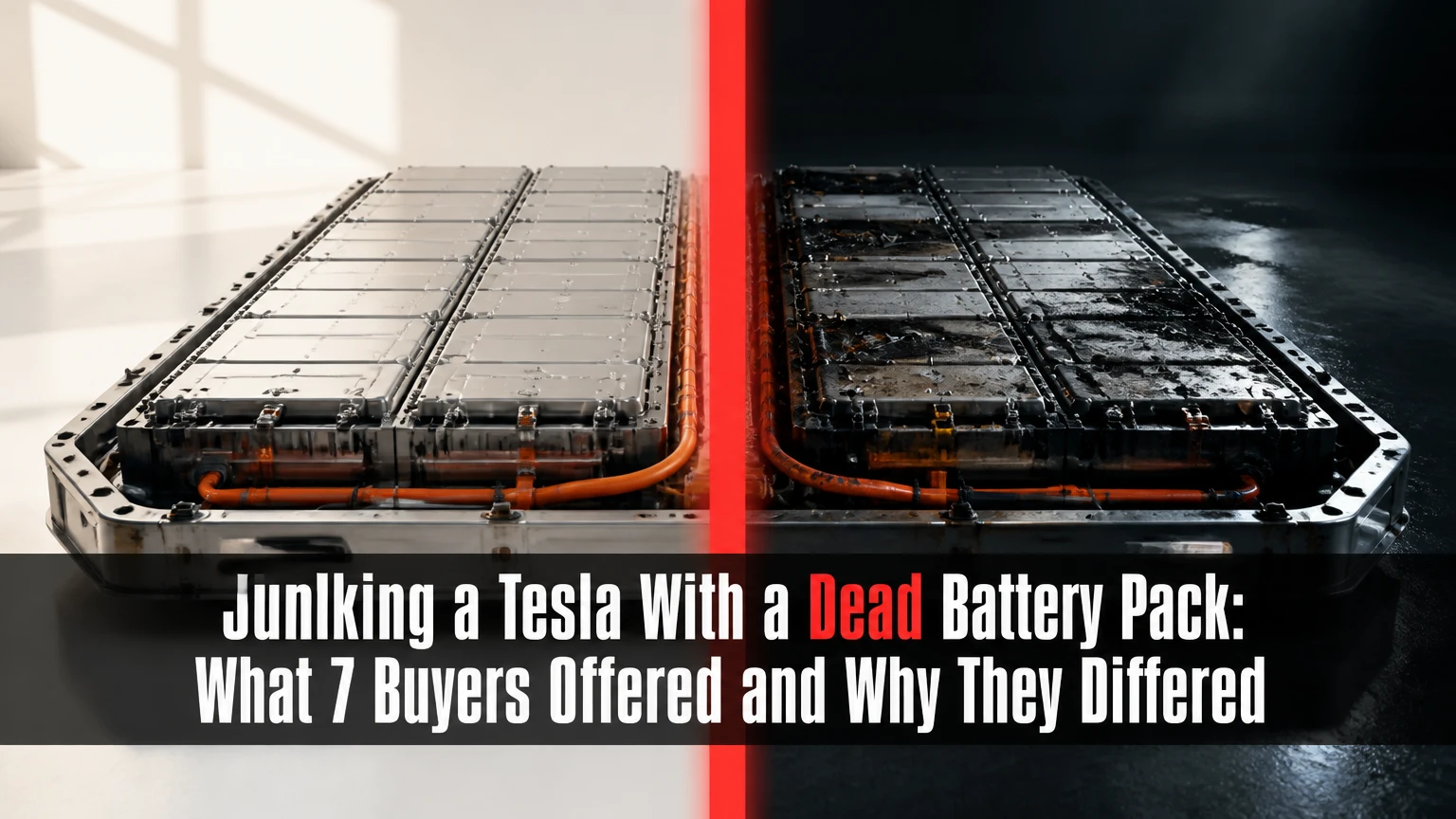
Nobody in the junk car industry has a clean playbook for a dead Tesla yet. We found that out when we tried to sell a 2019 Tesla Model 3 Standard Range with a failed battery pack and called seven different buyers. The offers ranged from $1,100 to $14,500 for the same car.
The spread exists because the battery pack in a Model 3 is worth between $8,000 and $22,000 as a replacement unit, but only to buyers who have the infrastructure to test, certify, and resell it. Most junk buyers do not. Here is every offer, every question asked, and the one buyer type that changed the entire conversation.
The Vehicle and the Failure
Vehicle: 2019 Tesla Model 3 Standard Range Plus, rear-wheel drive, 78,200 miles. Battery failure: the car displayed a “charge system fault” and would not accept a charge above 12% state of charge. Tesla Service confirmed the battery pack required replacement. OEM replacement pack cost quoted by Tesla Service: $13,500 parts plus approximately $3,000 labor.
The car drove under its own power at low speeds using the remaining 12% charge but was effectively non-drivable for normal use. Clean title. No collision history. Interior in excellent condition. All four tires in good condition.
We disclosed the exact battery fault and the Tesla Service diagnosis on every call.
Buyer 1: Tesla Service (Trade-In Credit Program)
Tesla offers a trade-in valuation through their app. We submitted the vehicle details including the battery fault disclosure. The app returned a trade-in credit value of $7,200 applicable toward a new Tesla purchase. This is not a cash payment: it is credit only, applicable only to a Tesla purchase within 7 days.
For anyone not purchasing a new Tesla, this option is effectively worth $0.
Offer: $7,200 in trade-in credit (no cash option)
Buyer 2: National Junk Car Buyer (Peddle)
We submitted the Model 3 through Peddle’s online form, selecting “does not run” and noting the battery failure in the condition field. The platform returned an offer of $1,100. A follow-up call confirmed this was their offer: they categorized the car as non-running and applied standard non-runner pricing. The representative did not ask about the battery pack specifically or whether the car’s drivetrain was otherwise intact.
Offer: $1,100
Buyer 3: National Junk Car Buyer (CarBrain)
CarBrain’s representative asked one question the Peddle form had not: “Is the issue isolated to the battery, or are there other mechanical or body issues?” We confirmed the battery was the only fault. He put us on hold for 4 minutes and came back with $3,200.
“Tesla battery packs are high-value salvage items,” he explained. “We can move them through our auction network.” The offer was still conservative because their auction buyers for Tesla battery packs are limited, but at least the offer reflected the battery’s existence as a value component.
Offer: $3,200
Buyer 4: Local Junkyard
The local independent yard operator was candid: “We don’t take electric vehicles. We don’t have the equipment to handle the battery safely, and we can’t resell the parts.” He confirmed his yard’s policy was no EVs.
Offer: None (declined)
Buyer 5: EV-Specialist Salvage Buyer (Found via Online Research)
We spent 40 minutes researching buyers who specifically handle electric vehicles and found a regional EV dismantler operating in our state. They purchase Teslas, Chevy Bolts, Nissan Leafs, and other EVs specifically for battery and drivetrain component recovery.
Their intake process was the most detailed of any buyer we contacted. They asked:
- What percentage state of charge does the car currently hold?
- What exact error code does the car display?
- Has the car been in a collision that might have deformed the battery pack enclosure?
- What is the VIN? (They looked up the build date to confirm the battery pack generation)
- Is the car’s 12V auxiliary battery functional?
After this 15-minute intake call, they offered $9,800 and scheduled a pickup time.
Offer: $9,800
Buyer 6: Private Buyer (Tesla Owner Forums)
We posted in a Tesla owners’ forum with the car details and the Tesla Service diagnosis. Three responses came within 24 hours. Two were from Tesla owners with failing battery packs looking for a replacement unit. One was from a shop that performs third-party Tesla battery replacements.
The highest offer from the forum came from a Tesla owner who had received a $14,000 OEM battery replacement quote and wanted to purchase our car for the battery pack. He offered $8,500 for the whole car, planning to use the pack himself if it could be recertified, or sell the remaining car body and components.
The third-party repair shop offered $12,000 for the complete car, explaining they would recertify the pack through their diagnostic process and either use it in a customer repair or resell it as a certified replacement.
Best offer from private channel: $12,000 (third-party repair shop)
Buyer 7: Battery Recycling Facility
We contacted a lithium-ion battery recycling facility that accepts EV battery packs. They do not purchase complete vehicles, only packs. They offered $1,800 for the battery pack if we arranged to have it removed and delivered. Removal of a Model 3 battery pack requires specialized lift equipment and takes approximately 4 to 6 hours at an EV shop: roughly $400 to $600 in labor. Net value of the pack through the recycler after removal cost: approximately $1,200 to $1,400.
Recycler offer for pack only: $1,800 (minus $400-600 removal labor)
The Full Offer Comparison
| Buyer | Offer | Cash | Time to Close |
|---|---|---|---|
| Tesla trade-in credit | $7,200 (credit only) | No | Immediate but purchase required |
| Peddle (national junk buyer) | $1,100 | Yes | Same day |
| CarBrain (national junk buyer) | $3,200 | Yes | 2 to 3 days |
| Local junkyard | Declined | N/A | N/A |
| EV-specialist salvage buyer | $9,800 | Yes | 3 to 5 days |
| Tesla owners forum (private) | Up to $12,000 | Yes | 1 to 2 weeks |
| Battery recycler (pack only) | $1,800 pack / net ~$1,300 | Yes | Required removal |
Why the Spread Is So Large
The $10,900 difference between the EV specialist’s $9,800 offer and the Peddle offer of $1,100 comes down to whether the buyer can extract and monetize the battery pack.
A Model 3 Standard Range battery pack (RWD, 2019 vintage) sells on the secondary market for $8,000 to $18,000 depending on condition, state of health certification, and whether it carries any warranty from the reselling party. A buyer who can test the pack, certify its state of health, and sell it through their own distribution network captures that value. A buyer who cannot is looking at a non-running car that goes to general salvage auction.
The local junkyard’s refusal was the most honest response of the seven: they correctly identified that they lack the infrastructure to handle EV battery packs safely or profitably.
What to Do if You Have a Dead Tesla
Do not call a generic junk car buyer first. Search specifically for EV dismantlers, EV salvage buyers, or Tesla-specific salvage operations in your region. Post in Tesla owner forums with the exact VIN and fault description: forum buyers will pay retail-adjacent prices because they are buying a battery for personal use.
If no EV-specific buyer exists in your area, CarBrain’s $3,200 is a reasonable floor: they at least recognized the battery value. Peddle’s $1,100 is the generic non-runner price applied to a car with a component worth 8 to 15 times that amount.
The battery is the asset. Find a buyer who knows that.