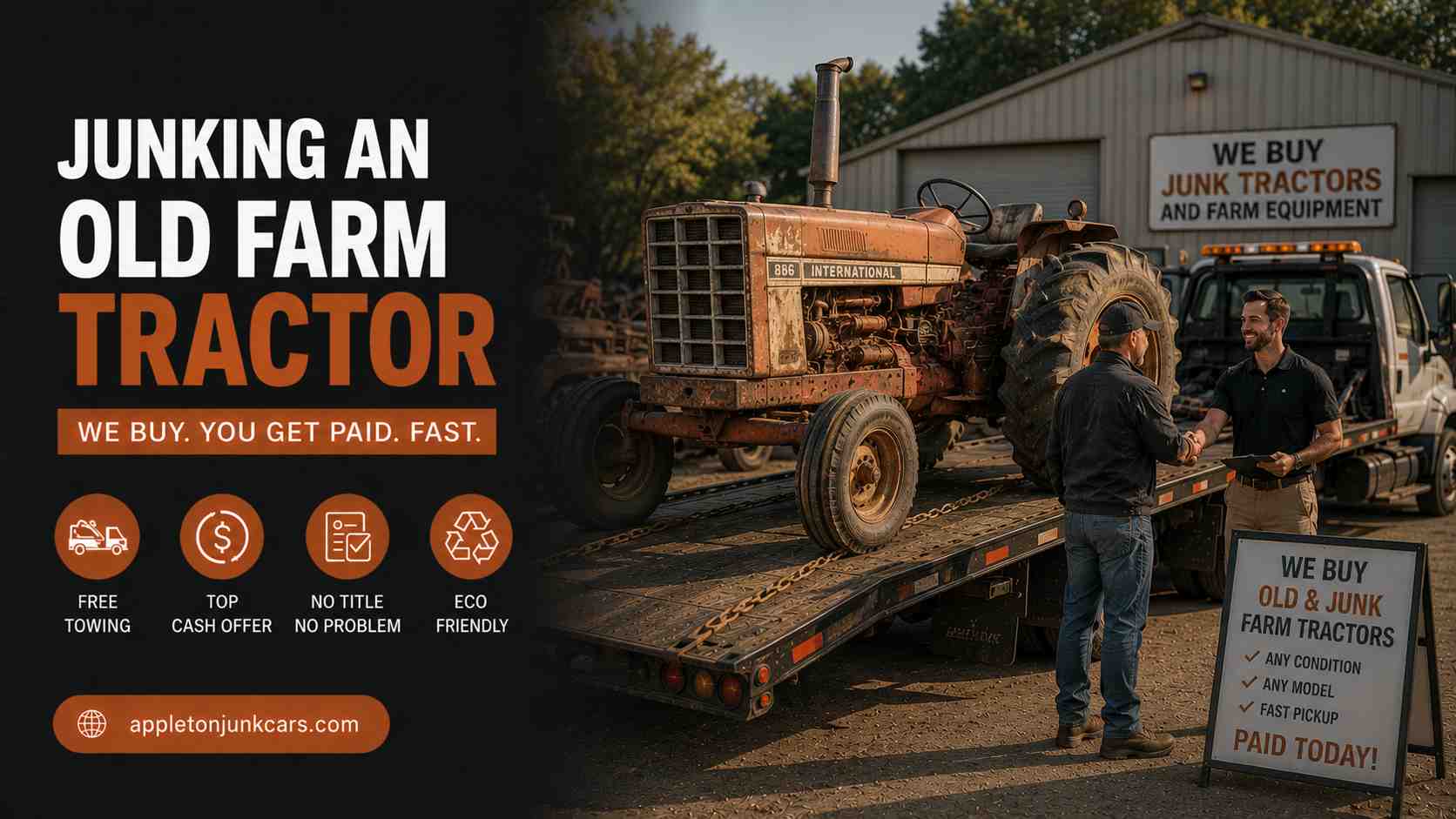
The old tractor has not moved in years. The engine is seized, the hydraulics are dry, or the cost to bring it back to working condition has long since exceeded what the machine is worth running. Most farm owners assume that junking a tractor means calling a scrap yard and accepting whatever the iron price yields that week. That assumption typically costs several hundred to several thousand dollars in recoverable value, depending on the brand of tractor sitting in the field.
Old farm tractors are purchased by farm equipment dealers for parts, by auction platforms that move non-running equipment to national buyer pools, by the vintage and restoration market that pays a premium for specific pre-1970 models, and by scrap iron yards as a last resort. The brand of the tractor, the condition of its drivetrain, and which buyer you contact first are the three variables that determine whether you walk away with $400 or $4,000 from the same machine.
This guide covers what your specific tractor is worth before your first call, why brand matters more than condition in this market, when parting out beats selling whole, and how to move a tractor that has not run in years without spending money on transport that you will not recover.
What an Old or Non-Running Farm Tractor Is Actually Worth
Farm tractor values in non-running or end-of-life condition are determined by three factors in this order: brand and model, drivetrain integrity (is the engine and transmission rebuildable or only good for parts), and current scrap iron pricing for the remaining metal weight.
Tractor Type and Brand | Scrap Iron Value | Parts or Rebuild Buyer Range | Running or Repairable Range |
|---|---|---|---|
John Deere (40 hp to 100 hp, any era) | $800 to $2,500 | $3,000 to $15,000 | $8,000 to $35,000 |
John Deere (100+ hp, utility or row crop) | $2,000 to $5,000 | $6,000 to $25,000 | $15,000 to $60,000+ |
Case IH or International Harvester (any size) | $700 to $2,200 | $2,500 to $12,000 | $7,000 to $30,000 |
New Holland (any size) | $600 to $2,000 | $2,000 to $10,000 | $6,000 to $28,000 |
Kubota (compact, under 60 hp) | $500 to $1,200 | $2,000 to $8,000 | $5,000 to $20,000 |
Massey Ferguson (any size) | $600 to $1,800 | $2,000 to $9,000 | $5,500 to $22,000 |
Vintage Farmall (M, H, Super series) | $400 to $900 | $1,500 to $6,000 (restoration) | $3,000 to $12,000 (restored) |
Oliver, Allis-Chalmers, Minneapolis Moline | $300 to $800 | $1,000 to $5,000 (collector market) | $2,500 to $10,000 (restored) |
Unknown brand or off-brand import | $300 to $700 | Limited parts market | Scrap is often realistic ceiling |
John Deere is the one brand where the parts premium is consistently two to three times any other manufacturer at the same horsepower and condition level. The John Deere aftermarket is the deepest, most liquid, and most nationally distributed parts market in farm equipment. A non-running John Deere tractor of almost any year in almost any condition will find a buyer at prices that significantly exceed the scrap floor. No other brand produces that consistency across condition levels.
Why Brand Matters More Than Condition in the Farm Tractor Market
A non-running John Deere 4440 and a non-running off-brand import tractor of the same horsepower and approximate age will receive offers that are $3,000 to $8,000 apart in most markets, even though their scrap iron content and physical condition are similar. The reason is parts demand, dealer infrastructure, and the cost of parts new.
John Deere, Case IH, and New Holland have global dealer networks and well-documented parts catalogs that make every component on those tractors identifiable, priceable, and findable. When a parts buyer acquires a non-running tractor, they need confidence that the components they pull can be identified, priced, and sold. On major brands, that confidence is high. On obscure brands with no dealer network, it is nearly zero, which is why those tractors attract only scrap pricing regardless of their mechanical condition.
Vintage tractors from Farmall, Oliver, Allis-Chalmers, and Minneapolis Moline occupy a separate category. Their buyer is not the commercial parts market but the restoration and antique show community. These buyers are motivated, knowledgeable, and willing to pay above scrap for a project tractor in rebuildable condition, but they are a niche buyer pool that must be reached through the right channels rather than standard equipment listings.
The Buyers Who Pay Above Scrap Value for an Old Tractor
Farm Equipment Dealers and Parts Specialists
Farm equipment dealers who sell used parts alongside new equipment are the most consistent commercial buyers for non-running tractors on major brands. These dealers need a constant supply of used components to fill repair orders at below-new-parts cost. A non-running John Deere or Case IH tractor with an intact engine, functional hydraulic pump, and rebuildable transmission is worth meaningfully more to a dealer than its weight in scrap iron. Contact dealers who specifically carry your brand and mention that the tractor is available for parts purchase.
Farm Equipment Auction Platforms
BigIron, Purple Wave, Machinery Pete, and IronPlanet are the primary national auction platforms for farm equipment. These platforms reach a buyer pool of farmers, dealers, and equipment investors across the country and internationally. Non-running tractors regularly sell at auction to buyers who price the repair accurately and are comfortable with the condition. The auction format also allows the market to set the price, which frequently exceeds any single local offer for a brand-name tractor. Commission rates on farm equipment auctions typically run 5 to 12 percent of the final sale price.
Vintage and Restoration Buyers
Pre-1970 tractors from Farmall, Oliver, Allis-Chalmers, and John Deere two-cylinder models have an active restoration community that specifically seeks project machines. These buyers are found through tractor-specific forums including Yesterday’s Tractors, through antique tractor Facebook groups, and through regional farm shows where enthusiasts actively network to find project machines. The condition threshold for a restoration buyer is lower than for a commercial parts buyer: a seized engine that has never been run with water intrusion is a restoration project. The same engine in a modern tractor is often not worth rebuilding.
Scrap Iron Yards
Scrap iron yards that handle commercial and agricultural equipment are the floor buyer for any tractor in any condition. They price by weight at the current heavy iron rate, which typically runs $80 to $200 per ton. A 10,000-pound tractor yields $400 to $1,000 in pure scrap value. This is always the option of last resort, not the starting point, for any tractor with a recognizable brand name and intact drivetrain components.
When Parting Out a Farm Tractor Beats Selling It Whole
Parting out a farm tractor is the highest-total-value approach but requires the most time, effort, and storage. It makes the most sense when the tractor has specific high-value components that a whole-tractor buyer would not pay full market value for.
Tractor Component | Typical Used Parts Value | When Worth Selling Separately |
|---|---|---|
John Deere diesel engine (rebuildable, low hours) | $2,000 to $8,000 | Almost always worth separating if you have a direct buyer |
Hydraulic pump (major brand, functional test) | $400 to $2,000 | Farm equipment dealers buy directly; quick sale |
3-point hitch assembly (complete, undamaged) | $300 to $1,200 | Good market with dealerships and private farmers |
PTO gearbox (any major brand, intact) | $300 to $1,500 | Dealers and farmers buy for repair needs |
Front axle assembly (MFWD 4WD, major brand) | $800 to $3,000 | High demand; front axles wear faster than frames |
Cab assembly with AC and heat (intact, late model) | $2,000 to $6,000 | Only on tractors under 20 years old; cab condition must be good |
Tires (rear duals, good tread, matching set) | $500 to $2,500 per set | If tread is over 50 percent; quick sale to farmers |
The front axle assembly and the cab are the two components most consistently worth separating before any whole-tractor sale on late-model utility tractors. Front axle assemblies wear faster than the frame and engine on tractors used in rough terrain, creating consistent demand from farmers who need a replacement axle for a running tractor. A cab in good condition with functioning HVAC is worth $2,000 to $6,000 to a dealer or a farmer who damaged theirs and wants to rebuild.
How to Handle the Title and Bill of Sale for a Tractor Sale
Tractor titling rules differ from vehicle titling rules in important ways. In many states, farm tractors are not titled as motor vehicles and do not require a state-issued title for ownership transfer. The sale is documented through a bill of sale that identifies the tractor by serial number, make, model, and approximate year, with the agreed sale price, date, and both parties’ contact information.
Some states do title agricultural tractors, particularly newer models and those that have been registered for road use. If you are unsure whether your tractor has a title, check with your state’s DMV or department of agriculture. In states where no title exists, the serial number on the tractor serves as the primary ownership identifier. The serial number plate is typically located on the frame near the engine or on the dashboard panel.
For auction sales through BigIron, Purple Wave, or similar platforms, the platform manages the ownership transfer documentation as part of their transaction process. For private sales and dealer purchases, a written bill of sale signed by both parties is the standard and sufficient documentation in most jurisdictions.
Getting the Tractor Off Your Property When It Will Not Move
Moving a non-running tractor that has been sitting for years presents specific challenges. Tires are often flat or rotted, the brakes may be seized, and the steering may be locked. Professional equipment movers and large-format tow operators handle these situations regularly.
For tractors under 15,000 pounds, a heavy-duty flatbed tow truck with ramp capability can typically load a non-running tractor using a chain or winch to drag it up the ramp once the wheels are freed. Inflate the tires if possible before pickup, even temporarily, as a tractor with inflated tires loads significantly more easily than one with flat tires.
For tractors over 15,000 pounds or tractors that cannot be moved at all (seized axles, buried in mud, structural problems), a lowboy equipment trailer with a telehandler or excavator to assist loading is required. This level of specialized transport should be arranged with equipment transport companies rather than standard tow services. Most farm equipment auction platforms and equipment dealers who purchase tractors have relationships with transport companies experienced in this type of recovery.
What Tractor Sellers Consistently Report
Farmers and equipment owners who have sold old or non-running tractors share a consistent pattern. Those who called a scrap yard first, received a weight-based quote, and accepted it without making a second call almost universally later learned they could have recovered significantly more. The difference is most pronounced for John Deere and Case IH tractors, where the parts market produces offers two to four times the scrap floor.
Those who posted on farm equipment auction platforms, particularly BigIron and Purple Wave for Midwest and Plains farm equipment, reported final prices that frequently exceeded their expectations because the auction format attracted buyers from outside their immediate region. A non-running John Deere that generated local interest of $1,500 in scrap quotes sold at auction for $4,200 because a dealer 400 miles away needed exactly that tractor for its engine and transmission.
The restoration market sellers were the most consistently surprised by results. A Farmall M that had been sitting in a barn for 30 years with a seized engine, offered to a scrap yard for $450, was sold after a Facebook post in an antique tractor group for $1,800 to a restoration buyer who drove four hours to collect it. The restoration community’s willingness to travel for the right project is something most sellers underestimate entirely.
Frequently Asked Questions
How much is a junk farm tractor worth?
A junk farm tractor is worth $300 to $2,500 in scrap iron value based on weight and current iron prices. The same tractor sold to a parts buyer or through a farm equipment auction platform is worth $2,000 to $15,000 or more depending on the brand and drivetrain condition. John Deere consistently commands the highest offers above scrap at every condition level because of the depth of the parts market. Scrap should be considered only after auction and parts buyer quotes have been obtained.
Who buys old non-running farm tractors?
Old farm tractors are purchased by farm equipment dealers who buy for parts resale, farm equipment auction platforms including BigIron, Purple Wave, and Machinery Pete, vintage and restoration collectors for pre-1970 models, scrap iron yards for metal weight value, and export buyers through platforms like IronPlanet. John Deere, Case IH, and New Holland tractors have the most active commercial parts buyer market. Vintage Farmall and Oliver tractors have a dedicated restoration collector market.
Do I need a title to sell a farm tractor?
In most states, farm tractors are not titled as motor vehicles and do not require a state-issued title for sale. A bill of sale with the tractor’s serial number, make, model, year, sale price, and both parties’ signatures is the standard documentation. Some states do title agricultural tractors, particularly newer models. Check with your state DMV or department of agriculture if you are unsure. Auction platforms manage their own ownership transfer documentation.
How do you junk a tractor that will not start?
Junking a non-running tractor follows the same process as any non-running heavy equipment sale. Get the scrap iron quote first as your floor. Then contact farm equipment dealers and auction platforms with the specific brand, model, serial number, hours, and a description of the failure. For auction platforms, accurate condition disclosure with photos is sufficient to generate bids. For private sales and dealer purchases, an in-person inspection is standard. Moving the tractor requires either flatbed equipment transport or a dedicated equipment recovery service.
Is a John Deere tractor worth more when junked?
Yes, consistently and significantly. John Deere commands the largest premium above scrap value of any tractor brand at every horsepower and condition level. The John Deere aftermarket parts infrastructure means every component is identifiable, priceable, and sellable. A non-running John Deere utility tractor typically earns two to four times its scrap value from a parts or auction buyer. No other brand produces this premium as consistently across all conditions.
What are the most valuable parts on an old farm tractor?
The most valuable individual components on a major-brand farm tractor are the diesel engine (rebuildable units earn $2,000 to $8,000), the front axle assembly for four-wheel-drive models ($800 to $3,000), the cab assembly on late-model tractors ($2,000 to $6,000), the hydraulic pump ($400 to $2,000), and the PTO gearbox ($300 to $1,500). Matched sets of rear dual tires in good condition also earn $500 to $2,500 on the private market.
How do I find a buyer for a vintage or antique tractor?
Vintage tractor buyers are found through dedicated communities rather than standard equipment platforms. Yesterday’s Tractors is an active forum specifically for antique tractor enthusiasts. Facebook groups dedicated to specific brands such as Farmall, Oliver, or Allis-Chalmers have members who actively search for project machines. Regional antique farm shows and tractor pulls are attended by buyers who network specifically to find machines. These buyers often travel significant distances for the right project and are not found through standard equipment auction listings.
Can I sell a tractor for scrap without a title?
In most states, yes. Farm tractors sold for scrap do not require a title in states where agricultural tractors are not titled as motor vehicles. A bill of sale with the serial number and both parties’ information is typically sufficient for a scrap transaction. The scrap yard’s requirements vary by state law and yard policy. Contact the yard before transporting the tractor to confirm their specific documentation requirements.
The Bottom Line
Junking an old farm tractor does not have to mean selling iron by the pound. The brand of the tractor determines whether the scrap yard quote is a reasonable outcome or a significant undervaluation. For John Deere, Case IH, New Holland, and Kubota tractors, a parts buyer or an auction platform almost always produces meaningfully more than scrap rates. For vintage Farmall and other pre-1970 models, the restoration community is the right buyer at prices that often surprise sellers who expected only scrap.
Get the scrap iron quote first to establish your floor. Then contact farm equipment dealers who carry your brand and post the tractor on at least one national auction platform with accurate condition details and photos. Those two steps, done in that order, reach the buyers who are actively searching for exactly what you have.
The one preparation step that consistently improves outcomes: finding the serial number and documenting it before any conversation with any buyer. The serial number allows a dealer or auction buyer to pull the complete parts catalog for that specific tractor and make an accurate offer. Without it, offers are conservative estimates. With it, offers reflect what the machine is actually worth to a buyer who knows the platform.