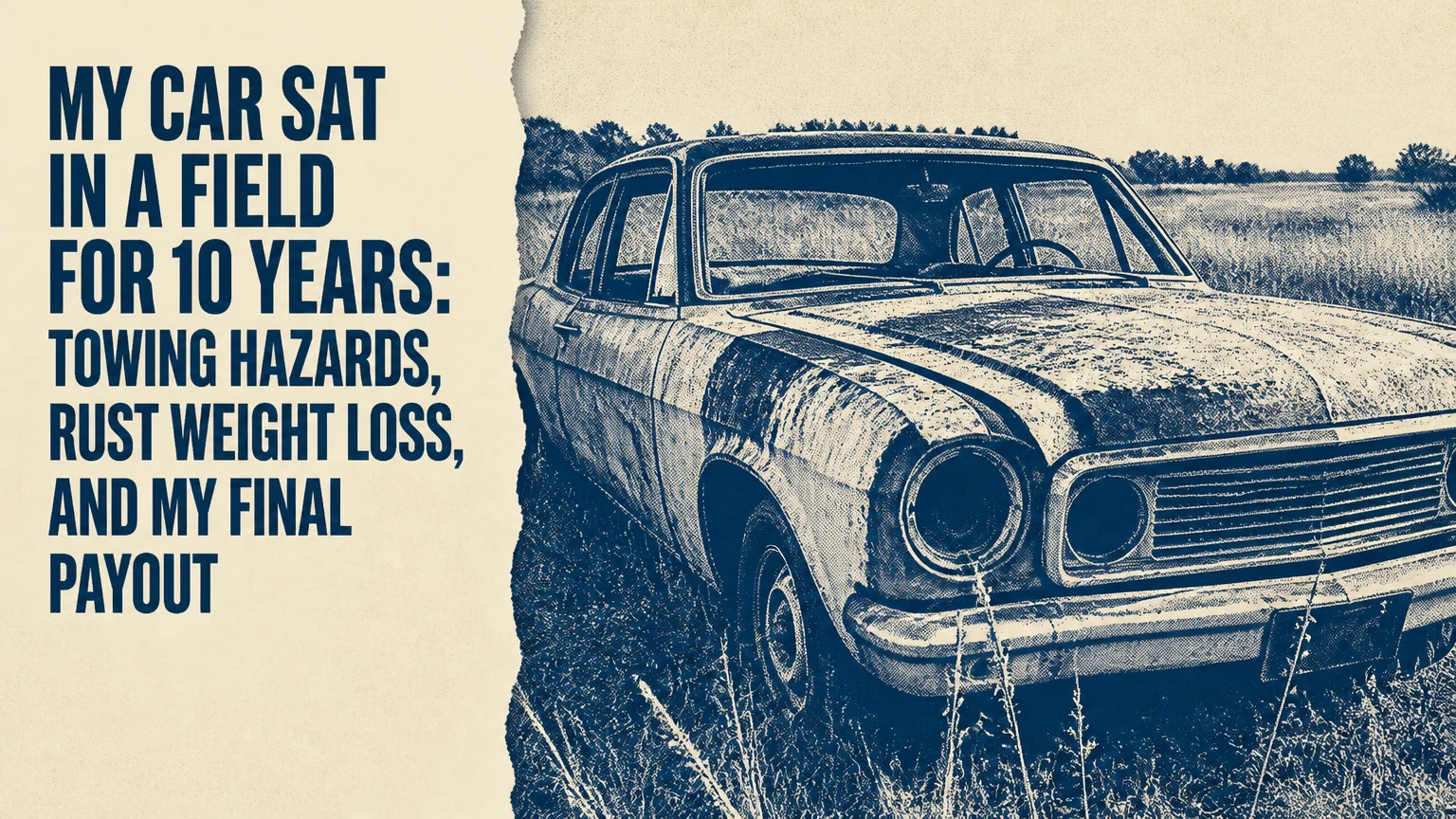
The flatbed driver measured the distance from the gate to the 2004 Ford Explorer at 190 feet, looked at the ground (soft soil, one low section with standing water 40 feet from the car), and told us the recovery would cost $380 before he would accept the tow. That was the first number in a series of numbers that defined what a decade in a field actually does to a scrap transaction.
The Explorer weighed 274 pounds less than its OEM curb weight when we put it on a certified scale. The best scrap quote we received was $410. After the $380 recovery charge, we cleared $30.
1. The Vehicle and Its Field Condition
Specification | Detail |
|---|---|
Vehicle | 2004 Ford Explorer XLT |
Engine | 4.0L SOHC V6 (Cologne) |
Years in field | 10 (2014-2024) |
OEM curb weight (lbs) | 4,456 |
Actual weight at scale (lbs) | 4,182 |
Weight loss from rust and decay (lbs) | 274 |
Fuel in tank | Empty, tank dry, confirmed by visual inspection through filler |
Tire condition | 4 flat: 2 sidewall cracks with visible daylight, 2 intact but fully deflated |
Distance from gate to car (ft) | 190 |
Ground condition | Soft soil throughout, one section with standing water 40 ft from vehicle |
2. The Rust Assessment: Component by Component
We measured rust severity at eight locations using a digital ultrasonic thickness gauge and visual inspection. OEM steel wall thickness specifications came from the Ford service manual for the 2004 Explorer body structure.
Component | OEM Wall Thickness (mm) | Measured Remaining (mm) | Rust Classification | Towing Implication |
|---|---|---|---|---|
Left rear frame rail (worst point) | 4.8 | 2.3 | Penetrating, structurally compromised | Winch anchor point rejected here, used front tow hook only |
Right rear frame rail | 4.8 | 3.9 | Surface, structurally sound | Acceptable for chain anchor |
Left rocker panel (floor junction) | 1.8 | 0.4 | Penetrating, perforated at one point | No structural load, cosmetic only for tow |
Floor pan (driver front) | 1.2 | 0.2 | Penetrating, 3 perforations visible | Interior water intrusion confirmed, no tow impact |
Brake lines (all four corners) | N/A (steel tubing) | Corroded through, no pressure integrity | Non-functional, no brake assist during winching | |
Fuel lines | N/A (steel tubing) | Corroded but intact, tank empty | No hazard, tank confirmed dry | |
Hood hinge mounting points | 3.0 | 2.6 | Surface only | No tow impact |
Subframe front crossmember | 5.2 | 4.1 | Surface, structurally sound | Front winch attachment safe at this point |
Image placeholder: photo of 2004 Explorer left rear frame rail with ultrasonic gauge probe contact visible, gauge display showing 2.3mm reading, OEM spec sheet clipped to frame showing 4.8mm original thickness, visible rust pitting at measurement point, scale reference card in frame
3. The Towing Hazards and How the Driver Handled Each One
Ground Penetration and Soft Soil Extraction
All four tires had sunk into the soil over 10 years. The front tires sat 4 inches below grade level. The rear tires sat 6 inches below grade on the left side, where the standing water drainage ran. The driver used a come-along rated at 4,000 lbs to break the rear tires free from the soil before attaching the winch cable. Breakout force required: three full come-along pulls at maximum extension before the rear moved. Total breakout time: 22 minutes before the winch cable was attached.
Frame Rail Rejection for Winch Anchor
The driver inspected the left rear frame rail before attaching his winch chain and rejected it when the rail deflected visibly under thumb pressure at the 2.3mm point. He moved the anchor to the right rear tow hook, which showed no deflection, and ran the winch cable at an angle to the front-mounted capstan. The asymmetric pull created a slight yaw during the first 20 feet of movement that the driver corrected by slowing the winch and repositioning the come-along.
Brake Line Failure Risk During Movement
No brake lines on this vehicle held pressure. The driver confirmed this by asking us not to apply the parking brake before winching and not to expect any braking assist if the car moved unexpectedly during loading. A 4,456-pound SUV on a soft downhill grade with no braking function is a runaway risk. The driver chocked the front wheels before beginning the rear extraction and left the chocks in place until the front of the car was on the flatbed deck.
Image placeholder: photo from driver’s position on 2004 Explorer recovery: all four tires visible below grade level with soil compacted around sidewalls, come-along cable attached to right rear tow hook, ground chocks under front wheels, flatbed ramp extended in background 190 feet away across soft field
4. Rust Weight Loss: What 274 Pounds Actually Means at the Scale
The OEM curb weight of a 2004 Explorer XLT 4.0L is 4,456 pounds. We confirmed this against the door placard, which still read the original specification. The scale at Yard B returned 4,182 pounds. The 274-pound difference represents steel that oxidized, crumbled, and either fell from the vehicle or remained as loose rust scale.
At the regional scrap steel rate at time of test ($0.085 per pound), 274 pounds of lost steel equals $23.29 in lost scrap value. That is not the meaningful number. The meaningful number is that a car sitting in a field loses structural material, and the buyers who inspect before quoting discover that loss and price it into their conditional offers.
Weight Category | OEM (lbs) | Actual at Scale (lbs) | Difference (lbs) | Scrap Value Lost ($) |
|---|---|---|---|---|
Vehicle total | 4,456 | 4,182 | 274 | $23.29 at $0.085/lb |
Frame steel (estimated) | 320 OEM | Unmeasured separately | Partial loss at left rear rail | Included above |
Body panel steel (estimated) | 480 OEM | Unmeasured separately | Minimal loss (surface rust) | Included above |
5. The Scrap Quotes and Recovery Fee Breakdown
Yard | Quote ($) | Condition Assessment | Recovery Fee Charged ($) | Net Payout ($) |
|---|---|---|---|---|
Yard A (regional) | $320 | Rust documented, frame rail noted, condition-adjusted quote | $380 (charged by tower separately) | -$60 net (we paid $60 to have it removed) |
Yard B (national scrap buyer) | $410 | Weight-based quote, no on-site inspection before pickup | $380 (same tower) | $30 net |
Yard C (local) | $280 | Applied “field recovery” condition discount before quoting | $380 (same tower) | -$100 net |
Yard B produced the best net at $30 because they priced by scale weight without sending an inspector before the tow. Yards A and C both applied condition adjustments before the car moved. Yard A’s inspector documented the left rear frame rail. Yard C applied a blanket field-recovery discount.
The tower charged $380 regardless of which yard we chose. The recovery charge was for the site conditions: soft soil extraction, 190-foot pull, asymmetric winch setup, and extended site time of 52 minutes. A standard rollable car in a paved lot takes 6 to 8 minutes. The $380 covered 44 minutes of additional work.
6. What 10 Years in a Field Actually Returns
We cleared $30. The Explorer generated $410 at the scale and cost $380 to recover from the field. If we had used Yard A or Yard C, we would have paid out of pocket to have the car removed. The difference between the three yards on a field recovery with documented frame rust was $130 from lowest to highest, and the highest was barely above the recovery cost.
A car that sits in a field for 10 years is not a junk car with a storage problem. It is a field recovery operation with a scrap car attached. Price the towing first, get the yard quote second, and subtract one from the other before you decide whether removal makes financial sense at all.