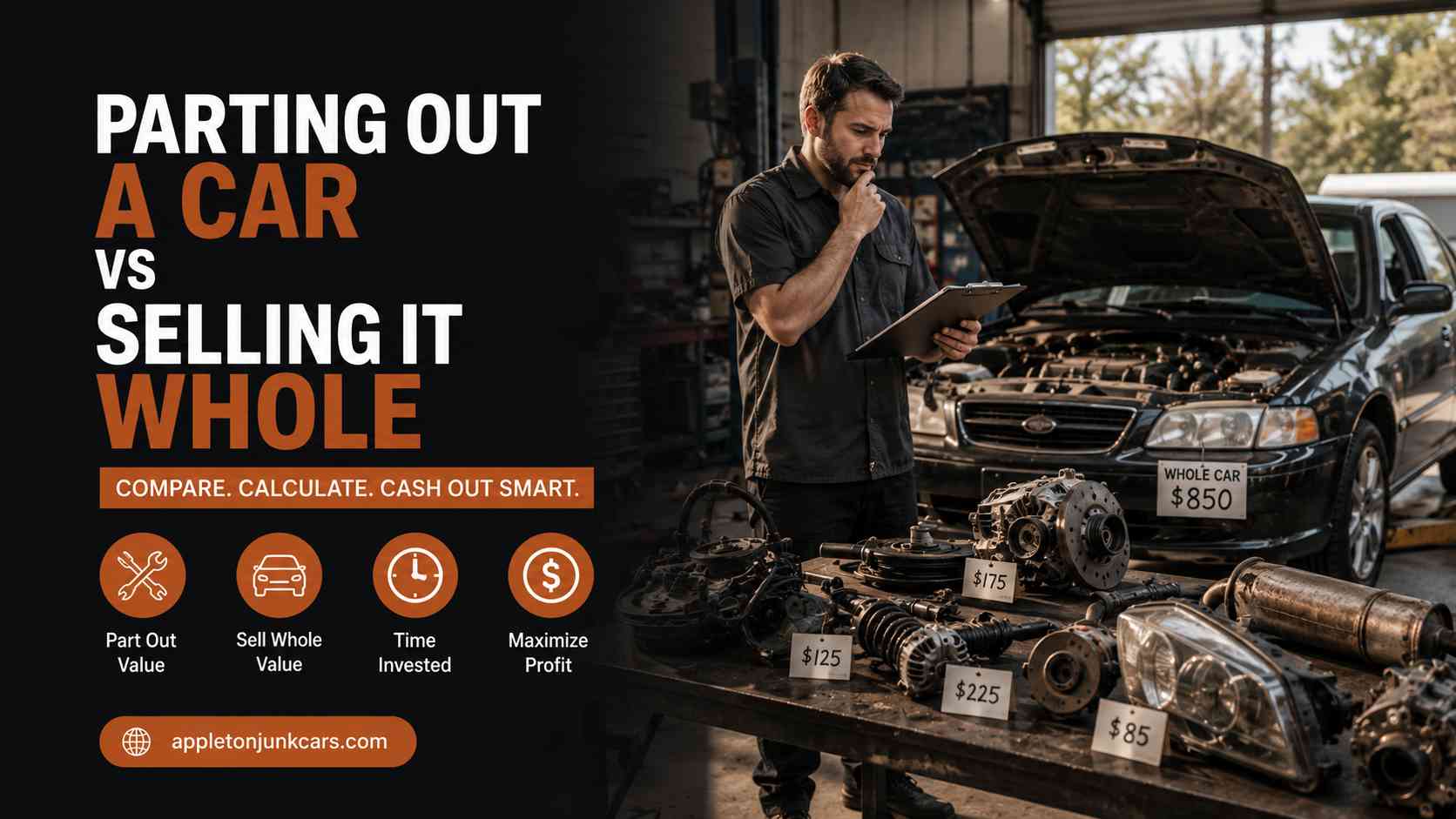
On paper, parting out a car sounds obvious. The engine alone can be worth more than the whole junk car offer. Add the transmission, the catalytic converter, the wheels, and a handful of other components and you are looking at numbers that make a $400 junkyard quote feel almost insulting.
In reality, parting out a car is a part-time job that most people are not prepared for. It requires tools, space, mechanical knowledge, weeks or months of storage, and a tolerance for fielding inquiries from forty people to sell to three. The difference between what parting out could make and what it actually makes in your specific situation is where this decision lives.
This article gives you the honest math, the parts worth focusing on, the situations where selling whole is clearly better, and a third path that most guides skip entirely: the hybrid approach that captures most of the upside with a fraction of the work.
The Money Gap: What the Numbers Actually Look Like
The financial case for parting out is real. A car that a junkyard would buy for $300 to $600 as a whole unit can generate $2,000 to $5,000 if its components are sold individually to the right buyers. That gap exists because the salvage yard needs to process, store, and markup the parts themselves. When you sell directly, you capture their margin.
But the math has a denominator that most comparisons ignore: time. Parting out a car typically takes 20 to 40 hours spread across several weekends, and the process extends over months as you wait for buyers for each component. When you divide the extra money by the hours invested, the effective hourly rate is often lower than people expect.
Here is a more honest version of the comparison:
Part Out | Sell Whole | Hybrid Approach | |
|---|---|---|---|
Typical return (popular model) | $2,000 to $5,000 | $300 to $700 | $700 to $1,500 |
Time required | 20 to 40+ hours | 1 to 2 hours | 3 to 8 hours |
Tools needed | Full garage setup | None | Basic hand tools |
Storage space required | Significant | None | Minimal |
Timeline to completion | Weeks to months | 24 to 48 hours | 1 to 3 weeks |
Buyer management | Many individual buyers | One transaction | A few buyers |
Leftover to dispose of | Stripped shell | Nothing | Partial car (still sellable) |
The Parts That Actually Drive the Value
Not every component in a car is worth pulling and listing. The economics of parting out are driven by a small number of high-value parts. Focus on these first.
The Catalytic Converter
Already covered in depth elsewhere on this site, but worth repeating here: the catalytic converter is often the single most valuable component in a junk car. It contains platinum, palladium, and rhodium, which are precious metals that trade on global commodity markets. Depending on the vehicle, a catalytic converter can be worth $100 to $800 or more. For hybrids, the figure can exceed $1,000.
It is also the easiest major component to remove. A few bolts or a cut with a reciprocating saw (in states where that is legal and the converter is from your own vehicle) and it is off. The effort-to-value ratio on the catalytic converter is the best of any part on the car, which is why many owners pull just this one piece before selling the rest whole.
Engine and Transmission
These are where the real money is in a part-out, but they are also the most demanding to remove correctly. A working engine from a popular model can sell for $800 to $3,000 depending on the vehicle, mileage, and condition. Automatic transmissions in good working order bring $200 to $800. Manual transmissions from performance or sports cars can bring significantly more to enthusiast buyers.
The critical caveat: both components need to be in genuinely working or rebuildable condition to command strong prices. An engine from a car that died because of an engine failure is worth little as a used part. An engine from a car that died from a non-engine problem, a transmission failure, an accident that spared the engine bay, or a rusted-out frame, is the valuable scenario.
Removing an engine or transmission requires an engine hoist or cherry picker, proper jack stands, and the mechanical knowledge to disconnect fuel lines, cooling systems, wiring harnesses, and drivetrain components safely. If you do not have this setup, the removal cost at a shop ($80 to $100 per hour) can eat significantly into the margin.
Wheels and Tires
A set of aftermarket alloys in good condition can sell for $200 to $800 as a set. Even stock aluminum wheels in clean condition bring $100 to $300. Tires with meaningful tread remaining add value to the set. This is a relatively easy removal with basic hand tools and a floor jack, making the effort-to-value ratio strong.
Headlight and Tail Light Assemblies
Modern LED or HID headlight assemblies can sell for $75 to $400 each because replacements from dealers are expensive. If your car has projector headlights, LED daytime running lights, or any premium lighting technology, the assemblies are worth listing. Tail lights are similarly valuable for popular models where the assemblies are frequently damaged in accidents.
Infotainment and Electronics
Factory navigation systems, premium stereo head units, backup camera systems, and advanced driver assistance modules all retain strong used market value because they are expensive to replace through dealers. A factory navigation head unit that costs $800 from the dealer might sell for $200 to $400 used. Easy to remove with a trim tool and a few wire connectors.
Other Parts Worth Considering
- Alternator and starter: $50 to $200 each. Easy to remove and fast to sell.
- AC compressor: $80 to $250. Higher demand in spring and summer.
- Seats and interior: Leather seats from premium trims can sell for $150 to $500 for a set. Useful for owners restoring the same model.
- Doors and body panels: Only valuable if undamaged and from a popular model. Difficult to ship; local sale only.
- Battery: If relatively new, $40 to $100. Easy removal. Auto parts stores sometimes buy used batteries.
- Window motors and regulators: $40 to $120. Frequently replaced part on aging vehicles.
The 3x Rule: A Quick Way to Decide
Here is a practical framework for making the call without extensive research. Look up the current junk car offer for your vehicle, then check eBay completed listings for the ten most valuable parts on your specific make, model, and year. Add up the top ten.
If the top ten parts total more than three times the whole-car offer, parting out is worth considering. If it does not, the extra work is unlikely to justify itself after time and hassle are factored in.
Example: a junkyard offers $400 for your car. Your top ten parts research suggests $1,800 in potential sales. That is 4.5 times the whole-car offer. The math strongly favors parting out if you have the capability.
Example 2: a junkyard offers $400 for your car. Your top ten parts research suggests $700 in potential sales. That is 1.75 times the offer. The extra $300 over many weekends of work is probably not worth your time.
The Third Option Most Guides Skip: The Hybrid Approach
Between fully parting out and selling whole, there is a middle path that most people overlook. Pull the two or three most valuable, easiest-to-remove parts, sell those independently, then sell the remaining car to a junk buyer.
A common version of this looks like:
- Remove and sell the catalytic converter: $150 to $600 depending on vehicle
- Remove and sell the aftermarket wheels if present: $200 to $600
- Remove and sell the infotainment system if premium: $150 to $350
- Sell the remaining car to a junkyard: $200 to $400 (slightly less without cat and wheels)
Total: $700 to $1,900 in a few hours of work across a weekend, versus $300 to $600 for the whole car in one transaction.
The junkyard offer will typically decrease when major components are missing, because those components had value to them too. Be upfront about what has been removed when calling for quotes. But the reduction in the whole-car offer is almost always less than what you received selling the removed parts independently.
This hybrid approach captures 60 to 80 percent of the financial upside of a full part-out with roughly 15 percent of the effort. For most car owners who are not mechanically inclined or do not have weeks to spend on it, this is the most practical high-return option.
When Parting Out Makes Clear Sense
The vehicle is popular with an active parts market. A 2007 Honda Accord, a 2010 Ford F-150, or a 2008 Toyota Camry has hundreds of thousands of identical vehicles on the road. Owners of the same model actively search for used parts. Parts from obscure or unpopular models sit in storage without buyers.
The powertrain is intact and working. This is the scenario where the real money is. A car with a dead transmission but a running engine is a parts goldmine. A car with a dead engine and a working body is a weaker parts proposition because the most valuable component is the problem.
You have the space, tools, and mechanical knowledge. Parting out without a proper workspace becomes messy and inefficient fast. A driveway with basic tools works for removing wheels and electronics. An engine hoist and jack stands are needed for powertrain removal.
You are not in a hurry. Parts sales take weeks to months. If you need money now or the car is in a location where it cannot sit for that long, parting out is the wrong timeline for your situation.
The vehicle has enthusiast or collector appeal. Sports cars, performance trims, and vehicles with active enthusiast communities command strong used parts prices because the buyers know what parts cost new and are motivated to find used alternatives. A rare trim piece from an enthusiast vehicle can sell for more than it would from a standard model.
When Selling Whole Makes Clear Sense
You need money quickly. A junk car buyer pays at pickup, which is typically within 24 to 48 hours of calling. A part-out pays over weeks or months. If cash is the priority, whole sale wins on timeline.
The car is not from a popular make or model. Parts demand is thin for uncommon vehicles. Listed parts will sit waiting for the narrow pool of buyers who need that specific component for that specific car. The theoretical value of parts rarely materializes for obscure models.
The powertrain is the problem. If the engine or transmission is why you are getting rid of the car, those components have limited or no resale value as parts. The remaining car without its two most valuable components is mostly scrap metal, and the economics of a full part-out no longer work.
You lack tools, space, or mechanical experience. Attempting a part-out without the right setup wastes time and risks damaging parts during removal, which reduces or eliminates their resale value. A damaged engine gasket during removal is a costly mistake.
The car is in a location where it cannot sit. Apartment complexes, rented driveways, HOA communities, and any location where a partially disassembled car will cause problems rule out a long part-out process.
Platforms for Selling Individual Parts
eBay Motors. The largest national marketplace for used auto parts. Reaches buyers across the country for smaller, shippable components. The fee structure takes a percentage of the sale, but the audience justifies it for valuable parts. Include the OEM part number in the title for maximum search visibility.
Facebook Marketplace. Best for local sales on heavy or bulky items that are impractical to ship. Engines, transmissions, seats, and body panels all sell well locally. No fees for private sellers. Expect significant inquiry volume from people who do not end up buying.
Craigslist. Still active in many markets, particularly for mechanical components. Cash-and-carry local transactions. Less traffic than Facebook Marketplace in most areas but attracts serious mechanics.
Car-specific forums and Facebook groups. For enthusiast vehicles, the best prices often come from people who know exactly what they need and understand its value. A Honda enthusiast forum buyer will pay more for the right part than a general marketplace buyer who is less certain of what they are getting.
Local junkyards and auto recyclers. For components that are not selling online after a few weeks, local auto recyclers sometimes buy individual parts at wholesale prices. Less money than private sale but faster exit than letting parts sit.
The Realities Nobody Warns You About
People who have parted out cars share some consistent observations that do not make it into the enthusiastic online guides.
The ratio of inquiries to actual buyers is brutal. For every person who actually shows up with money, expect twenty to fifty inquiries including lowball offers, requests to hold parts indefinitely, no-shows on confirmed appointments, and people who disappear mid-negotiation. One experienced part-out seller described needing contact with fifty people to produce two or three actual sales. This takes mental bandwidth and time that is easy to underestimate.
Some parts never sell. Interior trim from a common vehicle, used filters, worn brake pads, and most cosmetically damaged body panels simply do not have buyers at any meaningful price. You end up with a collection of parts that took time to remove and generate nothing. Knowing in advance which parts are worth pulling and which are not is essential.
The stripped shell is its own problem. After the valuable parts are sold, you are left with a partially disassembled car that still needs to leave your property. Junkyard offers on stripped shells are lower than on complete vehicles. You need to arrange that pickup, which adds another step to an already multi-step process.
Shipping is complicated and expensive. An engine weighing 400 pounds, a transmission weighing 150 pounds, or doors that will not fit in a standard box all create shipping challenges that reduce your effective national buyer pool. Heavy, bulky items almost always need to be local sales, which limits your audience.
Frequently Asked Questions
Does parting out a car really make more money than selling it whole?
For popular vehicles with working powertrains, yes, often significantly more. The gap between parting out and selling whole can be $1,000 to $4,000 for the right vehicle. For vehicles with non-working engines, unpopular models, or parts in poor condition, the gap narrows dramatically and may not justify the effort.
What are the most valuable parts to sell when parting out a car?
The catalytic converter, engine, and transmission are typically the highest-value components. Aftermarket wheels, headlight assemblies, premium electronics, alternators, and AC compressors round out the list of parts worth prioritizing. For enthusiast vehicles, performance parts and rare trim pieces can also command strong prices.
How long does it take to part out a car?
A thorough part-out typically takes 20 to 40 hours of work spread over several weekends, with the overall process taking weeks to months as you wait for buyers on each component. The hybrid approach of pulling only the top two or three value items takes a few hours over a single weekend.
What do I do with the shell after parting out?
The remaining shell can be sold to a junkyard for scrap value, typically $150 to $300. The offer will be lower than what you would have received for the complete car, since the valuable components have been removed. Let the junkyard know what is missing when you call so they can quote accurately.
Is the hybrid approach worth it?
For most car owners, yes. Pulling the catalytic converter and any obvious high-value components before selling the rest whole takes a few hours and regularly adds $200 to $600 to the total payout with minimal effort and no specialized tools for most components. It is the best balance of return versus effort for the average seller.
What if I remove parts and the junkyard offer drops significantly?
Be transparent when calling for quotes. Tell the buyer what has been removed so they can price accordingly. The drop in the whole-car offer should be less than what you received for the removed parts. If a buyer quotes significantly lower than expected because of removed parts, get other quotes to compare.
The Bottom Line
Parting out wins on maximum return. Selling whole wins on speed, simplicity, and zero effort. The hybrid approach wins on the ratio of extra money to extra work.
The right answer depends on three things: how popular your vehicle is in the used parts market, whether the powertrain is working, and how much time and mechanical capability you realistically have. Check eBay completed listings for your top parts before you decide. That research takes twenty minutes and tells you more than any generalization can.
If the math works and you have the setup, parting out is genuinely worth it. If it does not, selling whole is not giving up money. It is recognizing that time has value too, and the difference sometimes is not as large as it looks from the outside.