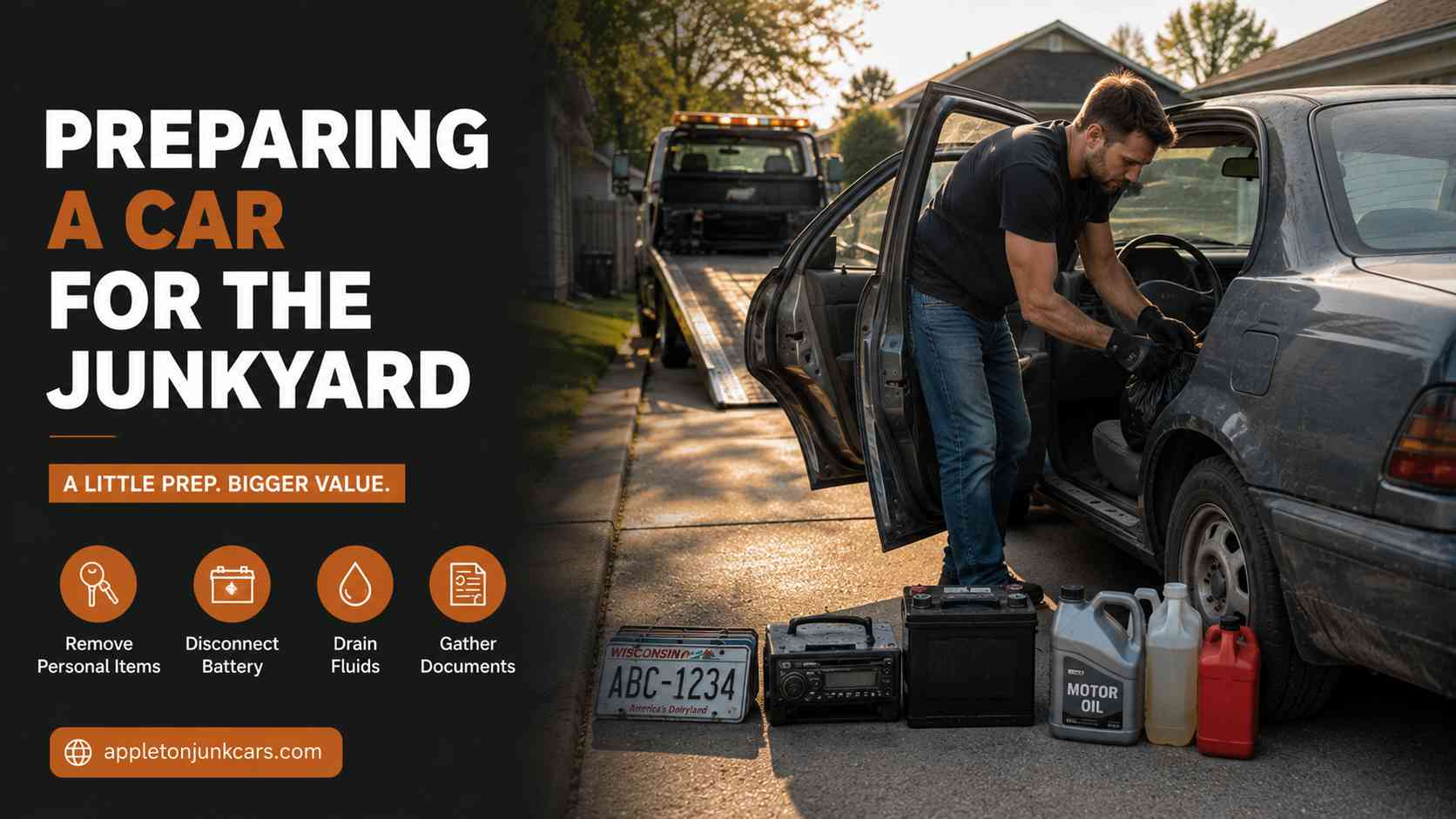
Most people think preparing a car for the junkyard means making sure someone is home when the tow truck arrives. The preparation that actually matters happens in the 24 to 48 hours before the pickup. What you do before any buyer visits determines how smoothly the transaction goes, what you receive in payment, whether any loose ends follow you after the car is gone, and whether you leave money or valuables behind.
The preparation list is not long, but every item on it matters. The title, the personal belongings, the high-value accessories, the administrative steps, and the site accessibility are each either a source of problems or a non-issue depending on whether you addressed them before the truck arrived. This guide covers all of it in the order you should address each step.
This is also the article to share with anyone who asks what they need to do before junking a car. The checklist at the end of this guide covers every step in a format you can reference the night before the pickup.
The Complete Step-by-Step Guide to Preparing a Car for the Junkyard
Step 1: Gather and Verify the Title Before Anything Else
The title is the most important document in the transaction. Everything else is secondary. Find the title before making any calls, before accepting any quotes, and before scheduling any pickup.
Confirm three things about the title: it is in your name (not a previous owner’s name), there is no lien or lienholder listed on the front (or if there is, the lien has been paid off and the lender has released it), and the title is physically complete with no alterations, missing sections, or illegible information.
If the title is in good order, set it aside in a safe place and have it ready for the day of pickup. If the title is lost, apply for a replacement at your state DMV before scheduling any pickup. Replacement titles take one to three weeks and cost $15 to $35. A clear title in hand consistently produces better offers and eliminates the most common cause of last-minute transaction failures.
Step 2: Remove Every Personal Item From the Vehicle
This step sounds obvious but generates more post-sale regret than almost anything else in a junk car transaction. Sellers consistently report discovering missing items weeks or months after the sale. By that point, the car is already crushed or dismantled and recovery is impossible.
Location | What to Check | Why It Matters |
|---|---|---|
Glove compartment | Insurance cards, registration documents, owner’s manual, pen, sunglasses, coins, toll receipts | Insurance and registration documents should not travel with the car |
Center console | Garage door openers, parking passes, phone chargers, spare change, sunglasses, medications | Garage door openers are the most commonly forgotten high-stakes item |
Under seats | Phone chargers, pens, coins, emergency supplies, forgotten tools | Hard to see; easy to miss during a quick walk-through |
Trunk and cargo area | Spare tire tools, jack, jumper cables, emergency kit, sports equipment, tools | Many sellers forget the emergency kit and tools; these have real replacement cost |
Seat pockets and door pockets | Maps, receipts, pens, small personal items | Quick to check; easy to overlook |
Sun visor clips and overhead | Garage remotes, sunglasses, parking passes, toll tags (EZ-Pass, SunPass, etc.) | Toll transponders especially important: they may continue billing to your account |
OBD-II diagnostic port | OBD-II scanner or trip tracker device plugged in | These are easily forgotten; some are expensive |
Toll transponders (EZ-Pass, SunPass, FasTrak, and similar) require particular attention. If a transponder stays in the car and the salvage yard or buyer drives the vehicle through a tolled area, the charges appear on your account. Remove and either deactivate or transfer the transponder before the car is picked up.
Step 3: Identify and Remove Accessories Worth Selling Separately
Certain aftermarket accessories are worth more sold separately than they contribute to a junk car offer. Identifying them before any buyer arrives gives you the option to sell them privately before the pickup and collect their full market value rather than whatever fraction a junk buyer implicitly factors in.
The categories worth checking: aftermarket head units with wireless CarPlay or Android Auto from name brands (Pioneer, Kenwood, Alpine, Sony) installed within the last four years are worth $80 to $300 on Facebook Marketplace. Name-brand amplifiers and subwoofers (Rockford Fosgate, JL Audio, Alpine) are worth $100 to $500 depending on model and condition. Fifth wheel or gooseneck hitches in working condition are worth $400 to $1,200 sold separately. Service bodies or flatbed beds from commercial trucks are worth $1,500 to $5,000 to truck body dealers.
What NOT to remove: the catalytic converter (removing it reduces your offer by more than its separate sale value), the lead-acid battery (included in every offer; removing it reduces the price), and the spare tire and jack if they came with the vehicle (buyers sometimes specifically ask about spare tire presence).
Step 4: Confirm What to Leave in the Car
Component | Leave In or Remove? | Reason |
|---|---|---|
Catalytic converter | Leave in | Removing before sale reduces offer by more than its separate value |
Lead-acid battery | Leave in | Included in every buyer’s offer; removing reduces the price |
Spare tire and jack | Leave in | Often included in buyer’s expectation of a complete vehicle |
Factory stereo (if aftermarket replaced it) | Leave in (or reinstall) | Does not affect offer; some buyers prefer it to an empty dash |
Aftermarket stereo with CarPlay (name brand, recent) | Consider removing | May sell for $80 to $300 privately in 10 to 20 minutes of work |
Fifth wheel or gooseneck hitch | Consider removing | Worth $400 to $1,200 privately; junk buyer does not pay full value |
Service body or flatbed | Consider removing and selling separately | $1,500 to $5,000; separate sale almost always produces more |
OEM wheels (if aftermarket are on the car) | Optional | Only if OEM wheels are in good condition and you have a private buyer interest |
The principle behind this table: components that buyers specifically price into their whole-car formula (cat converter, battery) should stay in because removing them reduces the offer by their full value. Components that buyers do not specifically price (aftermarket audio, specialty towing equipment) may produce more revenue if sold separately through private channels before the junk car pickup.
Step 5: Make the Car Accessible for Pickup
A junk car that is easy to reach and load is worth slightly more than one that requires special handling, because buyers factor access difficulty into their offers. Spending 30 minutes on accessibility can protect $50 to $150 in offer value.
Clear the area around the car: remove any vehicles, equipment, or debris that would require the tow operator to reposition before loading. A flatbed that can back straight to the car and load it in one motion is efficient; a flatbed that must maneuver around obstacles adds time and may result in a site surcharge.
If the car has flat tires, inflate them if possible before pickup. A car that can roll freely onto a flatbed loads significantly faster and more easily than one with flat tires. A portable compressor or a trip to a gas station for a few dollars of air is worth the effort.
If the car is in a garage, clear the space around it and make sure the garage door can be fully opened. Confirm that the ceiling clearance is sufficient for the flatbed ramp to extend into the garage if loading from inside is required. Many tow operators prefer loading from outside; if you can position the car at the garage door or in the driveway, loading is simpler for everyone.
Step 6: Handle the Post-Sale Administrative Steps in Advance
Several administrative steps are technically post-sale but are best planned before the pickup so you are not scrambling to figure them out while the tow truck is parked in your driveway.
Insurance Cancellation
Cancel your insurance policy effective on the day the car leaves your property, not before. Cancelling before the pickup eliminates coverage on a vehicle you still technically own. Call your insurer the morning of the pickup or immediately after the car is taken, and request a prorated refund for any unused premium.
Registration and Plates
Remove your license plates before the car is picked up. In most states, plates belong to the owner, not the vehicle, and should not transfer with the car. After pickup, cancel the registration at your state DMV and file a notice of transfer or release of liability form. This step formally closes the registration in your name and protects you from any violations associated with the vehicle after the sale date.
Lender Notification
If the car has an active loan, the lender must be involved in the sale. The junk car buyer’s payment typically goes toward paying off the remaining loan balance, with any excess paid to you. Contact the lender before scheduling pickup to confirm the payoff amount and the process for releasing the title after payment.
The Complete Pre-Sale Preparation Checklist
Task | When to Do It | Status Check |
|---|---|---|
Locate and verify title (your name, no lien) | Before calling any buyers | Most important step; do not schedule pickup without it |
Get 3 competing quotes (scrap floor, specialist, national platform) | 1 to 3 days before pickup | Use each quote as leverage in subsequent calls |
Remove all personal items from every compartment | Day before pickup | Check glove box, console, under seats, trunk, visors |
Remove toll transponders specifically | Day before pickup | Charges continue until transponder is deactivated |
Identify and remove accessories worth selling separately | 1 to 3 days before pickup | Head units, hitches, service bodies; never the cat converter |
Inflate flat tires if possible | Morning of pickup | Allows flatbed loading without winching |
Clear access path around the car | Day before pickup | Prevents access surcharges from the buyer |
Remove license plates | Before car is picked up | Keep plates; do not let them leave with the vehicle in most states |
Confirm title signing procedure with buyer | When scheduling pickup | Know exactly which line to sign and what to fill in |
Cancel insurance same day as pickup | Day of pickup, after car is gone | Never cancel before the car leaves your property |
File notice of transfer / release of liability | Within 5 to 10 days of sale | Protects you from violations after the sale |
Cancel registration and surrender plates | Within 30 days of sale | Closes the registration in your name |
This checklist covers every preparation and post-sale step in the sequence they should be completed. Printing or saving it and working through it systematically the day before a junk car pickup prevents every common post-sale complication.
Frequently Asked Questions
What do I need to do to prepare a car for the junkyard?
The key preparation steps are: verify the title is in your name with no lien; remove all personal belongings including garage door openers and toll transponders; identify any aftermarket accessories worth selling separately before the buyer arrives; inflate flat tires if possible; clear the area around the car for easy flatbed access; and remove your license plates before the car is picked up.
Should I clean out my car before junking it?
You do not need to clean the car cosmetically; junk buyers do not factor interior cleanliness into their offers. You do need to remove all personal items including documents, electronics, garage remotes, and toll transponders. Cleaning out personal items is about protecting yourself, not improving the offer.
Do I need to drain the oil and gas before junking my car?
No. The salvage yard or junk buyer is responsible for draining all fluids as part of their required depollution process before dismantling or crushing the vehicle. You are not expected to drain fluids before pickup, and doing so without proper collection equipment creates environmental liability. Leave the fluids in the car.
Should I cancel my insurance before or after the car is junked?
After the car is physically picked up and off your property, not before. If you cancel insurance before the pickup, you own an uninsured vehicle until the moment it leaves. If something happens to the car in that window, there is no coverage. Cancel on the day of pickup, after the tow truck has left, and request a prorated refund for any unused premium.
Can I sell the parts off my car before junking the rest?
Yes, selectively. Removing and selling specific aftermarket accessories (head units with CarPlay, name-brand amplifiers, fifth wheel hitches, service bodies) before the junk car pickup typically increases total recovery because buyers do not price these items at their full market value in a whole-car offer. Never remove the catalytic converter or the battery before sale; their removal reduces the offer by more than their separate sale value.
What should I leave in a car before junking it?
Leave the catalytic converter, the lead-acid battery, the spare tire and jack, and any factory-installed components that came with the vehicle. These are included in every buyer’s offer and removing them reduces the price. Remove personal items, aftermarket accessories with significant standalone market value, and your license plates.
Do I need to fix anything on my car before junking it?
No. Junk car buyers purchase vehicles in any mechanical condition, and repairs do not increase junk car offers because buyers are pricing the vehicle’s scrap and parts value rather than its operational condition. Spending money on repairs before junking a car is not recoverable in the offer.
How long does the junk car pickup process take?
The pickup itself typically takes 30 to 60 minutes from the time the tow truck arrives: paperwork review, title signing, loading, and payment. The scheduling lead time from accepting an offer to pickup is usually 24 to 48 hours through most national platforms and local salvage yards. The post-sale administrative steps (insurance cancellation, registration, notice of transfer) can be completed over the following two weeks.
The Bottom Line
Preparing a car for the junkyard is a 30 to 60-minute process that prevents multiple hours of potential problems afterward. The title is the foundation: confirm it is in order before any other step. The personal belongings check is the step most likely to prevent regret: garage door openers, toll transponders, and documents left behind are gone permanently once the car is crushed.
The accessory assessment is the step most likely to add money: the fifth wheel hitch, the name-brand aftermarket stereo, and the service body that a junk buyer would not price at full market value are worth separately selling before the car is picked up. The catalytic converter and battery are worth leaving in because every buyer prices them in and removing them reduces the total.
The post-sale administrative steps, insurance cancellation, registration cancellation, plate surrender, and notice of transfer, take less than one hour total spread across two weeks and prevent the trailing administrative complications that surprise sellers months after what should have been a clean, complete transaction.