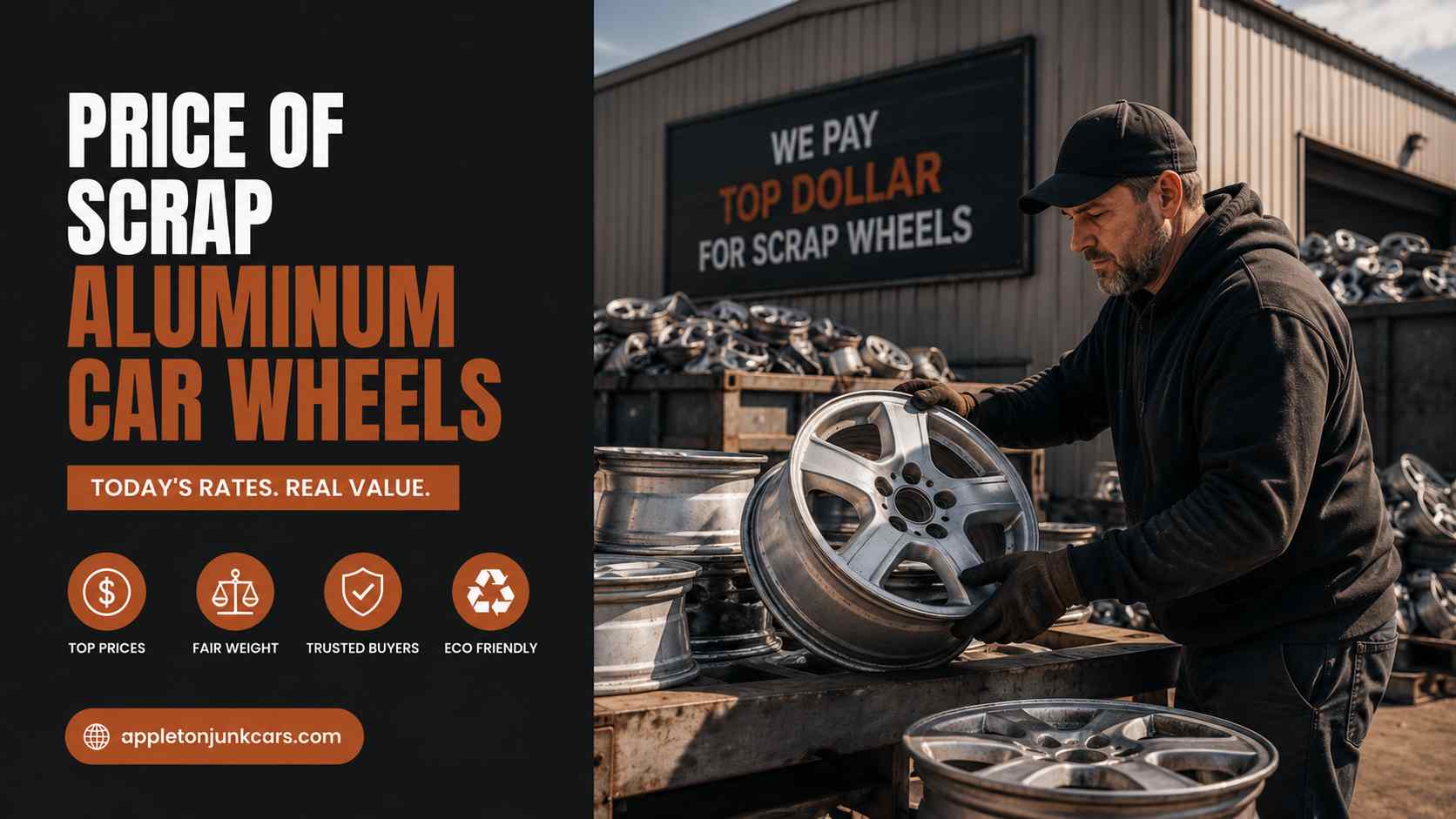
The current scrap price for aluminum car wheels ranges from $0.70 to $1.25 per pound, with most scrap yards paying roughly $0.90 to $1.10 per pound for clean rims. Those two numbers, per pound and per wheel, are what you need to know before you call anyone. The math is quick and the difference between a prepared set of wheels and an unprepared one can be $20 to $30 on a four-wheel set. That difference comes from three preparation steps that take about twenty minutes and cost nothing.
Why Aluminum Wheels Have Scrap Value
Aluminum is one of the most valuable and most actively recycled metals in the scrap market. Unlike steel, which loses value quickly and is priced at a fraction of a cent per pound, aluminum trades at a meaningful per-pound rate that makes relatively small quantities worth recovering.
Car wheels are a particularly clean and desirable form of aluminum scrap. They are cast or forged from a high-purity aluminum alloy that smelters and recyclers can process efficiently. The metal content is consistent, the form factor is easy to handle, and demand for recycled aluminum remains strong from automotive and packaging manufacturers who use it as a raw material.
What scrap yards are buying when they take your wheels is essentially the aluminum itself, weighed and priced at the going market rate for that grade of metal. The condition of the wheel from a cosmetic standpoint does not matter. A curb-rashed rim is worth the same per pound as a pristine one, as long as the preparation requirements below are met.
Per-Wheel Payout Estimates
Because car wheels generally weigh between 15 and 25 pounds depending on diameter and construction, a single wheel translates to the following approximate cash value at current market rates:
| Wheel Size | Typical Weight | Price per Wheel | Full Set of 4 |
| Small (15-inch) | 14 to 18 lbs | $13 to $18 | $52 to $72 |
| Medium (17-inch) | 18 to 22 lbs | $19 to $24 | $76 to $96 |
| Large (19-inch+) | 22 to 28 lbs | $25 to $32 | $100 to $128 |
| Chrome-plated (any size) | Same as aluminum | 10 to 20% less | Reduced rate (~$0.80/lb) |
A complete set of four standard aluminum rims typically yields $60 to $100 total at current market rates for clean, prepared wheels. Heavy-duty truck wheels and premium large-diameter rims at the higher end of the weight range can push a four-wheel set toward or above $120 at strong-market rates.
These estimates assume the wheels meet the clean aluminum wheel standard, meaning no tires, no balancing weights, and no plastic attachments. A set of wheels that does not meet that standard will be bought at a lower blended rate or may be refused entirely by some yards. The three rules below explain exactly how to get the clean aluminum premium.
3 Rules to Get the Highest Price | Scrap Aluminum Car Wheels
Scrap yards classify aluminum into grades, and the grade they assign your wheels directly determines the per-pound price they offer. Clean aluminum wheel scrap is a premium grade. Contaminated or mixed aluminum drops to a lower grade that pays less per pound. The difference between getting the premium rate and the lower rate comes down to preparation, and preparation is something you control entirely.
- Strip the rubber: Remove the tire completely. Yards will drastically cut the price or refuse the load if tires are still mounted on the rims. This is the single most important preparation step. A tire on a rim is contaminated aluminum from the yard’s perspective. They cannot process it at the premium rate because the rubber must be separated before the aluminum can be melted, and that separation costs them time and equipment.
Removing a tire without a tire machine takes effort but is doable. Deflate the tire fully, break the bead by driving over it or using a board and a car jack to press the sidewall off the rim lip, and work the tire off by hand. Alternatively, a tire shop will often dismount tires for $5 to $10 per wheel, which is worth it if the alternative is losing $0.20 to $0.30 per pound on the entire set.
- Pull the attachments: Remove all lead wheel-balancing weights, rubber valve stems, and plastic center caps. Lead weights, which are the small rectangular pieces clipped to or adhered to the inner rim surface, contaminate the aluminum with lead, which drops it out of the clean aluminum grade. Pry them off with a screwdriver or flathead tool. They take about thirty seconds per wheel.
Rubber valve stems are easy to miss but should be removed. Cut or pry them out. Plastic center caps are straightforward to pull off by hand or with a flathead. The goal is a bare aluminum wheel with nothing attached except the wheel itself. Each of these attachments, small as they are, can affect your grade classification at a yard that grades strictly.
- Check for chrome: Chrome-plated aluminum rims are bought at a lower rate, typically around $0.80 per pound. Chrome plating adds a layer of chromium over the aluminum surface that creates additional processing requirements when the metal is recycled. Recyclers must account for this in their pricing, and most yards pay 10 to 20 percent less per pound for chrome-plated wheels than for standard aluminum.
Chrome wheels are visually distinctive: they have a mirror-bright, extremely reflective surface that looks different from brushed, polished, or painted aluminum. Standard aluminum alloy wheels may be shiny but do not have the deep mirror finish of chrome plating. If your wheels have that mirror finish, expect a lower per-pound rate and factor this into your expectations when comparing quotes.
If you are not sure whether your wheels are chrome-plated or simply polished aluminum, ask the yard when you call. They will be able to tell you based on a description or photo.
How to Calculate What Your Specific Set Is Worth
The calculation is simple once you have two numbers: the weight of your wheels and the current per-pound rate at the yard you are selling to.
Step 1: Find the weight. The easiest method is to weigh one wheel on a bathroom scale and multiply by four. If you do not have a scale, use the typical weight ranges by diameter from the table above as your estimate. Most 17-inch aluminum wheels weigh 18 to 22 pounds. A set of four in the middle of that range is approximately 80 pounds total.
Step 2: Get the current per-pound rate. Scrap metal prices fluctuate daily with global aluminum markets. When you call the yard, ask specifically for their current price on clean aluminum car wheels. Do not ask for the general aluminum price, which may refer to different grades. The clean wheel rate is the number you need.
Step 3: Multiply. Total weight in pounds multiplied by the per-pound rate gives you the expected payout. A set of four 17-inch wheels weighing 80 pounds total at $1.00 per pound yields $80. The same set at $0.85 per pound yields $68. The rate matters and is worth confirming before you drive to the yard.
A worked example: You have four 18-inch aluminum alloy wheels, no tires, no chrome. Each weighs approximately 21 pounds. Total weight: 84 pounds. Current yard rate for clean aluminum wheels: $0.95 per pound. Expected payout: $79.80, or roughly $80.
If those same wheels had tires still mounted and lead weights attached, the yard might offer $0.70 per pound or less for a mixed aluminum load. The difference on 84 pounds is roughly $21. Twenty minutes of preparation to remove tires and weights returned $21. That is a reasonable return on time.
Scrap vs. Selling as Used Parts: Which Pays More?
For cosmetically damaged, bent, or heavily corroded wheels, scrap is the right path. The used wheel market prices on aesthetics and fitment, not metal weight, and a bent or heavily curbed wheel has little to no resale value regardless of its aluminum content.
For wheels in decent cosmetic condition from popular vehicles, it is worth checking the used market before defaulting to scrap. A set of clean 17-inch aluminum wheels from a Toyota Camry, Honda Accord, or Ford F-150 in usable condition may sell for $80 to $200 on Facebook Marketplace or Craigslist, depending on demand in your area. That is meaningfully more than the $60 to $80 in scrap value.
The used market requires more effort. You have to photograph the wheels, list them, field inquiries, and coordinate pickup. For wheels in marginal condition or from uncommon vehicles with low buyer demand, scrap wins on simplicity and net value. For clean wheels from popular vehicles, five minutes checking current listings on Facebook Marketplace tells you whether a quick sale is worth attempting before calling the scrap yard.
What Affects the Per-Pound Rate at Different Yards
The national scrap aluminum price is a reference point, but what individual yards offer varies based on several factors.
Local market demand. Yards in regions with active aluminum smelters or recycling facilities nearby can offer more because their transportation costs to the smelter are lower. Yards in remote areas may offer less because they must ship the material further before processing.
Volume. Yards typically offer better per-pound rates for larger quantities. Bringing in a single wheel is a small transaction. Bringing in twenty wheels from a shop cleanout or a large parts haul may qualify for a volume rate that approaches or reaches the upper end of the price range.
Current aluminum spot price. Global aluminum prices trade on commodity exchanges and move daily based on energy costs, industrial demand from automakers and packaging companies, and supply from primary smelters. A strong industrial economy with high manufacturing output pushes aluminum prices up. Economic slowdowns reduce demand and push prices down. Checking a current metal price tracking site before calling yards gives you context for evaluating whether a quote is reasonable for the current market.
Yard pricing model. Some yards use daily updated pricing tied directly to the London Metal Exchange spot rate. Others use weekly or monthly pricing schedules. Knowing which model a yard uses helps you understand why quotes might differ between locations on the same day.
Other Aluminum Parts From the Same Vehicle
If you are already pulling wheels to scrap, it is worth knowing that other aluminum components from the same vehicle may be available and worth bringing along.
Aluminum engine components, including intake manifolds, oil pans, valve covers, and alternator housings on many modern vehicles, are all aluminum alloy and priced at similar or slightly lower rates depending on the grade. Transmission cases on many passenger cars are also aluminum. Suspension components like control arms and knuckles on newer vehicles may be aluminum as well.
The more clean aluminum you can bring in a single trip, the better your negotiating position on the per-pound rate and the more efficient the transaction. Bundling wheels with other aluminum components from the same vehicle, rather than making separate trips, is the practical approach if you are scrapping the whole car or doing a significant strip.
Frequently Asked Questions
How much are aluminum car wheels worth in scrap?
The current scrap rate for clean aluminum car wheels is $0.70 to $1.25 per pound, with most yards paying $0.90 to $1.10 for a properly prepared set. A standard four-wheel set from a passenger car weighing 60 to 80 pounds total typically brings $60 to $100. Larger wheels and heavier sets can bring more.
Do tires need to be removed before scrapping aluminum wheels?
Yes. Scrap yards that buy aluminum wheels at the clean aluminum rate require the tires to be removed. Mounted tires contaminate the load and will result in either a significantly lower blended rate or refusal. Remove the tires before delivery. A tire shop will dismount them for a small fee if you cannot do it yourself.
Are chrome rims worth less as scrap than regular aluminum?
Yes. Chrome-plated aluminum wheels are typically bought at about $0.80 per pound compared to $0.90 to $1.10 for standard aluminum alloy wheels. The chrome plating creates additional processing requirements for the recycler. Check whether your wheels are chrome or standard aluminum before getting quotes, as this affects your expected payout.
How do I find out the current scrap price for aluminum wheels near me?
Call two or three local scrap yards and ask specifically for their current price on clean aluminum car wheels. Rates change frequently with the aluminum market, so call the same day you plan to bring the wheels in rather than relying on a quote from several days earlier. Sites like iScrapApp also list current scrap prices by material and location, which gives you a benchmark before making calls.
Should I remove the valve stems and balancing weights before scrapping?
Yes. Lead balancing weights and rubber valve stems are contaminants that can drop your wheels out of the clean aluminum grade. Both are easy to remove: pry off the balancing weights with a screwdriver and cut or pull out the valve stem. The extra five minutes of preparation helps you maintain the premium per-pound rate.
How much does a single aluminum car wheel weigh?
Aluminum car wheels typically weigh 14 to 28 pounds depending on the diameter and construction. A standard 15-inch wheel weighs around 14 to 18 pounds. A 17-inch wheel weighs 18 to 22 pounds. A 19-inch or larger wheel can weigh 22 to 28 pounds. Weigh one wheel on a bathroom scale and multiply by four to estimate the total weight for your set.
Is it better to sell aluminum wheels as used parts or scrap them?
Wheels in good cosmetic condition from popular vehicles can sell for significantly more as used parts than as scrap. A clean set of 17-inch alloys from a Honda Accord might sell for $100 to $200 on Facebook Marketplace versus $60 to $80 as scrap. Cosmetically damaged, bent, or heavily corroded wheels have little used market value and should go to the scrap yard. Check the used market quickly before committing to scrap on any wheel set in decent condition.
The Bottom Line
Scrap aluminum wheels are worth $0.70 to $1.25 per pound, which translates to $13 to $32 per wheel and $60 to $100 or more for a full set of four depending on the size and weight of your specific wheels.
The three preparation steps, removing the tires, pulling the balancing weights and valve stems, and identifying whether your wheels are chrome-plated, are what determine whether you receive the premium clean aluminum rate or a discounted blended rate. The preparation takes about twenty minutes and regularly adds $15 to $25 to the total payout on a four-wheel set.
Call at least two yards on the day you plan to bring the wheels in, ask specifically for the clean aluminum wheel price, and confirm whether chrome-plated wheels are priced differently. With the math from this guide and the right preparation, you will walk away knowing exactly what to expect before you load the car.