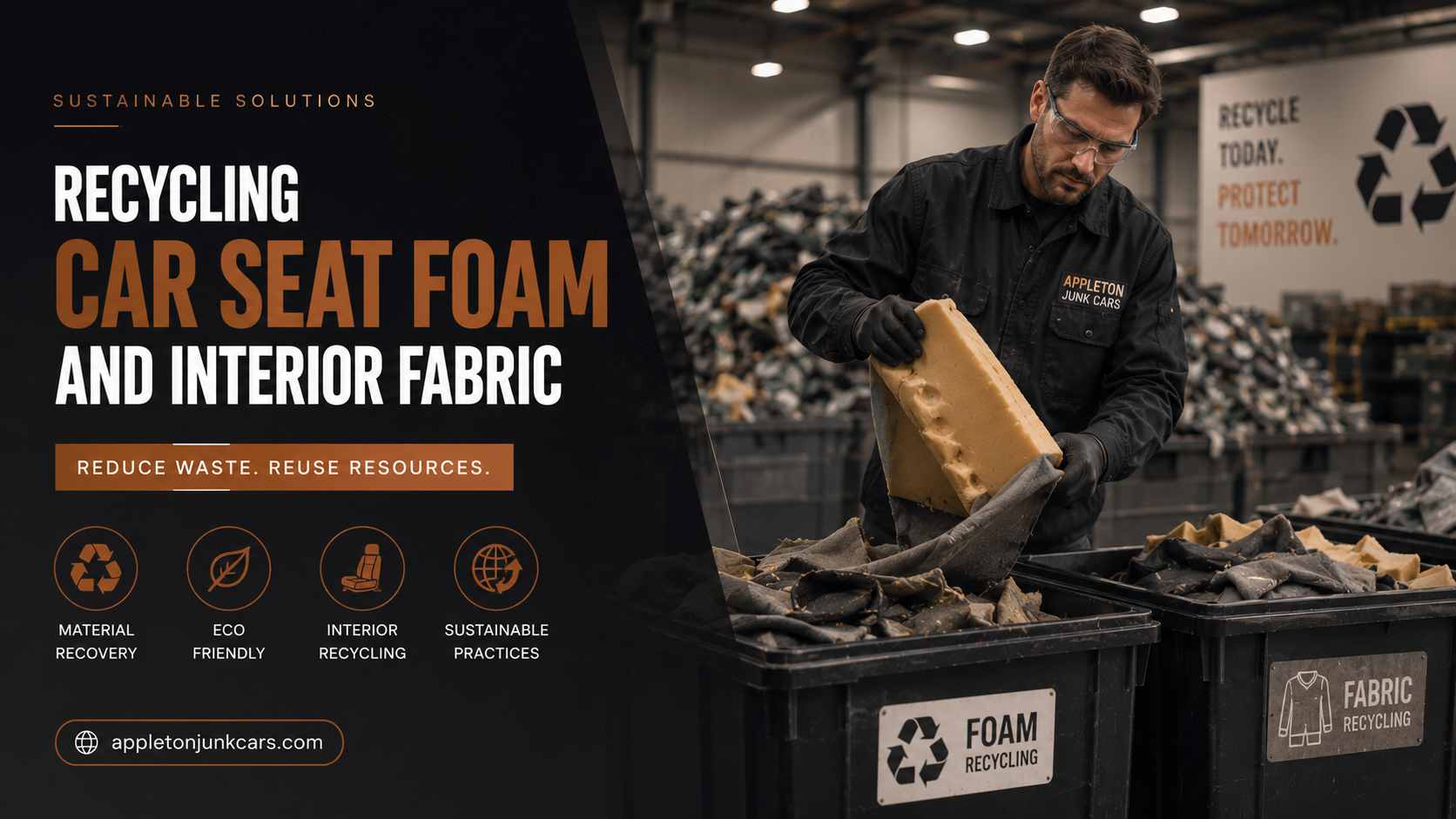
When a car reaches the end of its life, attention focuses on the metal frame, the engine, and the catalytic converter. The interior, the seat cushions, headliner, carpet, door panel fabric, and dashboard foam, receives far less attention. This neglect has a material explanation: most automotive interior materials are genuinely difficult to recycle, and until recently, the infrastructure to do so at scale simply did not exist. The result is that automotive interior materials make up a significant portion of auto shredder residue, the mixed waste fraction that currently ends up in landfill after the recyclable metals are extracted.
This is changing, but slowly. Foam recycling technology has matured significantly over the past two decades. Automotive carpet recycling programs exist and process meaningful volumes. Automakers under pressure from European recycling regulations are redesigning interior materials with end-of-life recovery in mind. And the chemical recycling industry developing broadly for post-consumer plastics is gradually developing capability for the mixed polymer streams found in vehicle interiors.
This guide covers what automotive interior materials are actually made of, why each is difficult to recycle in its current form, every recycling pathway that currently exists, and where automotive interior materials actually end up when a car is scrapped today.
What Car Seat Foam and Interior Fabric Are Actually Made Of
Automotive interiors contain a wider variety of materials than almost any other manufactured product of comparable size. Understanding the material composition is the starting point for understanding the recycling challenge.
Interior Component | Primary Material | Secondary Materials | Recycling Challenge |
|---|---|---|---|
Seat cushion and back foam | Flexible polyurethane foam (thermoset) | Fabric or leather cover, steel spring frame, plastic clips | PU is thermoset; cannot be melted; chemical or mechanical processing required |
Seat cover fabric | Polyester, nylon, or woven blends | Foam backing layer, velcro fasteners | Mixed fiber types; foam backing prevents standard textile recycling |
Floor carpet | Polypropylene or nylon face fiber | Jute, PP, or recycled fiber backing; heavy underlay | Backing contamination and moisture make standard carpet recycling difficult |
Headliner | Polyester fiber or glass fiber composite | Foam backing, adhesive layer | Composite structure; multiple bonded materials cannot be easily separated |
Door panels | ABS or PP plastic substrate | Fabric or vinyl cover, foam padding layer | Multi-material laminate; plastic recyclable if separated, but separation is difficult |
Dashboard foam padding | Rigid and semi-rigid PU foam | Plastic skin layer, metal armature | Same PU thermoset challenge as seat foam; additional complexity from composite structure |
Leather seat covers | Genuine leather (processed collagen) | Foam backing, stitching, piping | Limited leather recycling market; mostly downcycled or landfilled |
Vinyl and synthetic seat covers | PVC or TPO (thermoplastic olefin) | Foam backing, fabric backing | PVC recyclable in theory but rarely in practice; contamination issues |
The common thread across most of these materials is composite construction: multiple materials bonded together in ways that are difficult or impossible to separate without destroying the integrity of the individual components. A seat cushion consists of foam bonded to a fabric cover over a steel spring, and separating those materials for individual recycling requires labor, heat, or solvents that make the recovery uneconomical under current market conditions.
Why Polyurethane Foam Is the Central Recycling Challenge
Polyurethane foam is the primary padding material in virtually every automobile seat produced since the 1960s. It is also the most difficult automotive interior material to recycle because it is a thermoset polymer, meaning that the chemical reactions that form it during manufacturing create permanent cross-linked bonds between polymer chains that cannot be reversed by melting.
This is the fundamental distinction between polyurethane and thermoplastic polymers. A thermoplastic such as polypropylene or nylon can be melted, reshaped, and solidified repeatedly without degrading the polymer, enabling straightforward mechanical recycling. Polyurethane foam cannot be processed this way. Attempting to melt it produces degradation rather than melting. This means that any recycling of polyurethane foam requires either mechanical size reduction (which preserves the material in fragmented form) or chemical processing (which breaks down the polymer back to its constituent chemical building blocks).
The automotive sector uses flexible polyurethane foam as distinct from the rigid polyurethane foam used in insulation panels and refrigerators. Flexible PU foam contains approximately 60 percent polyol and 40 percent isocyanate by weight, plus water, catalysts, surfactants, and various additives. The recycling pathways for flexible foam are different from those for rigid foam, and the automotive flexible foam stream has somewhat less developed recycling infrastructure than the rigid foam stream from construction applications.
Foam Recycling Pathways: Rebonding, Chemical Recycling, and Energy Recovery
Rebonding: The Most Widely Practiced Pathway
Rebonding is a mechanical process that shreds post-consumer or post-industrial polyurethane foam into particles and bonds them together using adhesive binders under heat and pressure to produce a new composite material called rebonded foam or bonded polyurethane. The resulting product has different mechanical properties from virgin foam: it is denser, firmer, and less uniform, but it retains good cushioning and shock-absorption characteristics.
Rebonded foam is used primarily as carpet underlay and padding in residential and commercial flooring installations. It is also used in gymnasium mats, anti-fatigue floor mats, packaging material, and equestrian saddle pads. The market for rebonded foam is well-established and stable. Several million pounds of rebonded foam are produced annually in the United States from post-consumer and post-industrial foam waste.
The limitation of rebonding for automotive foam is the quality of the recovered material. Automotive seat foam is removed from vehicles after years of use, often with soiling, moisture, and physical degradation. Post-consumer automotive foam typically produces lower-quality rebonded material than post-industrial foam trim from manufacturing operations. Sorting, cleaning, and quality control add cost that not all processors find economical.
Chemical Recycling: Glycolysis and Hydrolysis
Chemical recycling of polyurethane foam breaks down the polymer into its chemical components for re-entry into new foam production. Glycolysis uses ethylene glycol or propylene glycol at elevated temperatures to cleave the urethane bonds, producing a mixture of polyols that can substitute for virgin polyol in new foam formulations. Hydrolysis uses water (sometimes combined with heat and pressure or steam) to achieve a similar cleavage. Both processes produce a polyol product that contains the original foam’s polyol component plus contaminants from the degradation process.
Chemical recycling of automotive foam is practiced commercially in Europe and Japan, driven by higher landfill costs and stronger regulatory pressure than exist in the United States. The RENUVA program by Covestro uses glycolysis to produce recycled polyol from PU foam waste, including some automotive foam, that is incorporated into new foam products. The process requires clean, sorted foam feedstock; the mixed, soiled foam typical of automotive dismantling streams requires pre-processing before it is suitable for glycolysis.
Energy Recovery
Polyurethane foam has a high calorific value, approximately 28 to 35 MJ per kilogram, making it a viable fuel for energy recovery in industrial combustion systems, waste-to-energy plants, and cement kilns. Energy recovery from PU foam is less preferred than material recycling from an environmental standpoint because it consumes the material rather than recovering the chemical value. However, for foam that is too contaminated or degraded for material recycling, energy recovery provides a productive use that displaces fossil fuel consumption at the burning facility.
Automotive Carpet and Floor Material: Fiber Types and Recycling Paths
Automotive carpet consists of a face fiber layer (what you see and walk on), a backing layer (which provides dimensional stability), and typically an underlay or padding layer. The face fiber is almost always either nylon (types 6 and 6,6) or polypropylene, both of which are thermoplastic polymers that are in principle recyclable by melting and reprocessing.
The recycling challenge for automotive carpet is the composite structure. The face fiber, backing, and underlay are bonded together in a way that makes separation mechanically difficult. Standard nylon or polypropylene recycling processes work with clean, single-material feedstock, not with fiber bonded to a calcium carbonate-filled polypropylene backing over a jute or recycled fiber underlay. Recycling the whole composite requires either accepting a lower-quality mixed output or performing separation.
Several companies have developed automotive carpet recycling processes. Carpet America Recovery Effort (CARE) coordinates post-consumer carpet recycling in the United States and works with manufacturers to develop end-of-life pathways for both residential and automotive carpet. Nylon face fiber recovered from carpets can be recycled into engineering-grade nylon for automotive parts, fiber filling, and other applications. Polypropylene face fiber recovered from carpets is recycled into lower-value applications.
Leather Seat Recycling: A Specific and Limited Market
Genuine leather seat covers from automotive interiors are processed collagen, a protein polymer derived from animal hides. Leather is not a synthetic polymer and therefore does not respond to the same recycling pathways as PU foam or synthetic fabrics. Recycling leather from automotive interiors typically means downcycling: converting high-grade automotive leather into lower-grade leather products.
Leather shredders and grinders process scraps and waste leather into fibers that are used in leather fiber board, a material used in shoe insoles, bookbinding, and some construction applications. Small scraps and off-cuts from leather seat manufacturing are the primary feedstock for this process; post-consumer automotive leather from dismantled vehicles has additional contamination challenges (soiling, treatments, adhesives) that reduce its value to leather processors.
The most common fate for genuine leather seats removed from junk cars is either resale as used seats through salvage yards (intact used leather seats from desirable vehicles have a private buyer market) or shredding for inclusion in the general ASR stream. The secondary leather market through salvage is the highest-value outcome; leather that is too degraded for resale typically ends up in landfill or is processed for fiber board if a local buyer exists.
What Automakers Are Doing to Design for Recyclability
Vehicle manufacturers under regulatory pressure, particularly in Europe, have been redesigning interior materials with end-of-life recyclability as an explicit design criterion. The changes are gradual but directionally significant.
Material reduction and simplification is the primary strategy: reducing the number of distinct polymer types used in interior components, eliminating thermoset materials where thermoplastics can substitute, and designing assemblies that can be disassembled rather than only shredded. Some manufacturers have moved from PU foam seat cushions to thermoplastic elastomer (TPE) seat cushions in specific applications where performance allows, because TPE can be mechanically recycled.
Use of recycled content is a second strategy: incorporating post-consumer recycled materials into interior components creates both a market for recycled material and a signal of manufacturer commitment to circularity. Recycled PET from beverage bottles is used in seat fabric, carpet fiber, and headliner batting by several manufacturers. Recycled polypropylene from various post-consumer sources appears in trim components and structural interior panels at increasing rates.
What Actually Happens to Interior Materials at a Salvage Yard Today
At a typical licensed salvage yard, interior removal is selective rather than systematic. Seats in good condition from popular vehicle models are removed and offered for resale through the yard’s parts inventory or online through platforms including LKQ, Car-Part.com, and eBay Motors. Interior components with active buyer demand, including instrument clusters, door panels, and center consoles from desirable trim levels, are similarly removed and cataloged.
Interior materials for which there is no parts buyer market remain in the vehicle hull. When the hull is sold to a shredder, the carpet, headliner, seat foam from vehicles not worth parting, door padding, and underdash materials go into the shredder and emerge as part of the ASR stream. This is the default outcome for the majority of automotive interior material from end-of-life vehicles in the current system.
The exception worth noting is that the parts market effectively provides the most valuable form of interior material recycling: keeping functional components in use by extending their life in another vehicle. A set of leather seats removed from a totaled luxury vehicle and installed in a matching vehicle of the same trim level represents the highest environmental value outcome, avoiding the need to manufacture replacement seats entirely.
Frequently Asked Questions
Can car seat foam be recycled?
Yes, but through limited pathways compared to metals or thermoplastics. Polyurethane foam from car seats is a thermoset polymer that cannot be melted and reprocessed. It is recycled primarily through rebonding, which shreds the foam and bonds it with adhesive into carpet underlay and gym mats, and through chemical recycling processes including glycolysis, which breaks the foam down into polyol components for reuse in new foam production. Energy recovery is used when material recycling is not economical.
What happens to car seats when a car is junked?
At a licensed salvage yard, car seats in good condition from desirable vehicles are removed and resold through the parts market. Seats with no resale demand remain in the vehicle hull and are shredded along with the rest of the interior. The foam, fabric, and other interior materials emerge as part of auto shredder residue (ASR), which is primarily landfilled in US operations. European operations subject to stricter recycling targets have more developed pathways for processing ASR-fraction interior materials.
What is rebonded foam?
Rebonded foam, also called bonded polyurethane or granulated polyurethane, is a composite material made by shredding post-consumer or post-industrial polyurethane foam into particles and bonding them with adhesive binders under heat and pressure. The resulting product has different properties from virgin foam: it is denser and firmer, but retains cushioning characteristics. It is widely used as carpet underlay, gymnasium mats, anti-fatigue mats, and packaging material. Rebonding is the most widely practiced recycling pathway for polyurethane foam including automotive seat foam.
Is automotive carpet recyclable?
Automotive carpet is theoretically recyclable because its face fiber is either nylon or polypropylene, both thermoplastic polymers. The practical challenge is the composite structure: face fiber bonded to a calcium carbonate-filled backing over an underlay is difficult to separate for single-material recycling. Programs exist through Carpet America Recovery Effort (CARE) and manufacturer take-back initiatives to process automotive and residential carpet, recovering nylon or polypropylene fiber for recycling into lower-value applications.
What happens to leather car seats when a car is scrapped?
Leather seats from desirable vehicles are often removed and resold through salvage yard parts inventory or online platforms before the vehicle is shredded. Leather that is too degraded for resale enters the shredder with the rest of the interior. In the ASR stream, leather may be processed by leather fiber board manufacturers who shred scraps into fiber for use in shoe insoles and similar applications, but this market is limited. Most post-consumer automotive leather from scrapped vehicles ends up in landfill.
Are car interiors being designed for better recyclability?
Yes, increasingly. Automotive manufacturers under European recycling regulations are incorporating recyclability as a design requirement for interior components. Changes include reducing the variety of polymer types in interiors, substituting thermoplastic materials for thermosets where performance allows, designing disassembly pathways that allow component separation before shredding, and using post-consumer recycled materials such as recycled PET in seat fabric and carpet. These changes are gradual and will take decades to fully affect the end-of-life vehicle population.
Why is polyurethane foam so hard to recycle?
Polyurethane foam is difficult to recycle because it is a thermoset polymer, meaning that the chemical reactions that form it create permanent cross-linked bonds between polymer chains that cannot be reversed by heating. Unlike thermoplastic polymers such as nylon or polypropylene, which can be melted and reshaped repeatedly, polyurethane foam degrades when heated rather than melting. Recycling requires either mechanical size reduction for lower-value applications or chemical processing to break the polymer back into its constituent chemical components.
What is the difference between PU foam and memory foam in car seats?
Standard automotive seat foam is flexible polyurethane foam produced in specific density ranges for seating applications. Memory foam, or viscoelastic polyurethane foam, is a modified form of PU foam that responds to heat and pressure by conforming slowly to the applied shape. Some premium automotive seats incorporate memory foam layers. Both are thermoset polyurethane polymers with the same fundamental recycling challenges. The recycling pathways, rebonding, chemical recycling, and energy recovery, apply to both types.
The Bottom Line
Car seat foam and automotive interior fabric are among the most challenging materials in the end-of-life vehicle stream. The thermoset nature of polyurethane foam, the composite construction of upholstered components, and the mixed fiber content of carpets and fabrics all create barriers to the straightforward mechanical recycling that works well for metals and clean thermoplastics.
The pathways that do work, rebonded foam for carpet underlay, chemical recycling where feedstock quality supports it, nylon fiber recovery from carpets, and parts resale for intact interior components, collectively process a minority of the automotive interior material generated annually in the United States. The majority enters the ASR stream and is landfilled.
The direction of improvement is clear: design changes that reduce composite bonding, substitute thermoplastics for thermosets, and simplify material composition will improve recyclability for future vehicles. Chemical recycling advances will improve economic viability for current material types. And continued growth of the parts resale market, which currently captures the most environmental value from any interior material by extending its useful life, represents an already-functioning pathway that benefits from no new technology at all.