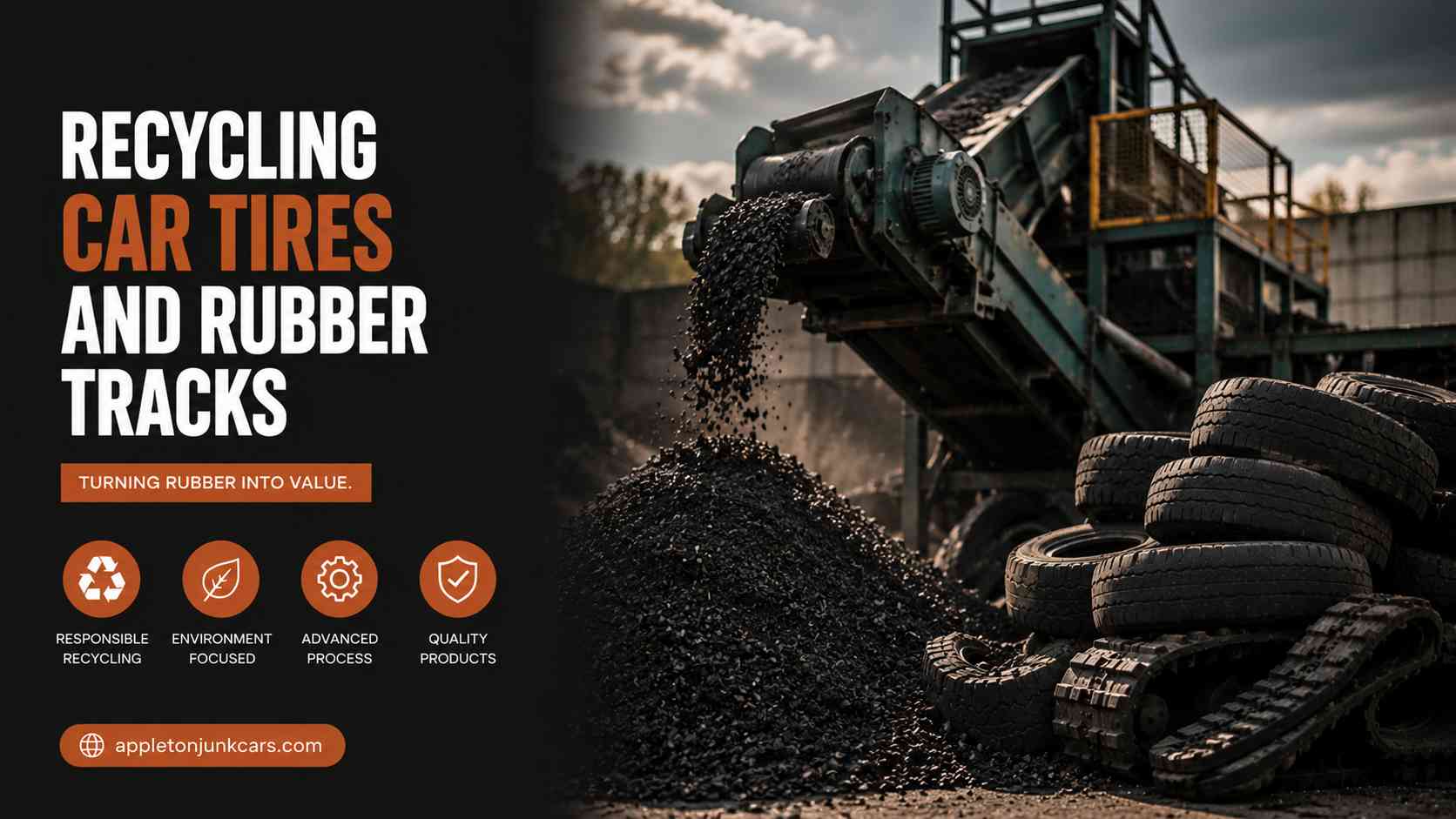
A car tire is one of the most difficult materials to recycle. Vulcanization, the process that gives tires their durability and resilience, creates chemical bonds between rubber molecules and sulfur that cannot be reversed by simple melting. Unlike steel, which can be melted down repeatedly without degrading, or glass, which can be remelted into new glass, vulcanized rubber cannot be returned to its original polymer state through a straightforward process. This chemical reality is what makes tires a persistent waste challenge despite the industry’s best efforts.
The tire recycling industry has responded to this challenge with several effective, if imperfect, solutions. Mechanical shredding converts tires into crumb rubber that has genuine market value as a building material, a surface material, and an asphalt modifier. Pyrolysis thermally decomposes rubber into fuel oil, carbon black, and steel. Retreading restores a serviceable tire to a worn carcass without requiring the full manufacturing process. Each approach addresses a different part of the problem and together they handle the approximately 290 million scrap tires generated in the United States each year.
Rubber tracks from heavy equipment, a different material from passenger tire rubber despite their common origin in vulcanized rubber, follow a separate and more limited recycling pathway that is worth understanding separately. This guide covers both, from the chemistry of why tires are hard to recycle through every processing method and end product to where individuals and businesses should take tires that need disposal.
What Makes Tires and Rubber Tracks Difficult to Recycle
A passenger car tire is composed of approximately 47 percent rubber (a blend of natural and synthetic rubber), 22 percent steel (in the belt reinforcement and bead wire), 17 percent carbon black (which gives rubber its black color and enhances its strength and wear resistance), 5 percent textile fabric reinforcement, and 9 percent other chemicals including sulfur, zinc oxide, and processing oils.
The challenge in recycling is the vulcanization crosslinks. When a tire is manufactured, sulfur atoms form bridges between rubber polymer chains, creating a three-dimensional network that gives the rubber its characteristic elasticity and resistance to heat, cold, and chemical attack. Breaking these crosslinks requires either very high temperatures (which degrades the polymer), chemical treatment (which is expensive and produces hazardous byproducts), or mechanical size reduction that maintains the crosslinked structure.
Rubber tracks from excavators, Bobcats, bulldozers, and other heavy equipment differ from tire rubber in their reinforcement structure. Tracks contain embedded steel cables and high-strength fabric arranged in specific load-bearing patterns that differ significantly from tire belt and bead arrangements. The higher steel content, different rubber compound formulations for abrasion resistance, and larger physical size add complexity to the recycling process relative to passenger tires.
Stage 1: Mechanical Shredding: The Universal First Step
Mechanical shredding is the primary first stage for most tire recycling pathways. The goal is to reduce the tire from its original form to manageable-sized pieces that can be further processed or used directly as tire-derived fuel or aggregate.
Primary Shredding
A primary shredder uses rotating blades or knives to cut tires into pieces approximately 2 to 4 inches in size. Whole tires are fed into the shredder using conveyors. The machines are heavy industrial equipment designed to handle the steel wire and fabric reinforcement in tires without jamming. Primary shredded material is called tire chips or tire-derived aggregate and has applications in landfill engineering, drainage systems, and some civil construction applications without further processing.
Secondary Shredding and Granulation
Further size reduction through secondary shredding and granulation produces progressively smaller pieces: granules of 10 millimeters down to 2 millimeters and fine crumb rubber of less than 2 millimeters. As size decreases, the value of the material increases and its range of applications expands. Fine crumb rubber is the highest-value product of mechanical processing.
After granulation, the steel wire is removed by magnetic separators and the textile fiber is removed by air classification. The resulting crumb rubber is a clean, sorted material consisting almost entirely of recycled rubber with minimal contamination.
Cryogenic Processing
Cryogenic tire processing uses liquid nitrogen to cool rubber to approximately negative 120 degrees Celsius, making the vulcanized rubber brittle and allowing it to be fractured into very fine particles rather than cut. The advantage is a cleaner separation of rubber from steel and fiber, and a finer crumb particle that is more uniform than mechanically produced crumb. The disadvantage is the energy cost of liquid nitrogen production and handling. Cryogenically produced crumb rubber commands a price premium in applications requiring very fine or very consistent particle size.
Crumb Rubber: The Most Widely Used End Product
Crumb rubber is granulated recycled rubber produced from shredded tires, with steel and fiber removed. It is the largest-volume end product in the tire recycling industry and has applications across multiple market sectors.
Crumb Rubber Application | Typical Particle Size Used | Environmental Benefit | Market Scale |
|---|---|---|---|
Athletic field infill (synthetic turf) | 0.5 to 2 mm | Replaces virgin materials; cushioning for player safety | Large; primary market for fine crumb rubber |
Playground safety surfaces | 2 to 4 mm | Replaces poured concrete and gravel; impact attenuation | Large; required by safety codes at many facilities |
Rubberized asphalt (road paving modifier) | 0.5 to 2 mm | Reduces cracking, extends pavement life, reduces noise | Very large; many state DOTs specify crumb rubber asphalt |
Rubber mulch (landscape and garden) | 10 to 20 mm | Does not decompose; retains color; weed suppression | Moderate; consumer and commercial landscaping |
Molded products (mats, bumpers, wheels) | Varies by product | Replaces virgin rubber in lower-performance applications | Moderate; consumer and industrial products |
Athletic running tracks | 0.5 to 2 mm | Standard surface material for competition tracks | Moderate; specialized athletic infrastructure |
Acoustic and vibration damping panels | Fine crumb | Reduces sound transmission in construction | Smaller niche; growing in green building |
Rubberized asphalt is one of the largest and most environmentally significant applications for crumb rubber because it consumes large volumes of material and produces a pavement with measurably better performance characteristics. Rubberized asphalt reduces road cracking by approximately 50 percent compared to conventional asphalt, extends pavement life by 10 to 15 years, and reduces tire noise by 3 to 5 decibels. Several states including California, Arizona, and Florida have specifications that favor or require crumb rubber asphalt on highway projects.
Tire-Derived Fuel: Energy Recovery From Rubber
Tire-derived fuel (TDF) is shredded tire material burned as a supplemental fuel in industrial furnaces, cement kilns, pulp and paper mills, and power generation facilities. Rubber has a high energy content: approximately 15,000 BTU per pound, comparable to coal and significantly higher than wood. Burning TDF produces energy that displaces fossil fuel consumption at the burning facility.
The primary users of TDF are cement kilns, which are among the highest-temperature industrial furnaces in operation and can handle the higher-temperature combustion of rubber without the emissions problems that occur at lower-temperature facilities. Cement kilns operate at temperatures above 1,400 degrees Celsius, which completely combusts the rubber and incorporates the steel from tire wire into the cement clinker product rather than producing a separate ash stream.
TDF combustion is regulated under the Clean Air Act, and facilities that burn TDF must comply with emissions standards for the pollutants associated with rubber combustion, including sulfur oxides from the tire’s sulfur content, zinc oxides from vulcanization agents, and polycyclic aromatic hydrocarbons from rubber degradation. Permitted TDF facilities operate within these limits, and modern cement kilns typically show lower net emissions per unit of energy when burning TDF than when burning the coal it displaces.
Pyrolysis: Converting Rubber Into Fuel, Carbon Black, and Steel
Pyrolysis is a thermal decomposition process in which rubber is heated to temperatures of 400 to 700 degrees Celsius in the absence of oxygen, preventing combustion. Under these conditions, the vulcanized rubber breaks down into three recoverable products: pyrolysis oil, carbon black, and steel wire.
Pyrolysis Oil
Pyrolysis oil is a complex mixture of hydrocarbons produced from the thermal cracking of the rubber polymer. It is chemically similar to diesel fuel and can be used as a fuel in industrial burners and marine diesel engines. With additional refining, it can be upgraded to transportation fuel quality. The energy value of pyrolysis oil is approximately 40 MJ per kilogram, comparable to petroleum fuel oil.
Recovered Carbon Black
Carbon black makes up approximately 22 percent of tire weight and is recovered as a powder from the pyrolysis process. Recovered carbon black (rCB) is chemically similar to virgin carbon black and can be used as a partial substitute in rubber compounding, plastic pigmentation, and ink formulations. The quality of rCB varies with pyrolysis process conditions and requires post-processing steps to achieve the particle size and purity required for high-performance applications. The market for rCB is growing as manufacturers seek recycled-content materials for their products.
Steel Recovery
The steel wire embedded in tire belts and beads survives the pyrolysis process and is recovered as a clean steel fraction after the rubber fraction is processed. This steel has high purity because the rubber combustion residue is minimal, and it is sold to steel scrap buyers for use in steel production.
Retreading: The Highest-Value Tier of Tire Recycling
Retreading is the process of removing the worn tread from a tire carcass that is still structurally sound and bonding a new tread layer onto the carcass. A retreaded tire performs the same function as a new tire but uses approximately 70 percent less material and 70 percent less energy to produce than a new tire of equivalent size. This makes retreading the most resource-efficient form of tire recycling available.
Retreading is most extensively practiced in the commercial truck tire market, where tires are significantly more expensive than passenger tires (typically $400 to $800 per unit new) and where fleet operators have the maintenance infrastructure to manage tire inspection and retreading programs. Commercial truck tires can typically be retreaded two to three times if the original carcass is maintained in good condition throughout its service life.
Passenger tire retreading is less common in the United States because the lower cost of replacement passenger tires reduces the economic incentive, and because many consumers are unfamiliar with retreading and have unfounded concerns about retreaded tire safety. Retreaded passenger tires, when properly produced and inspected, meet the same DOT safety standards as new tires. Some tire retailers offer retreading services for certain tire categories.
Rubber Tracks From Heavy Equipment: A Different Challenge
Rubber tracks from excavators, compact track loaders (Bobcats), and similar equipment differ from passenger tires in their construction and in their recycling pathways. A rubber track is a continuous loop of reinforced rubber containing embedded steel cables and cord fabric arranged to distribute the machine’s weight across the full track contact area.
When a rubber track wears out or fails, it faces the same vulcanization recycling challenge as a tire but with additional complications. The steel cable reinforcement in tracks is more densely embedded than tire belt steel, making separation during shredding more difficult. The rubber compound is formulated for abrasion resistance rather than flexibility, which means it behaves somewhat differently in shredding equipment than tire rubber.
Current recycling pathways for rubber tracks include mechanical shredding at facilities with equipment capable of handling the higher steel content, with recovered steel sold to metal recyclers and the rubber fraction used in the same crumb rubber applications as tire-derived rubber. Pyrolysis is also applicable to rubber track material and produces similar product fractions. Some damaged tracks with limited surface wear can be vulcanization-repaired by specialist track repair companies, which extends service life without generating waste.
Track Type | Steel Content | Primary Recycling Pathway | Reuse Potential |
|---|---|---|---|
Mini excavator track (1 to 5 ton class) | Moderate steel cable | Mechanical shredding; rubber to crumb, steel recovered | Vulcanization repair for surface damage |
Compact track loader (CTL/Bobcat) track | Moderate to high steel | Mechanical shredding at equipped facilities | Repair if carcass is intact; scrap if delaminated |
Full-size excavator track (10 to 30 ton) | High steel cable density | Shredding or pyrolysis; large volume per unit | Repair feasible for localized damage; shorter usable life than tires |
Agricultural rubber track (combine, sprayer) | Moderate steel | Mechanical shredding; agricultural equipment recyclers | Repair programs available through some dealers |
Heavy equipment track recycling is less systematized than tire recycling because the volume of end-of-life tracks is much smaller than the volume of scrap tires, reducing the economic case for dedicated processing infrastructure. In most regions, rubber tracks are handled by general scrap metal dealers who have the equipment to process mixed rubber and steel material, or by tire recycling facilities with equipment capable of handling higher-steel-content feedstocks.
Where Old Tires and Tracks Should Go and What to Avoid
Passenger and light truck tires can be returned at no charge to any tire retailer when purchasing replacement tires. Most states have tire disposal fees embedded in new tire prices that fund collection and recycling infrastructure. Retailers are required to accept old tires in most states as a condition of operating a tire business.
Many municipal solid waste facilities, transfer stations, and household hazardous waste events accept scrap tires from residents, typically at no charge for small quantities (four to eight tires per visit is a common limit). Commercial tire generators including fleets, trucking companies, and auto service centers use licensed scrap tire haulers who collect under manifest and route the tires to licensed processors.
Illegal tire dumping is a significant ongoing problem because tire disposal fees create an incentive for some operators to avoid proper collection channels. Illegally dumped tires create mosquito breeding habitat, fire risk, and rodent habitat. The fires that result from illegally dumped tire stockpiles are among the most difficult to extinguish because rubber burns hot and produces dense toxic smoke. Every state has laws against illegal tire dumping with penalties ranging from fines to criminal charges for large-scale illegal dumping operations.
Frequently Asked Questions
How are car tires recycled?
Car tires are recycled through three main processes. Mechanical shredding reduces tires to crumb rubber, with steel and fiber removed, which is used in playground surfaces, athletic tracks, rubberized asphalt, and molded products. Tire-derived fuel processing shreds tires for use as supplemental fuel in cement kilns and industrial furnaces. Pyrolysis thermally decomposes tires in the absence of oxygen, producing pyrolysis oil, recovered carbon black, and clean steel wire. Retreading, the most resource-efficient process, applies new tread to sound tire carcasses, extending service life without full remanufacturing.
What is crumb rubber made from?
Crumb rubber is granulated recycled rubber produced by mechanically shredding tires and removing the steel and fabric reinforcement through magnetic separation and air classification. The resulting material is clean recycled rubber in particle sizes ranging from fine powder (under 1 mm) to coarser granules (4 to 10 mm). It is used as infill in synthetic turf athletic fields, as surface material in playgrounds, as a modifier in asphalt paving, and in molded rubber products.
Can tires be recycled into new tires?
Tires cannot currently be recycled back into new tires through a practical commercial process because the vulcanization crosslinks that make tires durable cannot be reversed to recover the original rubber polymer in a form suitable for new tire compounding. However, the recovered carbon black from pyrolysis (rCB) can substitute for a portion of the virgin carbon black used in new tire manufacturing, creating a partial recycled-content pathway from old tires into new tires.
What happens to the steel in recycled tires?
Steel from tire recycling enters the scrap metal market. In mechanical shredding, magnetic separators extract the steel wire from the shredded material stream, and the resulting steel is sold to steel mills or scrap dealers. In pyrolysis, the steel wire survives the process clean and is recovered as a high-purity steel fraction. In cement kiln combustion, the steel is incorporated into the cement clinker product. In all cases, the steel is recovered as a valuable commodity rather than lost to landfill.
Are retreaded tires safe?
Yes. Retreaded tires that are properly manufactured and inspected meet the same DOT safety standards as new tires of equivalent rating. The entire commercial aviation industry uses retreaded tires on aircraft because of their consistent quality and cost efficiency. Retreaded tires are required to carry DOT markings indicating they have passed the same performance standards as new tires. The condition of the carcass, not the retreading itself, determines the safety of the finished tire.
Where can I take old tires for recycling?
Old tires can be returned to any tire retailer when purchasing replacement tires, at no charge in most states. Municipal solid waste facilities and transfer stations accept residential quantities (typically four to eight tires per visit) in most regions. Tire recycling drop-off events are organized by many municipalities and county governments. Commercial tire waste generators use licensed scrap tire haulers for collection. Searching your state environmental agency’s website for “scrap tire recycling” provides state-specific collection locations.
How are rubber tracks from excavators recycled?
Rubber tracks from heavy equipment are recycled primarily through mechanical shredding at facilities equipped to handle the high steel cable content. The steel is recovered by magnetic separation and sold to scrap metal buyers. The rubber fraction is used in the same applications as tire-derived crumb rubber. Pyrolysis is also applicable to rubber track material. Some damaged tracks with only surface wear can be vulcanization-repaired by specialist companies, extending service life without generating waste.
Why is it illegal to dump tires?
Illegally dumped tires create three significant public health and environmental hazards. They provide breeding habitat for mosquitoes, which can carry diseases including West Nile virus and dengue fever. They create fire risk: tire fires are extremely difficult to extinguish, burn at high temperatures, and produce dense clouds of toxic smoke containing sulfur oxides, carbon particles, and hazardous organic compounds. They also provide nesting habitat for rodents. All states prohibit illegal tire dumping with penalties including fines and, for large-scale dumping, criminal charges.
The Bottom Line
Tire and rubber track recycling is a mature but imperfect industry working against the fundamental chemical challenge of vulcanization. The three main pathways, crumb rubber production, energy recovery as TDF, and pyrolysis, collectively divert the majority of scrap tires from landfills in states with active tire management programs. Retreading remains the most resource-efficient option where it is applicable, particularly for commercial truck tires.
The applications for recycled tire rubber are more diverse than most people realize. Rubberized asphalt alone represents a large and growing market that improves road performance while diverting millions of tires from landfill annually. Playground surfaces and athletic tracks provide a visible consumer-facing application where the recycled content is both appropriate and beneficial to performance.
Rubber tracks from heavy equipment follow similar pathways but face additional processing challenges from their higher steel content and more varied material compositions. Repair and life extension remains the most practical first option for any track with repairable damage, because the recycling pathway for tracks is less economically efficient than for tires. Whatever the material, the collection infrastructure for both tires and tracks is accessible: retailers, municipal programs, and licensed haulers together provide disposal options for every volume and type of end-of-life rubber.