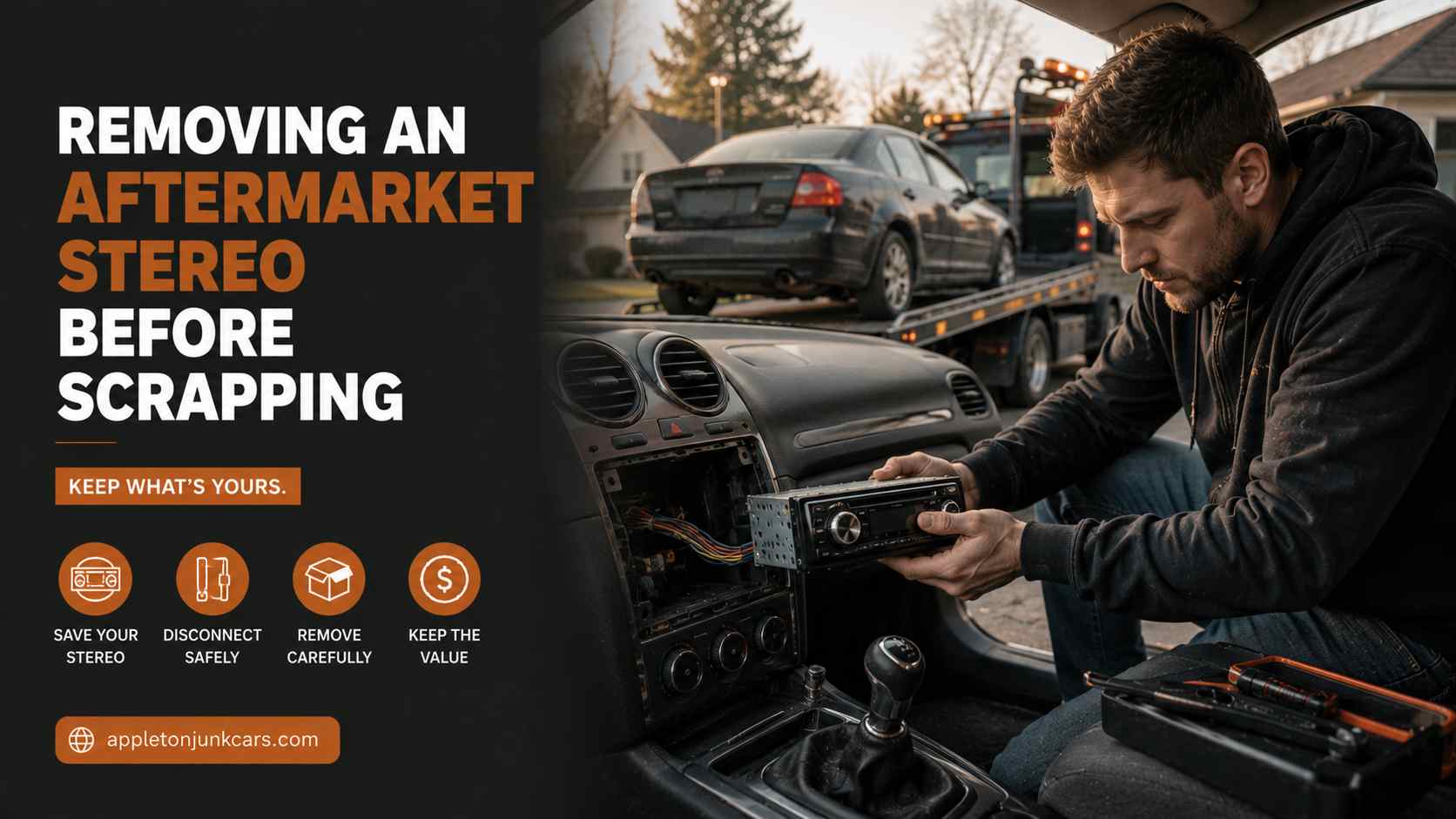
The car is heading to a junk buyer, and somewhere in the dash is an aftermarket head unit you paid real money for. The question every seller faces is whether removing it before the tow truck arrives is worth the effort, and whether the junk offer changes if it is gone. The answer depends almost entirely on what brand and model the unit is, how recently it was purchased, and whether the installation wiring makes removal a 10-minute job or a 40-minute project.
Removing an aftermarket car stereo before a junk car sale makes financial sense in specific situations and is not worth the effort in others. A $49 entry-level single-DIN unit from a bargain brand installed eight years ago has almost no resale value today. A double-DIN touchscreen with wireless CarPlay installed two years ago can sell privately for $80 to $250 or more. The decision is a straightforward value calculation, and this guide walks through every variable.
This guide covers which units are worth removing, what they are realistically worth on the used market, the step-by-step removal process, where to sell the unit after removal, and whether removing it affects what the junk buyer offers for the car.
Is Your Aftermarket Head Unit Actually Worth Removing?
The decision to remove an aftermarket stereo before scrapping comes down to three questions: what is the unit worth in working condition today, how long will removal take, and does the junk offer change if the unit is missing?
Remove Before Scrapping? | Situation | Reasoning |
|---|---|---|
Yes, remove first | Double-DIN touchscreen with CarPlay or Android Auto, purchased within 3 years | These units sell for $80 to $300 used. 15-minute removal pays well. |
Yes, remove first | Name-brand amplifier (Rockford Fosgate, JL Audio, Alpine) in trunk | Amplifiers sell for $100 to $500 used. Easy disconnect. |
Yes, remove first | Subwoofer and custom enclosure, name brand, good condition | Package sells for $80 to $300. Worth pulling if you have storage. |
Probably not | Single-DIN unit, 5+ years old, no navigation or CarPlay | Used value is $20 to $50. Rarely worth the time. |
Probably not | Generic or off-brand double-DIN, no CarPlay, older Android tablet style | Very limited used market. $15 to $40. Not worth the effort. |
No, leave it | Unit is integrated with backup camera display, parking sensors, or OEM HVAC controls | Removal may require reconfiguring vehicle systems. Junk buyer does not care either way. |
No, leave it | Pickup is tomorrow and you have no storage or buyer lined up | Unsold units create clutter. Only remove if you have a buyer or a platform ready. |
The practical rule: if the unit cost more than $100 when new and was installed within the last four years, it is worth removing. If the unit cost less than $75, is more than five years old, or is a generic brand with no active used market, leave it. The junk buyer will not offer more either way.
What Different Aftermarket Stereo Systems Are Worth on the Used Market
Aftermarket car audio depreciates faster than most electronics because installation is permanent, wiring varies by vehicle, and technology cycles are short. What a unit is worth today depends heavily on whether it has CarPlay or Android Auto (the single most important feature in current used car audio demand) and whether it is from a recognized brand.
Unit Type / Brand | Typical New Price | Realistic Used Resale Value | Platform |
|---|---|---|---|
Pioneer double-DIN with wireless CarPlay (last 2 to 3 years) | $200 to $400 | $80 to $220 | Facebook Marketplace, eBay |
Kenwood double-DIN with CarPlay (last 2 to 3 years) | $200 to $450 | $80 to $240 | Facebook Marketplace, eBay |
Alpine iLX or Halo large-screen unit | $400 to $900 | $180 to $500 | eBay, Craigslist |
Sony double-DIN with CarPlay (last 2 years) | $150 to $300 | $60 to $160 | Facebook Marketplace |
JVC double-DIN with CarPlay | $130 to $250 | $50 to $140 | Facebook Marketplace |
Any single-DIN (no touchscreen, no CarPlay) | $50 to $150 | $10 to $45 | Craigslist only; slow market |
Rockford Fosgate amplifier (R or T series) | $150 to $600 | $100 to $380 | eBay, Facebook Marketplace |
JL Audio amplifier | $200 to $800 | $120 to $500 | eBay; strong market |
Name-brand subwoofer in enclosure (Kicker, Rockford) | $100 to $400 | $60 to $250 | Facebook Marketplace, Craigslist |
Generic or off-brand head unit (any size) | $40 to $80 | $10 to $30 | Virtually no market |
CarPlay and Android Auto compatibility is the single feature that most separates a unit with active buyer demand from one with almost none. Used car audio buyers specifically search for “CarPlay” as their primary filter. A Pioneer unit from 2022 with wireless CarPlay will sell faster and for more money than an Alpine unit from 2018 without it, even if the Alpine was the more expensive product at purchase.
The Tools You Need and How to Remove the Unit Without Damaging It
What You Need
For most standard single-DIN and double-DIN installations, you need four items: a pair of DIN removal tools (two U-shaped metal or hard plastic tools, available for $3 to $8 at any auto parts store or online), a set of plastic trim pry tools, a Phillips screwdriver, and a small flathead screwdriver. If you do not have DIN removal tools, two straightened metal coat hangers bent into a hook shape work as substitutes for single-DIN units.
Step 1: Disconnect the Battery
Before touching any car audio wiring, disconnect the negative terminal of the car battery. This prevents shorts that can damage the head unit or the car’s electrical system during removal. On a dead car, this step may not be necessary if the battery has no charge, but it is always the safer practice.
Step 2: Remove the Trim Bezel
The trim bezel is the plastic panel surrounding the head unit in the dash. It is held by clips, screws, or both. Insert the plastic pry tool at a corner of the bezel and gently work around the perimeter until the clips release. Do not force it; work slowly from clip to clip. Some vehicles require removing adjacent trim panels or the center console to access the bezel fasteners.
Step 3: Release the Head Unit From the Dash
Insert the DIN removal tools into the small rectangular slots on either side of the head unit face. Press inward and slightly outward simultaneously until you feel or hear the internal locking clips release. Then pull the unit straight out from the dash. For double-DIN units held by screws rather than clips, remove the screws from the mounting bracket before pulling.
Step 4: Disconnect the Wiring
Once the unit slides out several inches, you will see two or three connections at the rear: the wiring harness (a multi-wire connector), the antenna cable (a coaxial-style connector with a single push-on fitting), and possibly USB or video cables. If the installer used a wiring harness adapter (a small plug-to-plug adapter that avoids cutting factory wires), the harness unplugs cleanly in one piece. If the installer cut and spliced wires directly, you will need wire cutters. Cut cleanly and do not leave exposed wire ends, even on a car going to scrap. Tape any cut ends if the car will sit before pickup.
Step 5: Remove the DIN Cage or Mounting Bracket
Most aftermarket head units are held in place by a metal mounting sleeve (DIN cage) that was installed in the dash opening. Once the unit is out, the cage is typically held by bent tabs at the perimeter of the dash opening. Use the flathead screwdriver to straighten the tabs and slide the cage out. The cage typically has no resale value on its own but should be removed cleanly so you have a complete unit to sell.
Where to Sell the Unit After Removal and What to Expect
The fastest market for used car audio is Facebook Marketplace for local sales. Buyers in this category are often in the middle of a car audio project and need a specific unit now. Listing with clear photos of the front face, the wiring harness adapter if included, and the OEM mounting hardware produces the fastest response.
eBay Motors is the right platform for higher-value units (Alpine Halo, JL Audio amplifiers, premium Rockford systems) where a buyer across the country might pay more than anyone locally. eBay requires shipping, which adds complexity for amplifiers and subwoofers but is straightforward for head units that box easily.
Craigslist reaches local buyers but typically produces slower results than Facebook Marketplace for car audio. It remains a viable platform for subwoofer and amplifier packages where local pickup makes more sense than shipping.
Include in every listing: the exact model number, the year of purchase if known, whether it powers on (test it with a 12V power supply if unsure), what wiring harness adapter or kit was included, and clear photos of both the front face and the rear connections. Completeness builds buyer confidence and reduces negotiation.
How Removing the Stereo Affects Your Junk Car Offer
For the vast majority of junk car transactions, removing the aftermarket head unit does not change the buyer’s offer. Junk car buyers price on the vehicle’s weight, scrap metal, and recoverable automotive parts: engines, transmissions, catalytic converters, and structural components. An aftermarket head unit is not a line item in their calculation.
The exceptions are worth knowing. On a newer vehicle where the aftermarket head unit is wired into a backup camera system, lane departure display, or parking sensor display, a buyer doing a detailed inspection may note the missing unit as something that would need to be replaced for the vehicle to function properly if it were repaired. In these cases, having the original factory unit available to reinstall before the sale is the cleaner approach.
The other exception: if the car is going to a salvage yard rather than a scrap metal buyer, the yard may have interest in the head unit as an inventory item. Ask the yard representative when you call. If they want to buy the unit separately, that conversation is worth having before you remove it yourself.
What Sellers Who Removed Their Stereo Before Scrapping Report
Sellers who removed aftermarket stereos before junking their car share consistent findings. Those who had name-brand CarPlay-capable double-DIN units universally reported that the removal took less than 20 minutes and the unit sold within one to three days on Facebook Marketplace for $80 to $200. The math consistently worked in their favor.
Those who removed generic or older units reported the opposite: the unit sat unsold for weeks, no buyer materialized, and the unit eventually ended up in a box in the garage. The effort produced no return. Several reported that their specific unit had no market because it lacked CarPlay support and was more than five years old.
The consensus from sellers who have done this more than once: check the exact model number on your unit before deciding. Look it up on eBay Sold Listings (filter to completed, sold items) to see what identical units have actually sold for recently, not what sellers are asking. That sold price is your realistic ceiling. If it is above $60, removing the unit is worth the time. If it is below $40, leave it.
Frequently Asked Questions
Should I remove my aftermarket stereo before junking my car?
It depends on the unit. A name-brand double-DIN head unit with CarPlay support purchased within the last three to four years is worth removing: it can sell for $80 to $250 on Facebook Marketplace or eBay and takes 15 to 20 minutes to remove. A basic single-DIN unit, a generic brand, or any unit more than five or six years old has very limited used market demand. Removing it produces minimal return and creates clutter. Check your unit’s model number on eBay Sold Listings to see actual recent sale prices before deciding.
Will removing the stereo affect my junk car offer?
In most cases, no. Junk car buyers price on the vehicle’s weight and automotive components like the engine, catalytic converter, and transmission. An aftermarket head unit is not part of their pricing formula. The exception is a salvage yard doing a detailed inventory, which may note missing equipment. For a straightforward junk sale, the head unit’s presence or absence has no meaningful effect on the offer.
How do I remove an aftermarket car stereo without tools?
The cleanest removal requires DIN removal tools, which cost $3 to $8 at auto parts stores. Without them, two metal coat hangers bent into a hook shape can substitute for single-DIN units. For double-DIN units held by screws rather than clips, a Phillips screwdriver is sufficient after the trim bezel is removed. The trim bezel can be released with a thin plastic pry tool or, carefully, a flathead screwdriver wrapped in tape to avoid scratching.
What is an aftermarket car stereo worth used?
A name-brand double-DIN touchscreen with wireless CarPlay installed within the last three years sells for $80 to $300 used depending on the brand and specific model. Alpine premium units and high-end Pioneer and Kenwood models reach the higher end of that range. Single-DIN units without touchscreens sell for $10 to $50. Name-brand amplifiers sell for $100 to $500. Generic brands have almost no used market regardless of age or condition.
What tools do I need to remove a car stereo?
Standard removal requires DIN removal tools (two U-shaped metal or plastic tools that release the mounting clips), plastic trim pry tools for the dash bezel, a Phillips screwdriver, and a small flathead screwdriver. The entire tool set costs $10 to $20 if purchased new. Most auto parts stores sell a basic removal kit.
Can I sell a used car stereo on eBay?
Yes. eBay Motors is one of the strongest markets for used aftermarket car stereos, particularly for name-brand units from Pioneer, Kenwood, Alpine, and Sony. The key to a successful eBay sale is listing the exact model number, accurate condition photos of the front and rear, and an honest description of any cosmetic damage. Amplifiers and subwoofers can be sold on eBay as well, though the shipping logistics for heavier items require more packaging effort.
Does the original factory radio need to go back in before scrapping?
No. Junk car buyers do not require the factory radio to be reinstalled before the sale. The car is going to be dismantled or crushed regardless of what is in the dash. If you removed the aftermarket unit and have the factory radio available, reinstalling it is optional and adds no value to the junk transaction.
How long does it take to remove an aftermarket car stereo?
A standard aftermarket head unit in a typical installation takes 10 to 25 minutes to remove. Complex installations involving OEM integration modules, multiple adapters, or extensive custom trim work take longer. An amplifier in the trunk disconnects in 5 to 10 minutes if accessible. A subwoofer in a custom enclosure takes 10 to 20 minutes to unbolt and remove. The total time for a full system (head unit, amp, sub) in a typical installation is 30 to 50 minutes.
The Bottom Line
Removing an aftermarket stereo before scrapping a car is worth it for the right unit and not worth it for most. The quick test: look up your exact model number in eBay’s completed and sold listings and see what identical units have sold for in the last 90 days. If the number is above $60, the 20 minutes of removal effort pays a reasonable return. Below $40, your time is better spent on something else.
CarPlay and Android Auto support is the single feature that determines whether a used head unit has a buyer pool. With it, a used unit from a recognized brand sells in days. Without it, a unit of any brand sits for weeks regardless of how good it sounded. If your unit has CarPlay, remove it. If it does not, verify the used price before deciding.
Leave the catalytic converter in place, leave the wiring tidy and taped, and do not remove anything that is structurally connected to how the junk buyer plans to move or process the car. The head unit and amplifier are entirely self-contained removals that leave the car exactly as useful to the buyer as it was before.