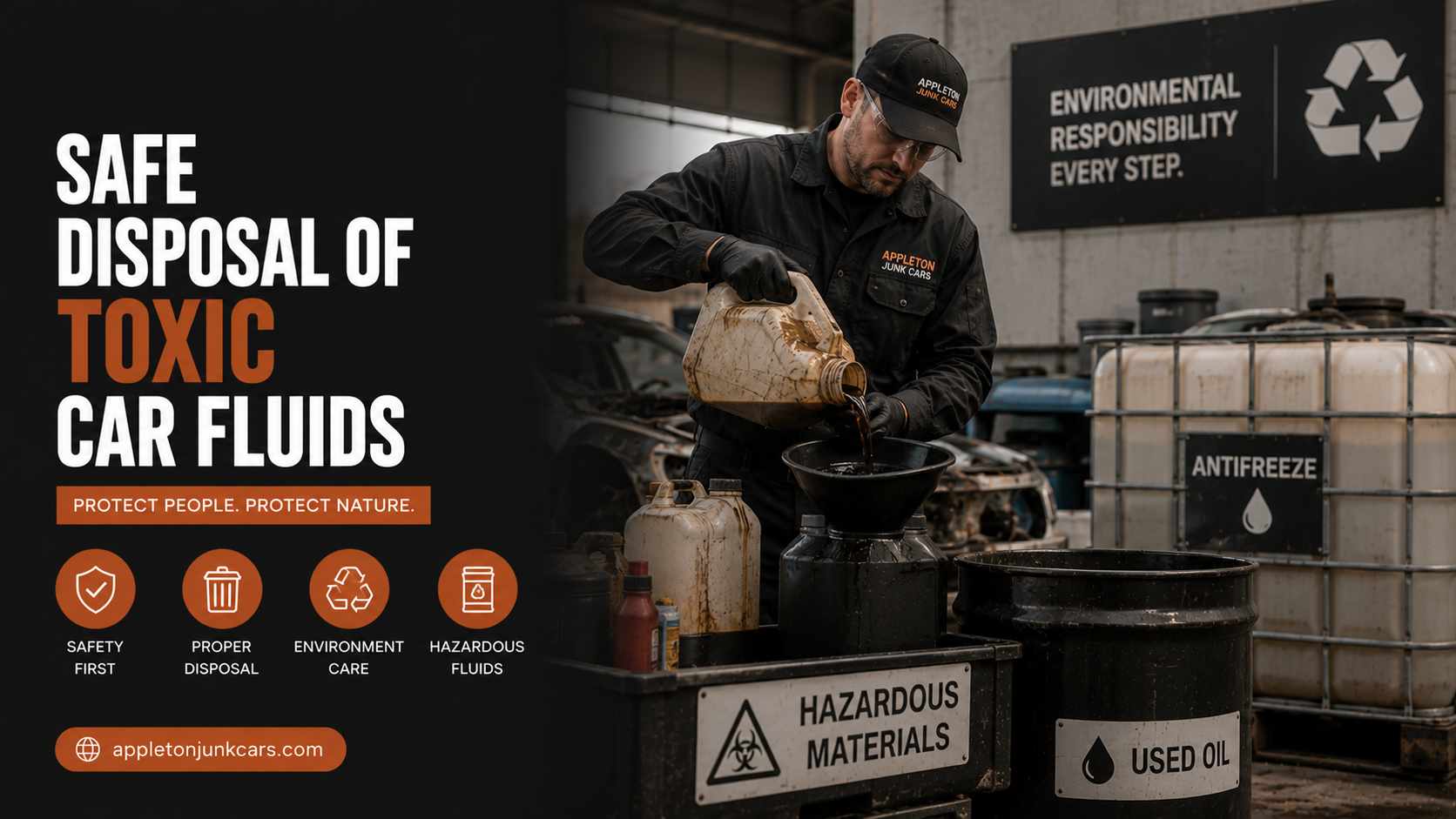
If you have done your own oil change, flushed the coolant, drained the brake fluid, or removed fuel from a tank before a sale or junkyard pickup, you have produced automotive fluids that cannot go into household trash, down a sink drain, into a storm drain, or onto the ground. Every automotive fluid produced during home vehicle maintenance is either legally regulated as hazardous waste or subject to disposal restrictions that prevent standard disposal routes.
Improper disposal of automotive fluids is both an environmental hazard and a legal violation in all 50 states. A single quart of used motor oil can contaminate 250,000 gallons of groundwater. A small fuel spill that reaches a storm drain can be traced to a single household and carries fines that easily exceed the value of the fluid. The good news is that the collection infrastructure for all common automotive fluids is accessible, free or very low cost, and requires nothing more than showing up with the fluid in a sealed container.
This guide covers every common automotive fluid that requires special disposal, where to take each one, the specific facilities and programs that accept them, and what actually happens when each fluid is improperly disposed of so you understand why the restrictions exist.
The One Rule That Applies to Every Automotive Fluid
Never pour any automotive fluid into a household drain, a storm drain, a ditch, or directly onto the ground. This rule applies without exception to motor oil, gasoline, diesel, antifreeze, brake fluid, transmission fluid, power steering fluid, and any other petroleum-based or glycol-based fluid from a vehicle. These are the specific disposal pathways that cause the contamination events that lead to fines, remediation costs, and environmental damage.
Storm drains are the most commonly misunderstood pathway. Unlike household drains that flow to wastewater treatment plants, storm drains in most municipalities flow directly to waterways without treatment. Automotive fluids poured into a storm drain reach surface water unfiltered. This is why storm drain dumping carries particularly severe penalties in most states, with fines ranging from $500 for a single incident to tens of thousands of dollars for repeat violations.
Household drains flow to wastewater treatment, but wastewater treatment plants are not designed to remove petroleum hydrocarbons. Automotive fluids that enter wastewater treatment inhibit the biological treatment processes that the plant relies on, are not fully removed from treated effluent, and accumulate in sewage sludge at concentrations that affect its usability as agricultural amendment.
Motor Oil: The Highest Volume and Most Accessible Recycling Stream
Used motor oil is the most common automotive fluid generated at home and has the most accessible recycling infrastructure of any automotive fluid. An estimated 1.3 billion gallons of used motor oil are generated by DIY vehicle owners in the United States annually. The EPA classifies used motor oil as a material that must be recycled rather than disposed of as waste.
Where to take it: auto parts retailers including AutoZone, O’Reilly, Advance Auto Parts, NAPA, and Walmart Auto Center accept used motor oil at no charge. Most accept it in any sealed container, including the original bottles or any clean container with a secure cap. Call ahead to confirm current acceptance at your specific location and to ask about volume limits, as some stores have per-visit quantity limits.
Municipal household hazardous waste programs accept used oil without volume limits at permanent drop-off facilities and during collection events. Many gas stations with service bays accept used oil. Some licensed oil recyclers offer residential curbside pickup for used oil in some regions.
What not to mix with used oil before recycling: antifreeze, solvents, gasoline, brake fluid, or any other substance. Mixed fluids are more difficult and expensive for recyclers to process and may be rejected at collection points. Keep used oil in a separate sealed container from all other fluids.
Antifreeze and Coolant: Separate Collection Required
Used antifreeze, consisting primarily of ethylene glycol with water and degraded additive packages, must not be mixed with used oil. The two fluids require different recycling processes and contaminate each other if combined. Most recyclers and collection programs that accept used oil also accept antifreeze, but in separate containers.
Where to take it: auto parts retailers that accept used oil typically also accept used antifreeze in a separate container. Municipal household hazardous waste programs accept it universally. Some auto service centers that perform coolant flushes as a service accept used antifreeze from retail customers as a courtesy.
Antifreeze is acutely toxic to animals, particularly dogs and cats, because its sweet taste makes it attractive but its toxicity is high. Ethylene glycol causes kidney failure in companion animals after ingestion of relatively small amounts. Outdoor spills of antifreeze, even small ones, create a hazard to pets and wildlife. Propylene glycol-based antifreeze, used in RVs and some non-automotive applications, is significantly less toxic but still requires proper disposal.
Gasoline and Diesel: The Most Hazardous and Most Regulated Fluid
Gasoline is the most volatile, flammable, and rapidly groundwater-contaminating of all common automotive fluids. It should never be poured anywhere except into a properly operating engine or into an approved container at a licensed disposal or recycling facility.
Where to take it: municipal household hazardous waste programs accept gasoline and diesel. Some municipalities operate specific fuel disposal events. A few auto parts stores accept small quantities of gasoline in sealed approved containers, though this is less universal than oil acceptance. Gasoline that has not phase-separated or significantly degraded can be returned to service by diluting it with fresh fuel if it is contamination-free.
What to do with fuel drained from a junk car: if the fuel is relatively clean and you own another gasoline-powered vehicle, siphoning or pumping the fuel into an approved container for use in that vehicle is legal and practical. If the fuel is water-contaminated, phase-separated, or heavily degraded, it constitutes hazardous waste for household hazardous waste disposal. Never pour old fuel into the regular trash, down a drain, or onto the ground.
Brake Fluid, Transmission Fluid, and Other Petroleum-Based Fluids
Fluid Type | Proper Disposal Method | Where to Take It | What Not to Do |
|---|---|---|---|
Brake fluid (glycol-based, hygroscopic) | Household hazardous waste; some auto parts stores; not mixed with motor oil | Municipal HHW program; dedicated collection events | Do not mix with used oil; do not pour down drain or storm drain |
Automatic transmission fluid (ATF) | Used oil collection stream (unmixed) | Same locations as used motor oil; auto parts stores, HHW | Do not mix with antifreeze; keep separate from brake fluid |
Power steering fluid (petroleum-based) | Used oil collection stream | Same as motor oil; auto parts stores, HHW programs | Same restrictions as motor oil |
Differential and gear oil | Used oil collection stream | Same as motor oil | Same restrictions as motor oil; keep separate from antifreeze |
Windshield washer fluid (methanol-based) | Check local HHW program; some classify as hazardous | Municipal HHW is safest option | Do not pour large quantities down drain; methanol is a hazardous solvent |
Diesel exhaust fluid (DEF, urea solution) | Generally not hazardous; some municipalities accept in drain with large dilution | Contact local wastewater authority for guidance | Do not mix with any petroleum-based fluid; keep completely separate |
Transmission fluid, power steering fluid, and differential oil can be mixed with used motor oil for recycling purposes because they are chemically similar petroleum products. The used oil recycling stream accepts all of these in combination. The key exception is brake fluid, which is glycol-based and must be kept separate from petroleum-based oils for proper processing.
Where to Find Automotive Fluid Collection Near You
Collection Source | What They Accept | How to Find Them | Cost |
|---|---|---|---|
Auto parts retailers (AutoZone, O’Reilly, Advance, NAPA) | Used motor oil, ATF, gear oil, antifreeze (separate) | In-store drop-off; call ahead to confirm current availability | Free |
Municipal household hazardous waste program | All automotive fluids including gasoline, brake fluid, antifreeze, used oil | Search “[your county] household hazardous waste” or earth911.com | Free to residents |
Gas stations with service bays | Used oil; sometimes antifreeze | Call individual stations; acceptance varies | Usually free |
Auto service centers (oil change shops) | Used oil; sometimes antifreeze | Call ahead; not all accept outside fluids | Usually free; some charge a small fee |
Licensed used oil recyclers (commercial) | All petroleum fluids in bulk | Search earth911.com or your state’s used oil recycler list | Free for small quantities; bulk pickup for large volumes |
Earth911.com online locator | All types; searchable by fluid type and zip code | earth911.com; enter fluid type and location | Free search tool; collection varies by location |
Earth911.com is the most comprehensive and most reliably current online resource for finding automotive fluid collection near any zip code. The site is maintained specifically to locate recycling and disposal options for hazardous household materials including all automotive fluids. Searching by specific fluid type and your zip code returns a list of nearby facilities, their hours, and what they accept.
What Happens When Automotive Fluids Are Improperly Disposed
Engine oil poured onto the ground forms a water-resistant film that prevents rain from infiltrating the soil normally, creating a modified drainage pattern. The oil itself moves slowly through the soil, binding to soil particles and gradually reaching lower soil layers and eventually groundwater. In sandy or gravelly soil, this movement is faster. Near a water table, contamination can reach drinking water sources. Petroleum hydrocarbons in groundwater produce taste and odor problems at concentrations below 1 part per billion.
Gasoline poured onto the ground or into a storm drain creates an immediate hazard from flammable vapors and a longer-term groundwater contamination risk from BTEX compounds that move much faster through soil than motor oil. Benzene is a known carcinogen with no established safe exposure level. A small gasoline spill near a property’s water supply well represents a serious risk that typically requires professional remediation.
Antifreeze poured on the ground kills vegetation in contact areas and is attractive to wildlife and pets because of its sweet taste. Ethylene glycol is converted to glycolic acid and oxalic acid in soil and water, which can create localized acidification. The fluid is biodegradable over time but creates harm during its persistence phase.
The legal consequences of improper disposal are real and actively enforced in most states. Fines for illegal oil dumping range from $500 to $10,000 for first-time household offenders and higher for commercial violations. Storm drain dumping carries the highest penalties in most jurisdictions because of the direct and immediate surface water impact.
Frequently Asked Questions
What do I do with used motor oil after an oil change?
Take it to an auto parts store such as AutoZone, O’Reilly, Advance Auto Parts, or NAPA, where it is accepted for free in a sealed container. Most stores accept it without requiring a purchase. Municipal household hazardous waste programs also accept used motor oil. Store it in a sealed, clean container until you can drop it off. Do not mix it with antifreeze, brake fluid, or any other substance before recycling.
Can I pour antifreeze down the drain?
No. Used antifreeze should not be poured down a household drain or storm drain. It should be taken to an auto parts retailer that accepts used antifreeze (in a separate container from used oil) or to a municipal household hazardous waste collection program. Antifreeze is acutely toxic to animals and is regulated as hazardous waste in many states when generated in commercial quantities.
How do I dispose of old gasoline?
Old gasoline that is uncontaminated and has not phase-separated can be used by diluting it with fresh fuel in another gasoline vehicle. Old gasoline that is contaminated, water-mixed, or degraded should be taken to a municipal household hazardous waste program, which accepts fuel in sealed containers. Never pour gasoline down a drain, into a storm drain, or onto the ground. Some auto parts stores accept small quantities in sealed approved containers.
Where can I take used car fluids near me?
The best single resource for finding nearby automotive fluid collection is earth911.com. Enter the specific fluid type and your zip code to find local options including auto parts retailers, municipal household hazardous waste programs, and service centers. Auto parts retailers including AutoZone, O’Reilly, Advance Auto Parts, and NAPA are the most universally available option for used motor oil and often for antifreeze.
Can you mix different used car fluids together for disposal?
Transmission fluid, power steering fluid, and gear oil can be mixed with used motor oil for recycling because they are chemically similar petroleum products. Antifreeze must be kept completely separate from all petroleum fluids. Brake fluid must be kept separate from used oil because it is glycol-based and not compatible with the oil recycling process. Gasoline must never be mixed with any other fluid for disposal.
What happens if you pour motor oil on the ground?
Used motor oil poured on the ground creates a persistent contamination site. The oil binds to soil particles, prevents normal water infiltration, and migrates slowly toward groundwater. In states where groundwater is the primary drinking water source, oil contamination of the soil above the water table represents a risk that can require professional remediation at significant cost. Pouring used oil on the ground is illegal in all states and subject to fines.
Is brake fluid hazardous waste?
Brake fluid is classified as hazardous waste when generated by commercial operations in most states. For household quantities generated during DIY vehicle maintenance, it is classified as household hazardous waste and should be taken to a municipal household hazardous waste program. It should not be poured into the drain or mixed with used oil, as its glycol-based chemistry makes it incompatible with the used oil recycling stream.
Can automotive fluids be disposed of in regular trash?
No. None of the primary automotive fluids, including motor oil, antifreeze, gasoline, diesel, brake fluid, and transmission fluid, can legally be disposed of in regular household trash in any state. They are classified as hazardous materials that require specific disposal pathways. Auto parts stores, municipal household hazardous waste programs, and licensed recyclers provide free or low-cost collection for all of these fluids.
The Bottom Line
Every automotive fluid you handle at home has a correct disposal pathway, and every one of those pathways is free or very low cost. The effort required to dispose of a gallon of used motor oil correctly, driving it to the nearest auto parts store, is measured in minutes. The environmental harm and legal exposure from pouring it on the ground or into a storm drain can last years and cost far more than any convenience the improper method provides.
Auto parts retailers are the most accessible and convenient collection point for used motor oil, transmission fluid, gear oil, and in many locations antifreeze. Municipal household hazardous waste programs are the most comprehensive option, accepting all fluid types including gasoline and brake fluid that some retailers do not. Earth911.com connects any zip code to the nearest collection options for any specific fluid type.
Keep fluids separated: oil-based fluids in one container, antifreeze in another, brake fluid in a third. Do not mix types. Bring them in sealed containers. Drop them off. The recycling infrastructure that handles these materials exists precisely because properly managed automotive fluids are recoverable resources, not permanent waste, and the environmental value of keeping them out of the ground and in the recycling stream is real and measurable.