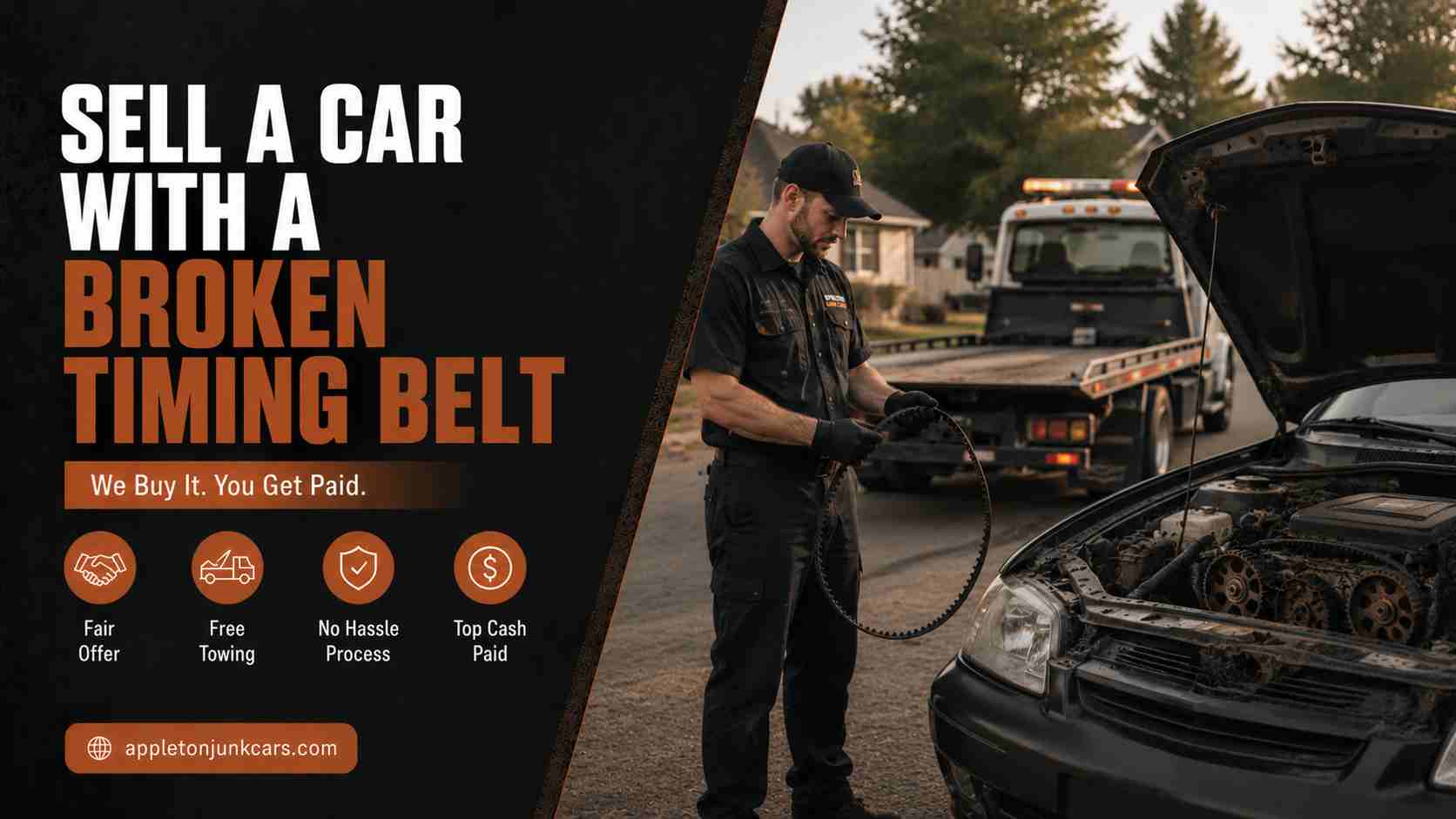
Yes, you can sell a car with a broken timing belt, and depending on the car’s make, model, and the extent of the engine damage, you may walk away with more money than you expect. The key is understanding exactly what you are dealing with before you call anyone. That first step shapes every other decision in the process.
What a Broken Timing Belt Actually Means for Your Car
Before you think about selling, you need to know one thing about your engine: is it an interference engine or a non-interference engine? This single answer changes what your car is worth to any buyer.
The timing belt’s job is to keep the camshaft and crankshaft spinning in perfect sync. That sync controls when the valves open and close inside the engine. In a non-interference engine, there is enough physical clearance between the pistons and the valves that even if the belt snaps, nothing collides. The engine simply stops. You replace the belt, re-time the engine, and in most cases the car runs again as if nothing happened.
In an interference engine, the pistons and valves share the same space at different moments. That design allows for better performance and fuel efficiency, but it means that when the timing belt snaps, the pistons crash directly into the stationary valves at full speed. The result is bent valves, damaged pistons, cracked cylinder heads, and sometimes a completely destroyed engine. Repair costs on an interference engine with a failed timing belt typically run anywhere from $1,500 to well over $4,000 depending on the extent of the damage and the labor rates in your area.
To find out which type your car has, check your owner’s manual, search your exact make, model, and year alongside the word “interference engine,” or call a mechanic and ask. Most modern cars use interference engines. Non-interference designs are more common in older vehicles and lower-compression engines.
Why does this matter for selling? Because a non-interference engine with a snapped belt is a much easier sell. The damage is limited. A buyer with a few hundred dollars in mechanical skills can fix it and drive it. An interference engine with internal collision damage is a harder sell and will draw lower offers, but it still has value and buyers do exist.
The Math You Need to Run Before Doing Anything Else
There are three numbers that determine your best path forward. Get all three before making any decision.
The first number is your car’s current market value in working condition. Look it up on Kelley Blue Book or Edmunds using the private party value with your car’s actual mileage and condition before the breakdown. This is what the car would have been worth with a functional engine.
The second number is the total repair cost. If you have not already gotten a quote, call two or three mechanics and ask for an estimate on the timing belt replacement plus any additional engine damage. On a non-interference engine in good health, belt replacement alone typically runs $400 to $1,000 depending on the car. On an interference engine with bent valves or worse, the number can climb well past $3,000.
The third number is what junk car buyers will pay you right now, as-is, no repair. Call two or three services and get actual quotes. This takes about fifteen minutes.
Now compare the three. If repair cost plus post-repair value gives you significantly more than the current as-is offer, fixing it might make sense. But here is the honest calculation most people miss: dealers and junk buyers will not pay you full retail value even after a repair. They will deduct their own margin and a risk buffer for any additional problems they expect to find. So the net gain from repairing is often smaller than the repair bill suggests.
The general rule in the industry is this: if the repair cost exceeds half the car’s current market value, selling as-is is typically the smarter financial move. If your car is worth $6,000 running and a full repair costs $3,500 or more, the math rarely works in favor of fixing it first.
Your Selling Options and Who Each One Is Right For
Option 1: Sell to a Junk Car Buyer or Salvage Yard
This is the fastest option and requires the least effort on your part. Junk car buyers and salvage yards purchase non-running vehicles constantly and have set processes for vehicles with known mechanical failures like a broken timing belt. They will ask about the make, model, year, mileage, and general condition. The offer you receive factors in the car’s weight and scrap metal value, the value of any usable parts, and current market demand for that specific model.
The biggest advantages here are speed and convenience. Most services offer free towing and same or next day pickup. You do not need to repair anything, clean anything, or advertise anywhere. You hand over the title, they hand over cash or a check, and the car is gone.
The tradeoff is price. Junk buyers build a margin into every offer. You will not get retail value. But if the car has significant engine damage and the repair cost is prohibitive, the difference between junk buyer price and what you could realistically get elsewhere may not justify the extra time and hassle.
Always get at least three quotes. Offers for the same car can differ by hundreds of dollars between buyers. Do not accept the first number without checking at least one or two alternatives.
Option 2: Sell Privately As-Is
A private sale takes more effort but often returns more money, especially if your car has a desirable engine, popular parts, or is a model with an active enthusiast community.
When listing a car with a broken timing belt privately, be completely upfront about the situation. State clearly in the listing that the timing belt has failed, describe the engine type and any known additional damage, and price the car accordingly based on what it would cost a buyer to repair it. Buyers in this market tend to be mechanically inclined people who can fix the problem themselves at a fraction of what a shop would charge. They know what they are looking at, and they will not be scared off by the problem the way a private buyer shopping for daily transportation would be.
Facebook Marketplace and Craigslist are both effective platforms for this. Use the description space to be detailed and honest. Include the year, make, model, mileage, the timing belt situation, and everything that is working well. Buyers appreciate complete information because it saves them the uncertainty of wondering what you are hiding.
Always have potential buyers sign a bill of sale that clearly states the vehicle is sold as-is with the known mechanical condition disclosed. This protects you from any claim that you misrepresented the vehicle.
Option 3: Sell to a Mechanic or Shop That Flips Cars
Independent mechanics and small repair shops sometimes buy cars with specific, known mechanical problems at a discount, fix them in-house at cost, and resell them. A car with a broken timing belt on a non-interference engine is particularly attractive to this type of buyer because the fix is straightforward and the car’s value increases significantly once it is running again.
This is not a widely advertised market. You find these buyers by calling local independent shops directly and explaining your situation, or by posting in local community groups and mentioning you are open to selling to a mechanic.
Expect to get less than private retail but more than scrap value. The mechanic has a clear plan to make money from the car, which means they will pay more than a junkyard would but less than a private buyer who is not planning to resell.
Option 4: Part It Out
If the engine is too damaged to be worth selling intact but the rest of the car is in reasonable shape, parting out can be the most profitable route. On a popular make and model with a healthy used parts market, the sum of individual parts sold separately often far exceeds what any single buyer would pay for the whole car.
High-value items to consider include the transmission (if undamaged), alternator, starter motor, wheels and tires, seats and interior components, infotainment system, body panels, tail lights, headlights, doors, and mirrors. Even the catalytic converter, which contains valuable platinum and palladium, can be worth $150 to $800 on its own depending on the vehicle.
The honest downside: parting out is a project. It requires physical space to store the car while it is being dismantled, time to list and manage individual sales, and patience to wait for buyers who want specific items. Once the high-value parts are sold, you are still left with a shell that needs to go somewhere, usually a scrap yard. For most people, the return on time does not justify the effort compared to selling the car whole. For someone who has the setup and enjoys the work, it can pay off significantly.
What Affects the Price You Get
Several factors push the offer up or down regardless of which selling path you choose. Understanding them helps you set realistic expectations and gives you something to negotiate with.
- Engine type and damage extent. A non-interference engine with only a snapped belt and no internal damage is worth considerably more than an interference engine with bent valves and cracked pistons. Buyers price the repair cost into their offers, so the more damage there is, the lower the offer.
- Make, model, and parts demand. Popular vehicles like Honda Civics, Toyota Camrys, and Ford F-150s have large parts markets with consistent buyer demand. Less common models with limited parts availability draw lower offers because buyers face more difficulty turning the car into profit.
- Mileage and overall condition. A lower-mileage car with a broken timing belt is worth more than a high-mileage one with the same issue. Buyers factor in the remaining useful life of the other major components: transmission, suspension, electrical system, body.
- Catalytic converter status. Never remove the catalytic converter before selling the whole car. It is one of the most valuable components in the vehicle. Selling the car intact with the converter in place almost always produces a higher total payout than separating them.
- Title status. A clean title, even on a car with a broken timing belt, is worth more than a salvage or rebuilt title. If your car has a clean title, make sure that is clear in any listing or conversation with buyers. It gives them confidence and flexibility in what they can do with the vehicle.
What to Do Before the Car Leaves Your Possession
Whether you sell to a junkyard, a private buyer, or a mechanic, run through this checklist before the car changes hands.
- Remove all personal items. Check the glove box, center console, under the seats, the trunk, and any door pockets. Non-running cars sometimes sit for a while and it is easy to forget what you stored inside them.
- Remove your license plates. Take them with you and either transfer them to your next vehicle or return them to the DMV, depending on your state’s requirements.
- Sign the title correctly and completely. Make sure your signature matches exactly how your name appears on the title. Any mismatch can delay or complicate the transfer for the buyer and could create paperwork problems for you down the line.
- File a release of liability with your state DMV. This formally notifies the state that the vehicle is no longer in your possession. The specific form and process vary by state, but the purpose is the same: once it is filed, you cannot be held responsible for anything that happens with the vehicle after the sale date.
- Cancel your insurance. Call your insurer once the car has been picked up and remove it from your policy. If you paid your premium ahead of time, you may be entitled to a refund on unused coverage.
What Owners in This Situation Consistently Say
People who have sold cars with broken timing belts share a few consistent lessons when they talk about the experience afterward.
The most common one is underestimating the car’s value before getting quotes. Many people assume a car with a dead engine is essentially worthless and accept whatever the first caller offers. In reality, even a car with significant timing belt damage on a popular model often has enough parts value to command several hundred dollars more than that initial lowball. Three quotes take fifteen minutes and routinely surface a better number.
The second recurring experience is not knowing whether their engine was an interference type. Owners who found out their engine was non-interference were often able to get meaningfully better offers because the car was only one timing belt replacement away from running again. That distinction carries real weight with mechanically-minded buyers. Knowing it upfront, and being able to state it clearly in a listing or conversation, is a legitimate negotiating point.
A third theme: people who disclosed everything upfront closed their sales faster and with less friction than those who stayed vague about the problem. Buyers who know exactly what is wrong can plan and price for it. Buyers who discover the problem after the fact feel misled and become difficult to work with or walk away entirely. Honesty makes the sale smoother every time.
Frequently Asked Questions
Can I sell a car with a broken timing belt?
Yes. Junk car buyers, salvage yards, private buyers, and mechanics all purchase cars with broken timing belts. The offer will reflect the repair cost and the car’s condition, but the car has real value regardless.
Does the type of engine affect how much I get?
Significantly. A non-interference engine with only a snapped belt is worth considerably more than an interference engine that has sustained internal collision damage. Find out which type you have before getting quotes, as it directly affects what buyers will offer.
Should I fix the timing belt before selling?
Run the math first. If the repair cost is low relative to the car’s post-repair value, fixing it might make sense. On a non-interference engine with no additional damage, a belt-only repair can sometimes justify itself. On an interference engine with serious internal damage, the repair cost almost always exceeds what you would gain from the sale. In that case, selling as-is is typically the better financial decision.
Will a junkyard take a car with a broken timing belt?
Yes, without question. Junkyards and salvage buyers specifically exist to handle cars that are no longer operational. A broken timing belt is a routine condition for them. They will make you an offer based on the car’s weight and parts value.
Can I sell the car without a title?
Some states allow the sale of older vehicles without a title using other proof of ownership like registration documents and a photo ID. However, having the title makes the process cleaner and typically produces better offers because buyers have fewer complications taking ownership. If you have lost the title, apply for a duplicate through your state DMV before selling.
How much can I expect to get for a car with a broken timing belt?
It depends heavily on the make, model, year, mileage, and extent of damage. A popular model in otherwise good condition with only a snapped belt on a non-interference engine might fetch $1,000 to $2,500 from a private buyer or mechanic. A heavily damaged interference engine in a common but older model might bring $200 to $600 from a junkyard. Getting multiple quotes is the only reliable way to know what your specific car is worth in your specific market.
The Bottom Line
A broken timing belt is not a death sentence for your car’s value. What matters most is understanding what the failure actually did to the engine, running the repair-versus-sell math honestly, and getting competing offers before agreeing to anything.
Non-interference engine with only a snapped belt? You have options and the car has real appeal to the right buyer. Interference engine with internal damage? The car still has value, and junk buyers will take it off your hands quickly with free towing and cash on the spot.
Be honest about the condition, collect at least three quotes, do the paperwork correctly, and move forward. The car sitting in your driveway not running is worth less with every passing week. The right buyer for it exists today.