You can sell a car with a cracked engine block to junk buyers, salvage yards, and parts buyers, and the cracked block does not eliminate the value of any component outside the engine: the transmission, axles, wheels, body panels, interior, electronics, and catalytic converter all retain full parts value regardless of what happened to the block.
The type of crack and which part of the block is affected determines whether the engine itself has any remaining value or is purely scrap metal.
Types of Cracks and What They Mean for Value
Freeze Crack
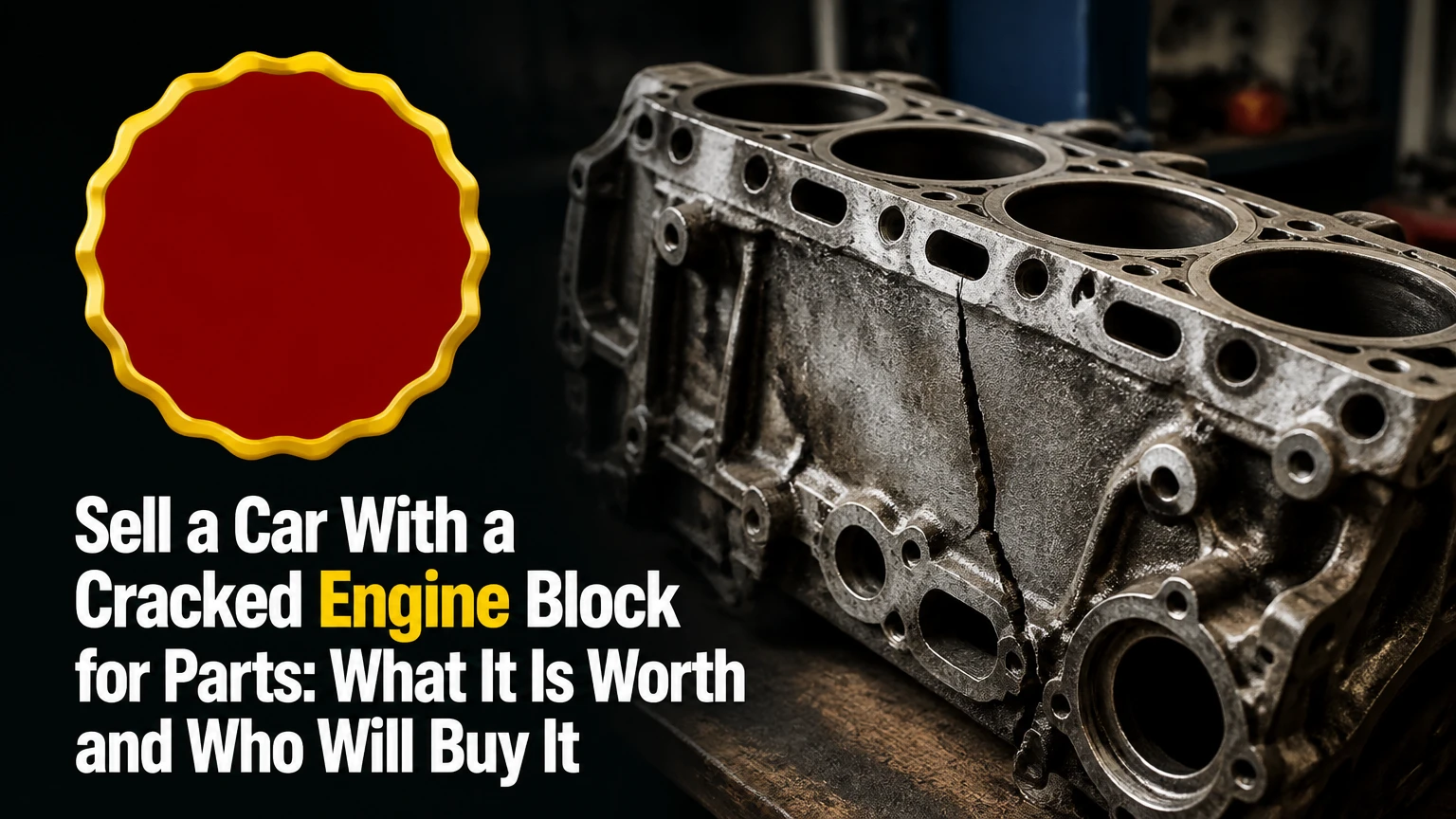
The most common cracked block scenario is a freeze crack: the coolant froze inside the block, expanded, and split the casting. Freeze cracks most often appear on the side of the block near coolant passages. They are typically visible from the outside as a hairline or open split, often accompanied by coolant seepage. A freeze crack does not necessarily damage the cylinder bores, crankshaft, or bearings. In some cases, a freeze crack can be repaired by a machine shop using metal stitching (also called cold welding or Loctite stitch pin repair), which inserts interlocking steel pins across the crack. Cost for this repair runs $400 to $1,200 depending on crack length and location.
Overheating-Induced Deck or Head Surface Crack
When an engine overheats severely, the aluminum cylinder head or the block deck surface can crack from thermal stress. A cracked deck surface (the flat mating surface between the block and head) means the head gasket cannot seal, even with a new gasket. Machine shop repair (re-sleeving or welding an aluminum block) is expensive and not always successful. A cracked iron block deck can sometimes be repaired; a cracked aluminum block deck is usually a replacement block situation.
Bore Crack
A crack that runs through the cylinder bore wall is serious. If the crack connects the bore to a coolant passage, coolant enters the combustion chamber. If it connects to the oil gallery, oil and coolant mix. These failures produce the white smoke or milky oil symptoms that accompany a blown head gasket, and a bore crack is often misdiagnosed as a head gasket failure until the head is removed and the block inspected. A bore crack is generally not economically repairable. The engine is scrap.
Main Bearing Web Crack
A crack in the main bearing web (the structural portion of the block that houses the crankshaft) is catastrophic. This typically results from a rod bearing failure or a hydraulic lock event that bent a connecting rod. The repair is not viable: the structural integrity of the block is compromised. This engine is scrap metal. The car still has full parts value outside the engine.
What Still Has Value When the Block Is Cracked
The critical insight most people miss: a cracked engine block does not destroy the value of the car. Every component outside the engine block retains its normal parts value. Specifically:
Component | Affected by Cracked Block? | Retains Value? |
|---|---|---|
Transmission (automatic or manual) | No | Full parts value |
Transfer case and 4WD components | No | Full parts value |
Front and rear axle assemblies | No | Full parts value |
Wheels and tires | No | Full parts value |
Catalytic converter | No | Full precious metal value |
Cylinder head (if undamaged) | Sometimes intact | Full value if not warped or cracked |
Accessories (alternator, AC compressor, power steering pump) | No | Full parts value |
Interior (seats, dash, electronics) | No | Full parts value |
Body panels, doors, hood, trunk | No | Full parts value |
Engine block itself | Yes | Scrap metal value only (unless repairable) |
Is Repairing the Cracked Block Worth It
Crack Type | Repair Viability | Repair Cost Range | Recommendation |
|---|---|---|---|
Freeze crack, external, small | Possible: metal stitching | $400 to $1,200 | Repair if vehicle value over $4,000 |
Freeze crack, large or multiple | Marginal: stitching plus sealer | $800 to $2,000 | Get a machine shop quote first |
Deck surface crack (iron block) | Possible with machine shop work | $600 to $1,500 | Repair only on high-value vehicles |
Deck surface crack (aluminum block) | Poor: welding often fails | $800 to $2,500+ | Sell as-is in most cases |
Bore crack through coolant passage | Not viable economically | Replacement block: $500 to $2,500 | Sell as-is |
Main bearing web crack | Not viable | Replacement engine: $2,000 to $6,000 | Sell as-is |
Who Buys Cars With Cracked Engine Blocks
Junk Car Buyers
Junk buyers are the most accessible and fastest buyers for cracked block cars. They price the offer on all recoverable value: parts plus scrap weight, with the engine contributing only its scrap metal weight since it cannot be resold as a running unit. For most vehicles, this offer is 30 to 55 percent of what the same car would bring running.
Salvage Yards
Salvage yards acquire cracked block cars specifically to part them out. They recover the transmission, axles, body panels, interior, and electronics, all of which are undamaged and sell normally. The engine goes to scrap. Their offer is similar to a junk buyer, sometimes slightly less because they factor in their own dismantling labor.
Engine Parts Buyers
Even a cracked block has valuable attached components. The oil pan, timing cover, intake manifold, fuel injectors, throttle body, alternator, and power steering pump are all separate from the block and undamaged. An engine parts buyer may purchase the engine as a core to strip these accessories. This is worth pursuing for popular engines where individual accessories have high used-market demand.
Machine Shops Buying Rebuildable Cores
For engines with repairable freeze cracks on desirable platforms (Coyote 5.0, LS small block, K-series Honda), some machine shops buy cracked blocks as repair cores. The engine must have intact bores and a rebuildable crankshaft and rotating assembly. Contact local engine rebuilders in addition to junk buyers if your vehicle has a high-demand engine.
What to Tell Buyers to Get an Accurate Offer
Specify the type of crack and its location. “Cracked block on the driver side near the water jacket” gives a buyer far more useful information than “cracked block.” Confirm whether the cylinder head is intact and undamaged: a good head on a cracked block adds real value. Confirm the transmission shifts and the rest of the drivetrain is functional. These details are the difference between a buyer assuming total loss and one who accurately prices a car with a full complement of intact parts.
Frequently Asked Questions
Can a cracked block be welded?
Cast iron blocks can sometimes be welded by a specialized shop using nickel rod welding, but thermal stress during the weld process can cause additional cracking. Metal stitching (inserting threaded pins across the crack without heat) is more reliable for cast iron. Aluminum blocks can be TIG welded but the process is difficult and the results vary. Any repair of an aluminum block crack should be pressure-tested before the engine is reassembled.
Does a cracked engine block mean the head is also damaged?
Not necessarily. A freeze crack on the block exterior does not damage the cylinder head. An overheating event that cracked the block deck, however, often warped or cracked the head simultaneously. Have the head inspected separately if you are considering selling the head as a used part: a warped head is worth scrap while a flat, undamaged head retains full used value.
What is a cracked block car worth to a junk buyer?
For most common vehicles, a cracked block car brings 30 to 55 percent of its running value from a junk buyer. A 2012 Honda Accord worth $7,000 running might bring $2,500 to $3,500 with a cracked block if the transmission and all other components are intact. Get three quotes because buyer pricing for cracked block vehicles varies based on demand for the specific vehicle’s non-engine parts in their market.
Should I drain the fluids before calling a junk buyer?
No. Most junk buyers accept vehicles with all fluids present and handle fluid disposal themselves as part of their processing. Draining fluids does not increase the offer and in some states improper fluid disposal creates environmental liability.
The Bottom Line
A cracked engine block is serious but it is not a total loss for the car’s sale value. Every component outside the engine retains full value, and those components often represent 60 to 70 percent of the total offer a junk buyer makes. Know the type of crack before calling buyers. For freeze cracks on popular engines, get a machine shop repair quote and compare it against the running car sale price before defaulting to a junk sale. For bore cracks and main bearing web failures, sell as-is and get multiple quotes to ensure you are capturing full parts value for everything that remained intact.