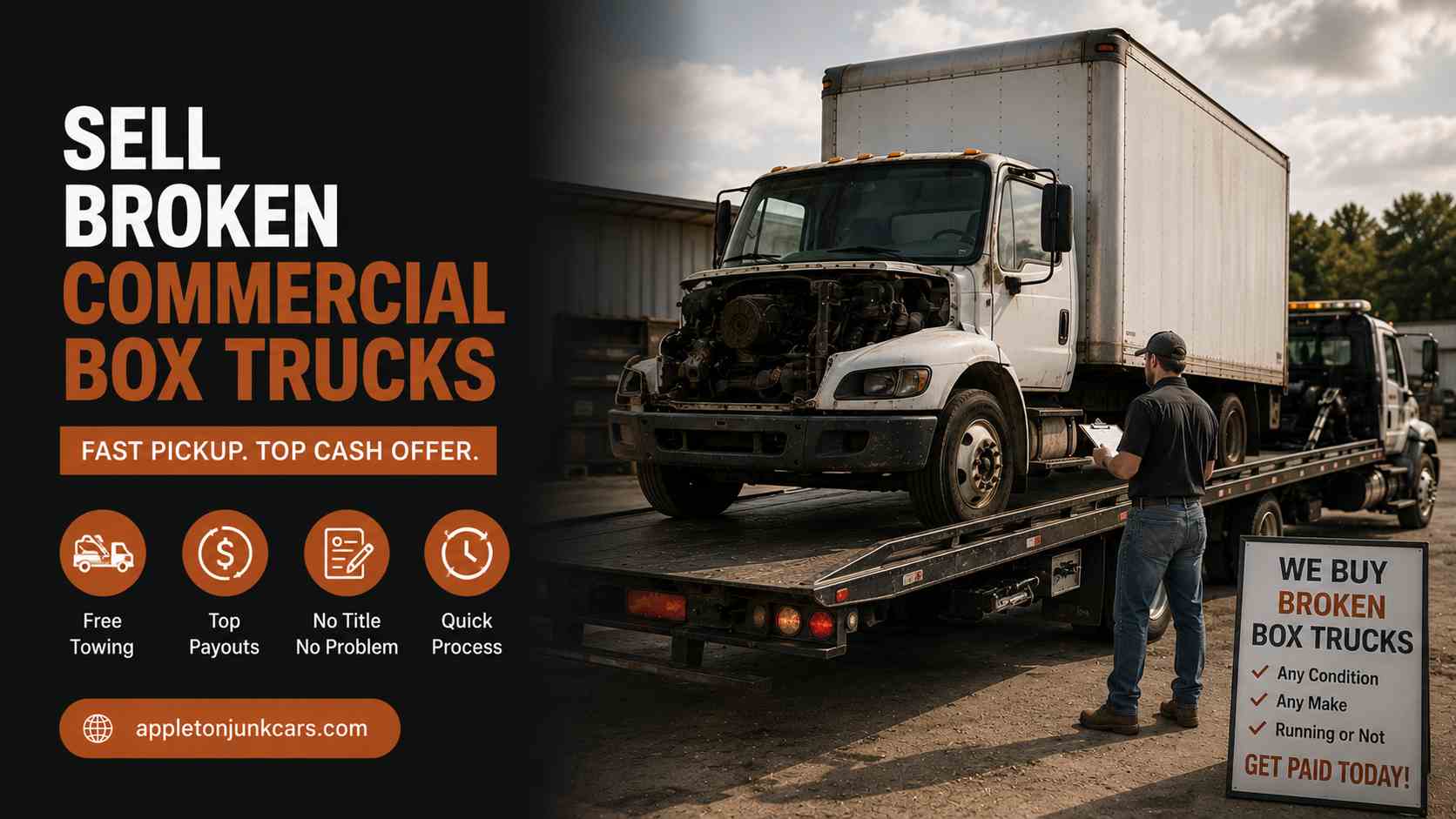
A broken box truck sitting in your yard or fleet lot is not a write-off yet. It is a commercial vehicle in a market with consistent demand from fleet buyers, parts specialists, commercial salvage dealers, and auction houses that move broken equipment every week. The difference between what you get by calling one buyer and what you get by understanding the full market for your specific truck is often $1,500 to $4,000, sometimes more on heavier units.
Box trucks present a different challenge than passenger vehicles when it comes to selling. The buyer pool is smaller but more specialized. The components that hold the most value, the cargo body, the liftgate, the refrigeration unit on a reefer truck, and the engine and transmission on certain chassis, are often valued separately rather than together. And the paperwork requirements for commercial vehicle sales have details that catch sellers off guard.
This guide covers realistic price ranges by truck size and condition, every buyer category in order of likely payout, how to handle the sale when the truck cannot drive, and the paperwork you need to have ready before any commercial vehicle transaction closes.
What a Non-Running or Damaged Box Truck Is Worth in Today’s Market
Box truck values vary widely based on chassis GVWR class, cargo body size, engine type, condition of the cargo body, and whether specialty equipment like a liftgate or refrigeration unit is present and functional. The figures below reflect realistic buyer offers, not dealer retail.
| Truck Type / Chassis Class | Engine Failure or Non-Running | Fair Condition Running | Additional Value from Specialty Equipment |
| Medium-duty box truck, 16 to 20 ft body (Class 4-5, up to 19,500 lb GVWR) | $2,000 to $6,000 | $8,000 to $22,000 | Liftgate: +$500 to $2,000; Reefer: +$1,500 to $5,000 |
| Heavy-duty box truck, 22 to 26 ft body (Class 6, up to 26,000 lb GVWR) | $3,500 to $9,000 | $12,000 to $35,000 | Liftgate: +$1,000 to $3,000; Reefer: +$2,500 to $7,000 |
| Light-duty box truck, 12 to 14 ft body (Class 3, up to 14,500 lb GVWR) | $1,500 to $4,000 | $6,000 to $18,000 | Liftgate: +$300 to $1,200 |
| Cutaway van box body, 10 to 14 ft (Transit, Sprinter chassis) | $1,000 to $3,500 | $5,000 to $16,000 | Limited specialty equipment typically |
| Refrigerated box truck (reefer), any size | Add $1,500 to $5,000 to above ranges | Functional reefer unit adds significant value at all conditions | Reefer unit alone worth $2,000 to $8,000 to parts buyers |
The cargo body and the chassis are two separate value components in the commercial truck market. A box body in good condition on a failed chassis has buyer appeal from multiple market segments. A running chassis with a damaged or rotted cargo body is similarly divisible. Understanding how your truck’s components break down determines which buyers to contact first.
Commercial Vehicle Auctions: The Highest Volume Channel for Broken Trucks
Commercial vehicle auction platforms are the most active market for non-running or mechanically compromised box trucks. Unlike passenger vehicle auctions that require a running vehicle, commercial platforms regularly sell equipment in any condition to a national buyer pool of fleet managers, rebuilders, and dealers who inspect and bid remotely.
The major platforms active in this segment include IronPlanet, Purple Wave, Ritchie Bros. Auctioneers, and CommercialTruckTrader’s auction division. For lighter-duty units on common chassis like Ford E-Series, Isuzu NPR, or Hino trucks, eBay Motors’ commercial vehicle section also moves significant volume. Each platform reaches a different buyer demographic: IronPlanet and Ritchie Bros. skew toward fleet buyers and heavy equipment dealers; eBay reaches a broader range including small operators and individuals.
The auction route typically produces stronger results than a single private sale for any truck that is genuinely difficult to move locally. The national buyer pool means your truck reaches every buyer who specifically wants that chassis class and body size, not just whoever happens to call you back first. Commission rates vary by platform: typically 5 to 10 percent of the final sale price. Factor this cost into your pricing expectations.
Fleet Maintenance Companies and Parts Buyers: The Market Most Sellers Skip
Fleet maintenance operations that service large numbers of commercial vehicles maintain ongoing demand for specific components. For box trucks built on common commercial chassis (Isuzu NPR/NQR, Hino 155/195, Ford F-650/750, International 4300), the drivetrain components, suspension parts, and body hardware have active secondary markets among fleet buyers who would rather install a used part than wait for a new one.
| High-Value Box Truck Component | Typical Buyer | Approximate Used Value |
| Liftgate (Maxon, Waltco, Tommy Gate, functional) | Moving companies, food service fleets, parts buyers | $1,500 to $4,500 depending on capacity and age |
| Refrigeration unit (Thermo King, Carrier, functional) | Reefer truck operators, refrigeration service companies | $2,000 to $8,000 depending on model and condition |
| Isuzu 4HK1 or 6HK1 diesel engine (low miles) | Fleet rebuilders, Isuzu dealers, parts yards | $3,000 to $8,000 for low-mileage rebuildable unit |
| Allison or Aisin automatic transmission | Fleet maintenance shops, rebuilders | $1,500 to $4,000 depending on model |
| Aluminum cargo body panels (undamaged) | Body shops, truck body fabricators | $500 to $2,500 per set |
| Dock bumpers, e-track systems, cargo straps | Moving and freight companies | $200 to $800 for intact sets |
| Air conditioning compressor and system (commercial unit) | Fleet shops, A/C repair specialists | $300 to $900 |
Selling components individually requires more time and effort than selling the truck whole, but the total proceeds frequently exceed the whole-truck offer from any single commercial buyer. The most practical approach for sellers with a place to store the truck is to remove and sell the two or three highest-value components first, then sell the remainder as a complete unit to a commercial salvage buyer or auction house.
Commercial Salvage Yards and Scrap Options for Box Trucks
Commercial salvage yards that specialize in heavy-duty and medium-duty vehicles are a different market segment from passenger car junkyards. They stock parts for fleet operators, handle wholesale transactions, and have the equipment to move large vehicles. They typically pay more than a scrap yard for any truck with working components but less than a direct fleet buyer for specific parts.
Commercial salvage buyers price trucks on a combination of parts market value and scrap weight. A non-running 26-foot box truck weighs 14,000 to 22,000 pounds. At current scrap prices for steel and aluminum, the pure metal value runs $1,200 to $2,500. Any functional component above that weight value increases the offer proportionally.
For trucks with catastrophic engine failures, major collision damage to the chassis, or severely deteriorated cargo bodies, the commercial scrap option may be realistic. Commercial scrap facilities that process box trucks need the cargo body separated from the chassis frame before shredding in some cases, and a few will handle this themselves. Confirm the acceptance process, fluid drainage requirements, and whether they handle transport for a vehicle of your truck’s size before agreeing on terms.
How the Sale Works When the Truck Cannot Drive
A non-running box truck presents logistical challenges that are different from a broken passenger vehicle. These trucks weigh 10,000 to 26,000 pounds fully empty and require commercial towing equipment for transport.
Flatbed and Heavy Tow Equipment
Standard passenger vehicle flatbeds cannot transport a medium or heavy duty box truck. Class 3 and 4 trucks on lighter chassis may be towable by a heavy-duty flatbed. Class 5 and 6 trucks typically require a commercial rollback or heavy wrecker with appropriate ratings. Get the towing logistics confirmed with your buyer or transport company before the deal closes. Discovering on the day of pickup that the equipment is inadequate delays transactions and sometimes kills them.
On-Site Inspection Before Pickup
For commercial vehicle transactions, most serious buyers will want to inspect the truck in person or through a representative before finalizing the offer. This is standard practice and should be expected. Have the truck accessible for inspection: hood operable, cab accessible, cargo body open, and any relevant documentation available. Buyers who inspect before committing produce cleaner transactions with fewer surprises.
Negotiating Transport Costs Into the Deal
Transport of a non-running box truck typically costs $300 to $900 for regional moves and $800 to $2,500 for longer distances depending on equipment required and distance. Who pays this cost should be agreed on and documented before the sale is finalized. Many commercial buyers will arrange transport at their expense for trucks they specifically want; others expect the seller to deliver or split the cost. Get it confirmed in writing.
The Paperwork That Commercial Vehicle Sales Require
Commercial vehicle title requirements differ from passenger vehicle titles in ways that catch sellers off guard.
Title and Ownership Documents
Box trucks are titled as commercial vehicles in most states. The title transfer process is similar to passenger vehicles: the seller signs the back of the certificate of title, notes the sale price and date, and the buyer registers the new title in their name. Some states require a separate odometer disclosure form for commercial vehicles. If the truck is titled in a business name rather than an individual’s name, a bill of sale on company letterhead signed by an authorized representative is typically required in addition to the title.
USDOT and FMCSA Considerations
If the truck is registered as a commercial motor vehicle with a USDOT number assigned to your business, you should contact the FMCSA to update or deactivate the registration associated with that VIN upon sale. The buyer will register their own USDOT number with the vehicle. This is not a title transfer requirement but is a compliance obligation that some sellers overlook, leaving the old business name associated with a vehicle they no longer own.
Lien Payoff for Financed Trucks
If the truck was financed and the lender holds a lien on the title, the lien must be satisfied before the title can transfer cleanly to a buyer. Contact the lender to obtain a payoff amount and confirm the process for releasing the title upon payment. For trucks where the outstanding loan exceeds the sale price, you must bring additional funds to cover the difference before the title can be released. This situation is more common on newer trucks purchased at high retail values that have depreciated significantly due to damage.
What Fleet Managers and Owner-Operators Who Sold Broken Trucks Consistently Report
Fleet managers and owner-operators who have sold broken or non-running commercial box trucks through various channels share a consistent set of findings. The single most impactful decision was reaching a national buyer audience rather than only local buyers. A box truck with a failed Isuzu engine has limited demand in any one geographic market but consistent demand from fleet buyers and rebuilders nationally who are specifically looking for that chassis and will pay significantly more to acquire it.
The second consistent finding is the value of the specialty equipment separate from the truck. Sellers who listed their refrigeration unit or liftgate separately on commercial equipment platforms before selling the truck whole consistently recovered more total value than those who included everything in a single whole-truck offer. Fleet buyers who wanted the reefer unit and not the truck were willing to pay market value for the component; buyers who wanted the whole truck adjusted their offer downward to reflect the reefer as a negotiating chip.
Those who engaged auction platforms reported generally positive outcomes on price relative to what local buyers quoted, with the caveat that the auction process added one to three weeks compared to a direct sale. For trucks that had been sitting with no serious local interest, the auction channel consistently moved inventory that had stalled in direct sale attempts.
Frequently Asked Questions
Who buys broken or non-running box trucks?
The main buyer categories are commercial vehicle auction platforms (IronPlanet, Ritchie Bros., Purple Wave), fleet maintenance companies and parts buyers, commercial salvage yards that specialize in medium and heavy-duty trucks, scrap metal facilities for end-of-life trucks, and private buyers including small operators looking for cheap project trucks. Auction platforms typically reach the broadest buyer pool. Parts buyers and fleet shops pay the most for trucks with specific working components they need. Scrap is the guaranteed floor for any condition.
How much is a broken box truck worth?
A non-running medium-duty box truck (16 to 26 foot body, Class 4 to 6 chassis) typically sells for $2,000 to $9,000 depending on the chassis model, engine type, body condition, and specialty equipment present. Trucks with functional liftgates add $500 to $3,000 to the baseline. Trucks with working refrigeration units add $1,500 to $7,000. Heavier trucks on Isuzu, Hino, or International chassis often bring more than those on Ford or GM chassis because of the active parts market for those commercial platforms.
Do I need a commercial title to sell a box truck?
Yes, a clean title is required for the sale of any titled commercial vehicle. The title process is similar to passenger vehicles but may involve additional documentation if the truck is registered in a business name rather than an individual’s name. If the truck carries a USDOT number, updating that registration with the FMCSA after sale is a compliance step separate from the title transfer. Most serious buyers will not close a transaction on a commercial vehicle without a clear title.
What happens to the cargo box when a box truck is scrapped?
The cargo body is typically separated from the chassis frame during the scrap process. The body is usually constructed of aluminum panels on a steel subframe, and the two metals are separated and recycled separately. Some scrap facilities handle this separation themselves; others require the seller to deliver the truck with the body already removed. If the cargo body is in good structural condition, it often has more value as a usable unit (for storage, workshop conversion, or installation on another chassis) than as scrap material. Check with a body fabricator or equipment dealer before scrapping a body in good condition.
Will a junkyard buy a box truck?
Standard passenger vehicle junkyards typically will not buy a medium or heavy-duty box truck because the parts market for commercial chassis is separate from the passenger vehicle parts market, and most passenger car junkyards lack the equipment to move a vehicle of that size and weight. Commercial salvage yards that specialize in fleet vehicles are the correct counterpart to a junkyard for a box truck. These yards stock parts for common commercial chassis including Isuzu, Hino, Ford F-650/750, and International 4300, and will purchase trucks for the parts they can resell.
How do I sell a box truck that won’t pass a DOT inspection?
A box truck that fails DOT inspection can be sold as-is to buyers who will either repair it to pass inspection under their own authority, use it for off-road or non-regulated purposes, or part it out without needing it to pass any inspection. Commercial auction platforms sell vehicles in non-DOT-compliant condition regularly. Disclose the specific inspection failures clearly in any listing: buyers price known defects accurately; they discount heavily for undisclosed ones. The DOT inspection failure does not legally prevent the sale of the vehicle; it prevents you from operating it commercially until it passes.
What is the best way to sell a fleet of broken trucks?
For multiple units, commercial auction platforms are the most efficient channel because they batch-list and batch-sell without requiring individual buyer negotiation for each truck. IronPlanet, Ritchie Bros., and Purple Wave have experience managing fleet liquidations and can assess, list, and sell multiple units in a single auction event. For fleets of three or fewer units, direct outreach to commercial salvage buyers and fleet maintenance companies is often faster. Separating high-value specialty equipment (reefer units, liftgates) from the chassis and selling them through specialized commercial equipment marketplaces before auctioning the stripped trucks typically maximizes total fleet recovery.
Do commercial vehicle auctions buy non-running trucks?
Yes. Commercial vehicle auction platforms regularly sell non-running, mechanically failed, and flood or collision-damaged trucks to national buyer pools that specifically seek distressed commercial equipment. Buyers on these platforms include fleet rebuilders, salvage dealers, parts buyers, and operators in markets with different inspection standards. The key to success on commercial auction platforms is accurate, complete condition disclosure with detailed photos and documentation of all known defects. Buyers who are misled by incomplete disclosures dispute sales and damage seller credibility for future transactions.
The Bottom Line
A broken box truck has real market value, and finding the right buyer determines how much of that value you actually recover. Scrap is the floor: every truck above a certain size has meaningful metal weight that produces a guaranteed minimum offer. But the ceiling is set by which specialized buyers reach your listing: fleet buyers who need your specific chassis, parts buyers who need your working liftgate or refrigeration unit, or auction buyers who will pay a national market rate for equipment that has limited local demand.
The practical sequence that produces the best outcomes: identify and price any specialty equipment separately before making any calls, get a commercial scrap quote as your floor, reach out to two or three commercial salvage yards that handle your chassis class, and submit the truck to a commercial auction platform if local quotes fall below your expectations. That sequence typically takes one week and consistently produces more than the first offer from the first buyer who calls back.
Accurate disclosure at every stage protects the transaction. Commercial buyers who specialize in broken equipment are not afraid of problems. They are afraid of surprises. Document the specific failure, photograph the components that work, confirm what is functional, and let the buyer accurately price the project. That approach closes more deals and closes them faster than any other approach in this market segment.