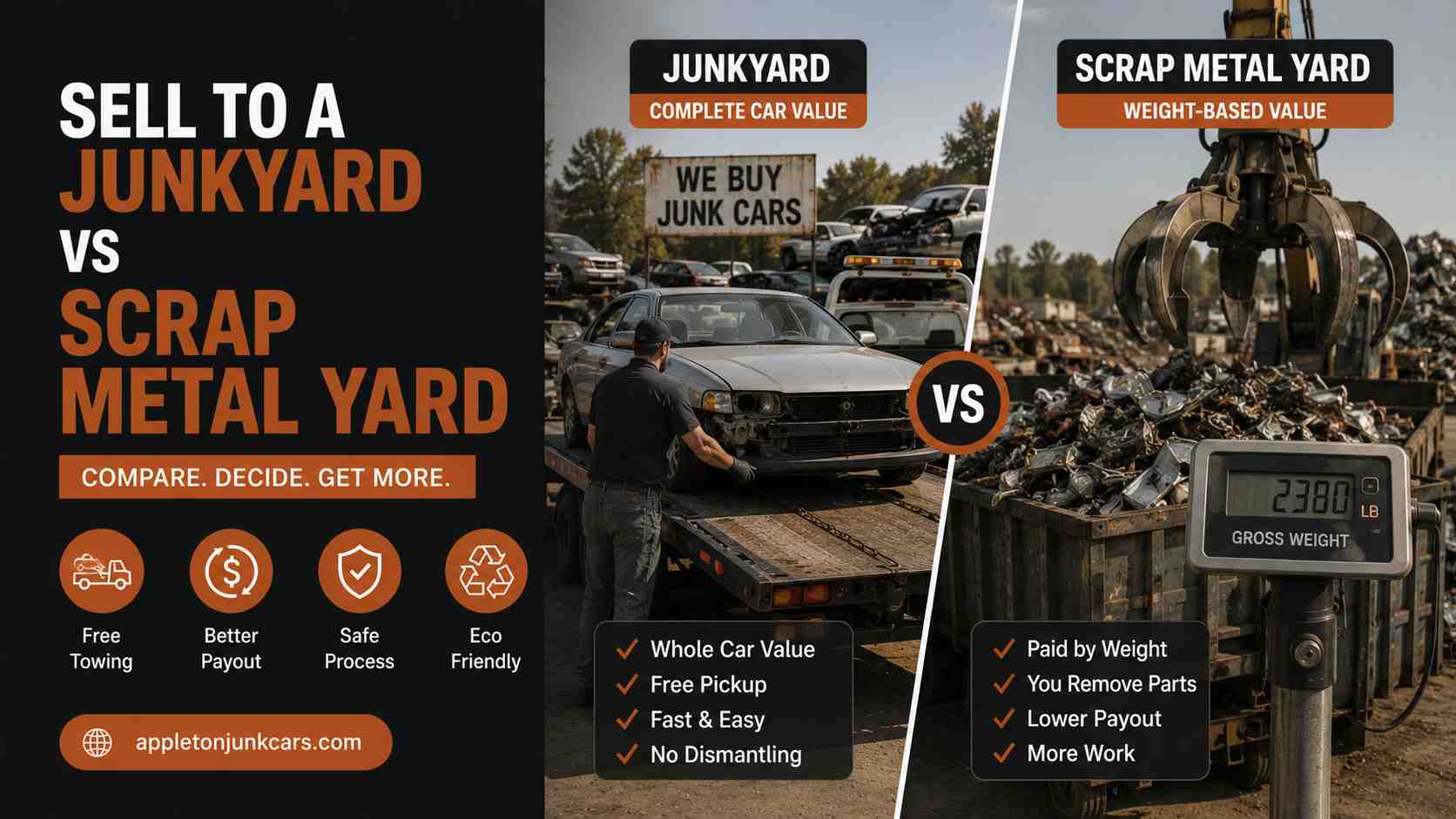
You have a vehicle that needs to go and two facilities ready to take it. Both call themselves recyclers. Both will send a tow truck. But a junkyard and a scrap metal yard are buying fundamentally different things when they buy your car, and they use different formulas to price what they are getting. The difference in what each one offers for your specific vehicle can easily be $300 to $700 on a typical passenger car and considerably more on the right truck or SUV.
Most sellers treat these as interchangeable options and call whichever is closest. That decision costs them money. The vehicle you have, its condition, which parts are still functional, and the current state of the scrap metal market all determine which facility will pay more and by how much.
This guide breaks down exactly how each buyer calculates value, which vehicle types and conditions favor each facility, and how to approach the choice to get the most out of whichever route you take.
What a Junkyard Buys vs What a Scrap Metal Yard Is Actually Paying For
A junkyard, formally called a salvage yard or auto recycler, buys vehicles primarily for their usable parts. They pull components and sell them to mechanics, body shops, DIY repairers, and online buyers through platforms like eBay and their own inventory systems. The vehicle’s value to a junkyard is the estimated sum of all recoverable usable parts, minus the cost of pulling, cataloging, storing, and selling those parts. Demand for the specific make and model drives most of the calculation.
A scrap metal yard buys vehicles for their raw commodity value: the steel, aluminum, copper wiring, and other metals that will be shredded and melted down. Individual parts are irrelevant to them. Weight, metal composition, and the current price of scrap steel on the commodity market determine the offer. Your 2009 Camry and your neighbor’s 2009 Corolla will get virtually the same offer at a scrap yard if they weigh the same. At a junkyard, the model that has more parts demand gets the higher offer.
The practical implication: the facility that pays more for your vehicle depends entirely on which of those two things your vehicle has more of: usable parts in demand, or weight in steel.
How Each Facility Arrives at Your Offer
Pricing Factor | Junkyard / Auto Salvage Yard | Scrap Metal Yard |
|---|---|---|
Primary valuation basis | Demand for parts from that make and model | Vehicle weight times current scrap steel rate |
Mileage impact | High mileage reduces engine and drivetrain value | No impact; weight is what matters |
Body condition | Panels and glass in good condition add value | No impact on offer |
Catalytic converter | Major value component; missing converter reduces offer significantly | Significant value component; adds $50 to $400+ |
Engine condition | Running or rebuildable engine adds substantial value | No impact; engine is scrap steel |
Interior condition | Seats, dash, and electronics add value if intact | No impact |
Vehicle popularity | In-demand models (Honda, Toyota, Ford trucks) earn more | No impact; weight is consistent |
Current market conditions | Parts demand fluctuates with model popularity | Scrap price fluctuates daily with commodity market |
The junkyard offer is also affected by what that specific yard already has in inventory. A lot that is stocked with six of your same model will offer less for a seventh because they do not need more of those parts. A yard with zero of your model may offer more than average because parts demand from their customers is unmet. This is why calling multiple junkyards for the same vehicle can produce offers that differ by $200 or more.
The Vehicle Types That Earn More at Each Facility
Vehicles That Favor the Junkyard
Popular makes and models with active parts markets earn meaningfully more at a junkyard. Honda Civics, Accord, and CR-Vs. Toyota Camry, Corolla, and Tacoma. Ford F-150 and Silverado/Sierra trucks. These platforms have consistent demand for used parts because there are millions of them on the road, repair shops source used parts for them constantly, and the parts hold their value even with mileage because they are known to last.
Vehicles with low mileage engines and transmissions in good condition earn disproportionately more at a junkyard. A used engine from a popular platform that ran cleanly to 90,000 miles is a real product that the yard will sell. The same engine at 210,000 miles with compression issues is scrap steel.
Vehicles with minor accident damage where body, interior, and electronics are still intact earn more at a junkyard than at a scrap yard, even when the mechanical failure is serious. Doors, fenders, interior trim, airbag modules, and infotainment systems from late-model vehicles have active secondary markets.
Vehicles That Favor the Scrap Yard
Heavier vehicles earn proportionally more at a scrap yard simply because they have more metal. A full-size pickup or SUV at 5,000 pounds earns 60 to 70 percent more than a 3,000-pound economy car at the same per-ton scrap rate. If both vehicles have comparable parts value, the truck still wins at a scrap yard more decisively.
Vehicles with most of their value already stripped or destroyed favor the scrap yard. A car with a seized engine, no catalytic converter, deployed airbags, missing interior, and major collision damage has limited parts appeal to a junkyard regardless of the model. When the parts are gone or ruined, the scrap yard offer often meets or exceeds the junkyard offer.
Very old vehicles with no active parts market earn their best price at a scrap yard. A 1998 economy car with 260,000 miles has almost no parts that mechanics will source from a salvage yard. Scrap metal is often the only realistic value.
What the Price Difference Looks Like in Real Dollar Amounts
Vehicle Example | Condition | Scrap Yard Estimate | Junkyard Estimate | Better Option |
|---|---|---|---|---|
2013 Honda CR-V, 145k miles | Engine rough, body solid, cat intact | $350 to $450 | $700 to $1,100 | Junkyard by $350+ |
2005 Chevy Silverado 1500, 240k miles | Rusted, engine seized, interior stripped | $550 to $750 | $250 to $400 | Scrap yard by $200+ |
2016 Toyota Camry, flood damage, airbags deployed | Drivetrain intact, water line visible inside | $450 to $600 | $900 to $1,400 | Junkyard by $450+ |
1999 Ford Taurus, 195k miles, runs rough | Body fair, no cat converter, worn throughout | $300 to $400 | $200 to $350 | Scrap yard by $50 to $100 |
2010 Ford F-250, engine blown | Heavy truck, body good, interior fair | $700 to $1,000 | $800 to $1,500 | Junkyard (larger spread on truck parts) |
The pattern is consistent: the newer the vehicle, the more popular the platform, and the more intact the major systems, the larger the junkyard premium. The older, heavier, and more stripped the vehicle, the more likely the scrap yard is competitive or superior.
Title Requirements and Paperwork: What Each Buyer Needs
Junkyards require a clean title in virtually every case. They are making a legal purchase of a titled vehicle and must account for VINs in their inventory database for law enforcement compliance. Selling without a title is not an option at most legitimate auto salvage operations. Some will work with a bonded title or replacement title if the original is lost, but this adds days or weeks to the process.
Scrap metal yards have more flexibility on title requirements, but that flexibility varies by state law rather than by yard policy. Many states require a title for any vehicle being scrapped above a certain weight or value threshold. Others allow a current registration with valid ID. A few states require neither for vehicles below a specific scrap value. Call the yard and your state DMV to confirm the exact requirement before transporting a titleless vehicle.
Neither facility cares whether the vehicle runs. Both will arrange towing for vehicles above scrap value, typically at no cost to the seller. Vehicles that fall below minimum scrap value (usually under $150 to $200) may require the seller to arrange delivery. Get the towing terms confirmed before agreeing to a price.
When Removing Parts Before the Sale Adds the Most Money
The highest-value strategy for retiring a vehicle is to remove and sell certain components privately before contacting either facility. This approach works best on vehicles that would otherwise go to a junkyard, because scrap yards are buying weight: removing parts slightly reduces your offer from a scrap yard, but not as much as those parts would earn sold separately.
Components worth extracting before sale, if they are in good condition and you have the mechanical ability to remove them cleanly:
Part | Typical Private Sale Value | Notes |
|---|---|---|
Catalytic converter | $50 to $500+ | Varies significantly by vehicle make and precious metal content |
Aftermarket wheels and tires (matching set) | $150 to $600 | OEM wheels in poor condition rarely worth removing separately |
OEM navigation or infotainment system | $100 to $800 | Only if in working condition; test before removal |
Premium stereo head unit (Bose, JBL, Harman) | $75 to $400 | Demand depends on vehicle model and system |
Third-row seats (SUVs, good condition) | $150 to $500 | Freight cost is a factor for buyers; local sale preferred |
Working alternator or starter (newer vehicle) | $50 to $200 | Lower value but quick to sell locally |
After removing these parts, your junkyard offer will drop to reflect the missing components. However, the total of the separate sale plus the adjusted junkyard offer typically exceeds what the junkyard would have paid for the intact vehicle. The scrap yard offer changes minimally because the parts you removed represent a small fraction of the total vehicle weight.
What Sellers Who Have Used Both Options Consistently Report
Sellers who have shopped their vehicle to both a junkyard and a scrap yard before deciding share a consistent finding: the junkyard offer was higher more often than expected, and the difference was larger than expected. The assumption that a scrap yard and a junkyard will produce similar offers for the same car is rarely accurate for any vehicle built after 2000 with an intact catalytic converter and a recognizable make and model.
The second consistent finding is that multiple junkyard quotes produce better results than a single call. Offers for the same vehicle from different yards in the same metro area can vary by $150 to $400. Yards with gaps in their parts inventory for a specific model will offer more to fill that gap. Calling three yards takes 20 minutes and the spread is almost always worth it.
Sellers who got the best overall outcomes used the scrap yard quote as a floor in every conversation with a junkyard. Telling a junkyard buyer that the scrap yard offered $380 for the vehicle changes the negotiation. The junkyard knows the car is going to the shredder if they do not compete. That knowledge produces better offers more often than sellers who call with no leverage at all.
Frequently Asked Questions
What is the difference between a junkyard and a scrap metal yard?
A junkyard, also called an auto salvage yard, buys vehicles primarily to pull and resell usable parts to mechanics, body shops, and DIY repair customers. A scrap metal yard buys vehicles for their raw metal content, which gets shredded and smelted for recycled steel and aluminum. The junkyard values parts. The scrap yard values weight. These two formulas produce very different offers depending on the vehicle.
Which pays more for my car: a junkyard or a scrap yard?
For most vehicles built after 2000 with intact major components, the junkyard pays more. Parts from popular makes and models have real secondary market value that exceeds what the same metal would earn at scrap rates. For older vehicles, very high-mileage vehicles, or cars with most of their valuable components missing or destroyed, the scrap yard offer is often competitive or higher. The only reliable way to know for your specific vehicle is to get both quotes and compare.
Do I need a title to sell to a scrap metal yard?
It depends on your state. Many states require a title for any vehicle being scrapped above a weight or value threshold, typically any car worth more than $100 to $200 in scrap. Some states allow current registration with ID as an alternative. A few states have minimal documentation requirements for scrap transactions. Call your local scrap yard and your state DMV before transporting a vehicle without a title to confirm the exact requirements.
How much is a car worth in scrap metal?
The base calculation is weight multiplied by the current scrap steel rate. Most passenger cars weigh 3,000 to 4,000 pounds. Current scrap steel prices typically run $150 to $300 per ton, which puts the base value of most cars between $225 and $600. Larger vehicles earn more because they weigh more. The catalytic converter adds $50 to $400 depending on the vehicle. Scrap prices fluctuate with the commodity market, so quotes from one month may not reflect what you receive the next.
Will a junkyard buy my car if the catalytic converter is missing?
Yes, but the offer will be lower. The catalytic converter is typically one of the most valuable single components on any vehicle at a junkyard. Its absence is immediately noticed and deducted from the offer. How much lower depends on the vehicle: catalytic converters from popular imports and hybrid vehicles contain more platinum-group metals and are worth more than those from common domestic economy cars. If you removed or sold the converter separately, tell the junkyard upfront and ask for the offer with and without it to see the actual impact.
How do scrap metal prices affect what I get for my car?
Scrap steel prices are a commodity that fluctuates daily based on global supply and demand. When scrap prices are high, scrap yards and junkyards both pay more because the baseline metal value is higher. When prices fall, offers across both facility types tend to compress. Historically, prices are higher in the late fall and winter when manufacturing demand peaks. Checking current scrap prices through sites like iScrap App or ScrapMonster before you call gives you a realistic baseline for what to expect.
Can I sell a car without a title to a junkyard?
Most legitimate junkyards require a clean title because they must document VINs in their inventory for law enforcement compliance and DMV reporting. Some will work with a bonded title or a court-issued replacement title if the original is lost. A few states allow junkyards to accept a vehicle on a current registration with additional ID verification for low-value vehicles. This varies by state law. If you do not have the title, pursue a replacement title from your DMV before trying to sell, as it is the fastest path to a full offer from the widest range of buyers.
What types of vehicles get the highest offers at a junkyard?
Popular late-model vehicles with active parts markets earn the most. Honda, Toyota, Ford trucks, Chevrolet trucks, and similar platforms with tens of millions of units on the road have consistent parts demand. Lower mileage on the engine and drivetrain increases the offer meaningfully. Intact interiors, functioning electronics, and undamaged body panels all add value because the yard can sell those components. Rare or discontinued models with limited parts availability can also earn strong offers if the yard has unfilled demand from mechanics who cannot find those parts elsewhere.
The Bottom Line
For most vehicles built after 2000 with an intact catalytic converter and recognizable make and model, the junkyard will pay more than a scrap metal yard. The parts value of a popular vehicle exceeds what the steel and aluminum are worth at commodity rates by a meaningful margin, and that margin is your money to collect or leave behind depending on which call you make first.
For older vehicles, heavily stripped or damaged vehicles, and very heavy trucks and vans where mileage has eliminated most drivetrain value, the scrap yard is often competitive or superior. Weight produces a consistent baseline offer that does not depend on the parts market for a specific model.
The practical approach: get the scrap yard quote first, because it is fast and gives you a floor. Then call three junkyards with that number as your baseline and let competition work in your favor. The 30 minutes that process takes almost always produces a meaningfully better outcome than accepting the first offer from whichever facility you happen to call.