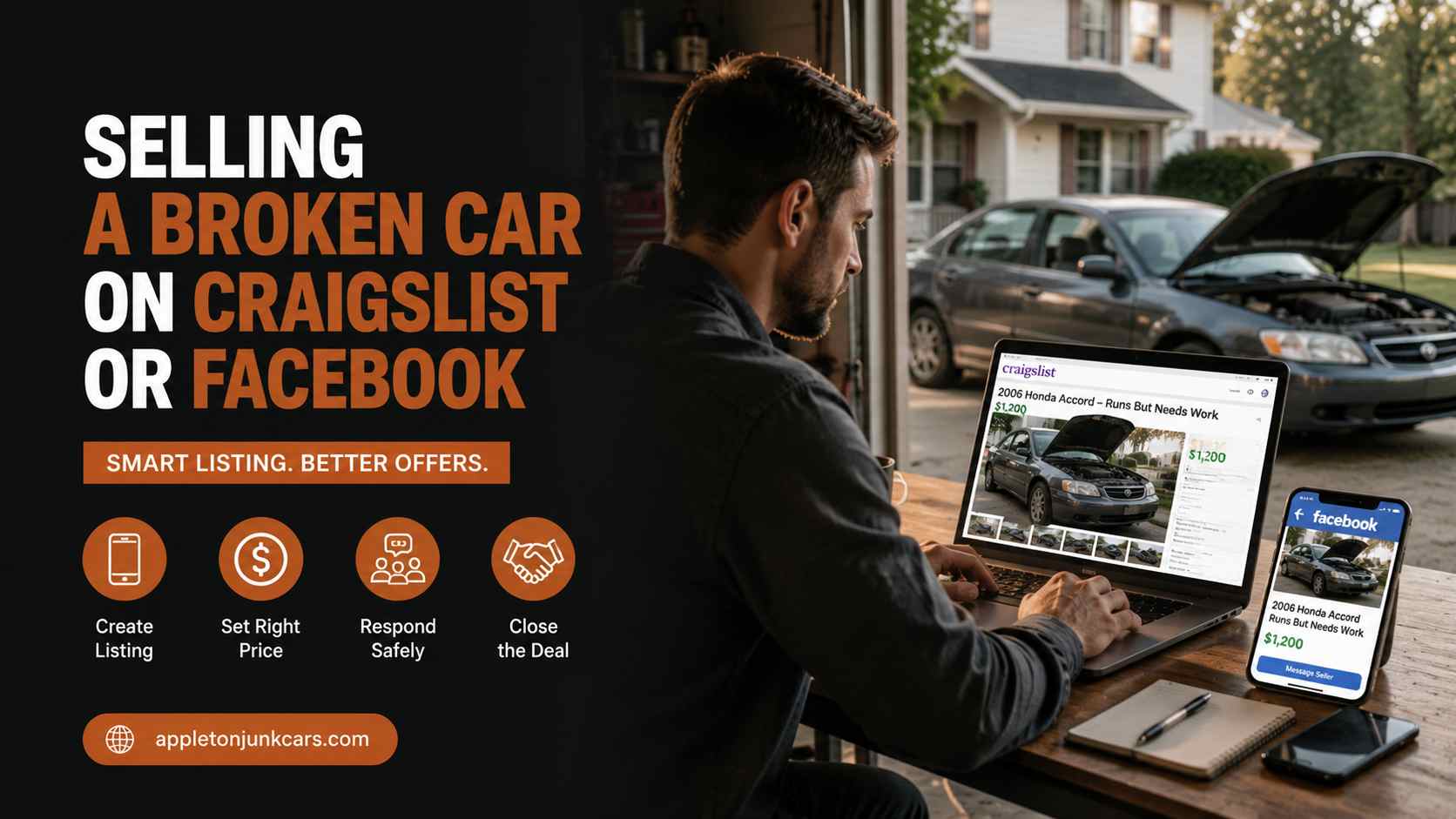
The car does not run, or it runs poorly enough that selling it as a working vehicle is not realistic. You have decided to try the private market before calling a junk buyer, because private buyers sometimes pay meaningfully more for a broken car than salvage yards do, particularly when the car has a specific, repairable issue or a desirable body that someone wants for a project.
Craigslist and Facebook Marketplace are the two platforms where non-running and damaged cars actually find buyers. These platforms host mechanics sourcing a cheap project, car enthusiasts looking for a specific body style or drivetrain to restore, parts buyers who need a specific component, and frugal buyers who can fix the problem themselves at a cost that justifies their offer to you. These buyers exist in meaningful numbers and respond to well-written listings.
Getting a result from these platforms on a broken car is almost entirely about listing quality. A vague listing with two photos and no description of what is wrong generates lowball offers and time-wasters. A specific, honest listing with clear photos and accurate pricing generates serious buyers who arrive knowing what they are looking at. This guide covers every element of the listing from platform choice through closing the deal.
Facebook Marketplace vs Craigslist: Which Platform Works Better for Broken Cars
Factor | Facebook Marketplace | Craigslist |
|---|---|---|
Buyer volume (2024 and beyond) | Higher overall traffic; larger active user base | Lower than peak but still significant in most metros |
Identity accountability | Buyers have Facebook profiles; reduces scammers | Anonymous; higher proportion of lowball and scam contacts |
Listing ease | Simple interface; photos upload from phone | Slightly more friction; HTML-style formatting optional |
Response speed | Very fast; responses often within hours | Varies; typically 24 to 48 hours for first response |
Buyer type for broken cars | Strong for project buyers, mechanics, enthusiasts | Strong for project buyers; also reaches commercial buyers |
Geographic reach | Typically 50 to 100 miles default radius | Typically metro area; adjustable |
Best use | Primary platform for most private broken car sales | Secondary platform; post simultaneously for maximum reach |
Post on both platforms simultaneously rather than choosing one. The time investment to create a second listing is 10 minutes. The incremental buyer reach is significant. Use the same photos and description on both. List on Facebook Marketplace first since it is the faster-moving platform, then post the Craigslist listing with identical content.
Writing a Title That Attracts the Right Buyers
The listing title is the most important single element because it determines whether buyers click or scroll past. For a broken car, the title strategy is different from a working car: you want to be specific about the problem because buyers who cannot handle the problem will filter themselves out, saving you time, while buyers who can handle it will specifically seek out listings like yours.
A strong title for a broken car follows this format: Year, Make, Model, Specific Problem, Title Status, Key Selling Point.
Examples: “2014 Honda Accord EX, blown engine, clean title, solid body 112k” and “2009 Toyota Tacoma 4×4, seized motor, runs on starter, title in hand” and “2016 Subaru Outback, head gasket failure, drove in, rust-free body.”
What makes these titles work: they state the exact problem (buyers can immediately assess whether they can fix it), they confirm title status (the most important document in any sale), and they include at least one positive attribute that explains why the car is worth considering despite the problem. Do not try to hide the issue in the title. Buyers for broken cars know cars can be broken; what they need is honesty about what they are getting.
The Description That Answers Every Question Before It Is Asked
A good broken car description eliminates the need for back-and-forth messaging by answering every practical question the buyer would ask if they were standing next to the car. Fewer questions means faster sales and higher-quality buyers, because buyers who need to ask a lot of questions are often not yet committed to purchasing.
Cover these elements in order: the specific mechanical failure (what exactly is wrong, what symptoms appeared, what the car does and does not do), the car’s history (how many owners, where it was driven, how it was maintained), the body and interior condition (honest description panel by panel and surface by surface), what works properly (everything except the stated failure), the title status (in your name, no lien, clean or salvage), and the odometer reading.
Example description opening: “Engine threw a rod bearing at 118,000 miles. You can hear it knock at startup and it smokes on acceleration. The engine needs to be replaced. Everything else on the car is fully functional: the transmission shifts cleanly, all electrical systems work, AC blows cold, no rust on the body, interior is clean with normal wear. This is a Honda parts car or a rebuild project.”
Close with the asking price, whether you will negotiate, that you are selling as-is with no warranty, and your preferred contact method. State clearly whether you have the title and whether towing is the buyer’s responsibility.
Photo Strategy: What to Show and What Buyers Need to See
Photos are the substitute for a test drive on a broken car. Buyers who cannot drive the car rely entirely on your photos to assess the body, interior, and damage condition. Sparse photos signal that you are hiding something and produce lowball offers. Comprehensive photos build confidence and attract buyers willing to pay close to your asking price.
Photo | What to Show | Why Buyers Need It |
|---|---|---|
All four corners of the exterior | Each corner at 45 degrees; both sides | Full body condition assessment |
Specific damage panels | Close-up of any dents, rust, or cracks | Honesty about known damage prevents disputes |
Engine bay, hood open | Full view of engine compartment | Buyers check oil condition, visible leaks, and engine appearance |
Specific engine damage (if visible) | Close-up of the failed component if accessible | Confirms the stated failure; serious buyers verify |
Interior front and rear | From driver door and rear passenger door | Seat, carpet, headliner, dashboard condition |
Dashboard with ignition on | Shows warning lights and odometer clearly | Confirms mileage; shows which warning lights are active |
All four wheels and tires | Each wheel individually | Tire and wheel condition affects value; buyers check |
Undercarriage (if accessible) | Front and rear undercarriage photos | Rust assessment; important for buyers in high-salt regions |
Title (front only, VIN and name visible) | Shows title exists, confirms your name, shows VIN | The single most trust-building photo a broken car listing can include |
Minimum photo count for a broken car listing: 12. Optimal: 16 to 20. Listings with fewer than 8 photos on Facebook Marketplace generate disproportionately more lowball offers and fewer serious buyers. The title photo is the most underused trust-builder in private car sales; many sellers never include it.
How to Price a Broken Car for Private Sale
Private sale pricing for a broken car follows three reference points: the scrap floor (the minimum any buyer should pay), the repair cost subtracted from the running market value (the maximum a rational buyer would pay), and the comparable market (what similar broken cars in your area are listed and sold for).
The scrap floor: call a local scrap yard and get the price per ton for a complete car at current steel rates. Multiply by the car’s approximate weight in tons. Add the catalytic converter value if it is intact. This is the minimum. No buyer should receive the car below this number.
The buyer’s maximum: find the private party value of the car running in fair or poor condition (KBB or Edmunds). Subtract the repair cost estimate for the stated failure. The remainder is what a buyer who planned to repair and keep the car would theoretically pay to break even. In practice, buyers pay less than this to build their own margin. A realistic asking price is 60 to 75 percent of the break-even value.
The comparable market: search Facebook Marketplace and Craigslist in your area for the same make and model with similar problems. What are comparable listings actually selling for? Sold prices (visible in Facebook Marketplace when the listing closes) are more informative than asking prices. Price your car near the lower end of the range to generate interest within the first 48 to 72 hours; a listing that generates no serious inquiries in the first three days is priced above the market.
Handling Inquiries, Lowball Offers, and Safety
Responding to Inquiries
Respond to every inquiry within 24 hours, ideally within a few hours. Delayed responses on Facebook Marketplace cause serious buyers to move on to other listings. Your response should answer any questions the buyer asked, confirm the listing details are accurate, and invite them to come view the car. Do not negotiate price by message before the buyer has seen the car; price negotiations by message almost always produce lower outcomes than in-person negotiations after the buyer has decided they want the car.
Handling Lowball Offers
Lowball offers are inevitable on broken car listings. Respond professionally and hold your floor: “I appreciate the interest. The asking price is firm at $X for now. If that changes I will reach out.” Do not get into extended price negotiations by message with buyers who have not seen the car. A buyer willing to travel and inspect the car is worth much more of your time than a message-only negotiator.
Safety for Viewing and Test Drives
For a broken car that does not run, there is no test drive. The buyer views the car at your property or a public location. Meet at your home if you are comfortable with it, or offer to meet at a nearby gas station or parking lot where the car can be seen in good light. Have a friend or family member present if meeting with an unknown buyer at your home. Payment should happen in person; cash is straightforward; digital payments (Zelle, Venmo, Cash App) are acceptable for trusted contacts or buyers with verified profiles but carry risks with unknown parties.
Completing the Sale: Payment and Paperwork
Accept only verified payment before the car leaves your property. Cash is the safest and simplest method. For larger amounts, a cashier’s check is acceptable if you verify it with the issuing bank by phone before signing anything. Personal checks are risky for car sales; if a personal check bounces after the car is gone, recovery is difficult. Digital payments are convenient but can be reversed under some circumstances; for unknown buyers, cash is the better choice.
Paperwork: sign the title in the designated seller section, complete the odometer disclosure if required, provide a bill of sale with the VIN, sale price, date, and both parties’ names and contact information. Keep a copy of the signed title. In your state, file a notice of transfer or release of liability with the DMV to formally disconnect your name from the vehicle after the sale. Remove the license plates before the buyer drives or tows the car away.
When to Stop Waiting and Call a Junk Buyer
A broken car listing that generates no serious inquiries in the first one to two weeks is telling you that the private market for that car at your price in your area is thin or absent. This is useful information rather than a failure. At this point, reducing the asking price by 20 to 30 percent for one additional week and then calling a junk buyer or salvage yard is the practical path.
Signs that the private market is not the right channel for your specific car: the make and model has limited enthusiast or project car appeal, the failure is expensive enough that the buyer’s maximum price is close to the scrap floor, or the car’s cosmetic or structural condition is too poor for anyone to want as a project. In these cases, a junk buyer who prices the car on parts and metal value is the more efficient outcome from the start.
The decision to try private sale before junk buyer is most worth the effort for cars from popular makes with active parts markets (Honda, Toyota, Ford trucks, Chevrolet trucks), cars with a specific desirable feature (diesel engine, four-wheel drive, clean body), and cars where the failure is specific and well-understood (blown engine, failed transmission) rather than systemic or unclear. If the car matches one of these profiles, two weeks of private listing is worth the effort. If it does not, starting with a junk buyer saves time without sacrificing meaningful recovery.
Frequently Asked Questions
Can I sell a broken car on Facebook Marketplace?
Yes. Facebook Marketplace is one of the most active platforms for non-running and mechanically compromised vehicles. Project car buyers, mechanics, and parts buyers regularly browse Marketplace for broken cars from specific makes and models. A well-written listing with honest condition description, 12 or more photos, and accurate pricing attracts serious buyers within 24 to 72 hours in most metropolitan areas.
How do I list a non-running car on Craigslist?
Create a listing in the Cars and Trucks section with a title that includes the year, make, model, specific mechanical failure, and title status. In the description, explain exactly what is wrong, describe what works, list the odometer reading and the title situation, include 12 or more photos covering the exterior, engine bay, interior, damage, and dashboard, and set a price based on the scrap floor and comparable listings. Post simultaneously on Facebook Marketplace for maximum reach.
How much should I ask for a broken car on Facebook Marketplace?
Price a broken car at 60 to 75 percent of the break-even value, which is the running market value minus the estimated repair cost. The scrap floor (the current metal value at a scrap yard) is your absolute minimum. Search completed listings on Facebook Marketplace for the same make and model with similar issues to calibrate your asking price against what has actually sold recently in your area. Price at the lower end of the comparable range to generate serious inquiries within the first 48 to 72 hours.
Should I disclose all problems when selling a car on Facebook?
Yes, always and completely. Full disclosure of all known issues protects you from post-sale disputes, prevents wasted viewings from buyers who discover surprises at inspection, and builds trust with serious buyers who value accurate information to make their purchasing decision. Buyers for broken cars are not deterred by problems; they specifically seek them out. Vague or incomplete listings generate more lowball offers and fewer completed transactions than honest ones.
Is Facebook Marketplace or Craigslist better for selling a broken car?
Facebook Marketplace is the stronger platform for most sellers of broken cars because of higher buyer volume, identity accountability (buyers have profiles), faster response times, and a simple mobile interface for photo uploads. Post on both simultaneously rather than choosing one, since the additional reach from a Craigslist listing takes 10 minutes to set up and reaches buyers who may not actively use Facebook.
How many photos should I include when listing a broken car?
A minimum of 12 photos for a broken car listing. Include all four exterior corners, close-ups of any damage, the engine bay, the specific failed component if visible, the interior from front and rear, the dashboard with the ignition on showing the odometer and any warning lights, all four wheels, and optionally a photo of the title confirming it is in your name. Listings with fewer than 8 photos generate disproportionately more lowball offers and fewer serious inquiries.
What should I do if no one buys my broken car on Craigslist or Facebook?
If a listing generates no serious inquiries in 10 to 14 days, try reducing the asking price by 20 to 30 percent for one additional week. If still no results, contact junk car buyers and salvage yards for quotes. A well-written private listing is worth the effort for popular makes with project car appeal, but some cars have a thin private buyer market, and a junk buyer who prices on parts and metal value is a more efficient channel for those vehicles.
What payment should I accept when selling a broken car privately?
Cash is the safest and most straightforward payment method for any private car sale. For higher amounts, a cashier’s check from a recognized bank verified by phone before signing is acceptable. Avoid personal checks for private car sales because of bounce risk after the car is gone. Digital payments (Zelle, Venmo, Cash App) are convenient for buyers with verified profiles but can be reversed under some circumstances; cash is preferable with unknown buyers.
The Bottom Line
Selling a broken car privately on Facebook Marketplace or Craigslist is worth attempting for cars from popular makes with active project or parts buyer markets. The process requires a specific, honest listing title, a detailed description that answers every practical question, 12 or more photos including the engine bay and title, and a price based on real comparable sales rather than KBB estimates that do not apply to non-running vehicles.
Facebook Marketplace is the primary platform because of higher buyer volume and faster response times. Craigslist is a secondary platform worth using simultaneously for the incremental reach it provides. Post on both, respond to inquiries promptly, hold your scrap floor, and complete the sale with cash and correct title paperwork.
If the listing produces no serious buyers in two weeks, the private market for that specific car may not exist at a price above the junk buyer floor. At that point, the junk buyer route produces the best outcome without further time investment. The private listing was worth attempting; the result tells you something accurate about the market for that car.