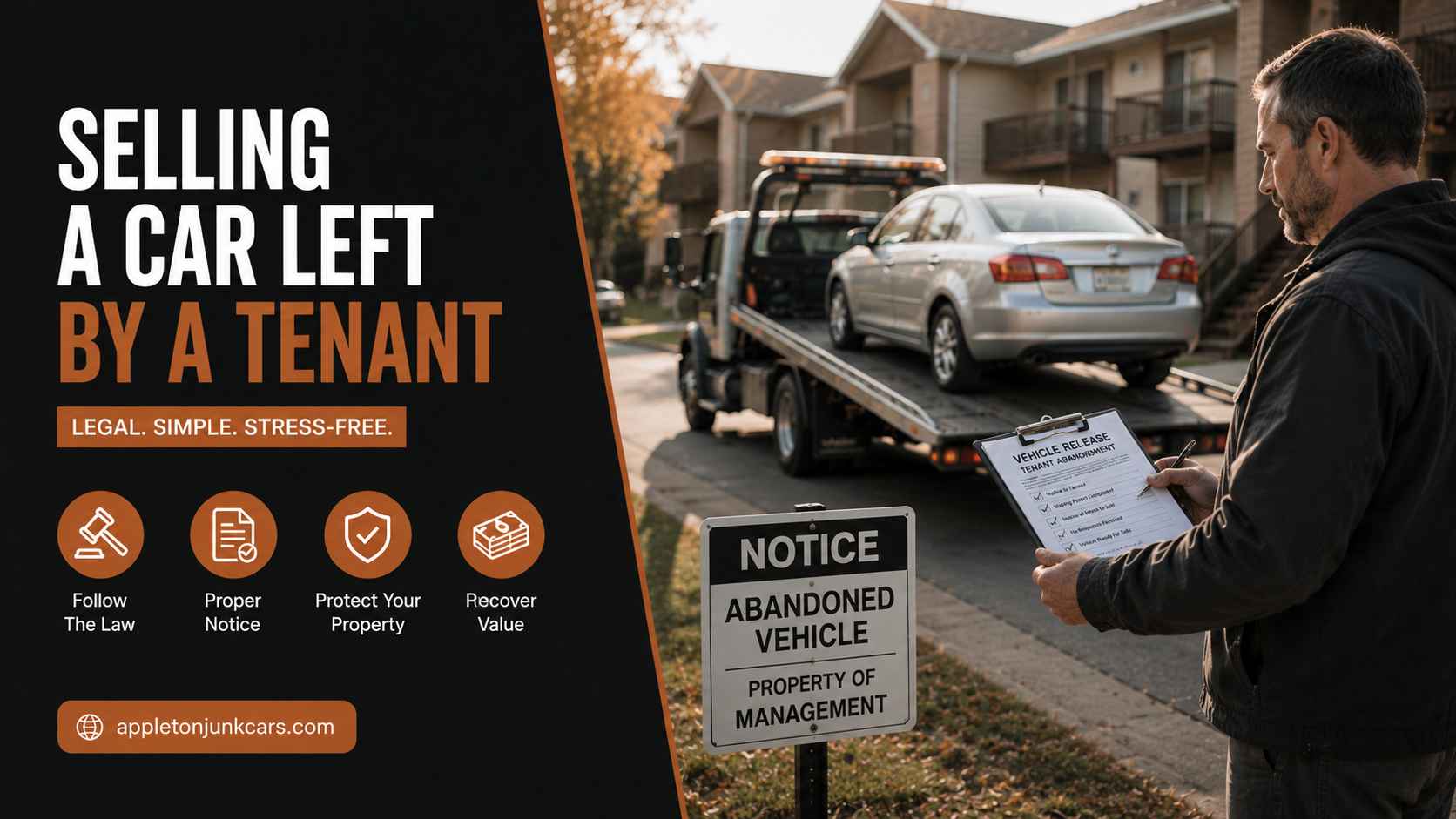
Yes, you can legally sell a car left behind by a tenant, but not right away and not without following a specific state-mandated process that typically takes 60 to 120 days.
A tenant moves out, or gets evicted, and leaves their car sitting on your property. Your first instinct might be to sell it, scrap it, or at minimum have it towed. The problem is that none of those options are legally yours to take yet. That car still belongs to the tenant. Selling it without completing the right legal process is considered vehicle theft or conversion in most U.S. states, regardless of how much rent they owe you.
This guide walks through every step landlords must take before they can legally sell or dispose of a vehicle left behind by a tenant. You will find out what to document, what notice to send and to whom, which two legal paths exist for clearing the car off your property, what each state specifically requires, how to handle the money if the sale goes through, and which mistakes are most likely to end in a lawsuit against you.
You Do Not Own That Car and Cannot Sell It Yet
Even if the tenant left without paying three months of back rent, their car is their personal property. Back rent is a debt, and collecting a debt does not give you ownership of the debtor’s belongings. A landlord who sells a tenant’s vehicle without following the correct legal process can face criminal charges for vehicle theft or a civil lawsuit for conversion.
Conversion is a civil claim that arises when someone takes control of another person’s property without legal authority to do so. It does not matter whether you intended harm or whether the tenant clearly abandoned the car. Courts have found landlords liable for conversion when they sold tenant property, even property that had been sitting unclaimed for months, simply because they skipped a required notice step.
The legal exposure is real. In New Jersey, landlords who improperly dispose of abandoned tenant property can be sued for twice the actual value of the items. In other states, criminal prosecution for vehicle theft is possible if the landlord sells the car before completing the abandonment process. The safest position is to treat the car as the tenant’s property until the law says otherwise.
Make Sure the Car Is Actually Abandoned
Before you do anything, you need to confirm the tenant has genuinely left and is not planning to return for the vehicle. A tenant who is temporarily away, in the hospital, or between addresses may still intend to retrieve the car. Acting too quickly puts you in a worse legal position than waiting.
Signs that point toward genuine abandonment include: the tenant has returned their keys, the lease has ended or been terminated, utility services at the property have been disconnected in their name, the unit is empty of personal belongings, and you have had no contact with the tenant for an extended period. The more of these factors are present, the stronger your legal standing when you begin the formal process.
Signs that should make you pause: the tenant left without formal notice, some belongings remain inside the unit, the car is newer and has apparent value, or the tenant has a history of irregular communication but has always come back. In these cases, wait longer and document more before proceeding.
Also check whether the car itself is stolen. Run the Vehicle Identification Number (VIN) through the National Motor Vehicle Title Information System (NMVTIS) at vehiclehistory.gov. If the car is reported stolen, call the police immediately and do not touch it. A stolen vehicle on your property is an entirely different situation that requires law enforcement involvement, not a landlord-tenant process.
How to Sell a Car Left by a Tenant | Step By Step Guide
Step 1: Document Everything Before Anyone Touches the Car
Your documentation is the foundation of every step that follows. If the tenant later claims you damaged the vehicle, removed items from it, or took it without warning, your evidence file is what protects you. Build it before the car is moved, towed, or photographed by anyone else.
What to photograph and record
- Take clear photos of the vehicle from all four sides, including the front, rear, driver’s side, and passenger’s side.
- Photograph the license plates separately, zoomed in so they are readable.
- Find and photograph the VIN plate on the driver’s side dashboard, visible through the windshield, and the VIN sticker on the driver’s side door jamb.
- Note the vehicle’s current condition in writing: any visible damage, flat tires, broken glass, rust, or missing parts.
- Record the date and time of each photograph. Most smartphones embed this automatically in the image metadata.
- If the vehicle is in a specific location on your property (blocking a driveway, in a numbered parking space, etc.), photograph that location context too.
Run a title status check
With the VIN in hand, go to vehiclehistory.gov and run a check. This will show you whether the vehicle is flagged as stolen, whether there is an active lien recorded against it (meaning a bank or finance company has a security interest), and whether the title has any brands such as salvage, junk, or parts-only. This information determines which legal path is available to you and how complicated the process will be.
If there is an active lien on the vehicle, the lienholder (usually a bank or auto finance company) must be notified during the formal notice process. Their interest in the car does not disappear just because the tenant walked away from it.
Step 2: Pull the Lease Agreement and Read It Carefully
Many standard lease agreements contain an Abandoned Personal Property Clause. This section governs what happens to property left behind by a tenant and may already specify the number of days you must store it, whether and how much you can charge for storage, and what disposal method is authorized once the deadline passes.
What the clause typically covers
A well-drafted clause will specify the storage period (commonly 15 to 30 days), daily storage fees the landlord is entitled to charge, the method of notice (certified mail to the last known address), and the approved disposal options (public auction, scrap, or donation). If your lease contains this clause and the tenant signed it, they have already agreed to these terms. That gives you a stronger legal foundation when you proceed.
When the lease says nothing
If the lease has no abandoned property clause, you fall back entirely on your state’s landlord-tenant statutes. These vary significantly. Some states are permissive; others require lengthy notice periods and specific court filings before you can touch anything. The state-by-state table later in this guide shows what your state requires. When the lease is silent, assume your state’s statutory requirements apply in full and follow them exactly.
Storage fees you may be entitled to charge
Most states allow landlords to charge reasonable storage fees for property left behind. The rate must be reasonable, which courts generally interpret as comparable to what a commercial storage facility would charge for equivalent space. Keep a log of dates and any costs you incur (additional security, covered storage, etc.). These documented costs can be deducted from the eventual sale proceeds before you must account for the rest.
Step 3: Send a Formal Written Notice and Send It to the Right People
This is the most legally critical step. You must make a documented, good-faith effort to notify the tenant that the vehicle is on your property, give them a specific deadline to retrieve it, and warn them what will happen if they do not. Skipping this step, or doing it informally (a text message or a verbal conversation), will make everything that follows legally vulnerable.
What the notice must contain
- A clear description of the vehicle: make, model, year, color, and license plate number.
- The VIN, if you were able to document it.
- The address where the vehicle is currently being stored.
- The deadline by which the tenant must retrieve the car (typically 10 to 30 days from the notice date, depending on your state).
- The daily storage fee you are charging, if any.
- A clear statement of what will happen if the vehicle is not claimed by the deadline: public auction, sale to a scrapyard, or towing by the authorities.
- Your contact information and a way for the tenant to arrange retrieval.
Who else must receive the notice
The former tenant
Send the notice to the tenant’s last known address as listed in the lease. If they provided a forwarding address, send it there too. If you have any other contact information (email, family member contact from a lease application, emergency contact), use those as well. The more good-faith attempts you can document, the more protected you are if the process is later challenged.
Recorded lienholders
If your VIN check revealed an active lien on the vehicle, the lienholder must also receive a copy of your notice. This is typically the bank or auto finance company that provided the loan to the tenant. You can find the lienholder’s name and address through the NMVTIS record or through your state DMV’s title records. Failing to notify a lienholder can invalidate the entire process and expose you to a claim from the lender even after the vehicle is sold.
How to send it and what to keep
Send the notice by certified mail with return receipt requested. This gives you a dated receipt confirming when the notice was mailed and, when the green card comes back, confirmation of delivery. If the tenant has moved and the letter comes back unclaimed, that return envelope is still evidence that you attempted proper notification. Keep every piece of that documentation: the copies of the notice, the certified mail receipt, the delivery confirmation, and any returned envelopes.
When you cannot locate the tenant
If you have no forwarding address and no contact information, send the notice to the last known address anyway. Some states also require you to run a search of the DMV’s records to find the vehicle’s registered owner address before proceeding. Contact your state DMV and ask what the procedure is for notifying a registered vehicle owner when they cannot be located. In several states, you may be required to publish a notice of intent to sell in a local newspaper before the deadline passes.
Step 4: Two Legal Paths for Getting the Car off Your Property
Once the notice period expires and the tenant has not claimed the vehicle, you still do not automatically own it. At this point, two legal routes exist. Which one you choose depends on whether you want to sell the car and keep the proceeds (after expenses), or whether you simply want it gone with as little paperwork as possible.
Option A: Report it to local authorities
This is the fastest and simplest path. Contact your local police department or, in some jurisdictions, the local municipality’s code enforcement office, and report the vehicle as abandoned on private property. Provide your documentation showing the tenant has vacated the property and the notice period has passed. Include your photos, the certified mail receipts, and the VIN number.
The authorities will dispatch a city-contracted towing company to remove the vehicle. The tow yard takes custody and handles the subsequent legal process: they run the title search, notify the registered owner again, and eventually auction the car or scrap it to recover their towing and storage fees. You lose any financial claim to the proceeds, but the car is gone and your legal exposure ends when the tow truck leaves.
This is the right choice when the car has little to no market value, when you want the liability off your hands as quickly as possible, or when the paperwork involved in the alternative path is not worth the trouble.
Option B: Apply for an abandoned vehicle title through the DMV
If the car has real value, you may want to go through the process of obtaining a new title in your name and then selling the vehicle yourself. This is slower and more paperwork-intensive, but it gives you legal ownership and the right to sell.
The process varies by state, but the general sequence is:
- Contact your state DMV or motor vehicle registry and ask specifically about the landlord lien or abandoned vehicle title process for private property.
- Submit an application for an abandoned vehicle title or a lien sale authorization. The form name varies by state (see the table in the next section for common examples).
- Pay the filing fee, which typically ranges from $25 to $100 depending on the state.
- The state DMV runs its own title search and, in most states, sends one final certified notice to the registered owner and all lienholders on record.
- A mandatory waiting period applies from the date that final notice is sent. This period is typically 15 to 45 days.
- If no one claims the vehicle or files an objection, the DMV issues a new title in your name or authorizes you to conduct a lien sale (a formal public auction).
- You can then sell the vehicle, but in most states the sale must be a public auction if the car is above a certain value threshold.
In Wisconsin, a specific form called MV2882 (Abandonment of Property to a Landlord) exists specifically for this situation. In California, the lien sale process uses Form REG 668 for vehicles valued at $4,000 or less and Form REG 280 for vehicles worth more. In Nevada, Form VP-147 (Lien Sale Affidavit) must be completed and notarized. Oregon’s DMV provides a landlord lien certification form as part of its Possessory Liens packet.
What Each State Requires: A 13-State Reference
The table below covers the notice periods, governing statutes, relevant DMV forms, and key notes for 13 commonly asked-about states. Laws change. Always confirm current requirements with your state DMV and an attorney before acting.
State | Notice / Wait Period | Governing Statute | DMV Form / Process | Key Note |
|---|---|---|---|---|
Arizona | 5 days | A.R.S. § 33-1370 | Contact AZ MVD | One of the shortest notice periods in the country. Landlord must store property and give written notice before disposal. |
California | 15 days (in-person); 18 days (mail/email) | Civil Code § 1987; Vehicle Code § 22658 | REG 668 (vehicle under $4,000); REG 280 (over $4,000); REG 168A post-sale | Landlord may also tow under Vehicle Code § 22658 after giving notice. Lien sale process is detailed and date-specific. |
Florida | Per Fla. Stat. § 715.104 | Fla. Stat. § 715.104 | Contact FL DMV | Landlord must store property and send certified notice. Vehicle may be towed if it poses a hazard. |
Illinois | 7 days | 765 Ill. Comp. Stat. 705/1 | Contact IL Secretary of State | State does not formally define abandonment; landlords must comply with notice and storage rules in the Landlord and Tenant Act. |
Indiana | 90 days | Ind. Code § 32-31-4 | Contact IN Bureau of Motor Vehicles | Longest notice period in the table. Landlord must store the property for the full 90-day period. |
Michigan | 7 days | MCL 554.602 et seq. | Contact MI Secretary of State | Short holding period but formal notice to both tenant and lienholders is mandatory before any disposal. |
Nevada | 15-30 days | NRS 108.270 et seq. | Form VP-147 (Lien Sale Affidavit) | VP-147 must be notarized before DMV will process title transfer. Sale must not occur before the statutory period ends. |
New York | 96 hours to declare abandoned; additional 10-day notice period | N.Y. Veh. & Traf. Law § 1224 | Contact NY DMV; report to police for public authority tow | Vehicle is legally abandoned after 96 hours on private property. Practical path is police report and authority tow. |
North Carolina | 7+ days | N.C.G.S. § 42-25.9 | Contact NC DMV | Landlord must provide written notice and reasonable storage time. Vehicles may be turned over to police for disposal. |
Oregon | 15 days | ORS 90.425 | OR DMV landlord lien certification (available in OR DMV Possessory Liens packet) | Oregon DMV provides a specific landlord lien certification form. Must be completed accurately or title transfer will be rejected. |
Texas | 60 days | Tex. Prop. Code § 92.0081 | Notify local law enforcement; contact TxDMV | Texas requires 60 days of storage with certified notice. Police report is the most practical first step; they arrange the tow. |
Washington | 45 days | Wash. Rev. Code § 59.18.310 | Contact WA DOL (Department of Licensing) | 45-day hold required before disposal. Certified notice required to last known address and to any lienholders of record. |
Wisconsin | Per lease and notice terms | Wis. Stat. § 704.05(5) | Form MV2882 (Abandonment of Property to a Landlord) + Form MV1 | Wisconsin has a dedicated landlord-to-tenant vehicle transfer form. Must be accompanied by a signed rental agreement. Fee of $214.50 per vehicle. |
Your state is not listed? Call your state DMV and ask: “What is the process for a landlord to title or dispose of an abandoned vehicle left behind by a former tenant on private property?” Every state has a procedure. The form names and fee amounts may have changed since this was written, so always get the current forms directly from your DMV.
Handling the Money After the Sale
If you went through the abandoned title process and sold the vehicle yourself, you generally cannot pocket the profit. The law in most states treats the proceeds as belonging to the vehicle’s former owner until specific conditions are met, even when that former owner owes you money.
What you can legally deduct
You are allowed to deduct your actual, documented costs from the sale proceeds. These typically include the cost of filing for the abandoned vehicle title or lien sale application, any advertising costs for the public auction, the daily storage fee you charged at the rate specified in your lease or at a commercially reasonable rate, and any towing costs you paid out of pocket. Keep receipts for everything.
Applying proceeds toward unpaid rent
This is where many landlords get into trouble. You cannot simply apply the remaining balance to unpaid rent and call it even. If you want to use the sale proceeds to offset what the tenant owes you in back rent, you generally need to obtain a court judgment first. File a claim in small claims court (or civil court, depending on the amount) for the unpaid rent. Once you have a judgment in your favor, most states allow you to apply any proceeds from the vehicle sale toward that judgment.
Applying sale proceeds to unpaid rent without a court judgment can be treated as unauthorized conversion of the former tenant’s funds, even if the debt is legitimate.
What happens to the remaining balance
After your allowable expenses are deducted, the remaining money does not belong to you unless a court judgment covers it. Most states require you to hold excess funds in a separate account for a designated period (typically 30 to 90 days) and notify the former tenant in writing that the funds are available. If the money goes unclaimed, it is usually turned over to the state’s unclaimed property department, not kept by the landlord.
A few states handle this differently; California, for instance, requires the lienholder to report the sale and remit any overage to the DMV, which then holds it for the owner. Check your state’s specific rules on this point.
How Long This Takes and What the Car Is Actually Worth
The realistic timeline
If you go through the full abandoned vehicle title process, expect the whole thing to take 60 to 120 days from the time you first document the vehicle to the time you have a title in hand and can schedule a sale. That timeline breaks down roughly as follows: 7 to 30 days for your initial notice period (varies by state), 15 to 45 days for the DMV’s own notice and waiting period after your application, and another week or two for title processing and sale logistics.
The police-report-and-authority-tow route is faster for getting the car off your property, typically 1 to 2 weeks from report to removal, but you receive no proceeds from that path.
What the car is likely worth
If the vehicle is in decent condition with a clear title, it can bring $3,000 to $15,000 or more through a private sale or auction. If it is junk (non-running, severely damaged, or very old), expect $200 to $700 from a scrap buyer. The value of your time and the legal risk involved in the full abandoned title process is worth calculating against what the car will realistically bring. A car worth $400 in scrap is often not worth the 90-day administrative process; the police-tow option makes more practical sense. A car worth $8,000 in a private sale is worth the effort.
What it costs to go through the process
- VIN history check through vehiclehistory.gov: $2 to $5
- Certified mail: approximately $4 to $8 per letter, times however many recipients
- DMV abandoned title application fee: $25 to $100 depending on state
- Newspaper publication (required in some states): $50 to $150
- Attorney consult if the situation is complicated: $150 to $350 per hour
- Wisconsin MV2882 filing: $214.50 per vehicle
The Moves That Lead Straight to a Lawsuit
Selling or scrapping the car without sending any notice
This is the most common and most costly mistake. A landlord decides the car has clearly been abandoned, sells it to a scrapyard, keeps the $350, and then gets served with a civil lawsuit for $3,500 (the car’s actual value plus statutory damages) three months later. The tenant does not have to prove you acted in bad faith. They only have to prove you did not follow the legal process.
Using the back of the existing title to sign over ownership
The title is in the tenant’s name. You are not the tenant and you are not their authorized agent. Signing the back of someone else’s title to transfer ownership is signature fraud. Even if you believe the car is worth nothing and the tenant will never come back, signing their name on a title is a crime.
Sending notice by text message or email only
Most states require certified mail for abandonment notices. A text message or email does not satisfy that requirement and cannot be used as legal proof of notice in a court hearing. Some states allow email as a secondary method alongside certified mail, but very few accept it as the sole form of notice.
Forgetting to notify the lienholder
If there is an active bank lien on the vehicle and you sell it without notifying the bank, the bank can pursue both you and the buyer. The lender’s security interest in the vehicle survives the tenant’s abandonment. It does not disappear because the tenant stopped making payments or moved away. Notifying the lienholder is not optional.
Moving the car yourself before the notice period is up
Repositioning the car on your property, having it towed to your driveway, or moving it in any way before the legal process is complete can be treated as interfering with the tenant’s property. Document where it sits, but do not move it until the law authorizes you to do so.
Applying sale proceeds to rent before getting a judgment
The money belongs to the former tenant until a court says otherwise. Taking the full sale price and applying it to unpaid rent without a court judgment is conversion of the tenant’s funds. File in small claims court for the unpaid rent and let a judge authorize the offset.
Thinking the eviction order covers the vehicle
A writ of possession from an eviction gives you the right to reclaim possession of the real property (the rental unit or land). It does not automatically give you the right to sell or dispose of the tenant’s personal property, including the vehicle. The two processes are separate. The eviction is complete when the tenant is out. The abandoned property process starts after that.
Questions Landlords Ask When This Situation Comes Up
Can I have the car towed immediately after the tenant leaves?
In most states, no. You must first send a formal written notice to the tenant and any recorded lienholders and wait out the statutory notice period before you can arrange a tow. California is one state where landlords may be able to tow more quickly under Vehicle Code § 22658 if the vehicle is blocking access or creating a hazard, but that authority has specific conditions attached. Check your state’s law before calling a tow company.
What if the car has no license plates?
Document the VIN instead. You can still run a title check through NMVTIS using the VIN. A vehicle without plates is still titled to someone in the state’s records. The VIN is your key to identifying the owner and any lienholders of record.
The tenant owes me four months of rent. Can I just keep the car as payment?
No. You cannot accept the car as compensation for unpaid rent without the tenant’s written, informed consent. Even if you believe the car’s value roughly equals what they owe, taking it as unauthorized payment is conversion. To use the sale proceeds toward unpaid rent, you need a court judgment for the rent amount first.
What if the vehicle is worth more than what they owe in rent?
If your authorized, documented expenses plus the court-ordered rent debt total less than the sale proceeds, the remaining balance belongs to the former tenant. You must notify them in writing that funds are available for retrieval, hold those funds separately, and if they go unclaimed, turn them over to your state’s unclaimed property department per the timeline your state sets.
Does the car have to be a running, drivable vehicle for this process to apply?
No. The abandoned property process applies to the vehicle regardless of its condition. A non-running, wrecked, or partially stripped vehicle is still legally the tenant’s personal property. You still need to follow the notification process before you can scrap it, donate it, or have it towed away.
Can I charge storage fees for the time the car has been on my property?
In most states, yes, but only at a commercially reasonable rate and only if your lease authorized storage fees or your state statute permits them. Document the daily rate from the day you gave formal notice. Courts will generally not accept storage fees for periods before you sent the formal abandonment notice.
What if the tenant contacts me during the notice period and says they will pick it up but then never does?
Document the contact. If they communicated an intent to retrieve the vehicle, that communication can restart or extend your notice obligations depending on your state. Some states treat any contact from the owner as a “claim” that suspends the timeline temporarily. Once the new deadline passes with no retrieval, you may proceed. Keep a written record of every communication and the date it occurred.
Can a scrapyard buy the car directly from me if I do not have the title?
Some scrapyards will accept vehicles without a title from a landlord who can show the tenancy agreement and the abandonment documentation. However, without a proper legal title transfer, this creates liability for both you and the yard. The far cleaner approach is to either go through the full abandoned vehicle title process or call the police and let them arrange the tow. Do not sell to a scrapyard using informal documentation and assume the problem is solved.
What if the tenant comes back after I have already sold the car?
If you followed every step correctly, sent proper notice, observed the required waiting period, and have the documentation to prove it, you are legally protected. If you skipped steps or did not properly notify the tenant, you are exposed. This is why the documentation and certified mail steps matter so much. They are your defense if the tenant later challenges what you did.
Does the process change if the tenant died while living at the property?
Yes, significantly. If the tenant is deceased, the vehicle becomes part of their estate. You cannot proceed through a standard abandoned property process. Instead, you need to contact the probate court in your county and notify the estate (or the next of kin if no estate has been opened). The estate’s executor or administrator is the person with legal authority to transfer the vehicle. Until an authorized representative of the estate acts, the car stays put. Consult an attorney if this situation applies to you.
Is there any faster way to handle this if the car is blocking access to my property?
In some states, a vehicle that is creating an immediate hazard or blocking access may be subject to a faster towing authority under traffic or property codes, separate from the general abandoned property process. California Vehicle Code § 22658 is one example. This typically requires that the vehicle be in a specific location (blocking a driveway or access road, for instance) and that you post a notice on the vehicle before calling the tow company. Contact a local attorney or your city’s code enforcement office if this applies to your situation.
Your Action Plan
Work through these steps in order. Each one builds on the one before it.
- Confirm the tenant has genuinely vacated. Check for returned keys, empty unit, and disconnected utilities. If there is any doubt, wait longer before starting the process.
- Run the VIN through vehiclehistory.gov. Confirm the car is not stolen, check for active liens, and identify the registered owner and any lienholders of record.
- Photograph everything. All four sides of the vehicle, close-up of VIN and plates, condition notes, and the car’s location on your property. Timestamp all photos.
- Pull out the lease agreement. Find the Abandoned Personal Property Clause, if one exists. Note the notice period and storage fee provisions it authorizes.
- Draft and send the formal abandonment notice. Include the vehicle description, VIN, storage location, retrieval deadline, storage fee rate, and consequences of non-retrieval. Send by certified mail, return receipt requested, to the former tenant at all known addresses AND to any recorded lienholders.
- Wait out the full statutory notice period. Do not touch the car until the deadline passes. Every state has a minimum period. See the table in this guide for your state.
- Decide which path you are taking. If the car has meaningful value, contact your state DMV about the abandoned vehicle title or lien sale process. If it has little value or you want it gone quickly, contact your local police department and report it as an abandoned vehicle on private property.
- If going through the DMV path, file the required application and pay the fee. Gather all your documentation (tenancy agreement, photos, certified mail receipts, VIN check results) and submit them with the application.
- After the DMV issues the authorization or new title, conduct the sale. In most states this must be a public auction for vehicles above a certain value threshold. Keep detailed records of all proceeds.
- Deduct your documented expenses from the proceeds. Filing fees, storage, advertising. Then either apply the balance to a court-ordered judgment for unpaid rent, or hold it separately and notify the former tenant the funds are available.
- Turn over any unclaimed balance to your state’s unclaimed property department if the former tenant does not claim it within the period your state sets.
Done correctly, this process protects you from a lawsuit, gets the vehicle off your property legally, and gives you the best chance of recovering something toward what the tenant owed you. Done incorrectly, it turns a manageable property dispute into a criminal or civil matter that costs far more than the car was ever worth.