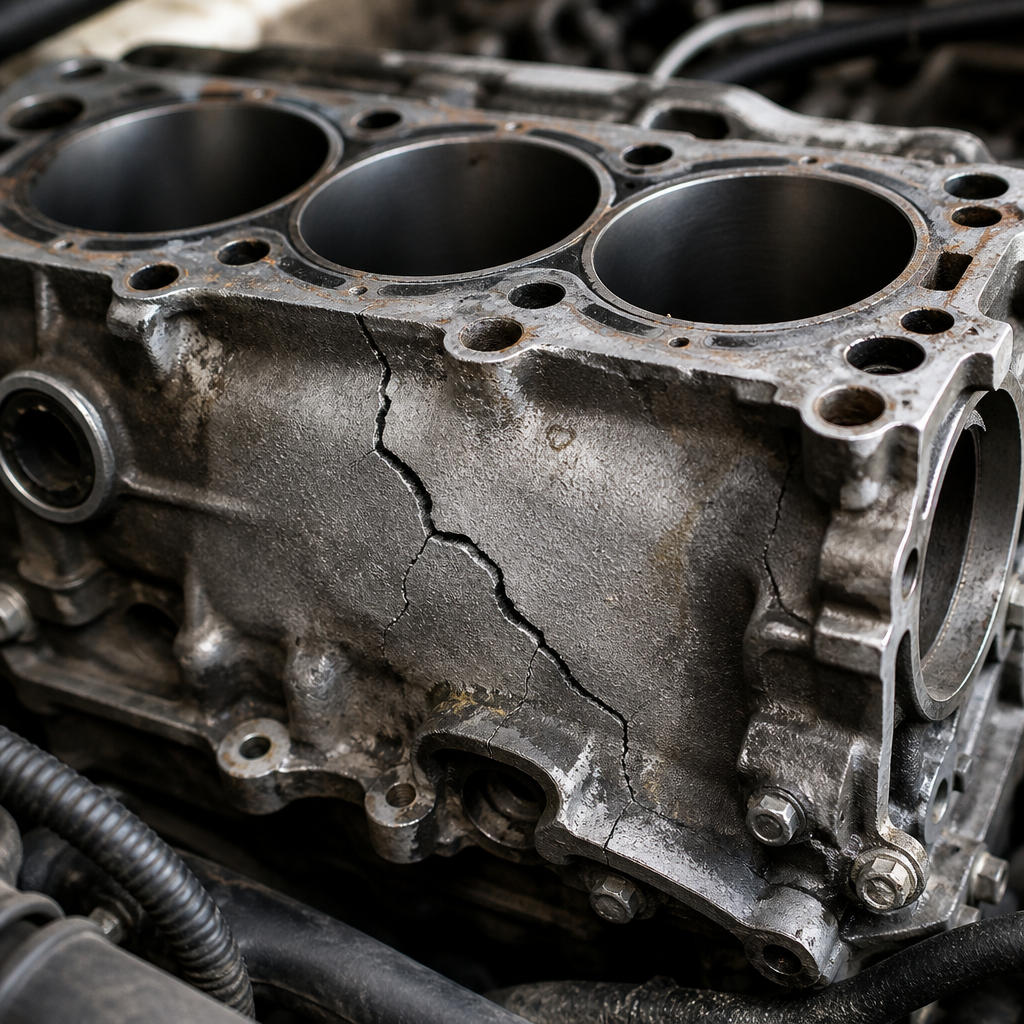
Yes, you can sell a car with a cracked engine block. The damage cuts the vehicle’s value by 40 to 70 percent compared to a running equivalent, and it legally requires written disclosure before any private sale is complete. Neither of those facts makes the car unsellable. It just means you need the right buyer and the right price.
This guide covers how to confirm the diagnosis, what it means for your car’s value, how to price it using the correct formula, every available selling option ranked by what they pay and how quickly they close, and the legal requirements that protect you after the keys change hands. Specific payout examples and real repair cost data are included throughout.
What a Cracked Engine Block Actually Means
The engine block is the central structural casting of the engine. Made from either cast iron or aluminum alloy depending on the vehicle, it houses the cylinders, pistons, oil passages, and coolant channels. When the block cracks, those fluid channels break open and fluids migrate where they are not supposed to go. Coolant leaks into the oil. Oil leaks into the coolant. In some cases, coolant enters a combustion chamber and gets burned. The lubrication system degrades rapidly, internal surfaces begin metal-on-metal contact, and the engine either stops working or causes progressively worse damage the longer it runs.
A cracked block is not the same thing as a blown head gasket, though the symptoms overlap. The head gasket sits between the cylinder head and the engine block and seals those same oil and coolant passages. A failed head gasket can mimic every symptom of a cracked block and is significantly cheaper to repair ($1,500 to $3,000 versus $4,000 to $7,000 for an engine replacement). This distinction matters when you are pricing the car, because a buyer who might pay $3,500 for a car with a failed head gasket will pay less for one with a confirmed cracked block. Do not guess.
How engine blocks crack
The most common cause by far is overheating. When an engine runs hot enough, the thermal expansion of the metal exceeds what the block’s structure can handle, and stress fractures form. This happens when a cooling system component fails (water pump, thermostat, radiator hose) and the owner continues driving rather than stopping.
The second most common cause is freeze damage. Engine coolant must be mixed at the correct ratio of antifreeze to water to maintain a freezing point well below ambient temperature. When the mixture is wrong or the coolant is old and depleted, water freezes inside the coolant passages and the expansion of ice generates pressure the block cannot contain.
Less common causes include hydrolocking (water enters a combustion chamber through a flooded air intake and causes a piston to snap or the block to fracture when the piston tries to compress an incompressible liquid), manufacturing defects in certain model years, and physical impact from a severe accident that transfers force directly to the block.
The Symptoms That Point to a Cracked Block
These are the symptoms buyers and mechanics will ask about. Know which ones apply to your car before you contact anyone.
Milky or frothy oil
Pull the oil filler cap and look at the underside. If the residue looks like chocolate milk or has a light tan, foamy appearance, coolant has entered the oil system. This is one of the most reliable indicators of either a cracked block or a blown head gasket. Check the dipstick as well for the same contamination.
White exhaust smoke
Thick white smoke from the exhaust pipe at startup or during running means coolant is entering a combustion chamber and being burned. A brief wisp of white smoke on a cold morning is normal condensation. Continuous thick white smoke with a sweet smell is not.
Persistent overheating
The temperature gauge regularly climbs to the red zone. The car may push coolant out of the overflow reservoir. The heater may blow cold air because the coolant level in the system has dropped too low to circulate through the heater core. If this happens repeatedly even after refilling the coolant, there is an internal or external leak somewhere.
Coolant disappearing with no visible puddle
You add coolant and within days it is low again, but there is no puddle under the car and no visible external leak. The coolant is going somewhere internal: into a combustion chamber (where it burns off as steam), into the oil passages (where it turns the oil milky), or out of a crack that drips onto hot exhaust components and evaporates before hitting the ground.
Bubbling in the radiator or overflow tank
With the engine running and the cap off (only do this when the system is cold, never on a hot engine), bubbling in the radiator suggests combustion gases are entering the cooling system through a crack. A combustion leak tester (also called a block tester) makes this definitive. The tester’s chemical fluid turns from blue to yellow when exhaust gases are present in the coolant. A yellow result, combined with the other symptoms, is strong evidence of a cracked block.
Misfires and loss of power
A cylinder that has coolant leaking into it cannot fire properly. OBD2 codes P0300 through P0308 (random or cylinder-specific misfires) combined with the other symptoms above support the diagnosis. The car may run roughly, hesitate under acceleration, or feel like it has lost significant power compared to normal.
Confirm the Diagnosis Before You Price or List Anything
Do not guess at a cracked block and list the car as having one if the diagnosis has not been confirmed. The reason this matters is financial. If the actual problem is a failed head gasket (repairable for $1,500 to $3,000) rather than a cracked block (requires engine replacement at $4,000 to $7,000), you are significantly underpricing the car or unnecessarily steering buyers toward a lower valuation.
A mechanic can confirm a cracked block through a combination of tests: a cooling system pressure test, a combustion leak tester on the coolant, a compression test on individual cylinders, and a leak-down test if a cylinder shows low compression. A mechanic who does all of these before condemning the block is doing the job correctly. One who jumps to “cracked block” based on symptoms alone, without testing, may be wrong. Get the full diagnostic.
The diagnostic fee is $80 to $200 at most shops. For a car you are about to sell for $800 to $3,000, knowing for certain whether the problem is a head gasket or a cracked block can change the price by $500 to $1,500. Pay for the diagnostic.
Why This Damage Cuts the Car’s Value So Sharply
The value hit from a cracked engine block comes from two separate sources, and buyers calculate both before making an offer.
The first is the direct cost of repair. Replacing an engine in a typical passenger car costs $4,000 to $7,000 total in 2026, combining the engine itself and labor. A used engine from a salvage yard runs $800 to $2,500. A remanufactured engine costs $2,000 to $4,500. A new crate engine costs $3,500 to $6,500. Labor to swap the engine runs $600 to $2,400 for most vehicles (independent shops charge $80 to $150 per hour; dealerships charge $120 to $200 per hour; a typical swap takes 8 to 15 hours for accessible engine bays). SUVs, pickup trucks, and vehicles with cradle-mounted engines take longer and can push the labor total to $3,000 or more. Luxury vehicles can run $8,000 to $12,000 or higher in total replacement cost.
The second source of the value hit is buyer uncertainty about what else is wrong. When a car cannot be test-driven, the buyer has no way to verify whether the transmission shifts smoothly, whether the suspension feels right, whether the brakes work, or whether any other systems have been compromised by the conditions that caused the block to crack. They are buying something they cannot fully evaluate. The market compensates for that uncertainty with a 30 to 50 percent additional discount beyond the repair cost deduction.
How to Price a Car With a Cracked Block
Use this formula for a private sale listing:
- Look up the Kelley Blue Book (kbb.com) value of your car in “Fair” condition. “Fair” is the condition category KBB uses for vehicles with significant mechanical or cosmetic problems. This is your starting reference point, not your asking price.
- Subtract the cost of a used engine swap for your specific make and model. A $1,000 salvage yard engine plus $1,200 in labor (for an accessible engine bay) is $2,200. A $2,500 remanufactured engine plus $1,800 in labor is $4,300. Use realistic mid-range estimates for your specific vehicle, not the cheapest possible option. Buyers will do this math too.
- Apply an additional 30 to 50 percent deduction to the remaining number. This accounts for the risk premium the buyer demands because they cannot test-drive the vehicle and cannot verify the other systems are sound.
- The result is your realistic private sale price for a buyer who plans to repair and drive the car.
Here is a worked example. A 2018 Honda Civic in “Fair” condition has a KBB private party value of approximately $14,000. A used engine swap for a Civic runs roughly $2,500 total (used engine at $1,000 plus labor at $1,500). After subtracting the repair cost: $14,000 minus $2,500 = $11,500. After the 30 to 50 percent risk discount: $11,500 x 0.55 = approximately $6,300 at the midpoint. That is a realistic private sale price for a well-maintained 2018 Civic with a confirmed cracked block and otherwise clean body and interior. A mechanic buyer might pay toward the higher end; a non-mechanic private buyer would need it even lower to feel comfortable.
A second example. A 2012 Ford F-150 in “Fair” condition has a KBB private party value near $12,000. Engine replacement for a V8 F-150 runs $5,000 to $7,500 total. After subtracting the midpoint repair cost: $12,000 minus $6,000 = $6,000. After the 30 to 50 percent risk discount: $6,000 x 0.55 = approximately $3,300. That figure aligns closely with the real-world cash buyer data, which shows 2010 F-150 trucks with cracked blocks selling for around $3,200.
For older vehicles where the KBB value minus the engine replacement cost produces a negative number, the private sale math no longer works. If a 2009 car with 180,000 miles has a KBB “Fair” value of $4,500 and an engine replacement would cost $4,500 to $6,000, there is no buyer who will pay a meaningful private-sale price for it. In these cases, salvage yards or instant cash buyers are the appropriate market.
Your Best Options for Selling It
Instant cash buyers
Companies like Peddle, CarBrain, Wheelzy, and Junk Car Medics buy vehicles with cracked blocks, blown engines, and catastrophic mechanical damage as a core part of their business. They price based on the car’s total value to them as a parts-and-scrap asset, not on the cost of making it run. These services provide instant online quotes (typically in under two minutes), arrange free flatbed towing to your location, and pay cash on the spot at pickup.
Current payout ranges for cracked block vehicles from these buyers are $800 to $3,500 for most passenger cars and up to $5,000 or more for trucks and SUVs with high-demand components. Real transaction data from 2026 shows examples like a 2016 Honda Civic with a seized engine selling for $3,950 and a 2010 Ford F-150 with a cracked block bringing $3,200. These are not scrap weight offers. These buyers evaluate the catalytic converter, transmission, body panels, and other reusable parts before making an offer.
If you want the fastest, least complicated transaction, this is the right option. Get quotes from at least three services before accepting one. The spread between the lowest and highest offer from competing buyers is often $300 to $700 for the same vehicle.
Local salvage yards
Local junkyards buy cracked block vehicles for scrap weight and secondary parts. Their offers are typically $300 to $1,200 depending on the vehicle’s weight, age, and what components they can resell. Heavier vehicles (trucks, vans, full-size SUVs) get higher offers because there is more scrap metal. Popular models get slightly higher offers because their secondary parts (transmission, doors, glass) have an active used market.
Salvage yard offers for cars with cracked blocks are almost always lower than what a national instant buyer would offer, because the yard is pricing purely for scrap and local parts demand rather than routing parts through a national distribution network. Call two or three local yards and one national service to compare. The national service usually wins on price.
Private “mechanic’s special” listing
Listing the car on Facebook Marketplace or Craigslist as a “mechanic’s special” or “project car” targets the buyers who can repair it themselves: independent mechanics, DIY enthusiasts, engine swappers, and parts flippers. These buyers can significantly reduce the effective repair cost because they supply their own labor and often have access to discounted parts through shop relationships.
This option takes the most time and effort but can produce the highest payout for the right vehicle. The key conditions that make a private listing worthwhile are: the car is a popular model with an active used parts market (Honda Civic, Toyota Camry, Ford F-150, GM trucks, Jeep Wrangler), the body and interior are in good condition, and the other mechanical systems are verifiably intact (transmission, AC, suspension, electronics).
Write the listing honestly and specifically. “Cracked engine block confirmed by diagnostic at [Shop Name]. Transmission shifts perfectly. Body is clean, no rust. New tires installed 6 months ago. Selling as-is, no warranty, price reflects engine condition.” That level of specificity builds trust with serious buyers and reduces the back-and-forth from people who later say they did not know the extent of the problem.
Dealership trade-in
Some dealerships accept cars with severe mechanical damage as trade-ins. This is convenient but financially the worst option in almost every case. The dealer calculates the trade-in value based on what the car would be worth repaired, then subtracts the full retail cost of the engine repair plus their margin. You end up with a trade credit that is effectively at or below salvage yard pricing, but packaged into a new car deal where the math is harder to see clearly.
Use this option only if the convenience of doing everything in one place matters more than the difference in payout. Get a standalone salvage or instant buyer quote first so you know what the car is actually worth before you walk into a dealership.
Donating to a vocational automotive program
Local high school and community college automotive programs actively accept donated vehicles for student training. A cracked engine block is actually a good teaching tool for a training environment. You cannot deduct more than the car is actually worth (the IRS requires a fair market value assessment, which for a car with a cracked block is the salvage or scrap value), but the donation is clean, creates no buyer-seller liability, and supports a community program.
If you itemize tax deductions and the car’s fair market value is $500 to $1,000, the tax benefit may roughly equal or slightly exceed what a salvage yard would pay you, without the hassle of the transaction. Contact the automotive department directly at schools in your area to confirm they are currently accepting vehicles.
The Legal Requirements You Cannot Skip
Selling a car with a cracked engine block to a private buyer comes with specific legal obligations. Ignore them and you create civil liability for yourself that can follow you long after the car is gone.
Written disclosure is mandatory
You must explicitly disclose in writing, before the sale is final, that the vehicle has a cracked engine block. Not “some engine trouble.” Not “runs rough.” The specific defect, clearly stated. This means including language like “Vehicle has a confirmed cracked engine block. Engine replacement required. Sold as-is.” in your listing, in any written communication with the buyer, and in the bill of sale.
Concealing a known major defect in a private vehicle sale is considered misrepresentation or fraud in most U.S. states. A buyer who later discovers you knew about the cracked block and did not disclose it can sue you for the cost of the repair, the cost of a replacement vehicle, and potentially additional damages depending on the state. This is not theoretical. Courts regularly side with buyers in cases where the seller demonstrably knew about a serious mechanical defect and sold without disclosure.
The as-is bill of sale
Create a written bill of sale that contains the following elements and have both parties sign it before exchanging payment:
- The vehicle’s year, make, model, VIN, and odometer reading
- The agreed sale price
- The explicit statement: “Sold As-Is, Where-Is, with No Warranties Expressed or Implied”
- A specific disclosure of the known defect: “Buyer acknowledges that this vehicle has a confirmed cracked engine block and is being purchased with full knowledge of this condition”
- The date of sale
- Printed names and signatures of both seller and buyer
Give the buyer a copy and keep one for yourself. This document is your legal protection. If the buyer later claims they did not know about the engine condition, your signed bill of sale with the explicit disclosure in it is your defense.
Template bills of sale that include as-is language are available free from most state DMV websites. Download your state’s version rather than writing your own from scratch, as state-specific forms are more likely to be recognized as valid in a local court.
What happens if you hide it
If you sell the car privately, represent it as having minor or no known issues, and the buyer later discovers the cracked block, you are exposed to a civil lawsuit. The buyer does not need to prove you lied. They only need to prove you knew about the defect and failed to disclose it. A mechanic’s diagnostic report, your text messages discussing the problem, or a prior repair estimate in the car’s service records are all evidence a buyer’s attorney can use.
The damages in these cases typically include the cost of the engine replacement, any consequential damage, and sometimes the buyer’s attorney fees. Disclosure costs you nothing. Concealment can cost you thousands.
Selling Options Compared Side by Side
Use this table to match your priorities to the right selling path. Payout ranges reflect 2026 market data for cracked block vehicles.
| Selling Method | Typical Payout | Speed | Seller Effort | Best Fit |
| Instant cash buyers (Peddle, CarBrain, Wheelzy) | $800 to $3,500+ | Same day to 48 hrs | Minimal | Best for sellers who want the fastest transaction with zero effort. Free towing included. Quote is locked in for 7 days typically. |
| Local salvage yards | $300 to $1,200 | 1 to 3 days | Low | Best for older, higher-mileage vehicles where the parts have limited individual resale value. Purely scrap weight pricing. |
| Private “mechanic’s special” listing (Facebook Marketplace, Craigslist) | 30% to 60% of KBB running value | 1 to 4 weeks | High | Best for popular models (Civic, F-150, Camry) where the rest of the car is in good shape. Requires writing an accurate listing, responding to messages, and being available for inspection. |
| Dealership trade-in | Scrap-level deduction from trade offer | 1 to 2 days | Low | Rarely the best option. Dealership deducts the full retail cost of an engine replacement from the trade value. You net less than you would from any other buyer. Use only if convenience outweighs money. |
| Vocational school donation | Tax deduction (fair market/scrap value) | 1 to 3 weeks | Moderate | Best if the car has very little market value and you itemize deductions. Contact local automotive programs at high schools and community colleges directly. |
What to Realistically Expect Based on Your Specific Car
The range of payouts for cracked block vehicles is wide because the car’s other attributes matter significantly. A 2012 Honda Civic with a cracked block, clean body, and low-mileage transmission is fundamentally more valuable to a buyer than a 2012 Civic with the same cracked block plus a dented body, failing transmission, and 200,000 miles. Here is what the payout landscape typically looks like by vehicle type:
- Popular compact cars (Honda Civic, Toyota Corolla, Mazda3, VW Jetta): $1,500 to $4,500 from a cash buyer or private sale. High parts demand and competitive used engine market work in your favor.
- Mid-size sedans (Toyota Camry, Honda Accord, Nissan Altima, Hyundai Sonata): $1,200 to $4,200. Strong parts market. Engine replacement costs are moderate. Cash buyers and private “mechanic’s special” listings both viable.
- Full-size pickup trucks (Ford F-150, Chevy Silverado, Ram 1500, GMC Sierra): $2,000 to $6,000+. Highest raw weight means a solid scrap floor, and the parts demand for truck components is deep. Trucks with cracked blocks consistently bring more than cars with the same problem.
- SUVs and crossovers (Ford Explorer, Toyota 4Runner, Jeep Cherokee): $1,500 to $4,000. Good parts demand; heavier than most cars. Engine replacement can be expensive on some platforms.
- Luxury vehicles (BMW 3 Series, Mercedes C-Class, Audi A4): $1,000 to $5,000. High replacement cost for the buyer works against the price. Parts demand is real but the buyer pool for a mechanic’s-special listing is smaller.
- Older vehicles with 150,000+ miles (regardless of make): $300 to $1,200 in most cases. The KBB “Fair” value minus engine replacement often produces a near-zero or negative result. Salvage yard or instant buyer is the realistic path.
Things That Make the Sale Worse
Attempting to mask the symptoms before a sale
Adding a chemical stop-leak product or coolant flush to temporarily slow visible leaks before a sale does not fix the underlying crack. Sophisticated buyers will do a combustion leak test before purchasing. Mechanics can spot engine oil that has been partially diluted with fresh oil to hide the milky appearance. More importantly, these actions constitute active concealment of a known defect, which escalates the legal exposure from misrepresentation into fraud territory. Do not do it.
Removing parts before getting a quote
As covered in the “What to Remove Before Junking” guide in this series, removing the catalytic converter, battery, or other components before calling buyers reduces their offer by the value of the missing parts, often more than the parts would bring if sold separately. A cracked block car still has a working converter, intact glass, a serviceable transmission, and functional body panels. Those components contribute to the offer. Leave them in place.
Only calling one buyer
The spread between the lowest and highest offer for a cracked block vehicle from different buyers is typically $300 to $800. Accepting the first offer you receive without comparing it to others is statistically the wrong call. Get at least three quotes before committing to any sale. It takes 15 minutes and consistently produces a better outcome.
Pricing based on the car’s running value without accounting for the engine
Some sellers look up KBB, see a number they like, and list the car at or near that price with a buried mention of “needs engine work.” This results in either no interest at all or a stream of lowball offers from buyers who see through the pricing immediately. Price the car realistically from the start using the formula in this guide. A realistic price attracts serious buyers who can move quickly. An unrealistic price wastes weeks.
Not having the diagnostic in writing
When you list the car as having a cracked block, buyers will ask for proof. A written diagnostic report from a licensed mechanic that specifically states “cracked engine block confirmed” is the documentation serious buyers look for. Without it, you face extended negotiation, buyer skepticism, and the possibility that the buyer uses the unconfirmed diagnosis to demand a deeper discount than the actual damage warrants. Get the diagnostic report and have it ready to share.
Waiting too long
A car with a cracked block that sits outside degrades in other ways. The interior fades and molds. Body panels rust at the seams. Tires go flat and develop flat spots. Rodents move in. Every week a parked cracked-block car sits in a driveway or field, its value as a parts source and as a private-sale prospect decreases. Sell it now at a fair price rather than waiting for a better offer that never materializes while the car deteriorates around the engine problem.
Questions People Ask When They Have a Cracked Block
Can you sell a car with a cracked engine block?
Yes. The damage significantly reduces the value, typically by 40 to 70 percent compared to a running equivalent, and requires written disclosure to a private buyer. But the car is not worthless. Instant cash buyers, local salvage yards, and private “mechanic’s special” listings are all active markets for these vehicles.
How much is a car with a cracked engine block worth?
It depends on the make, model, year, and the condition of everything else on the car. For a private sale, use the KBB “Fair” condition value, subtract the realistic used engine replacement cost ($4,000 to $7,000 for most cars), and then apply an additional 30 to 50 percent discount for the buyer’s risk. For a cash buyer or salvage yard sale, expect $300 to $1,200 for older vehicles and $800 to $5,000 or more for newer, heavier, or more in-demand models.
Do I have to disclose a cracked engine block when selling?
Yes, if you sell privately. You must disclose the specific defect in writing, before the sale is final. Concealing a known major defect exposes you to civil fraud claims. Disclosure protects you. Include specific language in both the listing and the bill of sale.
What is an as-is bill of sale and do I need one?
An as-is bill of sale is a signed, written document confirming that the buyer is accepting the vehicle in its current condition with no warranties. It must include explicit language stating the vehicle is sold “as-is, where-is, with no warranties expressed or implied,” a specific disclosure of the known defect, the sale price, and both parties’ signatures. Yes, you need one for any private sale of a vehicle with known major defects.
Is a cracked engine block worse than a blown head gasket?
Generally yes, in terms of repair cost. A blown head gasket repair costs $1,500 to $3,000 in most cases and the car can be made to run again without replacing the engine. A cracked block almost always requires a full engine replacement, costing $4,000 to $7,000 or more. The symptoms of both overlap significantly, which is why professional diagnostic testing is important before condemning the block. Always rule out the head gasket first.
Can you repair a cracked engine block instead of replacing it?
External cracks that do not penetrate into fluid passages can sometimes be welded, pinned, or repaired with specialty epoxy compounds. These repairs are less common on modern aluminum blocks and generally carry significant risk of recracking, especially on engines that have already suffered thermal stress. Internal cracks that cross the boundary between coolant, oil, and combustion chambers cannot be reliably repaired. In those cases, engine replacement is the only durable solution. Get a mechanic’s opinion on whether your specific crack is repairable before assuming it is not.
Should I fix the engine or sell the car as-is?
Run the numbers specifically for your vehicle. If the total repair cost (engine replacement plus any associated parts: gaskets, seals, mounts, coolant, oil) is less than 50 percent of the car’s repaired market value, repair may make financial sense. If the repair cost equals or exceeds 50 to 60 percent of the repaired value, or if the vehicle has other significant mechanical or cosmetic issues beyond the engine, selling as-is is almost always the better financial decision. For high-mileage vehicles where other components are also near end of life, selling the car with a cracked block and putting the money toward a different vehicle is usually the correct call.
What is the fastest way to sell a car with a cracked block?
Instant cash buyers like Peddle, CarBrain, and Wheelzy are the fastest option. You get an online quote in minutes, confirm it by phone, schedule a pickup, and receive cash on the day the tow truck arrives. Most transactions close within 24 to 48 hours. Compare offers from at least three services before accepting one.
What should my listing say if I sell it privately?
Be specific. State the exact defect confirmed by diagnostic: “Cracked engine block, confirmed by diagnostic at [mechanic name] on [date]. Engine requires full replacement. No other known mechanical issues. Transmission shifts properly through all gears. Body is [condition]. All windows work. Selling strictly as-is, no warranty, price reflects engine condition. Diagnostic report available.” This level of detail builds trust and protects you legally.
Will a dealership take a car with a cracked block as a trade-in?
Some will. They will deduct the full retail cost of an engine replacement from the trade-in credit, which means your effective trade value is typically at or below what a salvage yard would offer. Dealership trade-in is the most convenient option but almost never the highest-paying one. Get an independent quote before walking into a dealership with a cracked block vehicle.
Can I donate a car with a cracked engine block?
Yes. Automotive training programs at high schools and community colleges regularly accept mechanically damaged vehicles for student training. You claim a charitable deduction for the vehicle’s fair market value, which for a cracked block car is typically its salvage or scrap value ($300 to $1,200 depending on the vehicle). The deduction only helps if you itemize. Contact the automotive department at local schools directly, as their acceptance criteria and intake processes vary.
What should I not do before selling a car with a cracked block?
Do not add stop-leak chemicals or attempt to mask symptoms. Do not remove the catalytic converter, battery, or other components before getting buyer quotes. Do not price the car at or near its running value and bury the engine disclosure in fine print. Do not accept the first offer you receive without comparing it to two or three competitors. And do not hand over the keys without a signed as-is bill of sale in your possession.
Your Action Plan
Follow these steps in order before you contact any buyer or list the car anywhere.
- Get the diagnostic confirmed in writing. Pay $80 to $200 at a trusted mechanic to confirm the cracked block diagnosis and rule out a blown head gasket. Ask for a written report. This protects you legally and gives buyers confidence.
- Calculate your realistic asking price using the formula. KBB “Fair” condition value, minus used engine replacement cost for your specific car, minus a 30 to 50 percent risk discount. This is your private sale range.
- Get at least three quotes from instant cash buyers. Go to Peddle.com, CarBrain.com, and one additional service. Enter your vehicle details and the specific damage. Compare all three offers before accepting any.
- Compare the cash buyer quotes against your private sale calculation. If the instant buyer offers are close to or above what a private sale would realistically bring (after accounting for the time and effort of a private listing), take the instant buyer offer. If the private sale price is significantly higher and the car is in demand (popular model, good body and interior), consider the private listing route.
- Prepare your disclosure documentation. Write a listing description that explicitly states the cracked block diagnosis. Prepare a signed as-is bill of sale using your state’s DMV template. Have the mechanic’s diagnostic report ready to share.
- List privately if going that route. Use Facebook Marketplace and Craigslist with the accurate listing description. Set a realistic price. Screen messages quickly, respond to serious inquiries, and do not allow test drives of a car that is not running.
- At sale, exchange payment before signing anything. Have cash in your hand before you sign the back of the title or the bill of sale. Both parties sign the as-is bill of sale. Both keep a copy.
- Notify your DMV and cancel your insurance that day. File a Notice of Transfer or Release of Liability with your state DMV on the day of the sale. Call your insurer and cancel the policy for that vehicle.
A cracked engine block is severe mechanical damage, but it is not a dead end. The car has real value to buyers who know what to do with it. Price it honestly using the right formula, disclose the problem clearly, get multiple competing offers, and use the as-is bill of sale to protect yourself after the keys change hands. Done in that order, the transaction is clean, legal, and final.