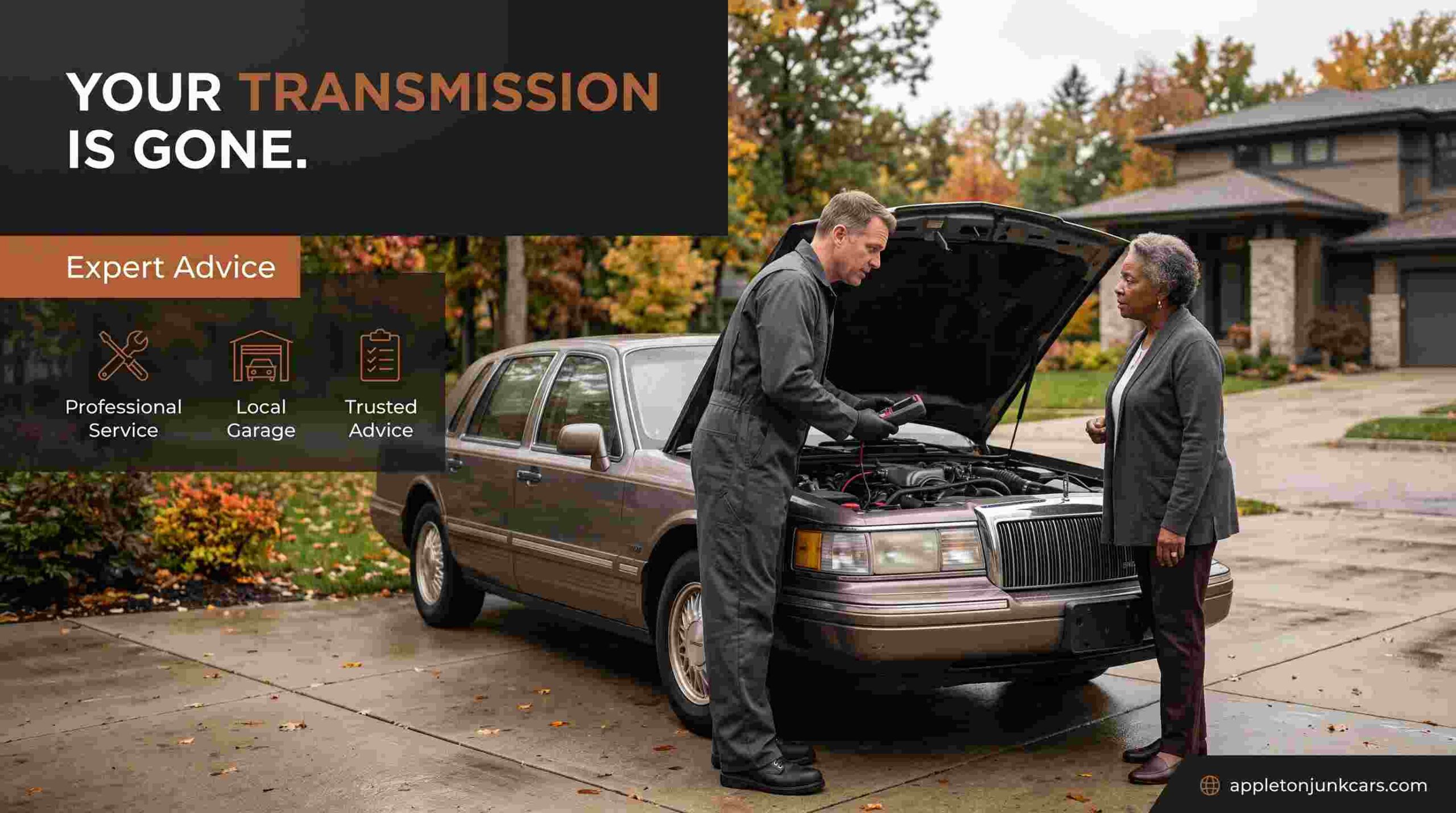
You already know something is wrong. The car moved differently yesterday than it did last week, or there was a noise you have been quietly hoping would go away, or you shifted into Drive this morning and the engine revved like nothing was listening. Now you are looking for clarity on whether this is a warning you can still act on or whether the transmission has crossed a line it cannot come back from.
That distinction matters enormously for what comes next. A failing transmission and a completely dead transmission look similar from the driver’s seat but represent very different financial realities. A failing transmission might cost $800 to $2,500 to repair depending on the problem. A completely dead one means you are looking at $2,500 to $5,000 for a rebuild or replacement, and in many cases the math simply does not work in the car’s favor.
This guide covers the specific signs that indicate a transmission is truly gone, the signs that suggest it is failing but still repairable, what to look for in the fluid, and what to do with this information once you have it.
The Critical Difference: Failing vs Completely Dead
Most articles about transmission problems blur these two categories together. For your purposes, they are entirely different situations.
A failing transmission still operates but is deteriorating. It may slip, hesitate, shift roughly, or make concerning noises. It might cost you real money to fix, but it can be fixed. Caught early, some transmission problems cost a few hundred dollars. Caught later, they escalate. A failing transmission is a car that can still get you to a transmission shop.
A completely dead transmission has experienced catastrophic internal failure. Major components have broken, seized, or disintegrated. The transmission may produce no output at all, meaning the car cannot move despite a running engine. Or it moves briefly before a terrible noise signals the end. At this stage, the decision is usually not repair or rebuild, it is rebuild or replace vs whether to spend that money on this car at all.
The symptoms below are organized by severity so you can assess where your situation actually falls.
Signs Your Transmission Is Completely Dead
These symptoms point to catastrophic failure, meaning internal components have reached a state that is beyond minor repair and likely beyond a routine rebuild without full disassembly.
1. The Engine Revs Freely But the Car Does Not Move
This is the most unambiguous sign of complete transmission failure. You put the car in Drive, press the gas, and the engine responds normally, the RPMs climb, but the vehicle goes nowhere. Same in Reverse.
What this means mechanically: the transmission has lost the ability to transfer torque from the engine to the driveshaft. This can happen when the torque converter has failed catastrophically, when internal clutch packs have completely burned and disintegrated, or when a gear or shaft has broken so severely that no power path remains through the transmission.
In some cases this symptom can be caused by something other than the transmission itself, specifically a broken shift linkage that is preventing the transmission from actually receiving the gear selection. A mechanic can diagnose this quickly. But if the linkage checks out and the engine revs freely while the car sits still in Drive, the transmission is gone.
2. A Loud Bang or Clunk Followed by No Movement
Some transmissions do not gradually decline to complete failure. They fail suddenly. If you heard a significant bang, clunk, or impact-like noise while driving, followed immediately by the car no longer moving or losing drive power, that is the sound of a major internal component breaking.
Broken planetary gear sets, shattered torque converter components, and cracked transmission housings can all produce this symptom. The noise is the failure event. Everything after it is the consequence.
This type of failure is not repairable in the traditional sense. The broken component itself is gone, and the debris it created circulating through the fluid causes collateral damage to other internal components. What starts as one broken gear becomes debris that scores clutch packs, damages the valve body, and contaminates everything it touches.
3. Black or Burned Fluid With Metal Chunks
Transmission fluid is the clearest window into what is happening inside the unit. Normal transmission fluid is bright red and transparent or slightly translucent. It should not smell strongly and should not contain visible particles.
Dark brown fluid with a mild burnt smell means the fluid is long overdue for a change and the transmission is under stress. This is a warning, not necessarily a death sentence.
Black, thick fluid with a sharp burning odor means the transmission has been severely overheated, the fluid itself has broken down chemically, and damage is already done to internal components. At this stage, a fluid change will not fix the underlying damage.
Black fluid with visible metal particles, chunks, or shavings is the sign of catastrophic internal wear or breakage. Small metallic specks from normal wear are expected over high mileage. Visible chunks of metal, brass shavings in significant quantity, or a gritty metallic paste that coats your finger when you check the dipstick indicates that major components are literally disintegrating inside the unit.
Metal contamination of this severity means the debris has circulated through the valve body, clogged hydraulic passages, and damaged every component the fluid touches. A fluid change alone cannot undo this damage because the debris has already done its work.
4. Complete Loss of All Forward or Reverse Gears
If the car was previously slipping and now will not engage any forward gear at all, or will not engage Reverse, the progression has reached complete failure. A transmission that slips occasionally is failing. A transmission that produces no engagement in any gear direction has failed.
This can occur gradually over days or weeks as increasing internal damage reduces fluid pressure until there is not enough hydraulic force to engage any clutch packs. It can also occur suddenly after a specific component failure.
One important diagnostic note: confirm the car has sufficient transmission fluid before concluding the unit is dead. A severely low fluid level can produce a no-engagement symptom. If the fluid is critically low, check whether a sudden fluid loss through a leak has occurred. A leaking pan gasket or damaged cooler line can drain the transmission quickly. This is worth ruling out before accepting a total-loss diagnosis on the transmission.
5. Locked Into One Gear With No Ability to Shift
If the transmission is stuck in a single gear and completely refuses to shift up or down regardless of throttle input, speed, or selector position, this is a serious failure sign. In automatic transmissions, this is sometimes called limp mode when it is a programmed protective response by the car’s computer, but true limp mode typically allows limited driving at low speed.
When the car is mechanically locked in one gear because physical components have broken or seized inside the transmission, there is no recovery from that condition without rebuilding or replacing the unit. The distinction between limp mode and true mechanical lock requires diagnostic scanning to read transmission fault codes, but if the car cannot achieve anything beyond a single fixed gear and has other symptoms on this list, the outlook is not good.
6. A Grinding or Howling Noise That Does Not Stop
Internal transmission noise that persists regardless of gear, speed, or throttle input indicates that something inside is physically damaged and running against other components. Bearings that have failed produce a continuous howling or rumbling noise. A cracked or worn planetary set produces grinding that does not vary.
This type of noise means hard parts are in contact that should not be. Every mile driven in this condition increases the debris load inside the unit and extends the eventual damage to surrounding components. A transmission that sounds like this has already suffered significant hard-parts failure.
Signs Your Transmission Is Failing But May Still Be Saveable
These symptoms are serious and should not be ignored, but they do not necessarily indicate complete failure. If these are all you are experiencing, the situation may be recoverable with prompt attention.
Symptom | What It Suggests | Urgency |
|---|---|---|
Gear slipping (engine revs, speed inconsistent) | Worn clutch packs or low pressure | High – stop driving, get diagnosed |
Delayed engagement (2-3 second pause) | Low fluid, worn pump, or solenoid issue | High – do not ignore |
Hard or rough shifting | Solenoid, fluid, or clutch pack issue | Moderate to high |
Whining or humming noise | Bearing or pump issue beginning | Moderate – needs diagnosis |
Transmission warning light or codes | Various, from sensor to internal | Get it scanned immediately |
Dark brown fluid, mild burnt smell | Overdue service, stress on system | Service soon, check for damage |
Fluid leak (red drips under car) | Seal or gasket failure | Do not drive low on fluid |
The Fluid Test: What Your Dipstick Is Actually Telling You
If your car has a transmission dipstick (some modern vehicles do not), pulling it and examining the fluid can give you significant diagnostic information in about thirty seconds. Here is how to read what you find.
Park the car on level ground and, for automatic transmissions, run the engine for a few minutes in Park before checking the fluid. This circulates the fluid and gives you a representative sample. Pull the dipstick, wipe it clean, reinsert it fully, then pull it again to read.
- Bright red, clear or slightly translucent: Normal. Fluid is in good condition.
- Darker red or light brown, no unusual smell: Aging fluid, due for service. Not an immediate emergency but address it soon.
- Very dark brown, mild burnt smell, no visible particles: Fluid has degraded, transmission has been stressed. Needs service. May have early internal damage.
- Black, strong burning smell, no particles: Severe overheating has occurred. Internal damage is likely. Needs immediate professional inspection.
- Black with visible metallic particles or shavings, gritty texture: Major internal component failure. This fluid has pieces of the transmission in it. The unit is severely damaged.
If you do not have a dipstick, look under the car for fluid on the ground. Transmission fluid is typically red or pink. If you see it pooling, the fluid level in the transmission may be critically low, which can cause no-movement symptoms even in a transmission that is not yet completely destroyed.
How to Confirm Your Diagnosis
None of the symptoms above are a substitute for a proper diagnosis by a transmission specialist. Before accepting that a transmission is completely dead and making any financial decisions based on that conclusion, two steps are worth taking.
Check the fluid level first. A transmission that has lost a significant amount of fluid through a leak can produce almost every symptom on the dead transmission list, including no movement in Drive and no gear engagement, without the transmission itself being internally destroyed. Checking the fluid takes thirty seconds. If it is bone dry, the car needs fluid and a leak diagnosed before any conclusions about the transmission’s health are valid.
Get a diagnostic scan. Modern vehicles store transmission fault codes in the onboard computer. A mechanic or a parts store with a code scanner can pull these codes and tell you exactly what the transmission’s computer has recorded. Some codes point to sensors, solenoids, or electrical issues that can be repaired for hundreds of dollars rather than thousands. Other codes confirm catastrophic internal failure. Knowing which you are dealing with before making a decision about the car’s future is worth the cost of a professional scan.
If the fluid is at the right level, the scan shows internal catastrophic codes, and the symptoms match those in the first section of this guide, you have your answer.
What to Do If the Transmission Is Completely Dead
Once you have confirmed that the transmission has failed beyond repair, you face a financial decision that benefits from honest math.
Get a quote for transmission replacement or rebuild. Rebuilds on common vehicles typically run $2,500 to $4,000 in labor and parts. Full replacement with a remanufactured unit runs $3,000 to $5,000 or more. For trucks and larger SUVs, these figures are often higher. For rare or discontinued vehicles, parts availability may make any rebuild impractical.
Compare that repair cost against the vehicle’s current market value in running condition. If the repair cost exceeds 50 percent of what the car would be worth running, the economic argument for repair is weak. If the car is worth $5,000 running and the transmission repair is $4,500, you are putting $4,500 into a car to recover $5,000. The margin is too small to justify the risk that something else fails after the repair.
The car still has value even with a completely dead transmission. Junk car buyers price based on weight, parts demand, and the value of components like the catalytic converter and other intact systems. A car with a dead transmission is not worthless. It is simply worth less than a running version of the same car, and the right buyer will still pay you for it.
Real Experiences From Drivers Who Have Been Through This
People who have faced a completely dead transmission describe the experience in consistent terms.
The most common form of regret is waiting too long after the first symptoms appeared. Gear slipping that started intermittently and was explained away, a delayed engagement that was attributed to cold weather, a whining noise that was labeled as just a quirk. Months later, what might have been a $700 solenoid replacement became a $4,000 rebuild because the early warning signs were dismissed. The transmission did not fail overnight. It arrived at complete failure through a progression that had an earlier, cheaper exit point.
The second consistent observation is from people who spent money rebuilding a transmission on a car that was not worth the investment. The rebuild was successful, technically. The car ran again. Then three months later something else failed on a high-mileage vehicle that was clearly approaching the end of its economically useful life. The transmission money was not recovered.
The people who describe the best outcomes are those who got a clear diagnosis quickly, ran the repair cost versus car value math honestly, and made their decision from information rather than hope.
Frequently Asked Questions
Can a completely dead transmission be repaired?
Occasionally yes, but the distinction matters. A transmission with catastrophic internal failure, meaning broken hard parts, severe metal contamination, or a cracked housing, typically requires full rebuild or replacement rather than repair of an individual component. The cost approaches or exceeds that of a remanufactured replacement unit, which is often the more cost-effective path.
What does a dying transmission feel like vs a dead one?
A dying transmission still moves the car but does so inconsistently. It slips under acceleration, shifts roughly, hesitates when changing gears, or makes noise during operation. A dead transmission produces no usable output: the car either does not move at all, or moves briefly before a major noise signals complete internal failure.
Can a transmission fail suddenly without warning?
It can, particularly if a physical component like a planetary gear or torque converter component breaks catastrophically. More commonly though, complete failure is preceded by weeks or months of symptoms that were not addressed. What feels sudden is often the final stage of a longer decline.
What does transmission fluid with metal in it mean?
Visible metal particles in transmission fluid indicate that internal components are breaking down physically. Small gray metallic paste on the drain plug magnet is normal wear. Visible flakes, chunks, or a gritty texture indicates major internal component failure. At that stage, the debris has circulated through the entire hydraulic system and caused additional damage beyond the original failure point.
Is it worth rebuilding a transmission on a high-mileage car?
Run the math. Compare the rebuild cost to what the car is worth running. If the repair cost exceeds 50 percent of the car’s running value, the economic case for repair is weak. Also consider what else might need attention on a high-mileage vehicle in the next year. A transmission that costs $4,000 to rebuild on a car worth $5,000 running leaves a thin margin even if everything goes perfectly afterward.
What can I do with a car that has a completely dead transmission?
Sell it. Junk car buyers, salvage yards, and online car buying services all purchase vehicles with non-running transmissions. The offer reflects the car’s value in its current state: its weight, its intact components, and current scrap metal prices. A car with a dead transmission is not worth nothing. It is worth exactly what the market for its parts and metal will bear, which is typically a few hundred to over a thousand dollars depending on the vehicle.
The Bottom Line
A completely dead transmission announces itself clearly once you know the signs. No movement in Drive or Reverse despite a running engine, a sudden bang followed by lost drive power, black fluid with visible metal particles, continuous grinding or howling noise, and complete loss of all gear engagement are not warning signs. They are confirmation signs.
If you are experiencing symptoms from the failing category rather than the dead category, those still matter and still require prompt attention. A failing transmission becomes a dead one if the warning signs are driven through rather than acted on.
Once you have a clear picture of where your transmission stands, the decision becomes financial rather than mechanical. Know the repair cost, know the car’s value, and make the call with clear numbers rather than optimism.