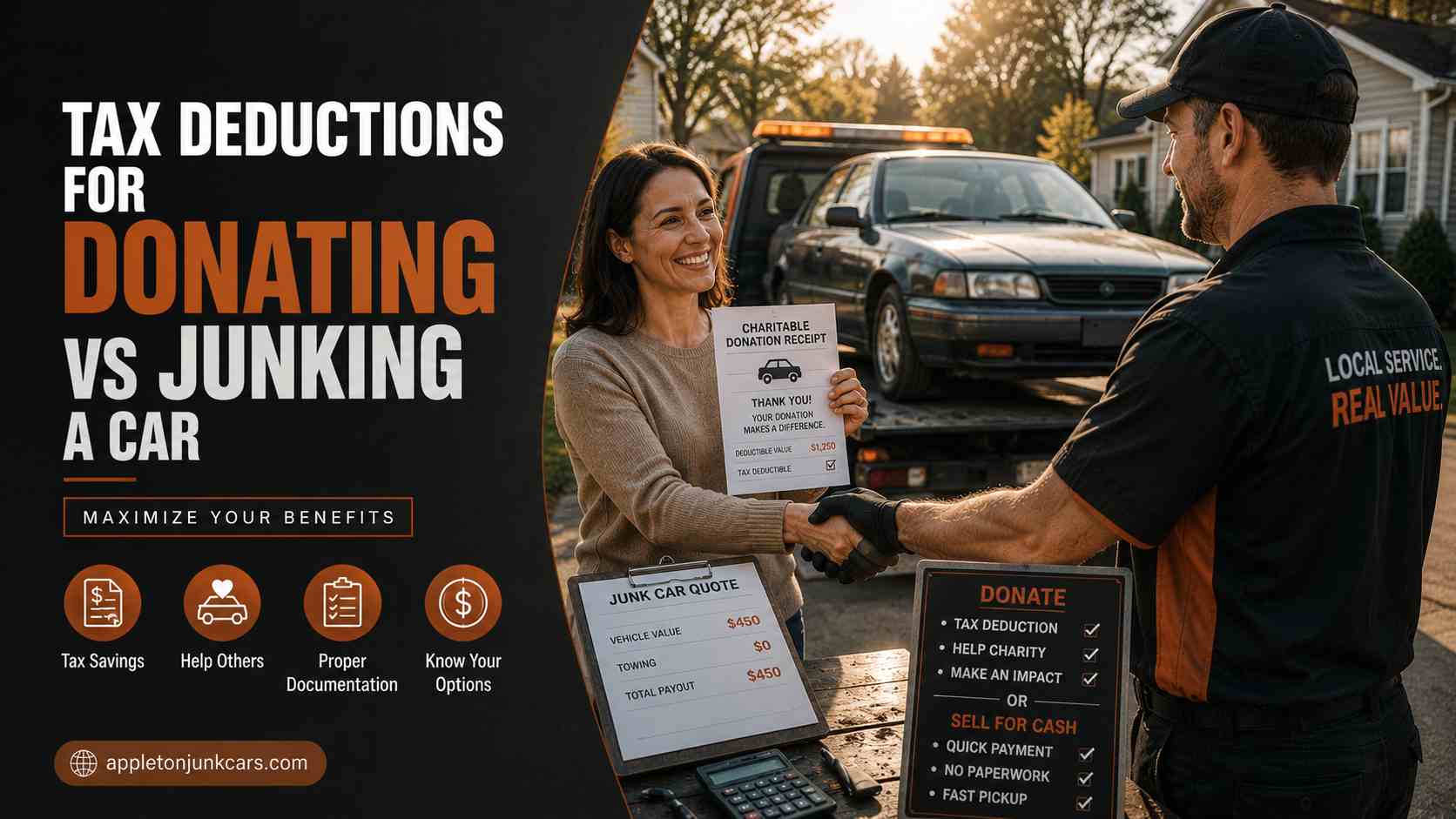
A non-running car creates two different financial paths. Junking it produces immediate cash. Donating it to a qualified charity produces a potential tax deduction. The question of which path is worth more financially requires understanding how vehicle donation deductions actually work under IRS rules, because the amount most donors expect to deduct and the amount the IRS actually allows are frequently very different numbers. The gap between those two amounts is often the difference between donation being the better choice and junking being the obvious winner.
Most people assume that donating a car allows them to deduct its Kelley Blue Book value. This is incorrect. The IRS rules that govern vehicle donations, specifically IRC Section 170 and IRS Publication 4303, set the deduction based on what the charity actually receives for the vehicle, not on what you think the car is worth. Most donated cars are sold at wholesale auction for significantly less than KBB value, and the deduction reflects the actual sale price.
This guide explains the IRS rules precisely, works through the actual math in several realistic scenarios, covers the paperwork required to claim the deduction, and gives you a clear framework for deciding which option puts more money in your pocket for your specific situation. Note that this is educational information about how tax rules work; consult a qualified tax professional about your specific situation.
How Vehicle Donation Tax Deductions Actually Work Under IRS Rules
Vehicle donations to qualified charities (organizations recognized under IRC Section 501(c)(3)) are governed by rules that changed significantly under the American Jobs Creation Act of 2004. Before 2004, donors could deduct the fair market value of any donated vehicle regardless of what happened to it afterward. After 2004, the rules tightened considerably.
When the Charity Sells the Vehicle
If a donated vehicle is sold by the charity rather than used in its programs, the deduction is limited to the gross proceeds the charity received from the sale. If the charity sells your car at auction for $425, your deduction is $425, regardless of what KBB says the car is worth in any condition. The charity is required to send you IRS Form 1098-C within 30 days of the sale, documenting the actual sale price, which is the amount you may deduct.
When the Charity Uses the Vehicle
If the charity uses the vehicle in its own operations rather than selling it, or makes significant modifications to it for use by a needy individual, the deduction may be based on the vehicle’s fair market value. These situations are less common than the sale scenario and require documentation from the charity that the vehicle was put to a qualifying use.
The $500 Threshold
For vehicles sold by the charity for $500 or less, the donor may deduct the lesser of the fair market value or $500, without waiting for the Form 1098-C. This provision applies when the car sells for less than $500, which is common for non-running or high-mileage vehicles. For any vehicle sold for more than $500, the Form 1098-C documenting the actual sale price is required to claim the deduction.
The Common Misconception About Donation Deductions
The most common and consequential misunderstanding about vehicle donations is the assumption that the deduction equals the KBB value of the donated vehicle. This misconception is specifically addressed in IRS Publication 4303, which states that fair market value is not always KBB and that the deduction for a sold vehicle is the actual sale proceeds, not the estimated market value.
Where does this misconception come from? Many vehicle donation programs market themselves with language like “get a tax deduction worth the value of your car.” This language is technically accurate only if the charity sells the car for its full market value, which rarely happens. Vehicle donation programs typically sell donated cars at wholesale auction, where prices for non-running or high-mileage vehicles routinely run $200 to $600, regardless of what a private sale might have produced.
The practical gap: a non-running 2010 Honda Accord that KBB values at $2,800 in “poor” condition (which still assumes the car drives) might sell at a donation program auction for $350. The donor’s deduction is $350, not $2,800. The tax benefit of a $350 deduction at a 22 percent marginal tax rate is $77 in tax savings.
The Math: When Donation Beats Junking and When It Does Not
Vehicle Scenario | Junk Car Offer | Expected Charity Sale Price | Deduction Amount | Tax Savings at 22% | Donation Net vs Junk Net |
|---|---|---|---|---|---|
Non-running compact, high miles | $300 | $200 to $400 | $200 to $400 | $44 to $88 | Junking wins by $200 to $260 |
Non-running mid-size, fair body | $600 | $300 to $600 | $300 to $600 | $66 to $132 | Roughly equal or junking slightly ahead |
Running but rough sedan, older | $1,000 | $500 to $1,000 | $500 to $1,000 | $110 to $220 | Junking likely wins; donation close only if itemizing |
Running vehicle, acceptable condition | $1,500 | $800 to $2,000 | $800 to $2,000 | $176 to $440 | Donation may beat junking if deduction is high and you itemize |
Running vehicle, good condition | $3,000+ | $1,500 to $3,500+ | $1,500 to $3,500+ | $330 to $770 | Donation can significantly exceed junking if you itemize |
The critical condition in every scenario in the “donation wins” column: you must itemize deductions on your federal tax return for the vehicle donation deduction to have any value. If you take the standard deduction, which most taxpayers do since the 2017 Tax Cuts and Jobs Act nearly doubled it, a vehicle donation produces zero tax benefit. The cash from junking is worth more in every scenario if you take the standard deduction.
The Itemization Requirement
A charitable deduction for a vehicle only reduces your tax liability if your total itemized deductions exceed the standard deduction for your filing status. For the current tax year, the standard deduction is approximately $14,600 for single filers and $29,200 for married filing jointly (these amounts adjust annually for inflation). If your mortgage interest, state and local taxes, charitable giving, and other itemized deductions do not exceed these thresholds, you receive no federal tax benefit from the vehicle donation.
The IRS estimates that approximately 90 percent of taxpayers now take the standard deduction rather than itemizing. For these taxpayers, vehicle donation has zero federal tax advantage over junking. The immediate cash from junking is the superior financial outcome in every case.
For the approximately 10 percent of taxpayers who do itemize, the vehicle donation deduction is valuable only to the extent it increases total itemized deductions above the standard deduction threshold. If you are already itemizing significantly above the standard deduction, additional charitable deductions reduce your tax liability dollar for dollar at your marginal rate.
The Paperwork Required to Claim the Deduction
Claimed Deduction Amount | Required Documentation | Who Provides It | Deadline |
|---|---|---|---|
Under $250 | Written acknowledgment from charity | Charity | At time of donation |
$250 to $500 | Written acknowledgment with description of vehicle | Charity | At time of donation |
Over $500 (sold by charity) | IRS Form 1098-C with actual sale proceeds | Charity sends to you | Within 30 days of sale |
Over $500 (used by charity) | Written certification of use, plus Form 8283 on your return | Charity; you file 8283 | By your tax return due date |
Over $5,000 | Qualified written appraisal in addition to above | Licensed appraiser (not charity) | Before return due date |
The Form 1098-C documentation requirement for vehicles sold for over $500 is the most commonly missed paperwork step. Without Form 1098-C, the IRS may disallow the entire deduction for the vehicle. If you donate and do not receive Form 1098-C within 30 days of the sale, contact the charity to request it before filing your return.
Choosing a Legitimate Charity vs a Vehicle Donation Middleman
A significant portion of the vehicle donation industry operates through middlemen: for-profit companies that collect donated vehicles on behalf of charities, sell them at auction, keep a substantial percentage of the proceeds as their fee, and pass the remainder to the charity. These arrangements are legal but significantly reduce the charity’s actual benefit from your donation and may also reduce your deductible amount.
Some vehicle donation programs pass only 10 to 30 percent of auction proceeds to the charity after deducting towing, auction, and administrative fees. If the charity receives $300 from a car that sold for $600 at auction, the organization you intended to benefit received half of the vehicle’s value. The donor’s deduction is still based on the gross sale proceeds ($600), but the charity’s actual benefit was $300.
To maximize benefit to the charity: donate directly to organizations with their own vehicle programs rather than through donation brokers. Large nonprofits including Habitat for Humanity, National Kidney Foundation, and many local organizations run their own vehicle programs with lower overhead costs and higher pass-through to the organization’s mission. Verify that any organization you donate to is a qualified 501(c)(3) using the IRS’s Tax Exempt Organization Search tool (apps.irs.gov/app/eos).
What Donors and Junk Car Sellers Consistently Report
People who have navigated both options share consistent findings. Donors who expected to deduct KBB value and received Form 1098-C documenting an auction sale of $250 to $450 consistently reported surprise and disappointment. The gap between their expected deduction and the actual documented sale price was the most common source of confusion.
Those who had run the itemization math before donating consistently reported being satisfied with the outcome because their expectations matched reality. Several noted that for running vehicles in decent condition donated to a charity with a strong vehicle program, the combination of goodwill toward the organization and the tax benefit produced a net outcome comparable to or slightly above what junking would have yielded.
Sellers who junked their vehicles and took the cash consistently reported the transaction was simpler and faster than they expected, and that the immediate cash was unambiguously the better outcome for vehicles worth less than $700 in junk condition. The donation math simply does not work for low-value vehicles, especially for taxpayers who take the standard deduction.
Frequently Asked Questions
Can I deduct the Kelley Blue Book value of my donated car?
No. The IRS does not allow vehicle donation deductions based on KBB or any other estimate of fair market value when the charity sells the vehicle. The deduction is limited to the actual gross proceeds the charity receives from the sale, as documented on Form 1098-C. For vehicles sold at charity auctions, this amount is frequently significantly lower than KBB estimates.
Is it better financially to donate or junk a car?
It depends on the vehicle’s condition, whether it runs, its junk value, the expected auction price the charity receives, and critically whether you itemize deductions on your federal return. For taxpayers who take the standard deduction (approximately 90 percent), junking almost always produces more money because the donation generates no federal tax benefit. For itemizing taxpayers with vehicles in better condition, donation can be competitive with junking. Work through the specific math for your situation.
What is IRS Form 1098-C and when do I need it?
Form 1098-C is issued by the charity that received your vehicle donation when the vehicle was sold for more than $500. It documents the actual gross sale proceeds and is required to claim the vehicle donation deduction. The charity must provide it within 30 days of the vehicle sale. Without Form 1098-C for a vehicle sold over $500, the IRS may disallow your deduction.
Do I need to itemize to get a tax benefit from donating my car?
Yes. Charitable deductions, including vehicle donations, only reduce your tax liability if you itemize deductions on Schedule A rather than taking the standard deduction. If your total itemized deductions do not exceed the standard deduction for your filing status, the vehicle donation provides no federal tax benefit. Most taxpayers now take the standard deduction following the 2017 increase.
What paperwork do I need to donate a car?
You need the vehicle’s title to transfer ownership to the charity. After the donation, you need written acknowledgment from the charity for deductions under $500, or Form 1098-C for deductions over $500 when the vehicle is sold. For deductions over $5,000, a qualified appraisal from a licensed appraiser (not the charity) is also required. Keep copies of all documentation with your tax records.
How long does a vehicle donation take?
Most vehicle donation programs schedule pickup within two to five business days of the initial contact. Paperwork from the charity, including the written acknowledgment and Form 1098-C if applicable, arrives by mail within 30 days of the vehicle being sold. The entire process from initial call to receiving your tax documentation takes four to eight weeks in most cases.
Can I donate a car without a title?
Most charities require a clear title to accept a vehicle donation because they need to transfer legal ownership to complete the sale. Some programs accept vehicles with title issues in specific states where alternative ownership documentation is permitted, but this is less common. If the title is lost, applying for a replacement before donating simplifies the process significantly.
Is a vehicle donation deduction subject to the 60 percent AGI limitation for charitable contributions?
For vehicle donations where the deduction is the actual sale proceeds (the most common scenario), the deduction is treated as a property donation limited to 30 percent of adjusted gross income (AGI) in the year of donation, with a five-year carryforward for any excess. The 60 percent limitation applies primarily to cash donations to public charities. Consult a tax professional for guidance on your specific situation.
The Bottom Line
For most junk car owners, the math favors junking over donation when the vehicle has a junk value under $800 and the owner takes the standard deduction. The tax benefit of donating a non-running car that sells at auction for $300 to $500 is $66 to $110 in tax savings at a 22 percent marginal rate, which is less than what junking would have produced in cash.
The scenarios where donation genuinely competes with or beats junking: the vehicle is in running condition and a charity’s auction produces $1,000 or more in actual proceeds, the taxpayer itemizes deductions with enough other deductions to be above the standard deduction threshold, and the taxpayer’s marginal tax rate is 24 percent or higher. Outside of those specific conditions, the immediate cash from junking is the better financial outcome.
The most practical advice: run the specific numbers before deciding. Calculate what a junk buyer would offer. Estimate what a charity auction would produce for your vehicle in its current condition (ask the charity or a donation program for their average auction price for similar vehicles). Apply your marginal tax rate to the deduction amount and compare. If you take the standard deduction, skip the calculation and take the junk offer.