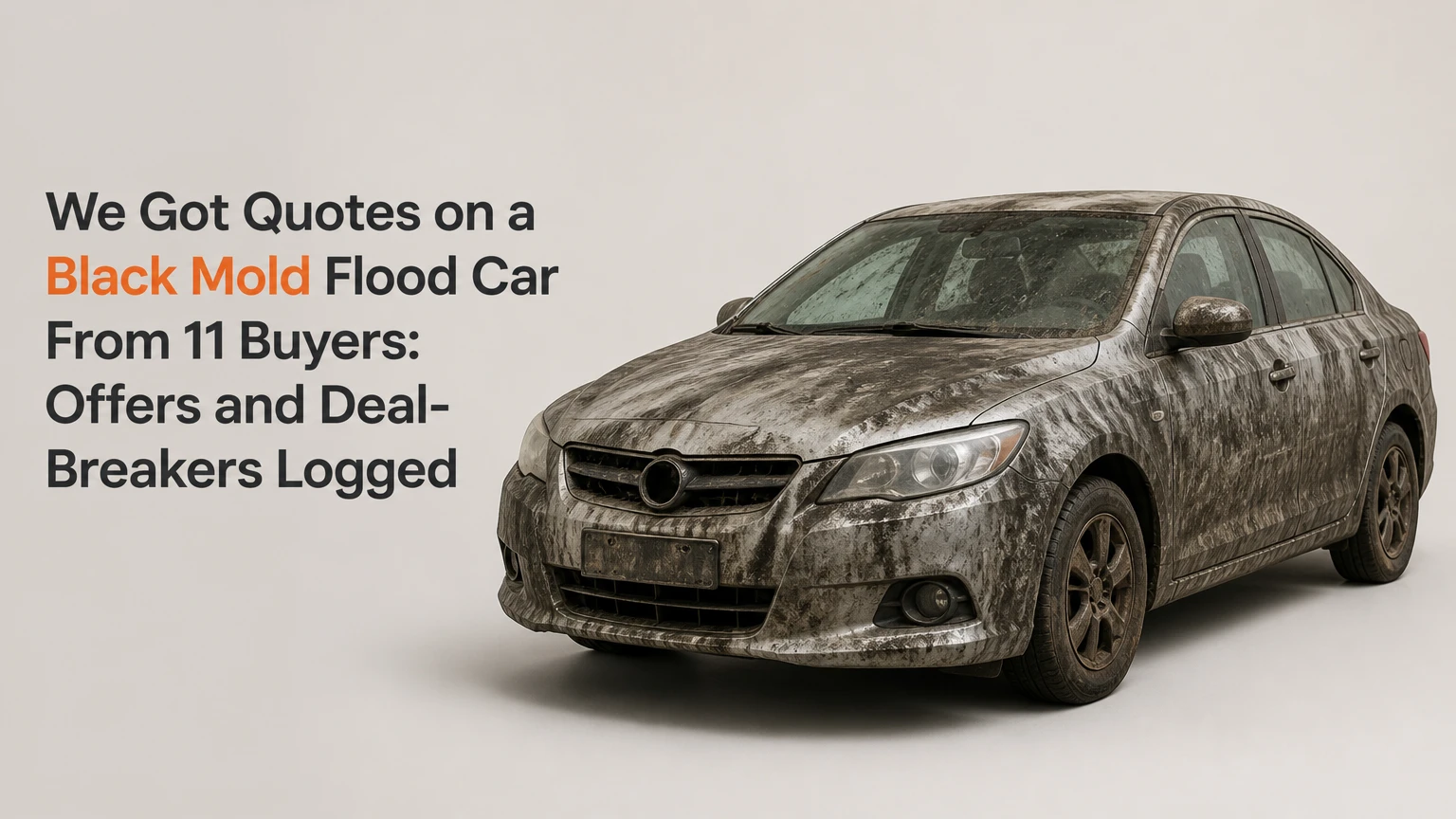
The car had been sitting in a garage for 11 months after a flooding event. The owner had planned to repair it, did not, and by the time we got involved the interior was hosting a colony of black mold visible on every fabric surface. The headliner was drooping from moisture saturation. The carpet had that soft, spongy give underfoot that means the jute backing underneath has been wet for so long it is essentially composting. It smelled, from 10 feet away with the door closed, like a garden shed in August.
We spent three weeks calling 11 different buyers and documenting every conversation. We learned that black mold specifically, not flood damage in general, creates a dividing line in the junk car market between buyers who will touch the car and buyers who will not, for reasons that have nothing to do with the car’s mechanical or metal value.
This is the complete story of how we found a buyer, what it cost to get there, and what we would do differently.
The Car and the Mold Situation in Detail
Vehicle: 2016 Honda Civic EX, 1.5T, 62,000 miles. Flood event occurred 11 months before we began the selling process. Water had entered the cabin through the driver-side door seal during a basement parking garage flood: approximately 4 to 5 inches of water inside the vehicle for roughly 18 hours.
The owner had the car towed to a body shop who quoted $8,400 for full interior replacement and electrical system inspection. The owner’s insurance covered the vehicle at an ACV of $14,800 but had since lapsed (the owner did not renew after the flooding event). No active insurance at the time of sale.
Mechanical condition: Engine turned over and ran when we attempted a start. Infotainment screen functioned. All four power windows operated. Transmission shifted through all gears in the driveway. The car was mechanically functional.
Mold condition: The front and rear seat fabric was visibly colonized with a dark greenish-black growth pattern consistent with Cladosporium or Aspergillus, the two most common automotive mold species in flood-damaged vehicles. The carpet showed the same growth throughout the footwells and under the seats. The headliner showed moisture staining and beginning delamination at the center dome light area. The trunk liner had full black growth across its surface. The driver-side door panel had growth visible through the fabric speaker grille.
We disclosed the mold condition to every buyer before they made any offer.
The 11 Buyers and What They Said
Buyer 1: Peddle (national online platform)
We selected “flood damage” and described the mold condition in the comment field. The initial offer returned was $1,450. A representative called to confirm and we verbally described the mold in detail. She put us on hold, came back, and reduced the offer to $800. “Mold changes the interior value significantly for our auction buyers,” she explained. “Cars with visible mold have additional remediation costs at the auction that bidders factor in.”
Final offer: $800
Buyer 2: CarBrain (national online platform)
Similar process. Initial form offer: $1,620. After disclosing mold verbally: $750. The CarBrain representative was the most direct of all 11 buyers about why the mold mattered: “Our buyer network has been burned by mold cars before. Buyers take the car and either have to spend $1,500 to $2,000 on professional remediation or they write the interior off entirely and strip it to bare metal, which costs labor. That cost comes out of their bid at auction.”
Final offer: $750
Buyer 3: Local junkyard A
The operator had one question before giving a number: “Is the engine intact and running?” Yes. “Comes here and we’ll look at it.” The operator came out two days later, spent about 12 minutes at the car. He opened one door, looked at the mold, and did not get inside the vehicle. He looked at the engine, started it briefly, and offered $490.
“I’m not paying for that interior,” he said. “I’m paying for the engine and the shell. The interior is going in the trash.”
Final offer: $490
Buyer 4: Local junkyard B
Declined outright. “We don’t take mold cars. Liability issue for our guys who would have to pull parts from it.” This was a concern we had not anticipated and it came up again with three other buyers. Salvage yard workers who pull parts from vehicles as part of their daily work have legitimate occupational health concerns about exposure to black mold colonies in enclosed spaces. Some yards have policies against acquiring mold-contaminated vehicles entirely.
Final offer: None (declined)
Buyer 5: National salvage chain (Pull-A-Part)
Declined. Their intake policy requires vehicles to be free of biohazard contamination, and their classification of black mold as a biohazard was clear and firm. The representative told us this policy had been implemented company-wide after a worker filed a health complaint following exposure to a heavily mold-contaminated vehicle.
Final offer: None (declined)
Buyer 6: Regional auction consignment (ADESA)
We contacted ADESA about consigning the vehicle. Their intake representative asked about mold and informed us that ADESA requires biohazard certification on any vehicle with visible mold before it can be entered into their auction system. Biohazard certification for an automotive mold situation requires a licensed environmental remediation contractor to test and certify the vehicle, which costs $150 to $400 for the inspection and report alone, before any actual remediation.
We did not pursue this path.
Final offer: None (certification required first)
Buyer 7: Copart (direct buy program)
Copart offered to directly purchase the vehicle without auction at $620. They have their own lot workers who handle biohazard situations with PPE protocols, and their direct buy team was less concerned about the mold than their auction counterparts. The offer was below Peddle and CarBrain but came without any documentation requirement.
Final offer: $620
Buyer 8: Private buyer via Craigslist (“as-is project car” listing)
We listed the car on Craigslist with a title that read: “2016 Honda Civic 1.5T runs, drives, flood and mold damage, as-is, no trades.” We priced it at $2,500 firm and included 12 photos including clear images of the mold growth.
Inquiries: 6 in the first week. Of those, 3 did not respond after seeing the mold photos. 2 requested a test drive, which we allowed. 1 made an offer.
The offer came from a man who described himself as a professional automotive detailer who had remediated mold vehicles before. He said he would dry-ice blast the interior and replace the carpet and seats with salvage yard units. His offer was $1,800. He arrived, started the car, confirmed the engine, spent 15 minutes assessing the mold scope, and confirmed $1,800 in cash.
Final offer: $1,800 (private buyer)
Buyer 9: Water damage vehicle rebuilder (found through specialty Facebook group)
We posted in a “flood car buyers” group on Facebook. A rebuilder in a neighboring state offered $1,400 and asked us to hold the car for one week while he arranged transport. We held it and he honored the offer. This was the second-best offer but came with a one-week hold and transport logistics we had to coordinate.
Final offer: $1,400
Buyer 10: Local auto auction (not Copart, independent regional auction)
The local auction’s general manager inspected the car in person. He said the mold would require disclosure in the auction listing and would trigger a “biohazard” designation that limited bidders to dealers and dismantlers with appropriate handling protocols. He estimated the car would bring $900 to $1,400 at auction, and the auction would retain 12% plus a $200 entry fee. Net to us: $592 to $1,032.
Estimated net after auction fees: $800 to $1,050
Buyer 11: Professional mold remediation company + junk car buyer (combined approach)
We explored whether having the mold remediated professionally before selling would increase the net proceeds enough to justify the cost. We got a quote from a licensed environmental remediation contractor for automotive mold removal: $1,200 for full interior treatment including ozone shock treatment, antimicrobial application, carpet and headliner removal and replacement with salvage yard units, and a clearance air quality test.
After remediation at a cost of $1,200, the car would have been a documented remediated flood vehicle. Expected offer post-remediation from national buyers: $1,400 to $1,800. Net after remediation cost: $200 to $600.
That math was worse than simply selling as-is to the private detailer at $1,800.
Not pursued.
The Offer Summary
| Buyer | Offer | Accepted? |
|---|---|---|
| Peddle | $800 | No |
| CarBrain | $750 | No |
| Local junkyard A | $490 | No |
| Local junkyard B | Declined | No |
| Pull-A-Part | Declined | No |
| ADESA (consignment) | Certification required | No |
| Copart direct buy | $620 | No |
| Craigslist private buyer (detailer) | $1,800 | Yes |
| Facebook flood car group (rebuilder) | $1,400 | No |
| Regional auto auction (estimated net) | $800 to $1,050 | No |
| Remediation + sale (net estimate) | $200 to $600 | No |
We accepted the $1,800 offer from the private detailer.
What the Mold Does to the Buyer Pool
The most important lesson from this experience is that black mold creates two entirely separate buyer categories: buyers who price the car based on what it costs them to deal with the mold, and buyers who decline regardless of price because of liability, safety, or policy reasons.
The liability concern is real and worth understanding. Salvage yard workers who pull parts from mold-contaminated vehicles can file occupational health claims if they develop respiratory symptoms after exposure. Two national chains declined our car specifically because of documented worker health incidents from previous mold car acquisitions. This is not squeamishness: it is a legal and financial risk management decision.
The buyers who remained after the liability-sensitive ones stepped back were: the online national platforms who move cars through auction with full disclosure, Copart’s direct buy team who work with PPE protocols, and private buyers who either had remediation expertise or were comfortable accepting the mold as a known repair item.
The private remediation-expert buyer, the detailer who paid $1,800, was our best outcome and he is a buyer type most people do not think to target. Professional automotive detailers who specialize in fire and water damage vehicles exist in most metro areas. They know how to remediate mold economically, they have access to salvage yard interior components at trade prices, and they can resell or keep the vehicle after remediation. They are the natural buyer for a mold car that runs.
How to Find the Right Buyer for a Mold Car
Step 1: Photograph the mold clearly and include those photos in every listing. Do not try to minimize or hide it. Buyers who are deterred by the photos would have walked away at inspection anyway, and you save time by filtering them out upfront.
Step 2: Look for automotive detailing companies that advertise mold remediation or water damage restoration. Call them directly and ask if they purchase vehicles as raw material for their remediation business. Many do.
Step 3: Post in automotive specialty Facebook groups: “flood car buyers,” “water damage vehicles,” and similar communities have buyers who specifically seek mold-affected cars.
Step 4: Submit to Copart’s direct buy program and the two or three national online platforms that have non-standard condition processes. Their offers will be below private market but they represent a reliable floor.
Step 5: Do not pursue professional remediation before sale unless the remediated vehicle’s expected sale price minus the remediation cost clearly exceeds what a private buyer will pay for the as-is car. In our case the math worked against remediation by approximately $1,200. Do the math before spending money on remediation.
The $1,800 we received from the private detailer was $1,310 more than the local junkyard’s $490 offer. That gap exists entirely because we spent three weeks calling 11 buyers instead of accepting the first offer from the first buyer who answered the phone.
What We Learned About Disclosing Mold Before the Inspection
We tested two disclosure approaches with different buyers in this process: full disclosure upfront on the first call, and disclosure only when asked or at the in-person inspection.
Full upfront disclosure produced lower initial offers but fewer surprises at pickup. Buyers who knew about the mold before visiting set their expectations correctly and arrived with the appropriate PPE (gloves, dust mask) and the mindset of someone buying a mold car rather than someone discovering mold unexpectedly at the inspection.
Delayed disclosure (when we tried it with three buyers) produced higher phone offers but serious problems at the physical inspection. One buyer’s driver declined to enter the vehicle at all once he saw the mold. He called his dispatcher, the dispatcher reduced the offer by $400 on the spot, and we spent 40 minutes on the phone resolving a dispute about whether the original offer was honored. It was not. We received the reduced amount.
The lesson: disclose mold on the first call, every time. Say exactly this: “I want to let you know upfront that the car has visible black mold throughout the interior from a flood event eleven months ago. The engine runs normally. Do you accept mold-affected vehicles?” A buyer who says yes with full information is a buyer who will complete the transaction. A buyer who says yes without full information is a liability.
The Professional Remediation Math in Detail
We ran the remediation math in the article but want to give you the full breakdown of what professional automotive mold remediation actually includes, so you can evaluate quotes you receive against what the service actually delivers.
A legitimate automotive mold remediation for a heavily affected vehicle typically involves: complete interior removal (seats, carpet, headliner, door panels stored off-vehicle), treatment of all metal surfaces and substrate with an antimicrobial agent, ozone shock treatment (high-concentration ozone pumped into the enclosed vehicle for 4 to 8 hours to kill spore colonies), reinstallation of replacement interior components (salvage yard units if original are contaminated beyond cleaning), and a final air quality test with a particle counter or mold spore sample submitted to a lab.
A quote below $600 for a fully mold-affected vehicle is almost certainly not including all of these steps. A quote of $1,200 to $1,800 for a severe mold situation in a sedan or SUV is realistic if all steps are performed by a certified remediation contractor.
The decision to remediate before selling only makes sense when the remediated vehicle can sell for significantly more than the as-is vehicle plus the remediation cost. For a running late-model vehicle (2018 and newer) with flood history but mechanical integrity, remediation may open the traditional used car market and produce a sale at 60 to 70% of clean-title market value.
For a 2016 Civic with a running engine, a clean-interior rebuilt-title example might sell for $8,000 to $10,000. After remediation at $1,400 and the as-is offer of $1,800, the net from remediation plus rebuilt-title sale would be approximately $6,600 to $8,600. Versus the as-is sale at $1,800. In that scenario, remediation plus rebuild is worth it.
For an older, lower-value vehicle, the math almost never supports remediation. Run the numbers for your specific vehicle before committing to it.