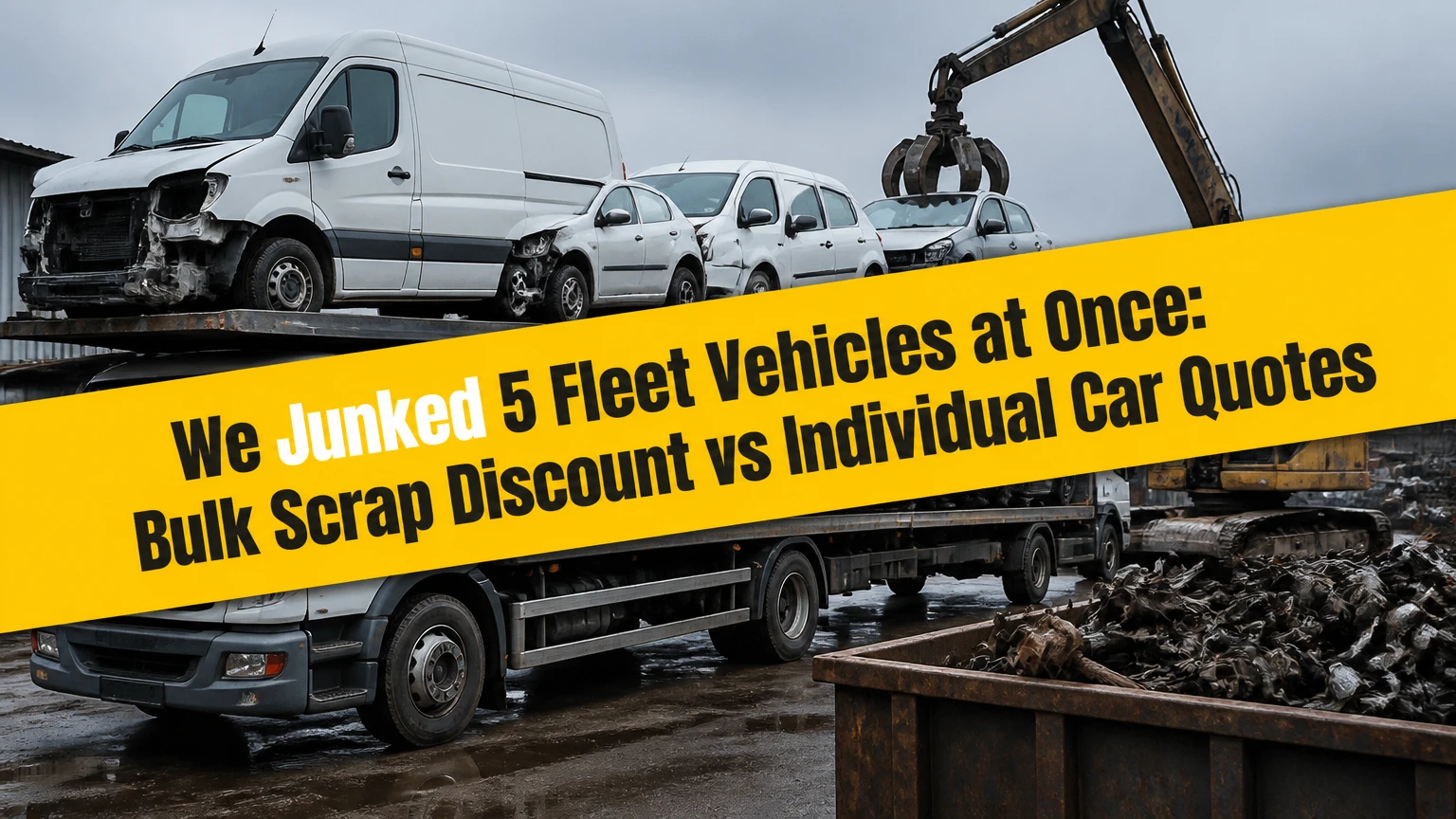
A small contracting company we work with had 5 aging trucks and cargo vans that had all reached end of life within the same 3-month window. Two had failed engines, one had a seized transmission, one had frame rust too severe for repair, and one had thrown a rod at 221,000 miles.
The company owner wanted them all gone quickly. We offered to run the math on two approaches: sell all 5 to a single yard as a bulk deal, or call separate buyers for each vehicle and take the best individual offer on each one.
The bulk deal produced $1,450 total, $290 per vehicle average. Individual selling produced $1,880 total, $376 per vehicle average. The difference was $430. But the individual approach required 14 hours of calls and scheduling coordination versus 2 hours for the bulk deal. Here is every number and the framework for deciding which approach makes sense for your situation.
The 5 Fleet Vehicles and What Each One Was Worth to Different Buyers
Fleet vehicles carry different value profiles than privately owned cars. Most are work trucks or vans with high mileage, commercial use wear, and no premium options. That profile affects which buyers are interested and at what price.
What each vehicle was and what it brought in individual quotes
Vehicle | Year and Mileage | Condition | Best Individual Offer (USD) | Bulk Allocation (USD) | Individual Advantage (USD) |
|---|---|---|---|---|---|
Ford F-150 XL | 2008, 215k miles | Engine failure (rod knock) | $295 | $250 | $45 |
Ford E-350 Cargo Van | 2009, 198k miles | Transmission failure, otherwise intact | $420 | $320 | $100 |
Chevy Silverado 1500 | 2010, 234k miles | Seized engine (overheating failure) | $305 | $255 | $50 |
Ford F-250 Super Duty | 2011, 187k miles | Severe frame rust, non-repairable | $390 | $290 | $100 |
Dodge Ram 1500 | 2008, 221k miles | Rod knock at 221k miles | $470 | $335 | $135 |
TOTAL | $1,880 | $1,450 | $430 |
Why the Dodge Ram produced the largest individual-vs-bulk gap
The Ram 1500 with rod knock at 221,000 miles was the most surprising result. A standard scrap yard pricing it by model and mileage estimated low. But the Ram 1500 of that era, specifically the 5.7L HEMI variant (which this was), has strong private parts demand.
A 5.7L HEMI engine with rod knock is useless as a running engine but valuable as a casting donor and core. Two private buyers and one specialized rebuilder called back after our listing, competing with the yards. The winning buyer, an independent used parts dealer, paid $470 specifically for the HEMI block, heads, and intake as a parts set rather than the whole truck as scrap.
How the Bulk Deal Was Negotiated and What the Yard Actually Offered
We called 4 yards and presented the 5-vehicle fleet as a package. We asked each yard for their best all-in offer for picking up all 5 on the same day, with one check and one title transaction per vehicle.
What the bulk negotiation conversation looked like
The yard that gave the best bulk offer was a regional chain with a dedicated commercial fleet disposal program. Their fleet coordinator quoted $1,450 for all 5 after we emailed the list of vehicles with year, make, model, mileage, and failure type for each one. They offered a single pickup day with 3 trucks.
Their internal justification for the bulk discount: 5 vehicles at once fills their processing capacity for the day without any incremental customer acquisition cost. They do not have to run 5 separate tow jobs, 5 separate quote calls, or 5 separate title submissions. The administrative savings let them offer better pricing per vehicle than a one-off transaction.
Where the bulk offer fell short and why
The bulk yard priced the F-250 at $290 and the Dodge Ram at $335. On individual quotes, both came in significantly higher. The bulk yard’s commercial coordinator did not assess the F-250’s frame rust condition in detail or the Ram’s HEMI variant specifically. She applied average fleet pickup pricing to the whole group.
Individual buyers for those specific vehicles did assess them specifically. The F-250 buyer paid a premium for the intact 6.7L Power Stroke diesel engine despite the frame rust. The Ram buyer paid specifically for the HEMI block. Neither of those specialized assessments would have happened in a 5-vehicle bulk quoting call.
Factor | Bulk Deal (1 Yard) | Individual Sales (5 Separate Buyers) |
|---|---|---|
Total received | $1,450 | $1,880 |
Average per vehicle | $290 | $376 |
Calls and research required | 2 hours (1 yard, 1 negotiation) | 14 hours (5 sets of calls, 5 negotiations) |
Pickup days required | 1 day, 3 trucks | 5 separate pickup windows over 8 days |
Title transfer submissions | 1 per vehicle, all same yard | 1 per vehicle, 5 different yards |
Advantage | $430 less, but 12 fewer hours of effort | $430 more, but 12 additional hours of coordination |
When Bulk Fleet Disposal Makes More Financial Sense Than Individual Sales
The $430 individual advantage is real, but it is not always the right answer. The choice depends on the company’s time constraints, the fleet’s geographical spread, and whether any vehicles in the group have unusual value that specialized buyers would recognize.
The three situations where bulk wins despite the lower payout
First: when the fleet is geographically dispersed across multiple locations and coordinating 5 separate pickups across 5 sites is genuinely costly. Individual buyers pick up one vehicle at a time from wherever it sits. A company managing 5 vehicles at 4 different job sites, each requiring someone to be present for the tow, may spend more in labor coordination than the $430 they would gain from individual sales.
Second: when the company’s administrative cost per vehicle title transfer is significant. Each title transfer requires someone to prepare and sign the title, confirm the buyer’s information, and follow up on the release of liability. At a company that charges internal administrative time at $50 per hour, processing 5 separate title transactions might cost $75 to $100 more than a single-fleet transaction with one yard.
Third: when the fleet is all generic, high-mileage vehicles with no specialized buyer premium. If all 5 vehicles are high-mileage economy cars with common engine failures and no variant-specific demand, the specialized buyer advantage disappears and the bulk pricing gap narrows. The Ram HEMI drove $135 of the $430 gap by itself. Without that specialized vehicle, the gap would have been $295 with the same coordination cost.
The one question that determines which approach to use
Ask this before committing to either approach: ‘Does any vehicle in this fleet have a component that specialized buyers would pay significantly more for than a standard yard?’ A diesel engine in a commercial van, a HEMI in a Ram, a specialized transmission in a work truck, or a catalytic converter from a heavy-duty application can generate $100 to $400 in additional value from a specialized buyer.
If yes: individual sell that vehicle at minimum. The specialized value is worth the extra 3 hours of calls. If no: the bulk deal saves significant coordination time at a modest per-vehicle cost. The math will tell you the threshold.
FAQs: Scrapping Multiple Fleet Vehicles at Once
Q: Do junkyards offer discounts for multiple vehicles picked up at once?
A: Some do, particularly yards with commercial fleet programs. The discount reflects their administrative savings from one coordinated pickup versus multiple separate trips. In our test, the bulk discount averaged $86 per vehicle below the individual best offer. The discount represents the yard’s efficiency gain, not additional value recognition.
Q: Is it always better to sell fleet vehicles individually?
A: Financially yes, if your fleet contains any vehicle with specialized component demand. In our test, individual selling returned $430 more on 5 vehicles. The break-even depends on whether the coordination time cost equals or exceeds the individual premium. At $430 over 12 extra hours, the individual approach generated $35.83 per hour of additional effort.
Q: How do I identify which fleet vehicles have specialized buyer value?
A: Check eBay completed listings for the specific engine variant, transmission, or other major component in each vehicle. A Ford E-350 with an undamaged 7.3L Power Stroke sells for more than one with a common 5.4L V8. A Ram 1500 with a 5.7L HEMI commands more than one with the 3.7L V6. The variant drives the specialized buyer interest.
Q: Do yards require anything different for fleet vehicle title transfers?
A: The title requirements are the same as individual transactions: original title signed over to the buyer, matching ID from the authorized representative. For corporate-owned fleet vehicles, the title may be in the company’s name and the signer must be an authorized representative. Bring a letter of authorization if the person signing the title is not listed as the owner on the face.
Q: Can we negotiate a fleet premium for bringing multiple vehicles to the same yard?
A: The negotiation lever in a bulk deal is your logistical value to the yard, not the vehicles’ scrap value. Frame the conversation as: ‘We have 5 vehicles ready for pickup at the same address on the same day. One truck can collect all of them. What is your best offer for that efficiency?’ Yards that have dealt with fleet disposal understand this value and price it.
Bottom Line
Individual selling beats bulk pricing by $430 on a 5-vehicle fleet in our test, but requires 12 more hours of calls and coordination. The right choice depends on whether any vehicle in the fleet contains a specialized component, what the company’s administrative time is worth, and whether geographical dispersion makes coordinated individual pickups impractical.
The specialized vehicle is the key variable: the Dodge Ram’s HEMI variant drove $135 of the $430 gap by itself. Before committing to a bulk deal, check eBay completed listings for the major component in each vehicle. Any vehicle where the specialized buyer premium exceeds $100 is worth a separate call regardless of how the rest of the fleet is sold.