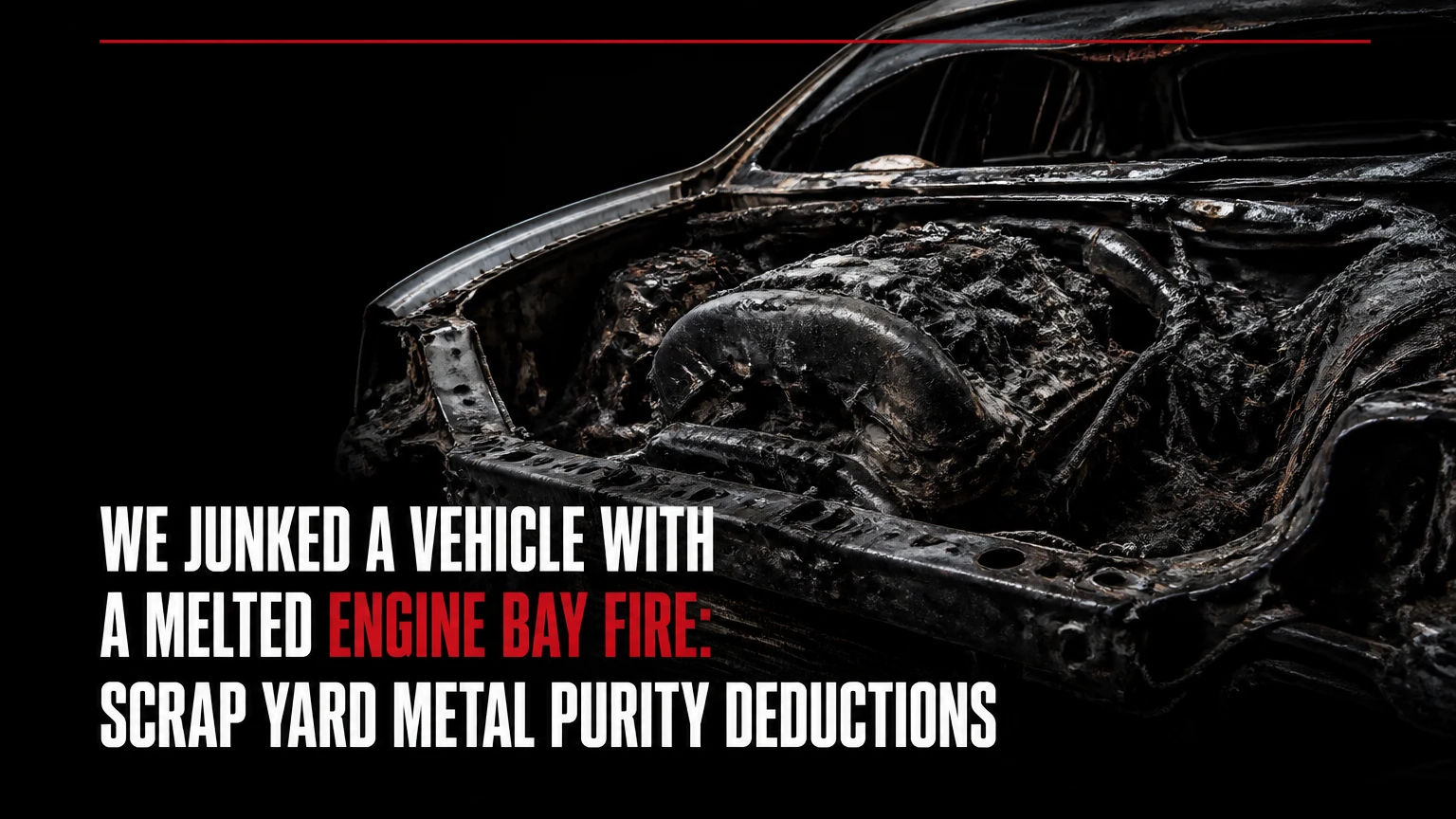
Our 2015 Toyota Camry XSE had an electrical fire that started in the fuse box area and burned for approximately 4 minutes before we extinguished it. The fire melted the entire main wiring harness in the engine bay, the air intake assembly, the plastic engine cover, the hood liner insulation, and the underside of the hood paint. The engine block survived with heat discoloration.
The cabin and fuel system were unaffected. Two of 5 yards we contacted refused the vehicle. Three quoted between $215 and $285. The non-fire offer on the same Camry in similar mechanical condition would have been approximately $380. The fire cost us $95 to $165 in payout depending on which yard we compared against, plus a hazmat handling note from one yard that added a 3-day delay.
What an Engine Bay Fire Does to the Vehicle’s Scrap Value and Yard Eligibility
How burned plastic and rubber contaminate the scrap steel stream
A scrap yard’s business model requires delivering steel to a processor at or above a minimum purity grade. Fire damage introduces 3 contamination categories that yards actively avoid: melted thermoplastic (ABS, nylon, polyethylene) fuses to steel surfaces and cannot be separated during the shredding process; burned rubber from wiring insulation leaves carbon deposits and sulfur compounds in the steel load; and partially combusted aluminum components (intake manifolds, bracket hardware) mix with ferrous steel in a way that contaminates both the aluminum and ferrous scrap streams.
One yard rep explained their internal calculation: when they purchase a fire-damaged vehicle, they estimate the percentage of the total vehicle mass that is contaminated material. A contamination estimate above 8% triggers a quality surcharge with their processor. Our Camry’s engine bay fire, which burned through approximately 12 to 15 lbs of plastic and rubber out of the car’s total 3,200-lb mass (roughly 0.5%), was below their 8% threshold. They quoted $250 with a $75 deduction from the clean baseline.
What the 2 yards that refused were concerned about
Yard 1 refused because their lot insurance policy specifically excludes intake of vehicles with active fire-related odor or visible combustion residue. The yard manager confirmed by phone that the exclusion was added after a processing incident involving a partially burned car that reignited in their lot due to residual heat in the catalytic converter. Our car had sat 4 days since the fire and showed no heat. The manager declined anyway, citing policy.
Yard 2 refused because they lacked hazmat handling certification. Some states require that yards receiving fire-damaged vehicles document the vehicle’s fire history and route contaminated materials through certified disposal channels. This yard’s insurance and operational license did not include that certification. They referred us to 2 yards that held the appropriate certification.
How 3 Yards Priced the Fire Damage: Their Assessment Methods and Offers
Buyer | Offered (USD) | Deduction vs Clean Camry ($380) | Primary Deduction Reason |
|---|---|---|---|
Yard A (certified hazmat yard) | $215 | -$165 | Full engine bay contamination assessed at 12 lbs melted material; high deduction for processor surcharge risk |
Yard B (standard scrap yard) | $250 | -$130 | Estimated 0.5% contamination by mass; deduction for reduced steel grade on engine bay components |
Yard C (pick-and-pull yard) | $285 | -$95 | Values body, interior, and undamaged components; engine bay deducted but body parts unaffected |
Why the pick-and-pull yard offered the most on a fire-damaged car
Pick-and-pull yards earn revenue from customers who pull parts themselves. An engine bay fire destroys everything above and around the engine: wiring, intake, covers, and the hood liner. It does not destroy the doors, the interior, the rear exterior panels, the headlights, the tail lights, the suspension, the catalytic converters, or the wheels. The pick-and-pull yard valued our Camry by everything the fire did not touch. Their $285 offer reflected those intact components. The fire-destroyed components were a zero in their calculation, not a negative, because they were already pricing the car without them.
How we confirmed the engine was structurally sound before calling
Before calling any yard, we had a mechanic perform a quick inspection focused on the engine block: no cracks visible at the block seams, all cylinder head bolts torqued normally when manually checked, no coolant in the oil (dipstick clean), block core temperature had fully normalized after 4 days. We provided this inspection note to every yard that asked. Yard B confirmed the note improved their internal estimate by approximately $20 because a structurally sound engine block (even non-running) retains some parts value to a rebuilder even after an engine bay fire.
The Metal Purity Deductions Applied to Each Component Category
Component Category | Value Before Fire (USD) | Value After Engine Bay Fire (USD) | Deduction Reason |
|---|---|---|---|
Main wiring harness | $150 to $280 (parts resale) | $0 | Completely melted, no resale or scrap value |
Air intake and throttle body | $85 to $140 | $0 | Melted ABS housing, unsalvageable |
Engine block and heads | $400 to $800 (running) / $80 to $150 (scrap core) | $60 to $110 (scrap core only) | Heat discoloration reduces parts value; block likely sound but untestable |
Hood (paint blistered underside) | $90 to $150 (used parts) | $0 to $25 (scrap steel only) | Paint damage from heat; no cosmetic resale value |
Ferrous steel (frame, body panels) | Standard rate $0.085/lb | $0.075/lb (reduced grade) | Possible contamination from adjacent burned material |
Interior, doors, rear panels | $200 to $400 (unaffected) | $200 to $400 (unchanged) | Fire did not reach cabin; value intact |
How to document an engine bay fire for buyers before calling
Photograph the fire damage from 4 angles showing the full extent of the burn zone before calling any yard. Include a photo of the engine oil dipstick showing clean oil (no combustion mixing), a photo of the cabin confirming no interior damage, and a photo of the fuel system area (fuel rail and fuel cap) confirming no fire proximity. Send all photos with the initial inquiry. Yards that receive complete documentation before quoting provide more accurate offers and are less likely to revise on arrival.
FAQs: Junking a Car With an Engine Bay Fire
Q: Will any junkyard accept a car with engine bay fire damage?
A: Most will, with conditions. Of 5 yards we contacted, 3 accepted the car. The 2 that refused cited insurance policy exclusions on fire-damaged vehicles and lack of hazmat handling certification. Search specifically for yards with hazmat handling capability if standard yards in your area decline.
Q: How much does an engine bay fire reduce the scrap payout?
A: In our test: $95 to $165 reduction on a 2015 Camry where the clean baseline was approximately $380. The reduction correlates with how much of the vehicle the fire affected. A fire confined to the wiring harness area with an intact engine, interior, and body reduces the offer less than a fire that reached the engine block or fuel system.
Q: Why did the pick-and-pull yard offer more than the scrap yards?
A: Pick-and-pull yards price cars on the components customers will pull, not on total vehicle condition. An engine bay fire destroys the under-hood components but leaves the doors, interior, lights, suspension, and exterior panels completely intact. The pick-and-pull yard’s offer reflected all the undamaged components, making fire-specific deductions smaller than at a scrap-weight-based yard.
Q: Does an engine bay fire create a hazmat situation for the junkyard?
A: In some states yes. Burned wiring harnesses contain lead-coated copper and flame-retardant compounds that require certified disposal. Some yards hold hazmat handling certification that allows them to accept fire-damaged vehicles. Yards without that certification may decline regardless of the fire’s severity.
Q: Can I sell parts from the car before junking it after an engine bay fire?
A: Yes, from any unaffected area. The doors, interior trim, seats, headlights, tail lights, wheels, suspension components, and rear exterior panels are typically unaffected by a contained engine bay fire. These parts are sellable through the same channels as any part-out. The engine bay components themselves are usually unsellable and go to the crusher.
Q: How long should I wait after an engine bay fire before contacting a junkyard?
A: Allow at least 72 hours for all residual heat to fully dissipate, particularly in the catalytic converter area and the engine block. One yard we contacted had an incident where a recently fire-damaged car reignited in their lot due to heat retained in the catalytic converter. Waiting 4 to 7 days eliminates that risk and gives you time to complete a proper photo documentation of the damage extent.
Bottom Line
An engine bay fire reduces a junk car’s payout by $95 to $165 on a typical mid-size sedan, driven primarily by the loss of wiring harness and intake parts value, reduced steel grade due to plastic contamination, and the hazmat handling cost some yards factor into their intake price. The best offer on a fire-damaged car typically comes from a pick-and-pull yard that prices the intact body, interior, and exterior components rather than focusing on the fire-damaged engine bay.
Document the fire’s extent in photos before calling any yard: show what burned, show what survived, and include an oil dipstick check and a cabin confirmation. Yards that receive full documentation quote more accurately and revise less on arrival. Allow at least 72 hours after the fire before scheduling any pickup to eliminate residual heat risk in the catalytic converter.