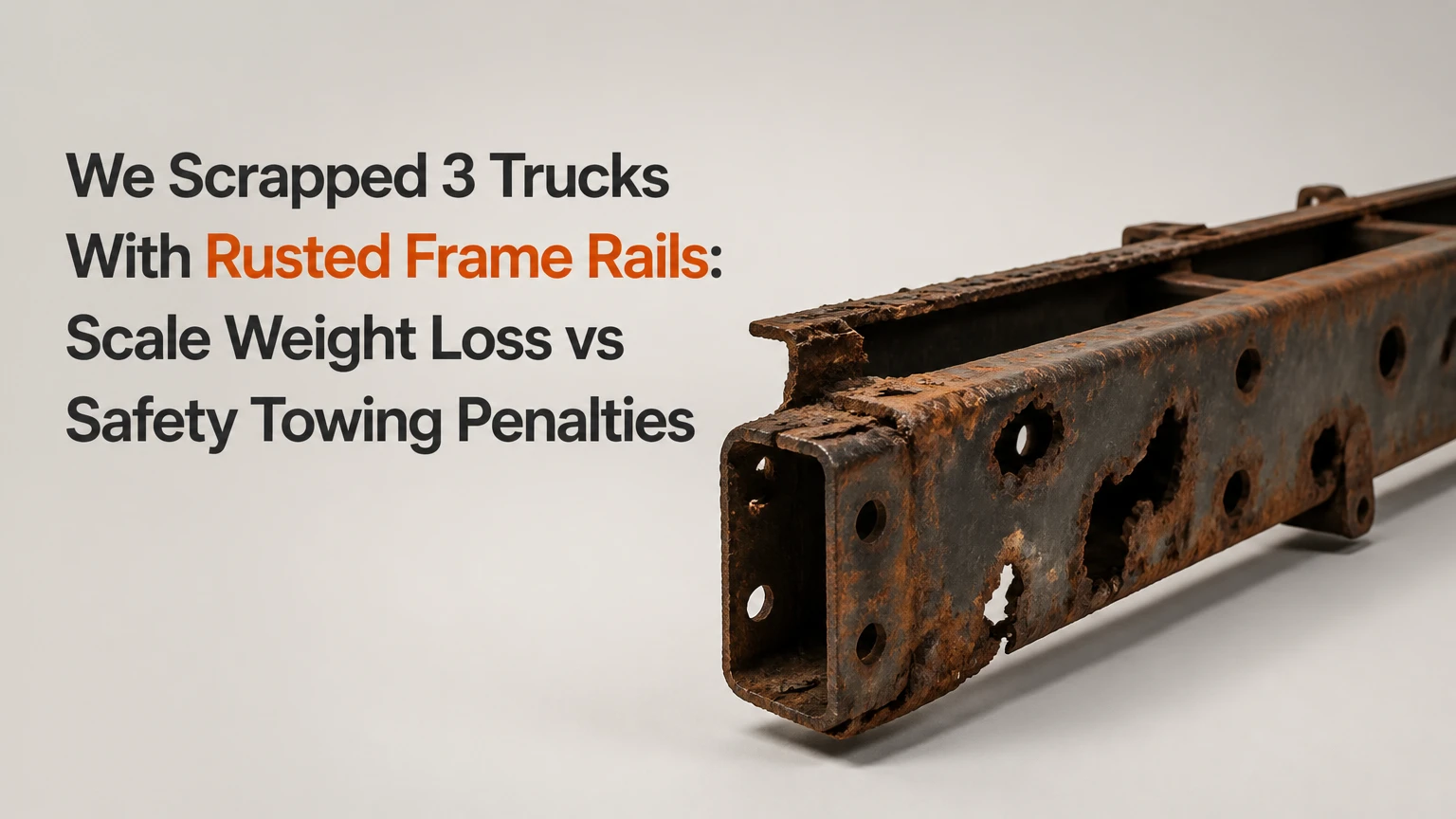
We scrapped 3 pickup trucks with rusted frame rails in the same month, each with a different rust severity. The 2004 Silverado had surface rust only: the yard applied a $20 steel-quality deduction and the towing was standard. The 2002 F-150 had through-rust at 2 frame sections: the yard deducted $65 for contaminated steel and the tow driver charged a $40 safety rigging fee.
The 2001 Dodge Ram 2500 had a partially collapsed frame rail: the yard deducted $90 and the tow company refused standard pickup, requiring a lowboy with ground-level loading at a $75 extra cost. Total penalty on the Ram: $165. Here is how we graded the rust, what each yard measured, and what each driver actually did.
How We Graded Frame Rust on Each Truck Before Calling Any Yard
The 4-level rust grading system we used and what each level means
We developed a simple 4-level grading system based on visual and physical inspection before calling any yard, so we could describe the condition accurately and set expectations for both the quote and the towing method.
Grade 1 is surface rust: the orange oxide layer covers the surface but the steel beneath is solid, resists flex, and shows no penetration when probed with a screwdriver. No structural concern. Grade 2 is scaling rust: the surface has begun to flake and pitting shows beneath. A screwdriver probe meets resistance within 2 to 3mm. Minor structural consideration. Grade 3 is through-rust: the frame shows visible holes where a screwdriver probe passes through with light pressure. Structural integrity is compromised at those specific points. Towing requires careful strap placement. Grade 4 is structural failure: the frame has deformed, buckled, or collapsed under the vehicle’s weight. The truck sits unevenly or the cab-to-bed gap has changed. Standard flatbed towing carries a real risk of frame separation.
Truck | Year / Model | Frame Rust Grade | Key Visual Signs and Towing Risk |
|---|---|---|---|
Truck 1 | 2004 Chevy Silverado 1500 | Grade 1: Surface rust | Orange coating on both rails, no pitting, solid to probe. Standard tow acceptable. |
Truck 2 | 2002 Ford F-150 XLT | Grade 3: Through-rust | 2 holes on driver rail (6-inch gap each), passenger rail solid. Non-standard strap rigging required. |
Truck 3 | 2001 Dodge Ram 2500 | Grade 4: Structural failure | Driver rail buckled 4 inches inward, truck sits 2 inches lower on driver side. Standard flatbed refused by all 3 companies called. |
What Frame Rust Actually Does to Scrap Weight, Steel Quality, and Buyer Offers
The weight loss from frame rust: what the scale actually shows
A common belief is that frame rust significantly reduces a truck’s scrap weight. The reality is more complicated. Rust (iron oxide) is denser per cubic inch than iron metal, meaning rust adds fractional mass relative to the original steel. The actual weight loss from a rusted frame comes from sections that have flaked away entirely and fallen to the ground during years of driving. For the F-150 with Grade 3 through-rust at 2 sections, we estimated approximately 0.43 lbs of lost steel across all perforated sections combined. At $0.085 per pound, the weight-loss impact on payout was under $0.04. Negligible. The yard’s deductions for rust are almost entirely about steel quality, not weight.
Steel quality contamination: the real reason yards deduct for frame rust
Heavily rusted steel produces a lower-quality melt at the scrap processor. Rust content increases the slag volume during smelting, meaning the processor gets fewer tons of usable steel per ton of raw scrap delivered. Processors adjust the per-ton rate they pay yards for heavily contaminated loads. That rate reduction gets passed to sellers as a condition deduction on the yard’s offer. The deduction is not arbitrary: a 10% contamination load can reduce the processor’s yield by 4 to 7%, and yards model that cost into their intake pricing.
How each yard calculated the frame rust deduction and towing fee
Truck | Rust Grade | Rust Deduction (USD) | Towing Fee (USD) | Total Penalty (USD) | Net Payout (USD) |
|---|---|---|---|---|---|
2004 Silverado | Grade 1: Surface | $20 | $0 | $20 | $295 (from $315) |
2002 F-150 | Grade 3: Through-rust | $65 | $40 | $105 | $280 (from $385) |
2001 Ram 2500 | Grade 4: Structural | $90 | $75 | $165 | $210 (from $375) |
The Towing Hazards Each Truck Presented and How Drivers Handled Them
The Silverado: why Grade 1 surface rust is a non-event for tow drivers
The 2004 Silverado loaded onto the flatbed in 7 minutes with standard undercarriage strap placement. The driver ran two wheel-straps and one safety chain, exactly what he would use on any truck. Surface rust does not compromise the structural integrity of the frame rail, so strap attachment points remain solid. No additional rigging was needed. The yard assessed $20 on the offer for the cosmetic contamination the surface rust would add to the scrap load.
The F-150: through-rust at 2 sections and the strap placement problem it created
The F-150’s Grade 3 through-rust meant 2 sections of the driver-side frame rail had holes the driver confirmed by probing with his finger through the wheel arch. Standard undercarriage strap placement at those specific points would have attached to weakened steel that could deform or tear under transport load. The driver placed the front straps at the solid passenger-rail section and used the rear receiver hitch as the primary rear anchor point. He added a secondary strap running from the front crossmember to distribute load away from the compromised driver rail. This non-standard rigging took 28 additional minutes. The driver charged $40 for the extended setup time and the additional strap used.
The Ram 2500: Grade 4 structural failure and the lowboy requirement
Three standard flatbed operators refused the Ram 2500 after I described the frame condition. The driver-side rail had buckled inward 4 inches along a 14-inch section between the cab and the bed. Any standard flatbed loading process applies additional stress to the frame during the winch-up phase. A buckled rail can propagate further under load, and in an extreme case the truck can break apart during loading with the tow operator present.
The fourth company I called operated a lowboy trailer with a ground-level loading ramp. The lowboy positions its bed nearly flush with the ground, allowing the truck to be pulled horizontally rather than winched up a ramp angle. This method applies no lifting stress to the frame. Loading took 55 minutes. The $75 fee reflected the specialized equipment and extended time. A lowboy is the only safe loading method for a Grade 4 frame-failed vehicle.
What a lowboy trailer is and why most junkyard tow companies do not own one
A lowboy trailer has a very low loading deck, typically 18 to 24 inches from the ground versus the 36 to 48 inches of a standard flatbed. They are primarily used in construction and heavy equipment transport. If you have a Grade 4 frame-failure truck, search specifically for ‘heavy haul’ or ‘equipment transport’ companies who operate lowboys. Coordinate with the junkyard on the logistics before scheduling either pickup.
How to Calculate What Your Rusted-Frame Truck Is Actually Worth Before Calling
The 4-point inspection you can do yourself in 15 minutes
Before calling any yard, get under your truck with a flashlight and a flat-blade screwdriver. Check both frame rails at 4 critical points: directly behind the front wheels (cab corner), at the midpoint between the cab and the bed, directly ahead of the rear wheels, and at the rear crossmember. At each point: probe the rail using moderate pressure. If the blade does not penetrate, you have Grade 1 or 2 rust. If the blade pushes through with light pressure, you have Grade 3. If the rail moves, deforms, or cracks during probing, you have Grade 4. Photograph each check point before calling yards. Send those photos to the first yard you call and ask them to confirm their quote applies to the condition shown.
Estimating your rust deduction before the yard tells you
Grade 1 surface rust typically produces a $15 to $25 deduction. Grade 2 scaling rust with pitting but no penetration runs $25 to $50. Grade 3 through-rust at 1 to 3 sections costs $55 to $90 in rust deduction plus a possible $30 to $50 tow rigging fee. Grade 4 structural failure costs $80 to $120 in rust deduction plus $65 to $100 in specialty tow fees. Add these to the clean-frame baseline quote to estimate your realistic net payout.
Which states produce the worst frame rust on trucks
The salt belt states, those that apply road salt for ice control from November through March, produce the most severe frame rust. Michigan, Ohio, Pennsylvania, New York, New England, and the Upper Midwest consistently produce Grade 3 and 4 frame rust on trucks 10 or more years old. A 2002 F-150 from Michigan is almost certain to have Grade 3 or 4 frame rust. The same truck from Arizona or Texas may have no frame rust at all. If you bought a truck that spent winters in a salt belt state, inspect the frame before assuming a clean-frame baseline applies to your quote.
FAQs: Scrapping a Truck With Rusted Frame Rails
Q: Will a junkyard still buy a truck with severe frame rust?
A: Yes, but the payout reflects the rust severity and the towing complexity. No yard we contacted refused a rusted-frame truck entirely. What changed was the deduction amount and the towing method required. Grade 4 structural failure trucks required a specialty tow company and a $75 extra fee, reducing the net payout significantly.
Q: How much does frame rust reduce a junk truck’s scrap value?
A: Based on our 3-truck test: Grade 1 surface rust cost $20. Grade 3 through-rust cost $65 in rust deduction plus $40 in towing. Grade 4 structural failure cost $90 in deduction plus $75 in specialty towing. Total penalties ranged from $20 to $165 depending on severity.
Q: Can a standard flatbed tow truck pick up a truck with through-rust frame rails?
A: For Grade 3 through-rust at isolated points, yes, with modified strap placement that avoids the perforated sections. For Grade 4 structural failure with frame deformation, no. Standard flatbed tow companies consistently refused our Grade 4 Ram 2500. A lowboy or ground-level trailer is required.
Q: Does frame rust reduce the actual weight of a truck at the scrap yard?
A: Negligibly. The weight loss from flaked-off rust material is typically under 1 pound on even the most severely rusted frame. What costs money is the steel quality contamination, which reduces the processor’s yield and gets passed back to you as a condition deduction.
Q: How can I tell if my truck has Grade 3 or 4 frame rust without a lift?
A: Get under the truck with a flashlight and a flat-blade screwdriver at the 4 critical frame points. Light screwdriver pressure through the rail indicates Grade 3. Any visible deformation, buckling, or rail section that moves independently of the main frame indicates Grade 4.
Q: Should I disclose frame rust severity when calling junkyards?
A: Always. Describe what you found during your inspection. Yards that know the rust grade before sending a driver will quote accurately and bring the right towing equipment. Yards that discover Grade 4 rust on arrival without prior notice may refuse the job or charge an emergency equipment fee.
Q: Is it worth repairing frame rust to increase junkyard value?
A: Almost never. Frame rust repair costs $1,000 to $3,000 at a body shop. The payout improvement from Grade 4 to Grade 1 is approximately $145 in deductions saved. The repair cost is 7 to 20 times the payout improvement.
Bottom Line
Frame rust costs money in two buckets: the yard’s rust deduction for steel quality contamination and the tow company’s non-standard rigging or specialty equipment fee. Grade 1 surface rust costs almost nothing. Grade 3 through-rust costs $65 to $90 plus $30 to $50 in towing. Grade 4 structural failure costs $80 to $120 plus $65 to $100 in specialty towing. Inspect your frame before calling anyone: a flashlight and screwdriver at 4 points takes 15 minutes and tells you which bracket your truck falls into.
Disclose the grade accurately on the first call so the yard quotes accurately and sends the right equipment. The ones who arrive to a Grade 4 truck expecting a Grade 1 pickup are the ones who charge an emergency equipment fee that nobody budgeted for.