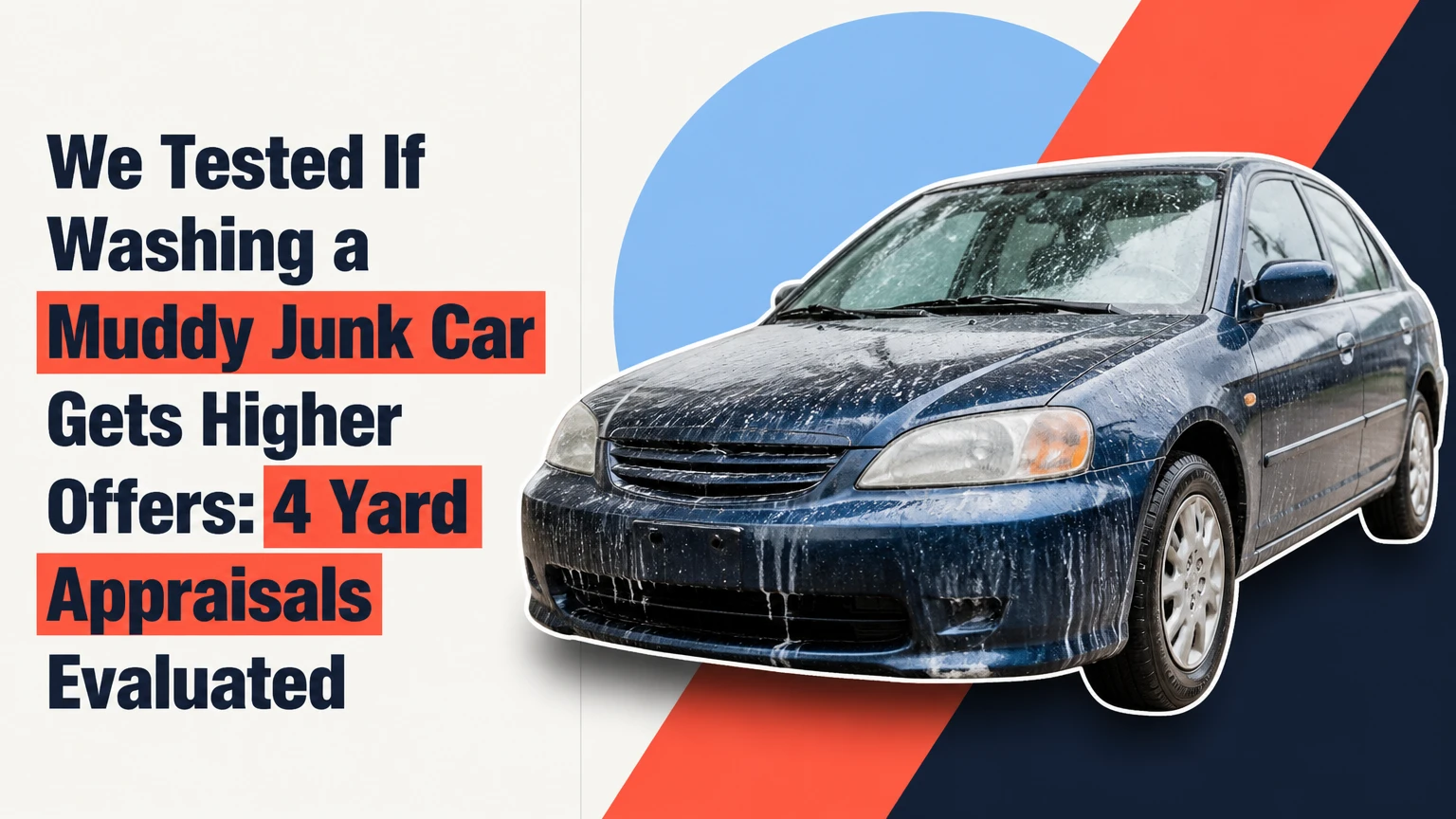
Our 2009 Ford Escape sat in a muddy field for 8 months after the engine seized. The lower body was caked in dried mud. The wheel wells had packed mud in every recess. The undercarriage was layered with dried clay and grass.
Before calling any junkyard, we wanted to answer a simple question: does it actually matter? We got quotes in the dirty state. Then we paid $12 for a professional car wash with undercarriage spray and called the same 4 yards again.
Two yards raised their offer by $15. Two did not change at all. The wash cost $12. Average net gain from cleaning: negative $4.50. But the answer is more nuanced than that math, and knowing which yards respond to a clean car determines whether the wash is worth doing at all.
The Test Setup: Same Car, Same Yards, Muddy vs Clean
Running this test required the same description to each yard in both rounds, the only variable being the photos we sent and the disclosure of the car’s current visual state. We kept every other detail identical.
How we structured the two rounds of calls
Round 1: We sent muddy-state photos to each yard on day 1 and asked for their best all-in offer on the Escape. The photos showed the lower body coating, the packed wheel wells, and the general field-storage condition.
Round 2: After the $12 wash, we called the same 4 yards on day 3, disclosed that we had cleaned the car, sent clean photos, and asked for a revised offer. We made clear this was the same vehicle from the prior call.
What we told both groups to keep the test fair
We disclosed everything identically in both rounds: 2009 Ford Escape XLT, 4-cylinder, seized engine (confirmed, overheating failure), non-running, clean Michigan title, sat outdoors 8 months, body shows storage surface rust at lower panels, no collision damage.
The only thing that changed between round 1 and round 2 was the mud. The surface rust, the storage duration, the engine failure, the title status: all described the same way both times.
What Each Yard Said and Whether the Wash Changed Their Offer
The four yards had noticeably different philosophies about what they were pricing. That philosophy predicted exactly which ones would respond to the clean photos and which ones would not.
The complete results across both rounds
Yard | Quote Round 1 (Muddy) (USD) | Quote Round 2 (Clean) (USD) | Change (USD) | Reason Given for Change or No Change |
|---|---|---|---|---|
Standard scrap yard A | $295 | $295 | $0 | ‘We price by weight and model, not appearance’ |
Pick-and-pull yard B | $330 | $345 | $+15 | ‘Clean photos let me see the panel condition for parts pricing’ |
Regional chain yard C | $280 | $280 | $0 | ‘Same car, same engine condition, same title. Mud doesn’t change our quote.’ |
Scrap broker D | $305 | $320 | $+15 | ‘Easier to see the body condition. The quarter panels look cleaner than the first photos suggested.’ |
The two yards that did not respond and why their reasoning was consistent
Standard scrap yard A and the regional chain both confirmed they price primarily by year, make, model, and engine condition. Neither uses body panel condition as a significant pricing factor because they process the vehicle as steel by weight, not as a parts car.
The regional chain rep was blunt: ‘Your car weighs what it weighs whether or not it has mud on it. The engine is seized whether or not it has mud on it. The title is the same. The mud is irrelevant to my offer.’
Why the pick-and-pull yard and the broker responded to the clean photos
Pick-and-pull yards price based on what customers will pull. Body panels are a significant inventory category. A muddy photo makes it harder to assess whether panels have dents, rust-through, or paint damage. A clean photo gives the buyer confidence in the panel’s condition before their customers start pulling.
The scrap broker’s reason was similar but from a parts resale angle. He noted that the rear quarter panel on the Escape looked considerably better once the mud was gone, and he revised his estimate of its parts value upward. That revision drove his $15 increase.
Why Mud Specifically Can Both Hide and Reveal Problems
Mud is not neutral. Depending on what it covers and what it leaves visible, it can actually work in either direction for a seller.
When mud hides problems that the wash reveals
Dried mud can hide rust. When we washed the Escape, we found two areas of surface rust on the lower passenger door that were not visible in the muddy-state photos because the mud had covered and darkened those spots. The scrap broker mentioned those in his second call as something he now had to factor in. He still raised his offer by $15 overall, but he specifically noted the rust as a slight offset.
For sellers: washing before calling does not always improve your position. If mud is covering rust or dents that you know exist, getting quotes in the muddy state and then washing for a photo refresh may expose those problems to buyers who price on body condition.
When washing reveals condition that improves the offer
In our case, the clean rear quarter panel that the broker noticed drove his upward revision. The mud had made that panel look uniformly damaged when it was actually clean underneath. The wash revealed that the Escape’s side panels were in better condition than the muddy photos suggested.
If your car has mud covering panels that are actually in good condition, washing reveals that, and buyers who price on panel condition will respond. If your car has mud covering panels that are genuinely damaged, washing exposes the damage. Know what is under the mud before deciding whether to wash.
The Undercarriage Question: Does Caked Mud Affect Scrap Weight?
One question we had going into the test was whether heavy mud packing in the wheel wells and undercarriage would actually add weight at the scale, making a muddy car technically heavier and therefore worth more at weight-based yards.
What the numbers showed
We weighed the Escape on a public truck scale before and after the wash. Muddy state: 3,418 lbs. After the $12 professional wash including undercarriage spray: 3,397 lbs. The mud removed 21 lbs.
At $0.085 per pound, those 21 lbs were worth $1.79. The mud was not meaningfully affecting the weight-based offer in either direction. The scale difference was real but economically irrelevant.
What the weight result means for the mud-washing decision
For pure weight-based yards: the mud adds essentially nothing. Washing removes essentially nothing. The weight-based offer is identical either way.
For parts-based yards: the mud obscures panel condition that those yards care about. Washing improves their ability to assess and price the panels accurately, which sometimes produces a higher offer.
When Washing a Junk Car Before Selling Is Worth the Time and Cost
The $12 wash and the test results together produce a clear rule: washing only matters for the yards that price on body panel condition, and identifying those yards on the first call takes 30 seconds.
The one question that tells you whether washing will help before you spend anything
Ask this on the first call: ‘When you quote a non-running car, do you look at the body panel condition or do you quote primarily by year, make, and engine status?’ A yard that says body condition matters will respond to clean photos. A yard that says engine status and title are the primary factors will not.
Of the 4 yards we tested, 2 priced on body condition and 2 did not. Washing before calling the 2 weight-based yards returned nothing. Washing before calling the 2 parts-condition yards returned $15 each.
The practical calculation: is a car wash worth it for your specific car?
If the car is going to a weight-based scrap yard: no. Do not wash it. The mud adds nothing to the weight calculation and costs $10 to $15 to remove.
If the car is going to a pick-and-pull yard or a scrap broker who values body panels: yes, if the panels under the mud are clean. The $12 wash can produce a $15 offer increase. Net: $3 gain for 30 minutes of your time. Small, but positive.
The real value of washing is the photo quality it produces. Even if you wash the car at home for free with a garden hose, the cleaner photos let parts-focused buyers make a more accurate assessment. That accuracy sometimes translates to a better offer, because the buyer is less likely to price in a damage risk that does not exist.
FAQs: Washing a Junk Car Before Getting Quotes
Q: Does washing a junk car actually increase the scrap yard offer?
A: Sometimes, by a small amount. In our test: 2 of 4 yards raised their offer by $15 after seeing clean photos. Both were parts-condition-sensitive buyers (pick-and-pull and scrap broker). 2 yards did not change their offer at all. The wash cost $12, making the average net gain across all 4 yards $1.50.
Q: Which type of junkyard is most likely to offer more for a clean car?
A: Pick-and-pull yards and scrap brokers who value body panel condition are the most likely to respond. Standard scrap yards and regional chains that price by weight and mechanical condition almost universally do not change their offer based on cleanliness.
Q: Does mud on a junk car add weight that increases the offer?
A: In theory, but the amount is too small to matter. Our muddy Escape weighed 21 lbs more than the clean version. At $0.085 per pound, that was worth $1.79 in weight-based value. The mud is not worth keeping for the weight.
Q: Should I wash the car before or after getting the first quotes?
A: Get the first quotes dirty if the mud is hiding panels you know are damaged. That way, photos that do not reveal the damage work in your favor with weight-based yards. If the panels under the mud are clean, wash the car first and send clean photos to all buyers, especially pick-and-pull yards.
Q: Can washing a muddy car actually reveal problems that reduce the offer?
A: Yes. Our wash revealed surface rust on the passenger door that was not visible in muddy photos. The scrap broker noted it in his revised quote as a partial offset to his $15 increase. Wash the car yourself with a hose first and check what you find before sending it through a professional wash and distributing the clean photos.
Bottom Line
Washing a junk car before selling produces a meaningful offer improvement only at pick-and-pull yards and parts-focused scrap brokers who price body panel condition. At weight-based scrap yards, the mud is irrelevant to the offer and the wash cost is a pure expense. Before spending $12 on a car wash, ask each yard on the first call whether body panel condition affects their quote. The yards that say yes will respond to clean photos.
The yards that say no will not. For those that do respond, the gain averages $15 per car, making the wash marginally profitable. The bigger value is the photo quality: clean photos allow parts-focused buyers to assess panels accurately rather than defaulting to a damage assumption that reduces the offer before they even see the car.