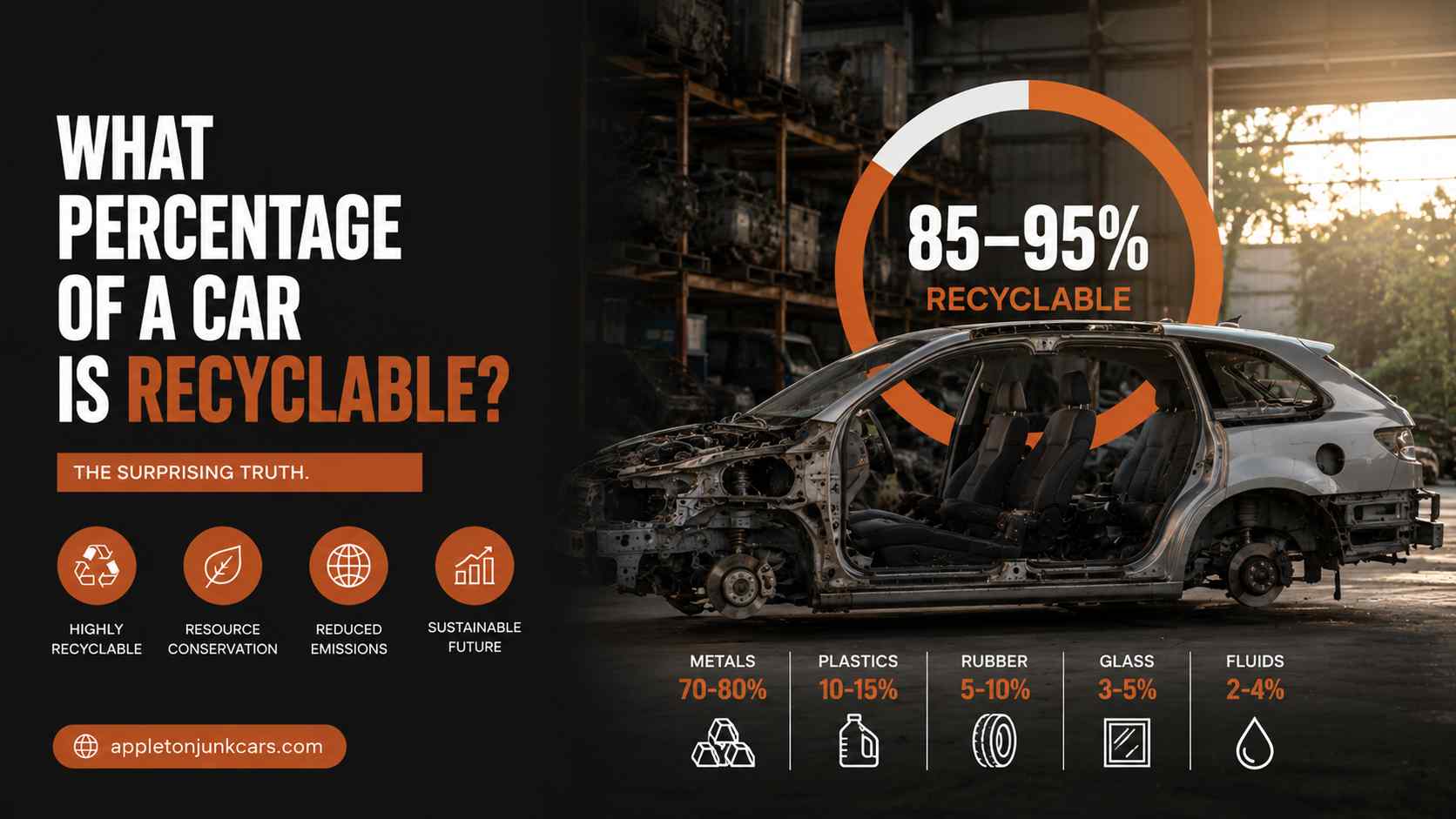
Approximately 80 to 85 percent of a car by weight is recyclable, making the automobile one of the most recycled consumer products in the world. The remaining 15 to 20 percent, the materials that cannot currently be recovered at scale, ends up as automotive shredder residue, a mixed stream of plastics, foam, glass, and rubber that most markets still send to landfill. Understanding what falls into each category helps you understand what happens when a scrap car leaves a driveway and enters the recycling process.
How Recyclability Is Measured and Why the Number Varies
The 80 to 85 percent figure applies broadly in North America. In Europe, the End-of-Life Vehicles Directive sets a more demanding target: 95 percent of a vehicle’s weight must be recovered by 2015 onward, with at least 85 percent through actual material recycling and the remaining 10 percent through energy recovery, meaning burning materials for fuel rather than landfilling them. European automotive recyclers and car scrapyards operate under this regulatory framework, which has pushed the industry toward more sophisticated fluid and plastic recovery than is standard in North American operations.
In California, the state’s stricter environmental regulations have driven higher de-pollution and fluid recovery standards than the federal minimum. California law requires licensed dismantlers to drain all hazardous fluids, capture refrigerants, and safely remove batteries and airbags before a vehicle enters the shredder. This reduces contamination in the output materials and improves downstream recycling quality, even if California’s headline recyclability percentage is similar to the national average.
The percentage also varies by vehicle type and age. Modern vehicles contain more aluminum, high-strength steel, carbon fiber, and engineering plastics than vehicles from decades ago. Some of these materials are easier to recycle than older alternatives. Others, particularly certain composites and mixed-material assemblies, are harder to separate and recover at the end of life.
What Your Car Is Actually Made Of: The Materials Breakdown
Before understanding what can be recycled, it helps to understand what a vehicle is composed of. The automotive industry has shifted the material mix significantly over the past three decades as manufacturers chased weight reduction and fuel economy targets.
Material | Approx. % of Vehicle Weight | Recyclability |
|---|---|---|
Steel and iron | 50 to 55% | Highly recyclable. Separated magnetically at scrapyards. |
Aluminum | 8 to 12% | Highly recyclable. High value per pound. |
Plastic | 8 to 10% | Partially recyclable. Some types recovered; others landfilled. |
Rubber | 4 to 6% | Limited recovery. Tires recycled separately; gaskets go to residue. |
Glass | 3 to 4% | Recyclable but often landfilled due to lamination and contamination. |
Copper and wiring | 1 to 2% | Valuable and fully recyclable. Recovered by automotive recyclers. |
Lead (battery) | 1 to 2% | 99% recycled through battery recycling programs. |
Fluids and hazardous | 2 to 4% | Drained and recovered by licensed dismantlers before shredding. |
Other (foam, fabric, composites) | 8 to 12% | Mostly unrecoverable. Becomes automotive shredder residue. |
Steel, Aluminum, and the Metals That Drive the Recycling Economy
The metals in a vehicle are what make scrap car recycling economically viable. Without the commodity value of steel and aluminum, the cost of processing, transporting, and dismantling a vehicle would exceed the revenue it generates, and the entire automotive recycling industry would collapse.
Steel and iron account for roughly half of a vehicle’s weight and are sorted from other materials at a car scrapyard using powerful magnetic separators. Once the shredded material passes through the magnet, the ferrous fraction is sold to steel mills that melt it down and roll it into new sheet steel. A significant portion of the steel in every new car on the market today began life as a scrapped vehicle.
Aluminum is the high-value fraction in the non-ferrous stream. Automotive recyclers separate aluminum from other non-ferrous materials using eddy current separators, which work by inducing currents in conductive non-ferrous metals and deflecting them from the rest of the stream. Aluminum from wheels, engine components, and body panels commands a strong per-pound price and returns to smelters that produce aluminum sheet for the automotive industry among other applications.
Copper wiring and motor windings represent a smaller weight fraction but a high value per pound. Recovering copper cleanly requires either manual stripping of wiring harnesses at the dismantler stage or downstream processing by specialized recyclers who separate copper from wire insulation mechanically. Automotive recyclers who take the time to harvest wiring harnesses before shredding capture significantly more value than those who send the complete harness to the shredder.
Plastic Parts and Bumpers: The Recycling Challenge Nobody Talks About
Plastic accounts for about 8 to 10 percent of modern vehicle weight, and it represents one of the most complex challenges in automotive recycling. The problem is not that plastic cannot be recycled. The problem is that vehicles use dozens of different plastic formulations, and most of them end up mixed together in the shredder output in a way that makes clean separation extremely difficult.
Bumpers are a specific case worth examining. Most modern bumpers are made from polypropylene, a thermoplastic that is technically recyclable and accepted by many municipal recycling streams when clean and properly sorted. Automotive bumpers, however, are typically painted, may have foam backing, often include metal reinforcement inserts, and arrive at the recycling stream mixed with other plastics from the same vehicle. European markets have developed better infrastructure for recovering and recycling bumper-grade polypropylene, partly driven by ELV Directive targets.
In North America, most bumpers and interior plastic parts end up as automotive shredder residue regardless of their theoretical recyclability, simply because the economics of sorting and cleaning them have not justified the investment at most facilities. This is a documented gap between what could be recycled under ideal conditions and what actually gets recycled at scale.
Manufacturers including the BMW Group have committed to designing vehicles with improved material recyclability built in. BMW’s sustainability targets include increasing the proportion of recycled secondary materials in new vehicles and designing components for easier disassembly and material separation at end of life. These design-for-recycling approaches represent the industry’s answer to the plastic gap, but their effects on real-world recyclability rates are still working through the system as older vehicles reach the end of their lives.
Battery Recycling: The 99 Percent Material and the Emerging Challenge
Lead-acid batteries, the 12-volt units that start nearly every conventional vehicle on the road, are the most successfully recycled consumer product in existence. Battery recycling programs recover approximately 99 percent of lead-acid battery materials including the lead plates, sulfuric acid electrolyte, and polypropylene casing. The infrastructure for this is mature, profitable, and operating at scale. Auto parts stores, car scrapyards, and battery retailers all participate in take-back programs. When you drop off a dead car battery, it is not going to landfill.
Electric vehicle and hybrid battery packs are a different story. Lithium-ion battery packs contain lithium, cobalt, nickel, and manganese, all of which have material value, but the chemistry and construction vary significantly between manufacturers and the recycling process is far more complex than lead-acid recovery. Specialized facilities exist to process these packs, and the economics are improving as EV volumes increase, but the infrastructure is not yet as established as the conventional battery recycling chain.
California has some of the most developed EV battery recycling regulations in North America. State law requires manufacturers to take responsibility for battery pack disposal, and the growing network of certified battery recyclers in California is processing an increasing volume of end-of-life EV packs as the first generation of mass-market electric vehicles reaches the end of their useful battery life.
Why Junkyards Crush Cars and How the Process Works
A common question from people unfamiliar with the automotive recycling industry is why junkyards crush cars. The answer is both practical and economic.
A car scrapyard cannot store intact vehicles indefinitely. They take up enormous space, they contain hazardous fluids that can contaminate soil and groundwater if not properly managed, and an intact vehicle has limited use once its sellable parts have been harvested by a pick and pull operation or professional dismantler. Crushing a vehicle reduces its volume dramatically, making it practical to transport and process at a shredding facility.
How Car Crushers Work
The machine commonly used at a scrapyard is called a baler, a car compactor machine, or simply a car crusher. The industrial car crusher works by hydraulic compression. The vehicle is loaded into a chamber where a hydraulic ram exerts tens of thousands of pounds of force, compressing the vehicle into a dense metal block roughly one quarter of its original volume. This baled cube can be stacked, transported efficiently, and fed directly into a shredder.
Some operations use a flattener press rather than a full baler. The car crusher machine name varies, but a flattener simply compresses the vehicle vertically to a fraction of its original height rather than boxing it into a cube. Both methods serve the same purpose: volume reduction for efficient transport to the downstream shredder.
The shredder itself is an industrial hammermill that reduces the compressed vehicle to fist-sized fragments in a matter of seconds. The shredded output passes through magnetic separators, eddy current separators, and density separation systems that sort the material into ferrous metal, non-ferrous metal, and automotive shredder residue streams. The residue, which constitutes roughly 20 to 25 percent of the shredded material by weight, is the fraction that currently goes to landfill in most markets.
Why Do People Abandon Cars?
Some of the vehicles that ultimately arrive at car scrapyards start as abandoned vehicles rather than voluntary scraps. The reasons people abandon cars rather than selling or properly disposing of them are varied.
The most common situation is a vehicle that has reached a repair cost threshold where it is not worth fixing but also has no title or paperwork that would allow it to be legally sold. Without a title, the car cannot be transferred to a buyer, which leaves the owner with a vehicle they cannot dispose of through normal channels. In jurisdictions where abandoned vehicle pickup and title resolution are accessible, these cars eventually reach the recycling stream. Where those services are limited or complicated, they are left on public property.
Some abandoned vehicles result from failed inspections, unpaid registration fees that have accumulated to amounts larger than the car’s value, or vehicles used in crimes where the owner simply walks away. The automotive recycling industry has processes for handling vehicles acquired through abandoned vehicle programs, and licensed automotive recyclers work with municipalities to process these cars through the standard recycling chain.
How Recyclability Varies by Manufacturer and Global Standard
Not every vehicle is equally recyclable, and the gap between the best and worst performers is meaningful.
The BMW Group has been among the more transparent major automakers about recyclability targets. BMW’s published sustainability figures indicate that their vehicles are designed to meet or exceed the European ELV Directive’s 95 percent recoverability target, with actual material recycling accounting for 85 percent of vehicle weight. BMW recycling programs also incorporate secondary aluminum and other recycled materials into new vehicle production, creating a more closed-loop system than manufacturers who treat end-of-life vehicles purely as waste to be processed.
European vehicles generally perform better on recyclability metrics than comparably aged vehicles from other markets, largely because the ELV Directive has been in force since 2000 and vehicle design in Europe must account for end-of-life material recovery from the outset. Design-for-disassembly requirements, material marking on plastic parts to enable sorting, and restrictions on hazardous materials in vehicle construction all improve what automotive recyclers can recover.
In the United States, there is no equivalent federal directive governing vehicle recyclability targets. Industry association guidelines and voluntary programs from the Automotive Recyclers Association fill some of this gap, but the baseline expectation is set by market economics rather than regulation. This produces the 80 to 85 percent national average recyclability rate, which is meaningful but lags behind what European operations achieve under regulatory pressure.
What Cannot Be Recycled: The 15 to 20 Percent That Becomes Waste
Understanding what falls outside the recyclable fraction is as important as understanding what gets recovered. Automotive shredder residue is the collective term for the materials that remain after metal separation. It typically includes:
- Seat foam and cushioning materials. Polyurethane foam does not separate cleanly from fabric coverings and is difficult to recycle economically. Most goes to landfill.
- Mixed plastic fragments. Small pieces of multiple plastic types mixed together after shredding cannot be cleanly sorted by most current infrastructure.
- Rubber seals and gaskets. Vulcanized rubber from door seals, window gaskets, and underhood components does not recover as scrap rubber and goes to residue.
- Laminated glass fragments. Windshields and other laminated glass are difficult to recycle because the plastic interlayer bonds to the glass. Side windows made of tempered glass are somewhat more recoverable but still often end up in residue.
- Wiring insulation. The plastic insulation around copper wiring becomes separated from the copper during shredding and ends up in residue unless manually stripped at the dismantler stage.
- Composite and fiber materials. Carbon fiber reinforced polymer components and glass fiber composites, increasingly common in weight-saving designs, have very limited recycling options currently.
Research into converting automotive shredder residue from a waste stream into a resource is ongoing. Some facilities recover energy from residue through controlled combustion. Others are exploring chemical separation processes that extract polymer fractions. But commercially viable, at-scale solutions that significantly reduce the amount of shredder residue going to landfill remain developmental rather than mainstream.
Frequently Asked Questions
What percentage of a car is recyclable in the world?
Globally, the average is approximately 80 percent of a vehicle’s weight, though this varies by country. European markets achieve close to 85 percent or above under ELV Directive requirements. Developing markets with less infrastructure for fluid recovery and material separation may achieve lower rates. The global automotive recycling industry recovers roughly 85 to 90 percent of the steel and aluminum in end-of-life vehicles, which are the highest-volume materials.
What percentage of a car is recyclable in California?
California’s recyclability rate is broadly similar to the national average of 80 to 85 percent by weight. However, California’s stricter de-pollution requirements mean that fluids, refrigerants, mercury switches, and airbag inflators are more consistently recovered before shredding compared to other states. California also has more developed EV battery recycling infrastructure than most US states. The state’s overall framework produces cleaner output materials even if the headline recyclability percentage is comparable to the national figure.
Why do junkyards crush cars?
Junkyards crush cars to reduce their volume for efficient storage and transport to shredding facilities. An intact vehicle takes up significant space and contains hazardous materials that become difficult to manage over time. After saleable parts are harvested, the remaining shell has no further use at the salvage yard. Crushing it into a compact block allows many vehicles to be transported in a single load to the metal shredder.
How do car crushers work?
An industrial car crusher, also called a baler or car compactor machine, uses hydraulic rams to compress a vehicle into a dense metal block under tens of thousands of pounds of force. The compressed block is transported to a shredder that reduces it to fragment-sized pieces, which then pass through magnetic and eddy current separators to sort the metal content by type.
What parts of a car are not recyclable?
The primary non-recyclable components are seat foam, mixed plastic fragments from shredding, rubber door seals and gaskets, laminated glass, wiring insulation, and composite materials such as carbon fiber. These collectively become automotive shredder residue, which constitutes about 15 to 20 percent of a vehicle’s weight and is typically sent to landfill in most markets.
What car parts have the highest scrap value?
The catalytic converter consistently has the highest value per pound of any component due to its platinum group metal content. The engine and transmission have the highest total value for working units sold as used parts. Copper wiring and aluminum components carry strong commodity value as scrap. Battery recycling of lead-acid batteries is essentially 100 percent economically recoverable. Wheels with high aluminum content and intact catalytic converters are the components most worth separating before sending a car to the shredder.
Are electric cars more or less recyclable than conventional vehicles?
The body, chassis, and most mechanical systems of an electric vehicle are as recyclable as their conventional counterparts. The battery pack adds a recycling challenge that does not exist in conventional vehicles, but the battery recycling infrastructure for lithium-ion packs is developing rapidly as EV volumes grow. In terms of total vehicle recyclability by weight, EVs are broadly comparable to conventional vehicles today, with the expectation that battery recovery rates will improve significantly over the next decade.
The Bottom Line
Approximately 80 to 85 percent of a car by weight is recyclable, a figure driven almost entirely by the value and effectiveness of metal recovery in the automotive recycling process. Steel and aluminum recycling are mature, efficient, and economically driven. Copper wiring and battery recycling are similarly well-developed. The gap between today’s recyclability rates and 100 percent recovery exists in the non-metal materials, particularly plastics, foam, and composites, where the technical and economic challenges of recovery are not yet fully solved.
Every scrap car that passes through a licensed car scrapyard or automotive recycler contributes metals back to the supply chain that are used in new vehicles, appliances, and infrastructure. The recycling process is not perfect, but at 80 to 85 percent material recovery on 15 million vehicles scrapped annually in North America alone, the automotive recycling industry is one of the largest material recovery operations on the planet.
Understanding what is recyclable and what is not helps set realistic expectations about the end-of-life process and highlights where the industry’s next improvements need to come from.