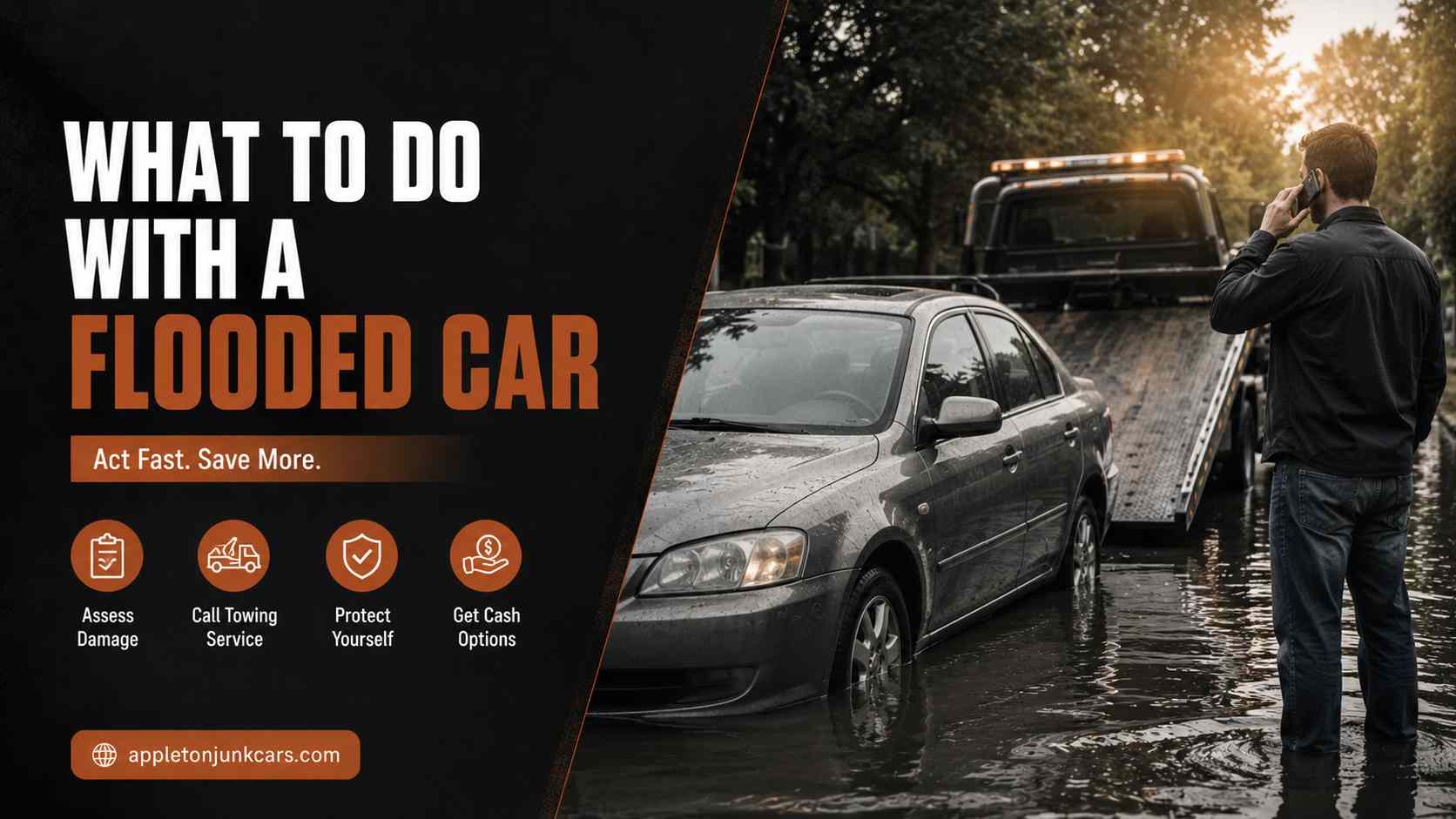
Your car went through a flood, a storm, a rising river, or a parking garage that turned into a lake, and now you are looking at a vehicle that may or may not be salvageable. What you do in the first 24 to 72 hours after a flood event significantly affects your options, your insurance claim, and how much money you ultimately recover. This guide walks through every decision point in the right order.
The first thing to understand: flood damage is not like other car damage. Water, especially if it was contaminated with sewer, mud, or saltwater, destroys things that look fine from the outside. Electronics corrode from the inside. Mold begins growing within 24 to 48 hours. The degree to which the car was submerged, how long it sat, and what type of water it was in determine whether repair is realistic or whether selling or scrapping is the better financial decision.
What to Do With a Flooded Car: Do Not Try to Start It
Before anything else, do not attempt to start a flood-damaged vehicle. If water entered the engine through the air intake, attempting to start the engine can hydrolock it: compress a slug of incompressible water in the cylinder rather than a compressible air-fuel mixture. The result is a bent or broken connecting rod, which turns a potentially repairable car into an engine-destroyed car. This is the single most damaging mistake flood victims make.
Assess the Water Level
How high did the water reach inside the car? There is a meaningful threshold roughly at floor level. If water did not reach the floorboard interior, the damage is likely limited to undercar components (exhaust, brakes, electrical grounds) and may be manageable. If water reached the dashboard or higher, the car has experienced major electrical system immersion and is almost certainly a total loss financially. The waterline mark inside the car, visible as a dirt or staining line on the upholstery and door panels, is your most important damage indicator.
Document Everything Before Touching It
If you have comprehensive insurance, photograph the water level mark, the exterior, the engine bay, and any visible damage before anything is moved or cleaned. Your insurer will want to see the condition of the vehicle at the time of the flood event. Thorough documentation also protects you from disputes about pre-existing damage.
Option 1: File an Insurance Claim (If You Have Comprehensive)
Flood damage is covered under comprehensive coverage, not collision coverage. If your policy includes comprehensive, contact your insurer immediately. Do not wait. Most policies require timely reporting, and waiting even a few days can complicate the claim. Your insurer will send an adjuster to assess the vehicle and will determine whether it is a total loss.
How Total Loss Decisions Are Made
Insurers use the actual cash value (ACV) of the vehicle before the flood event and compare it to the estimated cost of repair. If repair costs exceed a threshold (typically 70 to 80 percent of the pre-damage ACV, varying by state and insurer), the car is declared a total loss. You receive a check for the ACV minus your deductible. The insurer takes the salvage title and typically auctions the car to salvage dealers.
If the Insurer Declares It a Total Loss
You can negotiate the ACV if you believe the insurer’s valuation underestimates your car’s pre-flood value. Bring evidence of comparable vehicles currently listed for sale to support a higher valuation. In some states, you also have the option to retain the salvage title and keep the car after the insurer pays the total loss claim, minus the salvage value. This only makes sense if you plan to restore it yourself or sell the salvage.
Option 2: Repair the Flooded Car
Repairing a flood-damaged vehicle is realistic only under specific conditions: the water was clean (rain, not sewer or saltwater), the submersion was brief, the water level stayed below the dashboard, and the vehicle has been promptly dried and inspected. Even then, repair costs can be substantial and some problems do not appear until months later.
What Flood Repair Actually Involves
A proper flood repair on a car where water reached the interior includes removing and replacing all water-contaminated insulation and padding beneath the carpet, deep cleaning and drying every door panel and cavity, testing and inspecting every electrical module and connector for corrosion, replacing brake fluid and other hydraulic fluids that may have been contaminated, and treating the entire undercar and interior for mold prevention. Costs for proper flood restoration on even a moderately damaged vehicle run $2,000 to $8,000 and can exceed the vehicle’s value.
The Hidden Problems That Appear Later
Even a well-repaired flood car carries ongoing risk. Corrosion inside wire harness connectors progresses over months and years, causing intermittent electrical faults that are extremely difficult to diagnose. Mold in unreachable cavities causes persistent health problems for occupants. Rust accelerates on body panels, floor pans, and subframe members. These are the reasons most automotive professionals advise against investing significantly in flood repair unless the damage was truly minor.
Option 3: Sell the Flooded Car As-Is
Selling a flooded car as-is is often the most financially rational option, particularly after an insurance payout that did not cover the full replacement cost, or when you do not have comprehensive insurance. A range of buyers accepts flood-damaged vehicles, and the salvage title that results from a flood claim does not eliminate the car’s value to every buyer type.
Disclosure Requirements When Selling a Flooded Car
In most states, you are legally required to disclose flood damage when selling a vehicle. Selling a flood-damaged car without disclosure exposes you to fraud liability. A salvage or flood title must be present on any vehicle that has been through the insurance total loss process. Be straightforward about the damage history. Buyers who specifically seek flood-damaged vehicles for parts or professional restoration are not deterred by honest disclosure.
Who Buys Flooded Cars
Online instant-offer services (Peddle, Wheelzy, CarBrain) buy flood-damaged vehicles and include free towing. Local salvage yards accept them for parts value. Some specialized restorers and flippers buy flood cars intentionally, betting on their ability to repair them more cheaply than the market values them. Mechanical enthusiasts who want specific parts from your make and model are also potential private buyers. Get at least three quotes before accepting any offer.
Option 4: Donate the Car
Donating a flood-damaged vehicle to a registered charity is an option that removes the car without any sale transaction and provides a tax deduction based on the donated vehicle’s value. Many charitable organizations accept flood-damaged vehicles. The tax deduction for a donated vehicle is typically the fair market value of the vehicle in its current (flood-damaged) condition, which your tax professional can help you document. This option makes the most sense when the car’s market value is low enough that the paperwork of a sale is not worth the proceeds.
Frequently Asked Questions
Can a flooded car be repaired?
Possibly, but it depends on the water level, the water type, and how quickly the car was dried and treated. If water stayed below the door sills and the car was cleaned and dried within 24 hours, repair may be viable. If water reached the dashboard or the car sat submerged for more than a few hours, electrical system damage and corrosion make repair costs likely to exceed the car’s value. Repair of saltwater floods is almost never financially justified.
Is a flooded car a total loss?
Not automatically. Insurers compare estimated repair cost to the vehicle’s pre-damage actual cash value. If repair exceeds 70 to 80 percent of the pre-flood ACV, it is declared a total loss. A car worth $3,000 with $2,500 in flood repair costs is a total loss. A car worth $25,000 with $8,000 in flood repair costs may not be, depending on the insurer’s threshold.
Can I sell a flooded car without a salvage title?
If you did not file an insurance claim, the car retains its clean title. However, you are still legally required in most states to disclose known flood damage to buyers. Selling a flooded car without disclosing the damage exposes you to fraud liability. Honesty about flood history is both legally necessary and practically important: buyers who discover undisclosed flood damage after purchase have grounds for legal recourse.
The Bottom Line
A flooded car presents more options than most owners realize. Do not start it. Document the damage. File an insurance claim if you have comprehensive coverage. If repair is not financially justified, get quotes from multiple cash buyers. Disclose the flood damage honestly in any sale. The combination of an insurance payout (if applicable) and sale of the salvage often recovers more total value than either path alone, and more than paying for an expensive repair on a car that will carry flood damage history forever.