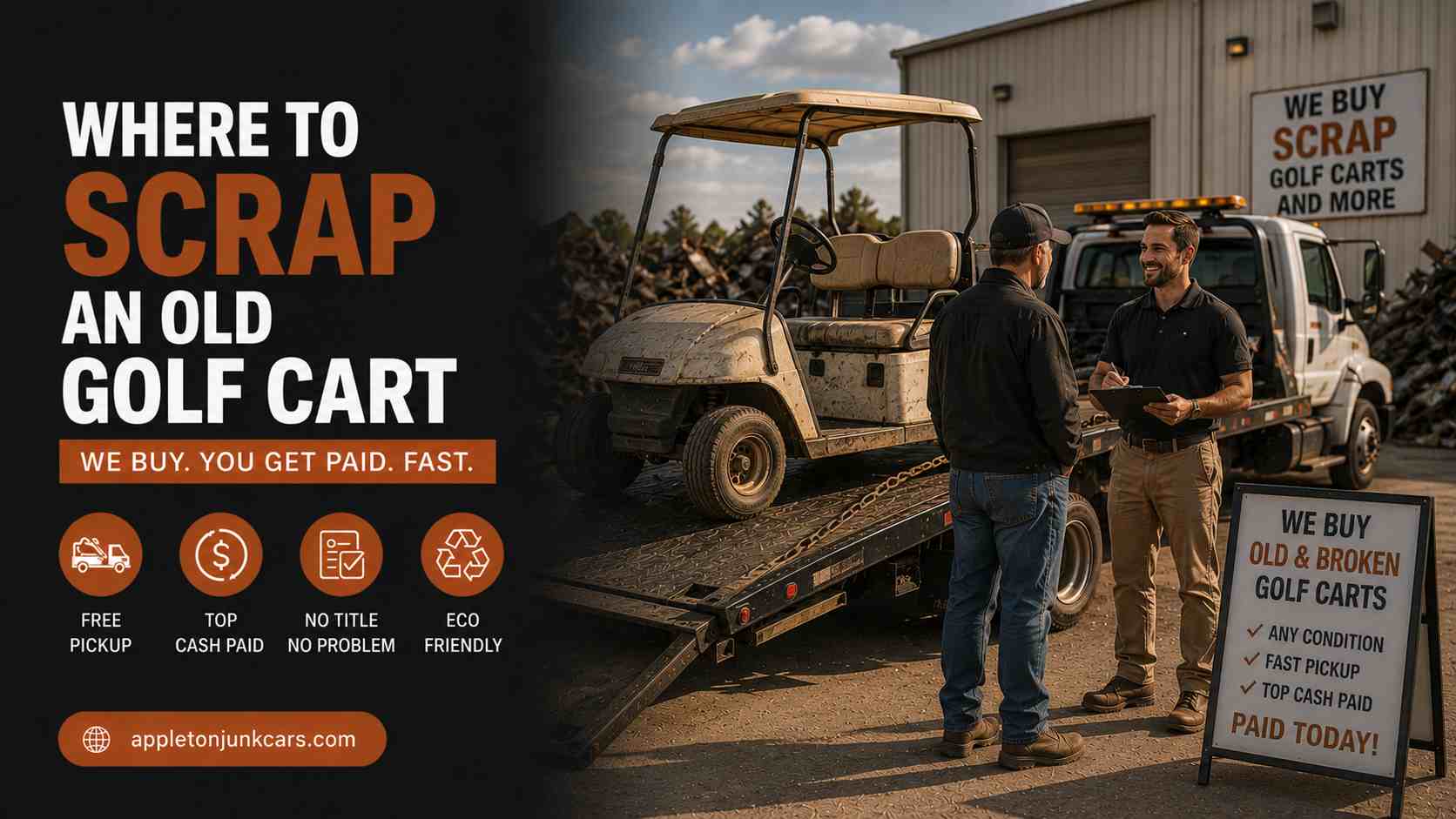
The golf cart stopped running, the batteries are dead beyond recovery, or the frame has been sitting long enough that fixing it costs more than it is worth. Most owners hit a wall immediately when they try to sell or scrap one because golf carts do not fit neatly into the car junkyard category or the lawn equipment category. Standard junk car buyers often will not touch them. Scrap yards will, but at metal weight rates that frequently undervalue what is on the cart.
Scrapping an old golf cart means something specific depending on which type you have. An electric golf cart with a dead battery pack and a sound aluminum frame is a fundamentally different asset than a gas-powered cart with a seized engine. The power source determines which buyer makes the best offer, how much the battery pack or engine is worth separately, and how quickly you can get the cart off your property.
This guide covers what every type of old golf cart is actually worth, the five buyer categories that purchase them and what each one pays, why the battery pack is frequently the most valuable part of an electric cart, how brand affects the offer, and the simple title and ownership documentation a golf cart sale requires.
What an Old or Non-Running Golf Cart Is Worth Before Your First Call
Golf cart values in scrap or non-running condition range from $50 for a stripped aluminum frame at a scrap yard to $3,500 or more for a lithium-powered late-model Club Car or EZGO with a dead controller but an intact battery system. The spread is driven by three variables: whether the cart is gas or electric, the brand and model, and the condition of the power system.
Golf Cart Type and Condition | Scrap Yard / Metal Value | Private or Dealer Offer Range | Notes |
|---|---|---|---|
Electric, working or near-working, good batteries | N/A: sell, do not scrap | $800 to $3,500 | Private sale or golf cart dealer is the correct channel |
Electric, dead lead-acid batteries, sound frame and cart | $80 to $200 (aluminum frame) | $200 to $700 (cart) + battery scrap | Battery lead has separate value; sell pack to recycler |
Electric, lithium battery pack, non-running cart | $80 to $200 (frame) | $800 to $3,000+ (battery pack alone) | Lithium pack is the primary asset; identify buyer first |
Gas, non-running engine (seized or failed) | $80 to $250 (steel and aluminum) | $150 to $600 (whole cart to private buyer) | Engine parts have limited salvage market |
Gas, running or easy-start, rough cosmetics | N/A: sell, do not scrap | $400 to $1,800 | Private sale or dealer; running gas carts sell quickly |
Any cart, heavily rusted steel frame, stripped | $40 to $120 (scrap metal) | Limited private interest | Scrap yard is the correct destination for stripped carts |
Club Car, EZGO, or Yamaha, good condition overall | Scrap is waste of value | $600 to $3,500+ depending on model | Brand-name carts always worth offering to dealers first |
The most important early decision for any electric golf cart owner: identify whether the battery pack is lead-acid or lithium before contacting any buyer. Lithium battery packs in golf carts are typically worth more than everything else on the cart combined. A dead lithium pack still carries significant reconditioned or recycled value. A dead lead-acid pack is worth scrap lead prices only, which changes the entire recovery calculation.
Electric vs Gas Golf Carts: Why the Power Source Changes Every Number
Electric golf carts and gas golf carts reach entirely different buyers when they are at the end of their useful life, and the valuation logic for each is different enough that they should be treated as separate categories from the start.
Electric Golf Carts at End of Life
An electric golf cart is powered by a battery pack, a motor controller, an electric motor, and associated wiring. When the cart dies, the failure is almost always in the battery pack, the controller, or both. The aluminum frame, the motor, the body panels, and the running gear are typically still functional.
The battery pack is the key asset. Lead-acid packs in standard golf cart voltage configurations (36V or 48V using 6-volt, 8-volt, or 12-volt batteries) have a finite cycle life of approximately 4 to 6 years under typical use. Dead lead-acid batteries have scrap value at approximately $0.20 to $0.35 per pound for the lead plates. A full 48V lead-acid pack weighing 180 to 250 pounds yields $36 to $87 in scrap lead. Used lead-acid batteries in reusable condition (not deeply discharged to death) sell for $15 to $40 per battery individually.
Lithium battery packs are a completely different scenario. A lithium pack in a newer golf cart (typically 48V lithium iron phosphate or similar chemistry) retains significant value even when the cart is non-functional. A 48V 100Ah lithium pack sells for $800 to $2,000 to a battery shop, golf cart dealer, or private buyer who can test and recertify it. Selling the lithium pack separately and then selling the remaining cart separately produces dramatically more total recovery than any combined whole-cart offer.
Gas Golf Carts at End of Life
Gas golf carts are typically powered by small single-cylinder or twin-cylinder engines from manufacturers including Kawasaki, Briggs and Stratton, and Robin (Subaru). These engines have limited salvage markets compared to automotive engines. A seized or failed golf cart engine has minimal recovery value beyond small engine parts buyers. The aluminum and steel frame has commodity scrap value. The body panels, seats, and accessories have private buyer demand if they are in good condition.
For a non-running gas golf cart, the frame material matters. Golf carts with aluminum frames earn more at scrap than those with steel frames because aluminum scrap prices are significantly higher than steel prices. An aluminum-framed cart that cannot be repaired economically is worth $80 to $250 at a scrap yard. A steel-framed cart of the same type yields $40 to $120.
The Five Buyer Types for Old Golf Carts and What Each One Pays
Golf Cart Dealers
Golf cart dealers who sell new and used carts regularly purchase non-running or end-of-life carts for their parts inventory or for refurbishment and resale. They are the most knowledgeable buyers and frequently offer more than scrap for any cart in brands they carry. A dealer who sells Club Car or EZGO carts needs used Club Car and EZGO components for their repair shop, and buying your whole cart is often more efficient for them than ordering individual parts. Call dealers who specifically carry your brand before calling any other buyer.
Private Buyers Through Online Platforms
Facebook Marketplace, Craigslist, and golf cart-specific platforms including GolfCartResource.com and GolfCartsPlus.com have active markets for non-running or project carts. Private buyers in this space are often mechanically inclined owners who know exactly what is wrong with their existing cart and need a parts source or an affordable rebuild project. For brand-name carts from Club Car, EZGO, or Yamaha in any condition, a private listing with honest description and photos of the body, frame, and battery area consistently generates offers within a day or two.
Golf Courses and Resorts
Golf courses and resort properties that operate large fleets of golf carts are occasional buyers of non-running or end-of-life carts for parts. A course running 60 Club Car DS carts that needs motors, solenoids, or controllers will sometimes purchase a complete dead cart from a private owner rather than ordering parts from a dealer. This buyer segment is not always easy to reach, but a direct phone call to the golf course superintendent or fleet manager at local courses is worth 10 minutes of calls for any brand-name cart in a common fleet configuration.
Battery Recyclers and Refurbishers
For electric golf carts specifically, battery recyclers and refurbishers are a buyer category most sellers never consider. These operations purchase dead lead-acid battery packs for the lead content and purchase dead or degraded lithium packs for cell recovery and reconditioning. They typically pay more than a general scrap yard for a complete battery pack because they can recover more value from the pack than a shredder can. Search for “golf cart battery recycling” or “EV battery recycler” in your region for the most direct comparison.
Scrap Metal Yards
Scrap metal yards are the guaranteed floor buyer for any golf cart in any condition. They price on the weight of the frame metal: aluminum frames earn significantly more per pound than steel. The body panels, seats, batteries, and motor are either scrapped at commodity rates or not taken at all. A full electric golf cart at a scrap yard typically yields $80 to $250 depending on frame material and weight. This is always the option of last resort, not the starting point.
The Battery Pack: The Most Undervalued Component on Every Electric Cart
Most owners of dead electric golf carts think of the battery pack as the problem rather than as an asset. That perspective consistently leads to leaving real money behind. The battery pack is the highest-value component on most electric golf carts, and it has its own buyer market completely separate from the cart itself.
Battery Pack Type | Configuration | Dead / Non-Functional Value | Usable / Rebuildable Value |
|---|---|---|---|
Lead-acid, 36V system | Six 6-volt batteries | $30 to $70 (scrap lead weight) | $60 to $180 (if individual batteries hold some charge) |
Lead-acid, 48V system (6V batteries) | Eight 6-volt batteries | $45 to $100 (scrap lead weight) | $80 to $240 (if individually testable) |
Lead-acid, 48V system (8V batteries) | Six 8-volt batteries | $45 to $100 (scrap lead weight) | $90 to $270 (if individually testable) |
Lithium Iron Phosphate (LiFePO4), 48V | Varies by Ah rating | $200 to $600 (cell recovery) | $800 to $2,000+ (refurbishable or direct resale) |
Lithium, 72V high-performance cart | High-voltage, large format | $400 to $900 (cell recovery) | $1,500 to $3,500+ (high demand from EV community) |
The key test for a lead-acid pack is individual battery voltage. A 6-volt battery that reads 5.8V or higher after a 24-hour rest has recoverable capacity. One that reads below 5.0V has been sulfated and is likely a scrap unit. Testing each battery individually with a basic voltmeter takes 15 minutes and tells you whether you have a fully dead pack (scrap only) or a partially recoverable pack that private buyers will pay more for. Posting individual test results in your listing produces noticeably better offers from golf cart buyers who know how to read the data.
How Golf Cart Brand and Model Affects What Buyers Will Pay
Golf cart brand is the second most important value factor after power source. Three brands dominate the golf cart market and have corresponding aftermarket and resale support.
Brand | Common Models | Resale / Parts Demand | Notes for Sellers |
|---|---|---|---|
Club Car | DS, Precedent, Onward | Highest of the three major brands | DS model is the most widely used fleet cart globally; parts always in demand |
EZGO | TXT, RXV, Express | Very high; large fleet install base | TXT is the most common; massive aftermarket support |
Yamaha | G-Series, Drive, Drive2 | High; strong reputation for reliability | G-Series (older) has aging parts market; Drive and Drive2 are current |
Cushman / Columbia / Tomberlin | Various | Moderate; niche market | Less common; smaller buyer pool but dedicated buyers exist |
Generic / off-brand / clone carts | Various | Low; primarily scrap value | Limited aftermarket; private buyer pool very small; scrap is often the realistic exit |
The Club Car DS is the most universally recognized and resold golf cart model in the world because it was the dominant fleet cart for golf courses for decades. Parts are cheap, abundant, and well-documented. A non-running Club Car DS in any condition has a buyer market that a non-running generic cart of equivalent age simply does not. If you have a Club Car, EZGO TXT, or Yamaha Drive model, lead with the brand and model number prominently in every listing and every phone call. It changes the offers you receive.
The Title Process, Transport, and How the Sale Actually Works
Does a Golf Cart Require a Title?
Most golf carts do not require a traditional vehicle title in most states because they are not classified as motor vehicles for on-road use. The sale of a golf cart is typically completed with a simple bill of sale that includes the make, model, serial number, the agreed sale price, the date, and both parties’ contact information. This is the most important document you generate in the transaction and the one that protects you from any future liability associated with the cart.
A few states and some municipalities classify street-legal golf carts (those modified for road use with headlights, turn signals, and registration) as low-speed vehicles (LSVs) that require titling and registration. If your cart has been converted to street-legal status, check your state DMV for the specific title transfer process, which follows the standard motor vehicle title procedure in those cases.
Serial Number: The Golf Cart’s Primary Identifier
The serial number on a golf cart serves the same function as a VIN on a car. It identifies the model year, model type, and manufacturing batch. The serial number location varies by brand: on Club Car carts it is typically on a plate under the seat. On EZGO carts it is usually on a plate on the frame under the seat or on the driver’s side dash. On Yamaha carts it is on a plate on the frame near the bag well or under the seat. Providing the serial number in your listing is the single detail that most helps buyers verify what they are getting and accelerates the offer process.
Transport Logistics for a Non-Running Golf Cart
A non-running golf cart cannot be driven to a dealer or a scrap yard. Standard options include a pickup truck with a ramp (most golf carts weigh 500 to 900 pounds and fit in a half-ton truck bed with a ramp), a utility trailer, or a flat-rate tow through a local company. Many golf cart dealers offer pickup for carts they are purchasing, particularly if the offer is accepted. Scrap yards that accept golf carts may offer flat-rate pickup for multiple carts or for a whole-cart that justifies the transport cost. Confirm transport logistics before finalizing any deal, as the pickup method and who pays for it directly affects your net recovery.
What Sellers of Old Golf Carts Consistently Report
People who have sold or scrapped old golf carts share a consistent set of findings. The most common: calling a generic junk car buyer or a scrap yard first and accepting their offer without ever contacting a golf cart dealer or posting privately online. Scrap yards quote metal weight. Golf cart dealers quote parts and resale value. For any Club Car, EZGO, or Yamaha cart, the gap between those two quotes is frequently $150 to $500 or more on a cart that the scrap yard quotes at $80 to $150.
The second consistent finding involves electric carts with dead lithium packs. Sellers who did not know they had a lithium pack (many were upgraded from lead-acid by a previous owner or by a dealer at purchase) accepted scrap quotes that completely ignored the most valuable component on the cart. Lithium pack identification before any buyer conversation is the single most impactful preparation step for electric cart sellers, because it can reframe a $150 transaction into a $900 to $2,000 one.
Those who got the best outcomes posted on Facebook Marketplace with the serial number, a clear photo of the battery area, and an honest description of what the cart does and does not do. Experienced golf cart buyers respond immediately to listings that provide enough information to price the cart accurately. Listings that simply say “old golf cart, not working” generate far fewer serious responses than those that say “2009 Club Car DS 48V electric, batteries dead, motor runs, serial number A0922-123456.”
Frequently Asked Questions
Where can I scrap an old golf cart?
Old golf carts can be scrapped at scrap metal yards that accept small vehicles and aluminum or steel frames. However, scrapping is almost never the best financial option for a golf cart in recognizable condition. Golf cart dealers who carry your brand, private buyers through Facebook Marketplace and Craigslist, golf cart-specific online marketplaces, and battery recyclers for electric carts all typically pay more than a scrap yard for any cart with working components or a brand-name frame.
How much is a junk golf cart worth?
A junk golf cart is worth $40 to $200 at a scrap yard for the metal frame and materials. The same cart sold to a golf cart dealer or private buyer is worth $150 to $700 or more depending on brand and condition. An electric cart with a lithium battery pack has significantly higher value because the battery pack alone may be worth $800 to $2,000 to a battery refurbisher or private buyer. The power source (electric vs gas) and the brand (Club Car, EZGO, Yamaha vs generic) are the two factors that most determine whether scrapping or selling is the right approach.
Who buys old golf carts near me?
Golf cart dealers who sell used carts, private buyers through Facebook Marketplace and Craigslist, golf courses that run large fleets and need parts, battery recyclers for electric carts, and scrap metal yards are the five main buyer categories. Golf cart dealers are usually the most efficient first call for brand-name carts. Search for “used golf cart dealer” and your city to find the closest option. Facebook Marketplace golf cart listings in most regions generate responses within 24 to 48 hours for carts with honest descriptions and accurate photos.
Do I need a title to sell a golf cart?
Most golf carts do not require a vehicle title because they are not classified as on-road motor vehicles in most states. A bill of sale with the serial number, sale price, date, and both parties’ names is the standard documentation for a golf cart sale. Street-legal golf carts that have been registered as low-speed vehicles (LSVs) may require a title transfer through the state DMV. Check whether your cart has ever been registered with your state before assuming no title is needed.
Are electric or gas golf carts worth more as scrap?
Electric golf carts are typically worth more than gas carts at every stage of the sale process because of the battery pack value. A dead lead-acid pack still has scrap lead value. A functional or repairable lithium pack can be worth more than the entire cart to a battery buyer. Gas golf carts have smaller engines with limited parts markets and metal frames valued at commodity rates. The exception is a running or easy-to-repair gas cart, which has consistent private buyer demand from owners who prefer gas over electric for extended range.
What is the best way to get rid of a non-running golf cart?
The fastest way to get rid of a non-running golf cart is to post it on Facebook Marketplace with the brand, model, serial number, power type, and a description of the specific issue. Experienced buyers respond quickly to honest listings and often arrange pickup within a day or two. If no buyers respond after three to five days, contact a golf cart dealer who carries that brand. If the dealer is not interested, contact a scrap yard that accepts aluminum or small vehicles. This sequence almost always produces better recovery than going directly to scrap.
How do I find the serial number on my golf cart?
Serial number location varies by brand. On Club Car golf carts, the serial number plate is typically found under the driver’s side seat on the frame or on a label in the driver’s side glove box area. On EZGO carts, it is usually on a metal plate on the frame under the seat or on the dash near the driver. On Yamaha carts, it is stamped into the frame near the rear axle or on a plate under the seat. The serial number decodes the model year and model type and is the most important piece of information for any buyer trying to verify what they are purchasing.
Can a golf cart be donated instead of scrapped?
Yes. Golf carts in working or near-working condition are accepted as donations by organizations including Habitat for Humanity ReStores, retirement communities, youth camps, and nonprofit facilities that use them for grounds maintenance. A donated cart in repairable condition generates a tax-deductible charitable contribution documented by the receiving organization. The fair market value of the donation, established by a comparable private sale price or a professional appraisal for carts worth more than $500, is the deductible amount. Confirm the receiving organization is a qualified 501(c)(3) before assuming the donation is deductible.
The Bottom Line
An old golf cart has more buyer options and more potential recovery value than most owners realize when they start making calls. The mistake that costs the most money is treating a brand-name electric cart the same way as a stripped aluminum frame: calling a scrap yard first and accepting the metal weight quote without ever contacting a dealer or posting online.
For electric golf carts, identify the battery chemistry before anything else. A lithium pack changes the entire transaction. For any Club Car, EZGO, or Yamaha cart regardless of condition, a golf cart dealer and a Facebook Marketplace listing should both come before a scrap yard call. The scrap yard quote establishes your floor. Every other buyer type is competing to beat that floor.
The bill of sale with the serial number is the document that completes the transaction legally and protects you after the cart leaves your property. It takes five minutes to write and is the difference between a clean transaction and a lingering ownership question if something happens to the cart after the sale.