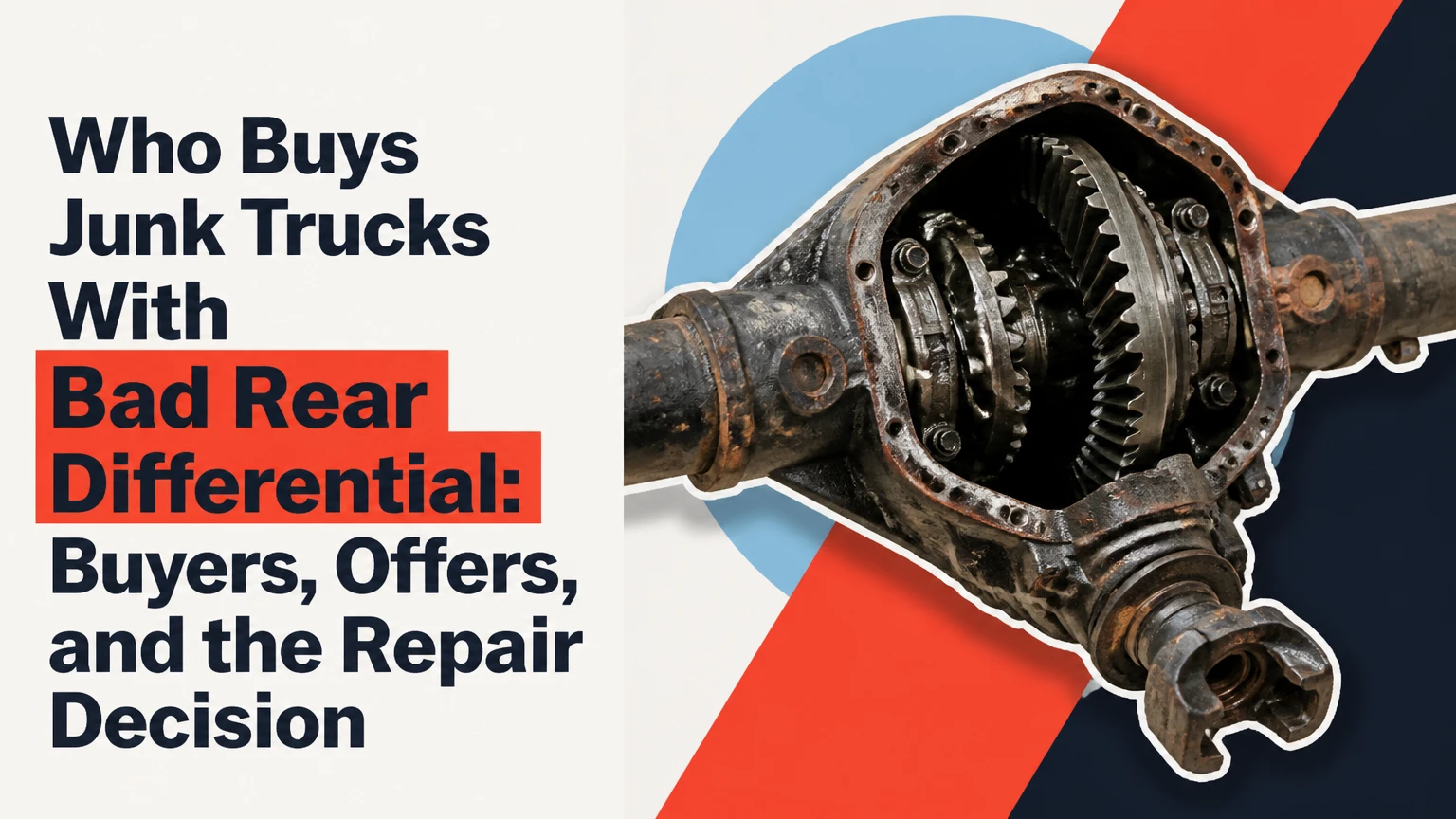
Junk car buyers, salvage yards, 4WD enthusiasts, and off-road parts dealers all buy trucks with bad rear differentials, and trucks command consistently higher offers than cars with the same failure because the drivetrain components in a junk truck, including the rear axle assembly itself, have significant standalone parts value in the used market.
A bad rear differential does not mean the truck is worthless: it means the engine, transmission, cab, bed, wheels, and every non-axle component still has full recoverable value, and those components on a full-size truck add up to a meaningful offer.
Understanding What a Bad Rear Differential Actually Means
The rear differential is the gearbox at the center of the rear axle that splits power from the driveshaft to the two rear wheels while allowing them to rotate at different speeds during cornering. When it fails, several very different conditions can result, and the failure type affects both driveability and buyer interest.
Ring and Pinion Gear Wear (Whine or Howl)
Worn ring and pinion gears produce a distinctive howl or whine that typically increases with vehicle speed and changes character when you lift off the throttle. The truck may still be fully driveable with this failure, sometimes for thousands of miles. This is the most common rear differential noise and is often what owners describe as a “bad rear end.” The diff still functions; the gears are just worn.
From a sale perspective, a truck that still drives with a differential whine is in a much better position than a truck that cannot move. A driveable truck with a whining rear end can be sold privately at close to normal value to a buyer who knows how to renegotiate for the repair cost.
Carrier Bearing Failure
The carrier bearing supports the differential case inside the housing. When it fails, the noise is a rough grinding or rumbling at speed, sometimes with vibration. The truck may still be driveable but the condition deteriorates faster than a worn ring and pinion. Replacement requires differential disassembly and professional setup of preload and backlash, making this a $600 to $1,400 repair.
Spider Gear or Side Gear Failure
Spider gears are the small internal bevel gears inside the differential case that allow speed differentiation between wheels. When a spider gear fails, the result is a loud clunk on acceleration from a stop or during tight turns, sometimes followed by one wheel losing drive. The truck may still move, but traction is compromised and the failure will worsen.
Complete Differential Lockup
A differential that has failed catastrophically, from a broken ring gear tooth, seized bearings, or complete fluid loss, can lock the rear axle solid. This is the most serious condition: the truck cannot be driven at all, or will skid the rear tires rather than allowing them to rotate at different speeds. On gravel or dirt this may allow slow movement; on pavement the truck essentially drags the rear tires.
Axle Seal Failure and Fluid Loss
A leaking axle seal allows differential fluid (gear oil) to escape. If the fluid level drops too low, the gear surfaces run dry and accelerate wear dramatically. A seal failure caught early is a $100 to $250 repair. A seal failure that led to extended dry running causes the gear damage described above. Many “bad rear differential” trucks have simply been run without adequate fluid.
Why Trucks Specifically Bring Better Offers With Differential Problems
The Rear Axle Assembly Has Standalone Value
Popular rear axle assemblies from common trucks are actively sought by the 4WD aftermarket, off-road community, and fleet operators. The Ford 8.8-inch rear axle from an Explorer or F-150 sells for $300 to $800 used. The GM 14-bolt full-float rear axle from a heavy-duty pickup sells for $600 to $1,500. The Dana 60 from older Ford and Dodge trucks sells for $500 to $2,000 depending on configuration. Even a truck with a bad differential often has an axle housing, axle shafts, and brakes that retain parts value.
The Engine and Transmission Are Unaffected
A bad rear differential does not damage the engine, transmission, transfer case, or front axle. On a truck with a bad rear diff, all of those components have full recoverable value. A junk buyer acquiring a 2014 Ford F-150 with a bad rear diff is still recovering a 5.0L Coyote engine, a 6R80 transmission, a transfer case, a front axle assembly, and all the body and interior components. The rear differential is one line item in a long list of recoverable assets.
Popular Truck Rear Axles and Their Parts Market Value
Axle / Truck Platform | Common Applications | Used Axle Assembly Value |
|---|---|---|
Ford 8.8-inch | F-150, Explorer, Ranger (1983 to present) | $300 to $800 |
Ford 10.25 / 10.5-inch | F-250, F-350 Super Duty | $500 to $1,400 |
Dana 60 (Ford) | F-250, F-350 (pre-2000) | $500 to $2,000 |
GM 8.5 / 8.6-inch 10-bolt | Silverado, Sierra 1500 | $250 to $700 |
GM 14-bolt (10.5-inch) | Silverado 2500/3500, suburban HD | $600 to $1,500 |
Ram 11.5 AAM | Ram 2500 / 3500 (2003 to present) | $500 to $1,200 |
Toyota 8-inch rear | Tacoma, 4Runner, Tundra | $400 to $1,000 |
Dana 44 (various) | Jeep, older GM and Ford trucks | $300 to $900 |
Even a truck with a bad differential often sells the axle housing, shafts, and brakes separately for more than a junk buyer would offer for the entire truck. This is the core argument for getting multiple quote types before accepting any single offer.
Is Repairing the Rear Differential Worth It Before Selling
Failure Type | Repair Cost Range | Truck Value Running | Recommendation |
|---|---|---|---|
Axle seal leak (caught early) | $100 to $250 | Any value | Always repair: cheapest fix with biggest return |
Ring and pinion wear (whine, still drives) | $600 to $1,400 rebuilt | Over $8,000 running | Consider repair: opens private buyer market |
Carrier bearing failure | $600 to $1,200 | Over $8,000 running | Consider if truck is otherwise clean |
Spider gear failure | $400 to $900 | Over $6,000 running | Case by case based on truck condition |
Remanufactured differential replacement | $800 to $2,000 installed | Over $10,000 running | Only on high-value trucks otherwise in excellent shape |
Complete differential lockup from dry run | $1,200 to $3,000+ | High-value truck only | Sell as-is in most cases |
Can You Drive a Truck With a Bad Rear Differential
Whether you can drive the truck affects every aspect of the sale: offer, buyer pool, and logistics.
A truck with a differential whine or noise that still drives normally can be driven to a buyer or shop. Driving it long distances on a failing diff will worsen the damage, but a short drive of 5 to 15 miles to a buyer is generally manageable for a whining diff that has not fully failed.
A truck with a locked rear differential should not be driven on pavement. The scrubbing force on the tires during any turning creates enormous stress on the axle components and can cause further damage. On a gravel surface, limited movement may be possible. Flatbed towing is the correct transport method for a locked rear diff truck.
Disclose driveability accurately to buyers. A buyer who quotes a driveable truck and arrives to find a locked rear end that needs a flatbed will renegotiate, and the renegotiation will not favor you.
4WD vs. 2WD: How It Affects the Offer
Four-wheel-drive and all-wheel-drive trucks with bad rear differentials command higher offers than two-wheel-drive equivalents for two reasons. First, 4WD trucks are more desirable overall, so all their non-axle components are worth more. Second, the front axle, transfer case, and 4WD system components on a 4WD truck add significant standalone parts value that a 2WD truck does not have. A 4WD truck with a bad rear diff may bring $500 to $1,500 more than the same truck in 2WD configuration simply because of the additional recoverable drivetrain components.
Frequently Asked Questions
What does a bad rear differential sound like?
The most common sound is a howl or whine that increases with vehicle speed, typically between 20 and 70 mph. It often changes pitch when you coast off the throttle versus accelerating. A rough grinding or rumbling at speed suggests carrier bearing failure. A loud clunk when pulling away from a stop or making tight turns suggests spider gear or side gear failure. A complete lockup produces tire scrubbing on pavement during any turning movement.
Can a rear differential failure damage the transmission or transfer case?
A rear differential failure does not typically damage the transmission or transfer case directly. However, if the driveshaft experiences vibration from a failing differential and is driven for extended periods, universal joint wear can result. Confirm the condition of the driveshaft and u-joints when assessing the truck before calling buyers.
Is a locker or limited-slip differential worth more than an open differential?
Yes. A limited-slip differential (positraction, traction-lok, G80 Eaton locker) or a locking differential is worth more to buyers in the off-road and 4WD market than an open differential. Identify which type of rear axle your truck has before calling buyers: a GM 14-bolt with an Eaton G80 locker is worth more than the same axle without it.
Will a junk buyer pay more for a truck than a car with the same failure?
Yes, significantly. A full-size pickup with a bad rear differential brings more than a sedan with a bad differential because the truck’s greater weight means more scrap metal, the parts are worth more individually, and trucks have stronger demand in the salvage market. Expect truck offers to be 30 to 60 percent higher than equivalent car offers for the same type of failure.
The Bottom Line
A bad rear differential is not a truck-ending failure in the junk market. The engine, transmission, cab, bed, wheels, and all non-axle components retain full value, and the axle assembly itself has significant standalone value in the 4WD and off-road aftermarket. Get quotes from both general junk buyers and salvage yards that specialize in trucks, check whether the truck drives (even with a whine), and disclose the exact failure accurately. The difference between a truck that drives with a noisy diff and one that is completely locked is several hundred dollars in the offer.