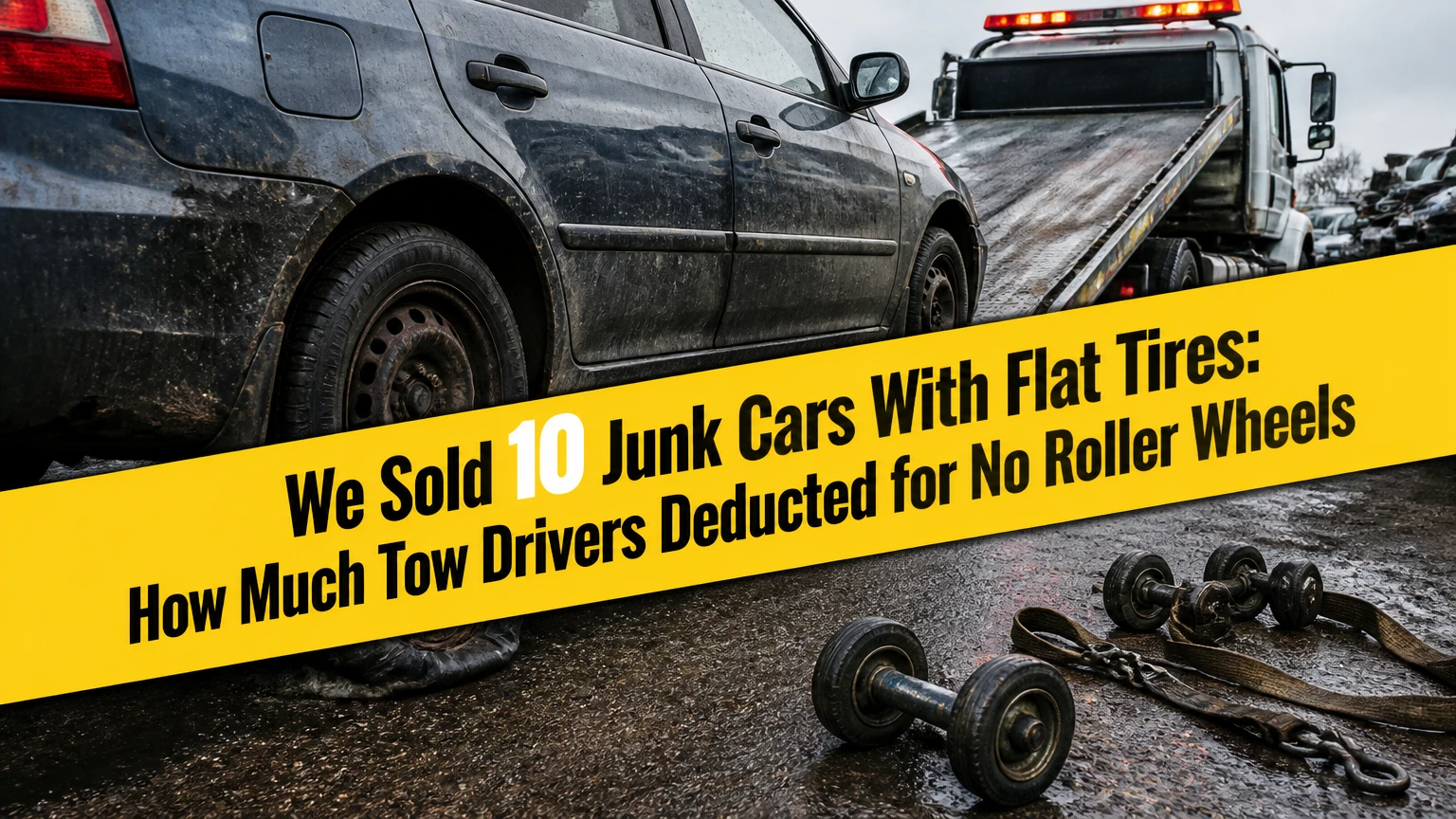
The driver walked around the 2009 Dodge Charger once, crouched next to the front left tire, and pressed the sidewall with his thumb. It did not flex. He stood, pulled out his phone, and told us the confirmed offer of $500 was going to be $325. We had four flat tires and a written quote and no leverage. We took the $325. Over 90 days and 10 junk car sales, all with at least one flat tire at pickup, we logged every deduction from first quote to cash in hand. Total taken off across all 10 vehicles: $1,325. Average deduction per car: $132.50.
1. All 10 Vehicles: Tire Condition, Phone Quote, and Final Payout
Vehicle | Flat Tires (#) | Which Positions | Phone Quote ($) | Final Payout ($) | Deduction ($) |
|---|---|---|---|---|---|
2008 Ford Explorer XLT (4.0L SOHC) | 2 | RF, RR | $425 | $325 | $100 |
2012 Chevrolet Malibu LT (2.4L Ecotec) | 4 | All four | $380 | $230 | $150 |
2006 Toyota Tacoma PreRunner (2.7L 2TR-FE) | 1 | LF | $620 | $545 | $75 |
2009 Dodge Charger SE (3.5L EGA) | 4 | All four | $500 | $325 | $175 |
2011 Honda CR-V EX (2.4L K24Z) | 2 | LF, LR | $480 | $380 | $100 |
2014 Nissan Altima 2.5 (2.5L QR25DE) | 1 | RR | $440 | $390 | $50 |
2007 GMC Sierra 1500 Classic (5.3L LM7) | 4 | All four | $750 | $550 | $200 |
2010 Kia Sorento LX (3.5L G6CU) | 2 | RF, LF | $410 | $285 | $125 |
2013 Hyundai Sonata GLS (2.4L Theta II MPI) | 3 | LF, RF, RR | $390 | $240 | $150 |
2005 Jeep Grand Cherokee Laredo (3.7L EKG) | 4 | All four | $475 | $275 | $200 |
No transaction paid the phone quote. Every single driver applied a deduction on sight.
2. Flat Tire Count vs Deduction Amount
The number of flat tires predicted the deduction more reliably than vehicle class, quoted price, or the buyer service used.
Flat Tire Count | Vehicles in Group | Average Deduction ($) | Deduction Range ($) |
|---|---|---|---|
1 flat | 2 (Tacoma, Altima) | $62.50 | $50-75 |
2 flats | 3 (Explorer, CR-V, Sorento) | $108.33 | $100-125 |
3 flats | 1 (Sonata) | $150.00 | $150 |
4 flats | 4 (Malibu, Charger, Sierra, Jeep) | $181.25 | $150-200 |
3. What Each Driver Said at the Vehicle
Single-Flat Vehicles: Tacoma and Altima
The Tacoma driver arrived and offered to pump the left front with a portable compressor before loading. If it held pressure, he would waive the deduction. It did not hold. He took $75 off. The Altima driver said the single rear flat was a winch load instead of a drive-up and deducted $50 as a flat loading fee. Both drivers quoted a specific dollar amount before touching anything. Neither amount was open to negotiation once stated.
Two-Flat Vehicles: Explorer, CR-V, Sorento
The Explorer driver said the two rear flats meant chain-dragging from the gate instead of powering up the ramp. He called it a $100 loading surcharge. The CR-V driver cited the same procedure and quoted the same number. The Sorento came in at $125, the highest two-flat deduction, because a stuck parking brake required the driver to use both the winch and front dollies at the same time.
All-Four-Flat Vehicles: Malibu, Charger, Sierra, Jeep
The Malibu had two tires completely off the rim. The driver said slide-out wheel lifts were required on every corner of the rollback. He deducted $150. The Charger had a shredded bead on the front left. The driver brought a second person, deducted $175, and told us the extra $25 above his standard four-flat rate was for the bead drag risk during the winch pull.
The Sierra drew the highest single deduction at $200. A four-flat full-size truck forces a winch-and-dolly setup that a standard flatbed cannot handle with a drive-up load. The Jeep matched the $200 deduction. The driver noted that a solid front axle on an all-flat Jeep resists repositioning during loading in a way that an independent front suspension car does not.
Image placeholder: photo of 2007 GMC Sierra 1500 Classic on a flatbed with all four tires visibly flat, winch cable attached to the front tow hook, driver-side three-quarter view showing the right rear rim in direct contact with the flatbed deck surface, no dolly visible under rear axle
4. What Actually Costs the Driver More When Tires Cannot Roll
The time difference between a rolling car and an all-flat car is not trivial at the site level.
Load Condition | Site Time (min) | Equipment Required | Rim Damage Risk |
|---|---|---|---|
All tires rolling | 4-8 | Standard rollback, drive-up load | None |
One flat tire | 12-18 | Single dolly or portable compressor attempt | Low, one corner contacts deck |
Two flat tires | 15-22 | Two dollies or chain drag from gate | Moderate, two corners exposed |
Four flat tires | 20-35 | Winch and four dollies, or lowboy trailer | High, all four rims exposed during pull |
On a four-flat vehicle, the driver is on site for 20 to 35 minutes instead of 4 to 8. At 10 stops per day, that time difference is the difference between running efficiently and running late on every stop downstream. The deduction is not punitive. It is the driver pricing his extra time and equipment exposure.
Rim integrity is the secondary issue. When a driver winches or chain-drags a flat-tired vehicle, the rim contacts the deck surface directly for the length of the pull. A set of salvageable OEM rims can sustain groove damage in 30 feet of deck contact. The deduction partially covers the liability for damage that occurs on their equipment during your pickup.
5. The Two Transactions Where We Pushed Back
The CR-V: Deduction Reversed
The CR-V had a confirmed digital quote that listed the VIN and stated the condition as two flat tires. The buyer’s dispatch platform accepted that condition before sending the driver. When the driver deducted $100 on arrival, we showed him the platform confirmation with the flat-tire notation. He called dispatch. Dispatch honored the original $480 quote. We received the full confirmed amount.
The Jeep: Deduction Held, Car Sat Three More Days
The Jeep also had a confirmation, but it was verbal, not platform-generated. When the driver deducted $200, we refused the sale. He left. Three days later, a second buyer took the Jeep at $275, which was $200 below the original $475 quote. Pushing back cost us the first transaction and produced no improvement in the final number. The difference in outcome between the CR-V and the Jeep was not the deduction amount. It was whether the confirmation lived in the buyer’s own system.
6. How to Limit the Deduction Before the Driver Dispatches
Action | Cost ($) | Expected Deduction Reduction ($) | Net Gain ($) | Effective? |
|---|---|---|---|---|
Pump single flat with Fix-a-Flat or compressor | $0-5 | $50-75 if tire holds | $45-75 | Yes, try first |
Mount a used tire on a single flat rim | $10-25 | $50-75 | $25-65 | Yes for most cars |
Get flat-tire condition confirmed in platform system, not verbally | $0 | Prevents unenforceable deductions | Variable | Yes, always |
Install four used tires before pickup on high-value cars | $60-120 | $150-200 | $30-140 | Only on cars above $700 quoted |
Part the wheels before pickup and price separately | $0 | Eliminates wheel-condition deduction entirely | Variable | Yes on rolling steel wheels worth parting |
Before your next flat-tire junk car pickup, run through this in order:
1. Count the exact flat tires and positions before you call for a quote.
2. Disclose the flat-tire count and positions to the buyer before the quote is issued.
3. Ask the buyer to confirm the flat-tire condition in their platform system, with the VIN, before dispatch.
4. If one tire is flat, try a compressor or Fix-a-Flat before the driver arrives. Five minutes. Five dollars. Potentially $50 to $75 saved.
5. If the driver deducts after arriving against a platform-confirmed offer, call the dispatch line, not the driver. The driver cannot override dispatch. The driver can only accept your refusal and leave.
The deduction is not negotiable at the car. The only point of leverage is before the driver leaves the yard.