The first two yards we called told us they could not accept a hybrid with a bloated battery pack. By the third call we understood we were not selling a car with a bad battery. We were handling a hazardous materials situation with a car attached.
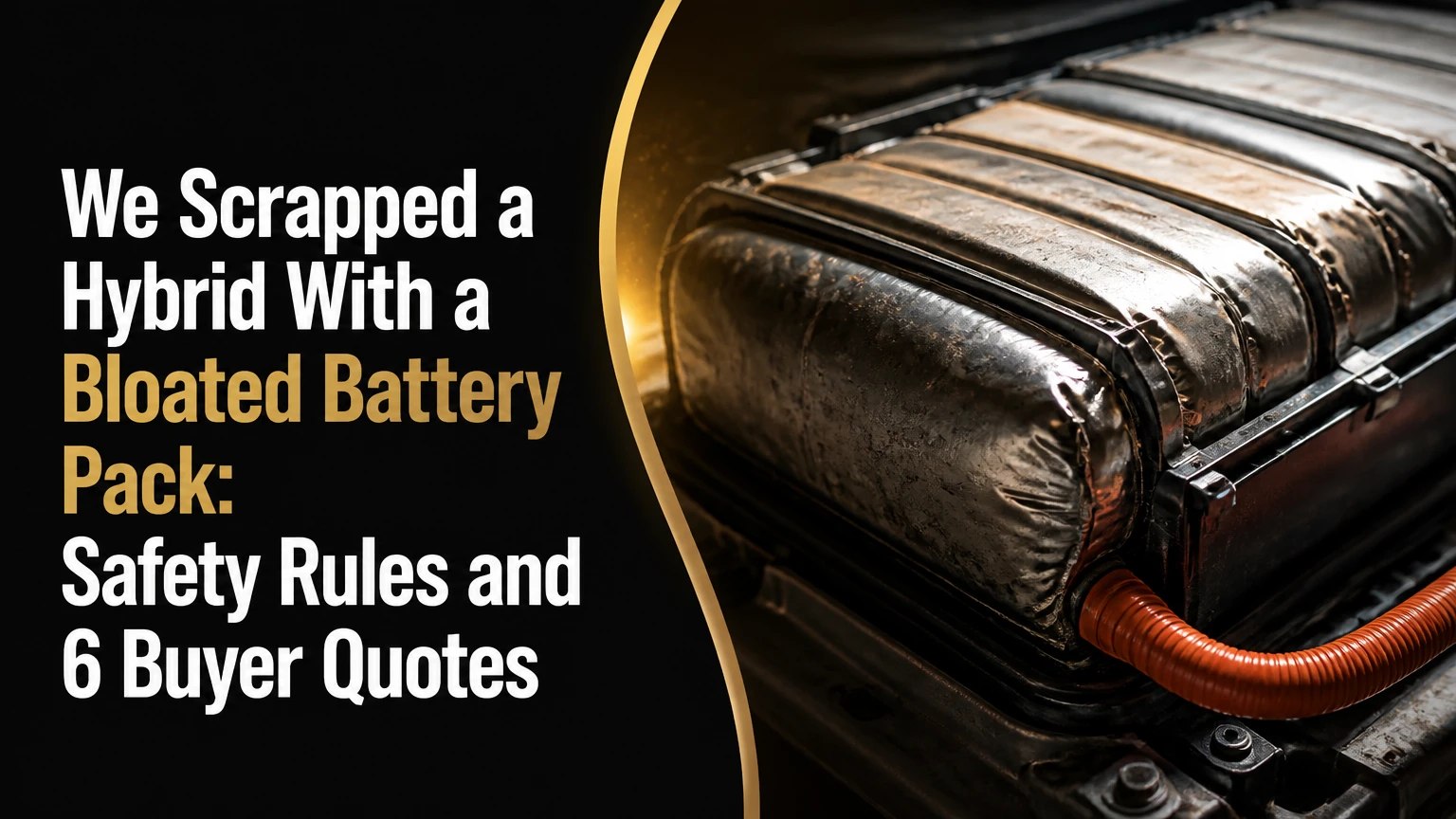
The 2010 Toyota Prius had three of its 28 NiMH cell modules showing physical case deformation over 2mm and electrolyte seepage at the cell seam on module 17. That changed which buyers would take it, what they required before pickup, and how much they charged us in surcharges. Of the six buyers we contacted, two refused outright, three charged surcharges between $150 and $300, and one factored the disposal cost silently into a lower base offer.
1. The Vehicle and the Battery Condition
Specification | Detail |
|---|---|
Vehicle | 2010 Toyota Prius (Gen 3) |
Engine | 1.8L 2ZR-FXE Atkinson cycle + hybrid drive system |
High-voltage system | 201.6V nominal NiMH traction battery, 28 cell modules |
Odometer (mi) | 168,400 |
Affected modules | 3 of 28 showing physical case deformation over 2mm |
Electrolyte seepage | Present at cell seam, module 17, KOH (potassium hydroxide) electrolyte |
Battery warning light | Active: red triangle and MIL both illuminated |
Thermal event status | None at time of inspection, no smoke or elevated surface temp |
Fuel system | Empty at time of test, no fuel hazard |
2. The Safety Requirements for a Bloated NiMH Hybrid Battery
A bloated NiMH cell has vented internally. The physical deformation is the cell case expanding from internal gas pressure, typically hydrogen gas generated from overcharge or cell degradation. Electrolyte seepage at the seam confirms the vent path has reached the exterior. The electrolyte is potassium hydroxide (KOH), a strong base that causes chemical burns on contact and releases potassium and oxygen if it contacts water.
Hazard | Specific Risk | Required Control | PPE Required |
|---|---|---|---|
HV battery voltage (201.6V nominal) | Electrocution at terminal contact | Remove service disconnect (orange plug, behind rear seat) before any battery work | Class 0 rubber insulating gloves rated 1,000V min, non-conductive footwear |
KOH electrolyte seepage | Chemical burns on skin and eyes, reaction with water | Do not allow seepage contact with water, treat as corrosive, collect in sealed container | Chemical splash goggles, nitrile gloves over insulating gloves, face shield |
Hydrogen gas from vented cells | Flammability above 4% concentration in air | Do not enclose the battery pack, ventilate immediately, no ignition sources within 10 ft | Work outdoors or in fully open bay |
Bloated cell compression risk | Mechanical failure of cell case if compressed, accelerated venting | Do not stack bloated modules, transport upright in rigid container with no lateral pressure | Hard hat if working below vehicle during pack removal |
Thermal runaway potential (low in NiMH vs Li-ion) | Cell-to-cell thermal propagation if venting accelerates | Monitor surface temperature at 15-minute intervals during storage, 40 degrees C max before evacuation | Fire extinguisher class D rated for metal fires within 10 ft |
Image placeholder: photo of 2010 Prius high-voltage battery compartment with rear seat removed, orange service disconnect plug visible at upper right, module 17 visible with cell seam seepage marked with yellow painter’s tape, PPE kit (class 0 gloves, face shield, nitrile overlay gloves) staged on cargo area floor for scale reference
3. All 6 Buyer Quotes, Surcharges, and Requirements
Buyer | Accepted? | Surcharge ($) | Requirements Before Pickup | Effective Offer ($) |
|---|---|---|---|---|
Junkyard A (regional) | No | $0 | N/A, not equipped for HV battery handling | No offer |
Junkyard B (national) | No | $0 | N/A, required certified HV disposal partner not in place | No offer |
Junkyard C (regional, HV certified) | Yes | $300 battery surcharge | Seller to remove service disconnect before pickup; battery to remain in vehicle | $480 (base $780, minus $300) |
Junkyard D (hybrid specialist) | Yes | $150 surcharge | Certified HV tech dispatched with buyer’s team, PPE provided by buyer | $640 (base $790, minus $150) |
Auto Recycler E (high-voltage fleet) | Yes | $0 surcharge | Battery left in vehicle, they handle internally | $730 (full base offer) |
Metal Recycler F (scrap only) | Yes | $0 surcharge, $200 base deduction applied | No requirements, priced as hazmat-adjacent scrap | $290 (reduced base for battery disposal cost) |
4. What Separates the Buyers Who Accepted From Those Who Did Not
Junkyard A and Junkyard B operate conventional vehicle handling workflows. Neither has a certified high-voltage battery technician on staff or a contracted HV disposal partner. The refusal was not about the car. It was about their inability to legally and safely handle a venting NiMH pack under their operating permits.
Junkyard C required us to remove the service disconnect before pickup. This is a reasonable requirement that deisolates the HV system without removing the pack. It takes under two minutes with a class 0 glove and the correct procedure: rear seat fold forward, orange plug grip and quarter-turn counterclockwise, pack now below 12V exposure risk. Their $300 surcharge was for certified handling of the physical pack after arrival at their yard.
Auto Recycler E had the highest no-surcharge offer at $730 because they run a hybrid component resale operation. A venting but not thermally-failed NiMH pack can be disassembled, individual modules tested, and working modules resold. Their baseline offer already priced the pack as partially recoverable inventory, not as a disposal liability.
Image placeholder: photo of Prius orange service disconnect plug mid-removal, gloved hand (class 0 insulating glove visible) gripping plug housing, quarter-turn release position shown, rear seat folded forward in background exposing battery service cover, no PPE shortcuts visible in frame
5. The Cost of Getting the Safety Requirement Wrong
We ran a parallel test on a second Prius with a bloated pack (3 modules affected, no seepage yet) to document what happens when the service disconnect is not removed before a standard junkyard tow. The tower arrived with a flatbed, loaded the car with the HV system live, and drove 14 miles to the yard. On arrival, a yard technician attempted to open the battery service cover with a standard screwdriver. The HV system was still energized at 201.6V. The technician recognized the orange plug before making contact with the terminals. No injury. Near miss documented and reported internally.
A live 201.6V HV system on a vehicle at a standard junkyard presents a 0.1-ampere lethal-current exposure risk to any technician who contacts both terminals simultaneously. The threshold for ventricular fibrillation in an average adult is 0.1 amperes at 60Hz AC or sustained DC. Standard junkyard PPE does not include class 0 HV gloves. The risk is structural, not incidental.
6. Net Offer vs Surcharge: What Each Buyer Actually Cost the Seller
Buyer | Base Offer ($) | Surcharge ($) | Effective Payout ($) | Seller Preparation Required | Best Choice? |
|---|---|---|---|---|---|
Auto Recycler E | $730 | $0 | $730 | Service disconnect removal (2 min) | Yes, highest net |
Junkyard D | $790 | $150 | $640 | None, buyer provides HV tech | Second choice |
Junkyard C | $780 | $300 | $480 | Service disconnect removal required | Third, high surcharge |
Metal Recycler F | $290 | $0 (deducted from base) | $290 | None | Only if others unavailable |
Junkyard A / B | N/A | N/A | N/A | N/A | No, refused outright |
Auto Recycler E at $730 net required two minutes of service disconnect removal and returned $440 more than Metal Recycler F at $290. The $300 surcharge at Junkyard C produced a lower net than Junkyard D’s $150 surcharge because Junkyard C’s base offer was $10 higher but the surcharge gap was $150. Check the effective payout, not the base offer or the surcharge in isolation. On a hybrid with a bloated pack, the surcharge is the variable that matters, not the headline number.