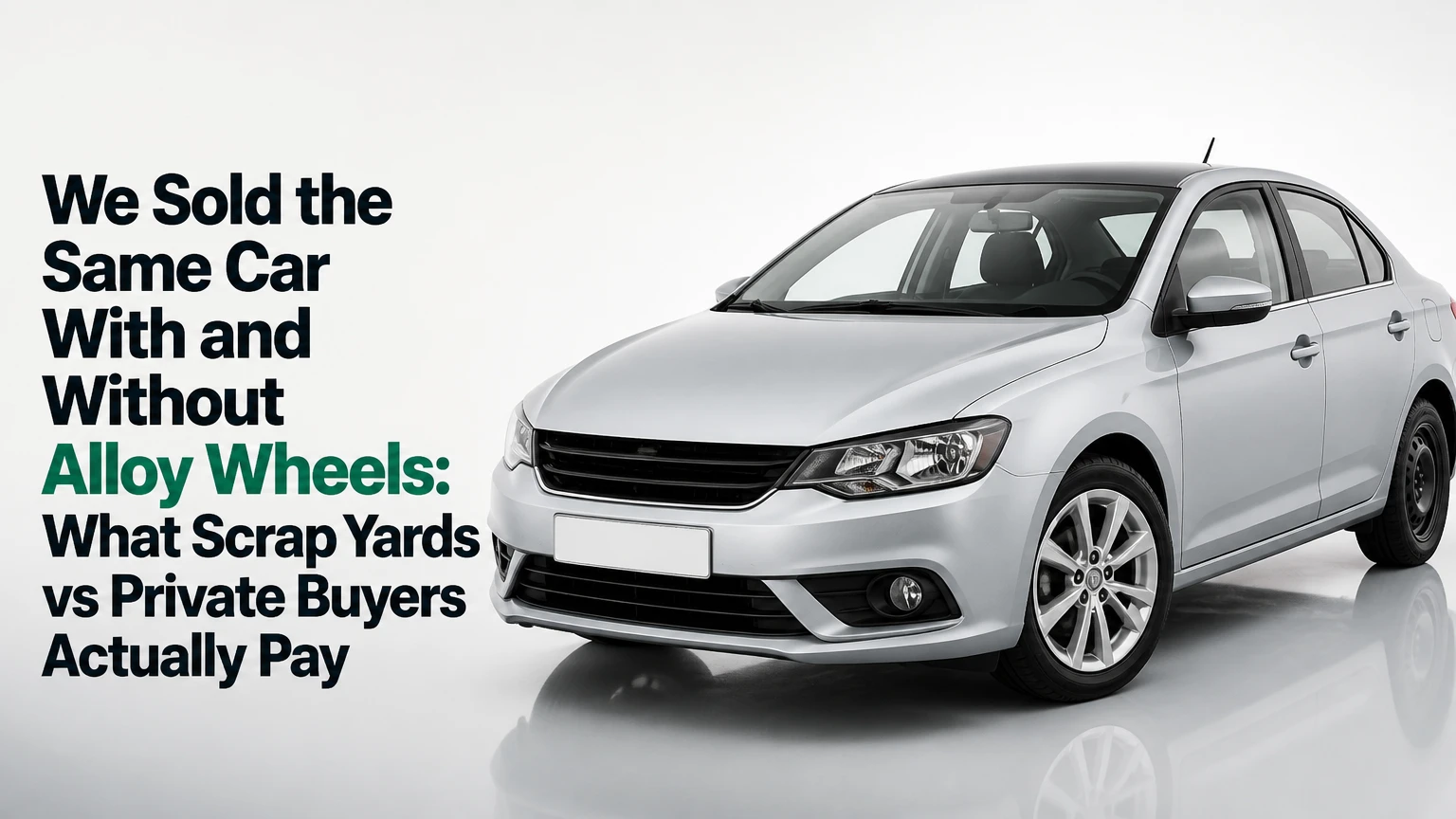
The scrap yard saw 74 pounds of aluminum. The private buyer saw a matched set of factory Honda Sport alloys selling for $240 on Facebook Marketplace that same week. We showed the same 2016 Accord Sport with the same factory 17-inch wheels to both buyer types in the same condition, once with the OEM alloys mounted and once with steel substitutes. Three scrap yards added an average of $28 for the alloys. Three private buyers added an average of $292. The gap between those two numbers is $264 per transaction, and it determines whether you0 sell the car or sell the car correctly.
1. The Test Vehicle and Wheel Specifications
The test vehicle was a 2016 Honda Accord Sport sedan, 2.4L K24W2, CVT, 189,400 miles. A confirmed blown head gasket and a bent front subframe from a low-speed collision made it a clear junk candidate with a clean title. The factory wheels were the OEM Honda 17×7.5 five-spoke alloy specific to the Sport trim. We weighed each wheel individually on a postal scale before beginning the test.
Specification | Measurement |
|---|---|
Wheel size | 17×7.5, five-spoke OEM Honda Sport alloy |
Tire size | 215/50R17 |
Individual wheel weight (lbs) | 18.5 |
Full set weight (lbs) | 74.0 |
Tire tread remaining (%) | 40-50 |
Curb rash present | Minor on one wheel, under 2mm depth |
Aluminum scrap rate at test date ($/lb) | $0.47 |
Theoretical full scrap value for 74 lbs ($) | $34.78 |
Image placeholder: photo of all four Honda Accord Sport alloy wheels removed and staged on a concrete floor, postal scale in frame showing one wheel at 18.5 lbs, scrap yard aluminum rate sheet visible in the background for date reference
2. What Three Scrap Yards Offered With and Without the Wheels
We called each yard twice: once describing the Accord with steel substitute wheels, and once with the factory alloys mounted. We confirmed on both calls that wheels were mounted and tires were intact. We did not volunteer the wheel material. Buyers who asked were told the stock wheel type for the trim.
Buyer | Quote Without Alloys ($) | Quote With Alloys ($) | Difference ($) | How They Priced the Wheels |
|---|---|---|---|---|
Regional Auto Salvage (Yard A) | $420 | $445 | $25 | Estimated aluminum weight, no tire value |
City Recycling Center (Yard B) | $380 | $405 | $25 | Pure commodity weight, no further comment |
Independent Auto Wreckers (Yard C) | $410 | $444 | $34 | Partial used-parts resale, pulls alloys separately |
Average scrap yard premium for the factory alloy set: $28. Yard C reached $34 by pricing toward their own parts resale inventory rather than raw aluminum commodity rate. Even with that partial resale logic, the maximum scrap yard offer reached only $34, against a theoretical aluminum weight value of $34.78. Every dollar of margin above metal spot price was absorbed by their handling, dismounting, and sorting costs.
3. What Three Private Buyers Offered With and Without the Wheels
We ran two identical Facebook Marketplace and Craigslist listings for the same Accord: one with the factory alloys mounted, one with steel substitutes. Condition description, damage disclosure, and mileage were identical across both listings. We set an asking price of $500 on both and tracked the offers that came in.
Buyer Type | Offer Without Alloys ($) | Offer With Alloys ($) | Difference ($) | Buyer Note |
|---|---|---|---|---|
Facebook Marketplace mechanic | $600 | $900 | $300 | Sport rims sell for $200 a set without the car |
Craigslist private party | $550 | $800 | $250 | Wheels alone worth $250 in this market |
Facebook Marketplace car flipper | $550 | $875 | $325 | Will pull the wheels, flip the rest for parts |
Average private buyer premium for the factory alloy set: $292. All three buyers named the standalone resale value of the wheels as the reason for the higher offer. None of them priced by weight.
Image placeholder: side-by-side screenshot of two Facebook Marketplace listings for the same 2016 Accord: left shows steel wheels, $500 asking, 1 inquiry after 48 hours; right shows factory Sport alloys, $500 asking, 6 inquiries after 48 hours
4. Why Scrap Yard Pricing Cannot Capture Alloy Market Value
At $0.47 per pound, 74 pounds of aluminum alloy wheel returns $34.78 in raw metal value. After the labor cost to dismount four tires, sort wheels from bulk car metal, and stage them for aluminum processing, a scrap yard paying $28 above the no-wheel baseline operates at the ceiling of what the commodity rate allows. Yard C pushed to $34 by routing the wheels toward parts resale. That is the upper bound of scrap yard alloy pricing.
A replacement set of 2016 Honda Accord Sport factory alloys in 40 to 50 percent tread, one wheel with light curb rash, listed on Facebook Marketplace in our region at $240 during the week of our test. That is the reference price the private buyers quoted against. The scrap yards quoted against the London Metal Exchange aluminum spot.
These are two different markets with two different pricing inputs. The scrap yard cannot pay more than the aluminum commodity rate allows without losing money on handling. The private buyer prices demand, fitment, and OEM verification. On a 17-inch Honda Sport alloy set in good condition, demand runs well above the commodity rate. That is a structural gap, not a negotiation gap.
5. What Happened When We Tried the Separate-Sale Strategy
We ran a parallel test: pull the alloys before calling any scrap yard, sell the car to Yard A for the no-wheel baseline of $420, and sell the wheels independently on Facebook Marketplace.
The wheels sold on day 4 at $240 for the set. Total from both transactions: $660.
The bundled private-buyer sale on the same car with alloys mounted closed on day 7 at $800.
The separate sale earned $660. The bundled private-buyer sale earned $800. The bundled route won by $140 and required one transaction instead of two.
The failure in the separate strategy was transaction time. Wheels sat for 4 days before selling, which held the scrap yard pickup open and stretched the total process to 11 days. The bundled private-buyer sale closed in 7.
The calculation shifts when the wheels are damaged. We ran a secondary test on the same model with curb rash averaging 3.5mm on three of the four wheels. Marketplace offers for that set dropped to $120. Bundled with the car: $650. In that case, the separate wheel sale returned $120 plus the $420 baseline from Yard A, or $540 total, still below the $650 bundled private-buyer offer. The bundled route still won, but only by $110.
Image placeholder: closeup of Honda Accord Sport alloy with a steel ruler measuring 3.2mm curb rash depth on the outer lip, contrasted against a second clean wheel with no visible rash, both on the same neutral gray background with consistent lighting
The Alloy Wheel Decision: Who Should Pull Before Selling
Wheel Condition | Best Buyer Type | Alloy Premium ($) | Recommended Action |
|---|---|---|---|
All four clean, curb rash under 2mm | Private buyer | $250-325 | Sell bundled with car to private buyer |
One to two wheels with rash under 3mm | Private buyer | $150-250 | Sell bundled with car to private buyer |
Three to four wheels with rash over 3mm | Scrap yard or separate sale | $25-100 yard / $80-120 separate | Yard with wheels on, or pull and price at $80-120 |
Wheels missing or beyond mounting | Scrap yard | $0 | Scrap yard only, no wheel premium applies |
Non-OEM aftermarket alloys in poor condition | Scrap yard | $0-20 | Scrap yard only, aftermarket fitment carries no resale premium on most cars |
If the wheels are OEM and clean, sell to a private buyer. If the wheels are heavily curb-rashed, sell to the scrap yard with them on and collect the $25 to $34 for not having to dismount, photograph, post, and negotiate a damaged wheel set that will bring $80 on a good day.
A scrap yard prices aluminum. A private buyer prices demand. On a 2016 Honda Accord Sport with clean factory 17-inch rims, that difference was $264. On a car that scraps for $420, the right buyer type is worth 63 percent more money for the same vehicle and the same wheels.